
I have written before on many things in Paris and sometimes I found me new things not yet in my blog that should be, This is the case lately of finding old paper pictures in my vault , and Paris is a huge part of it. I have written on many places of Paris ; this is another set of pretty streets to see on the off the beaten path trails of my Paris ; worth the detour, me think, Therefore, here is my take on the streets of Paris, part VIII !!! Hope you enjoy the post as I.
The Avenue Rapp is located in the 7éme arrondissement of Paris. It is 440 meters long, it starts at the place de la Résistance and ends up Place du Général-Gouraud. It is mainly served by line C of the RER, at the Pont de l’Alma station. This avenue was name in honor of the general of French Empire Jean Rapp, who distinguished himself during the campaign of Egypt, the Battle of Austerlitz and remained famous for having repeatedly saved life of Napoleon I , the avenue was inaugurated in 1858, and it was first called avenue du Champ-de-Mars before taking its current name in 1864 From 1894 to 1899, there was the Champ-de-Mars racecourse, where shows had succeeded the racetrack at the Pont de l’Alma, which had been forced to close in 1892. Then, left for preparatory work for the 1900 universal exhibition. The Montmartre racecourse, which opened on May 13, 1900, succeeded it.
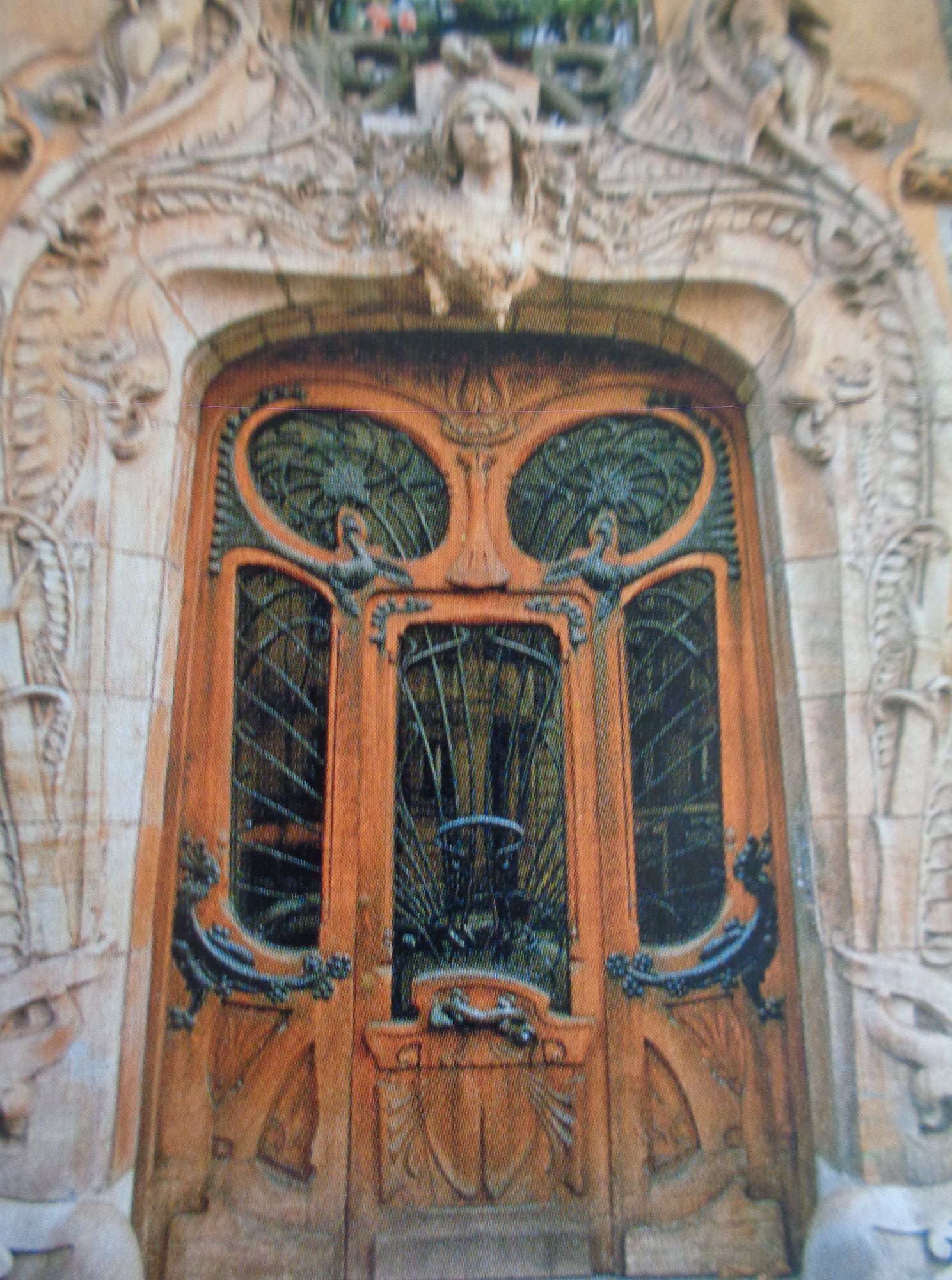
Some interesting things to see here , me think are: at no 1: mansion of the beginning of the 20C, housing the Bulgaria Embassy today. At no 20: a clock tower emerges behind the roof of the Haussmann facade. At this address, the Grands Magasins du Louvre department stores had built their administrative and warehouse headquarters in 1860. The belfry lit at night was to be visible by far converted in the 1980s, in an apartment, At no 33: building from 1898; today; the Luxembourg Embassy. The main here and see pic is at no 29, the Lavirotte building (this is a door) . The architect Jules Lavirotte built between 1900 and 1901 this building for which he was the winner of the Façades competition in the city of Paris in 1901. He used various materials stone, stucco, sandstone and ceramics associated with plant, animals, characters and sex symbols. The building is a testimony to Art Nouveau of Parisian architecture.
Films have it that in the first scene of the film Les Petits Mouchoirs (2010) by Guillaume Canet, Ludo, the character interpreted by Jean Dujardin, leaves the disco Le Baron and crosses the Place and the Pont de l’Alma in a scooter, then taking Avenue Rapp , where he has a traffic accident at the crossroads with rue de l’Université. Great film.
The City of Paris cultural site on the building of ave Rapp : https://www.sortiraparis.com/arts-culture/histoire-patrimoine/articles/301263-l-immeuble-lavirotte-joyau-art-nouveau-de-l-avenue-rapp-a-paris
The Paris tourist office on 20 unusual places to see in Paris, see ave Rapp : https://parisjetaime.com/eng/article/20-unusual-places-to-see-in-paris-a1089
The Cour de Rohan is located in the Monnaie quartier or neighborhood of the 6éme arrondissement or district of Paris. The way bears the name of “Rohan”, which is an alteration of Rouen, because of its vicinity with the Hôtel des Archevêques de Rouen, overlooking the rue du Jardinet, The Cour Rohan is served by metro lines 4 and 10 at Odéon station. This courtyard, created before the 16C, The cour is cited under the name of rue de la Cour de Rouen in a manuscript of 1636. The cour de Rohan is actually a succession of several small courtyards leading to a brick and stone mansion. This one was built around 1636 for Jean d’Aultry, viscount of Lévignan.

The no 3 mansion built on the orders of Henri II of the remains of the enclosure of Philippe Auguste are visible to nos 3-7, The cour de Rohan leads both to the cour du Commerce-Saint-André at the Caf é Le Procope on rue du Jardinet. From 1936, the painter Balthus had his workshop at the entrance to the cour de Rohan, The writer Georges Bataille joined him there after WWII, and it is whispered that the latter liked to take advantage of the outside for organize parties. The intellectual elite of the time, Simone de Beauvoir, Sartre and Albert Camus, were happy to be there. The painter and engraver Charles Jouas and his wife symbolist painter Louise Desbordes had a workshop at no 3 bis from 1894. The American artist Sheila Hicks has had her workshop in the courtyard since 1964. The Cour de Rohan benefits from two entries: one from the cour du Commerce-Saint-André , and the other by rue du Jardinet. Upon entering the first, you are already going in front of the vestiges of the enclosure of Philippe Auguste dating from the 1200s. Then ,see a sublime hotel in the 16C. It was built by King Henri II for his beautiful Diane de Poitiers, just that! Besides, the funny iron tripod is the very last Pas-de-Mules in Paris, which used to ride a horse. Then the figurative painter Balthus also worked there from 1936. He was nicknamed “the king of cats”, because we find often a little feline in the foreground of his paintings. Today, the cour de Rohan is a private street, where it is very difficult to go in, but with a little luck, daring and politeness, who knows, a resident could perhaps let you see this little gem full of surprises ..as I did !
The Paris tourist office on the 6éme arrondissement or district of Paris : https://parisjetaime.com/eng/article/explore-paris-s-6th-arrondissement-a823
There you go folks, this is a wonderful thing to do, walks in a popular area of my eternal Paris , for all to see, and visit while in Paris. The streets tells you all like a book of architecture and history ; very nice indeed. Again,hope you enjoy this post on the streets of Paris, part VIII as I.
And remember ,happy travels, good health, and many cheers to all !!!

 Paris1972-Versailles2003
Fabulous door
LikeLiked by 2 people
But of course it’s Paris 😎
LikeLiked by 2 people