
In my dear gorgeous Versailles ; there are many places other than the castle. The city needs to be seen more, my kind of town, actually did lived there for 9+ glorious years! Very nice family memories. I found me older paper pictures that again should be in my blog, Therefore, here is my take again on the galerie des carrosses in the Grande Ecuries part II !!! Hope you enjoy the post as I
The Grande Ecuries(stables) are right in the Place d’Armes, in front of the palace/museum, between the avenue de Saint-Cloud and avenue de Paris. They were built under the direction of the architect Jules Hardouin-Mansart and completed in 1682. With a merry-go-round, it sheltered the king’s hunting and war horses. The facades of this stables received a remarkable sculpted decor. In particular, there is a distinction, at the tympanum of the arcade of the Grande Ecuries, a group of three horses caroling, They were placed under the orders of the Grand Squire of France. The great squire in the upper hand on the king’s stud farms, controls equestrian academies and takes care of the horses mounted by the king and the princes. These horses are perfectly trained for hunting and war. The royal stables are hosting collections today as well as different institutions such as the Galerie des Carrosses in the Grande Ecuries.
Majestic bodies or small cars of Marie-Antoinette’s children, carriers or sled chairs forming a strange and wonderful bestiary: the discovery of these works constitutes an exceptional testimony of court life and splendor under the old regime, the empire and catering. The Galerie des Carrosses is located on the ground floor of the Grande Ecuries or big stables. It consists of two vaulted galleries allowing a significant redeployment of collections over almost 1,000 m2. The collection of coaches does not include travel vehicles but consists only of large ceremonial sedans. Thus, each car tells a page of the history of France through a dynastic or political event: marriage of Napoleon Ier , Napoleon, first consul in 1799, was crowned Emperor in 1804, baptism of Duke of Bordeaux, coronation of Charles X, grandson of Louis XVI and Louis XVIII, last king of the Restauration (monarchy) from 1824 to 1830… Funeral of Louis XVIII, brother of Louis XVI and Charles X, first king of the Restauration until his death in 1824…. Designed to hit the spirits, these coaches are works of total art. Of an ostentatious luxury, adorned with oce and sculptures, dazzling meeting of all the decorative arts, they were made by the best artists and craftsmen: architects, carpenters, sculptors, painters, bronziers, gilders, upholsterers, embroiderers , etc.
These procession wagon cars had been ordered from several renowned Parisian coachbuilders: Chilbourg, Deloche, Devaux, Guetting, and Rasp. The outdoor decoration of the wagon cars had been entrusted to Gautier. All these wagons had boxes and trains carved and decorated with golden bronze. The nine cars found to date are not painted but golden with the gold leaf on the entire body, which allowed them to keep their sparkle. One of these cars is kept in a private collection at the Palazzina de Caccia di Stupinigi in Turin. Another “Cybèle” is kept at the Living Horse Museum in Chantilly. The Cybèle had been found and bought by Napoleon III. The other seven sedans, who had been gathered by Louis Philippe in premises specially built at the Petit Trianon, were transferred to the Museum of Carrosses of the Grande Ecuries. The Topace wagon car with seven mirrors weighing 3 tons. Gold background box. Painted belt of a garland of flowers and imperial gallery with a golden bronze palmette decoration.
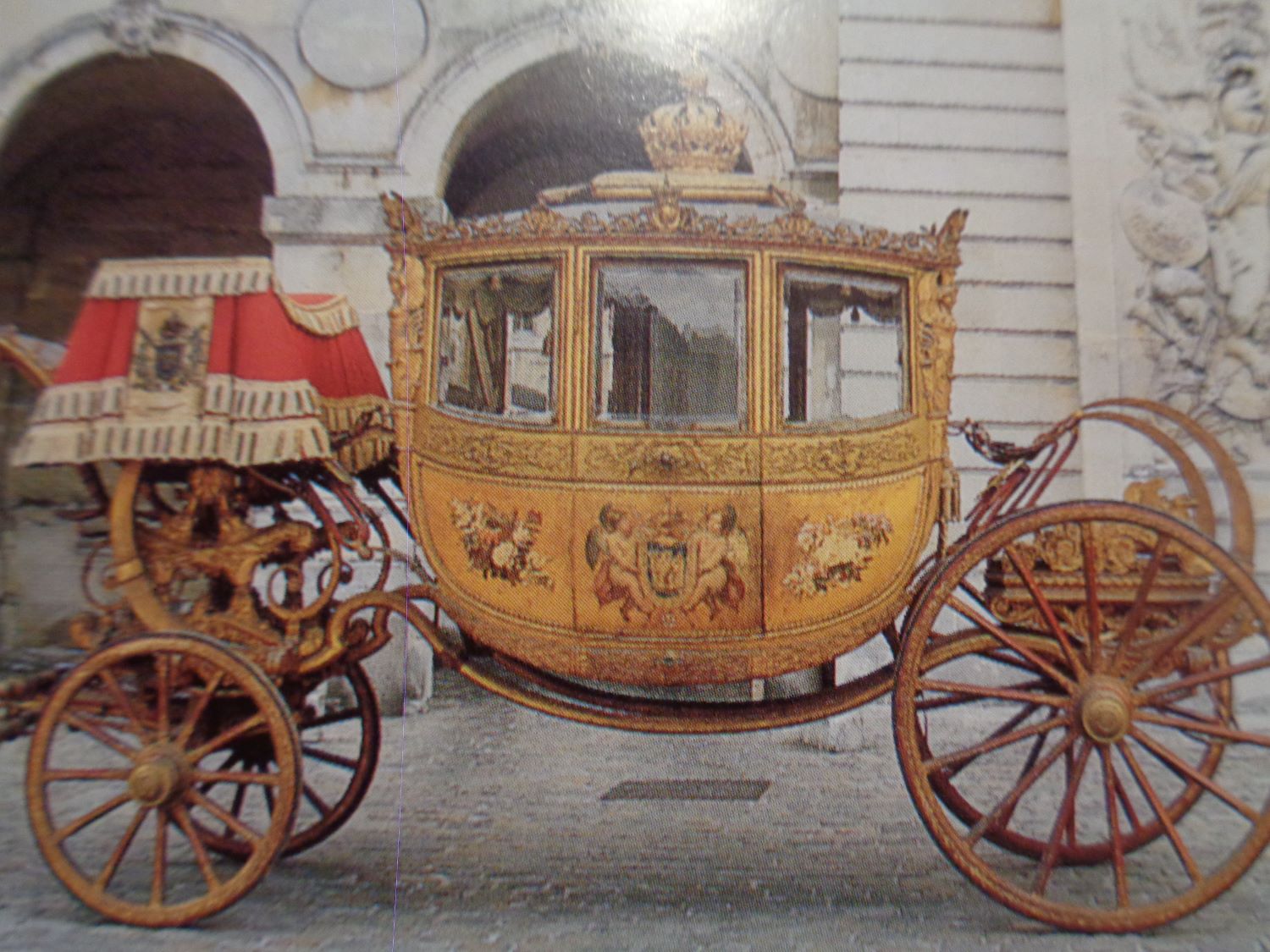
The carrosse or coach of the coronation of Charles X was started in 1814 for the coronation of Louis XVIII, the construction of this carriage was abandoned when the king, in political prudent, renounces this ritual ceremony , in the French post-revolutionary and post-imperial context, During the accession to the throne, in 1824, King Charles X announced his desire to organize his coronation, thus reconnecting with the tradition of his ancestors , In less than six months, it is completed, thanks to the intervention of many craftsmen: the coachbuilders Daldringen and Ots, the sculptor Henri-Victor Roguier, the bronziers Denières and Matelin or even the painter Pierre Claude François Delorme, The procession going to the Cathedral Notre-Dame de Reims , drawn by eight caparisoned horses, then on June 6, 1825 for the entrance to Charles X to Paris. It was used one last time in 1856, for the baptism of the Imperial Prince, son of the emperor Napoleon III ,It is considered as one of the most beautiful coaches in the world, it is the only body of the coronation of a King of France preserved today !
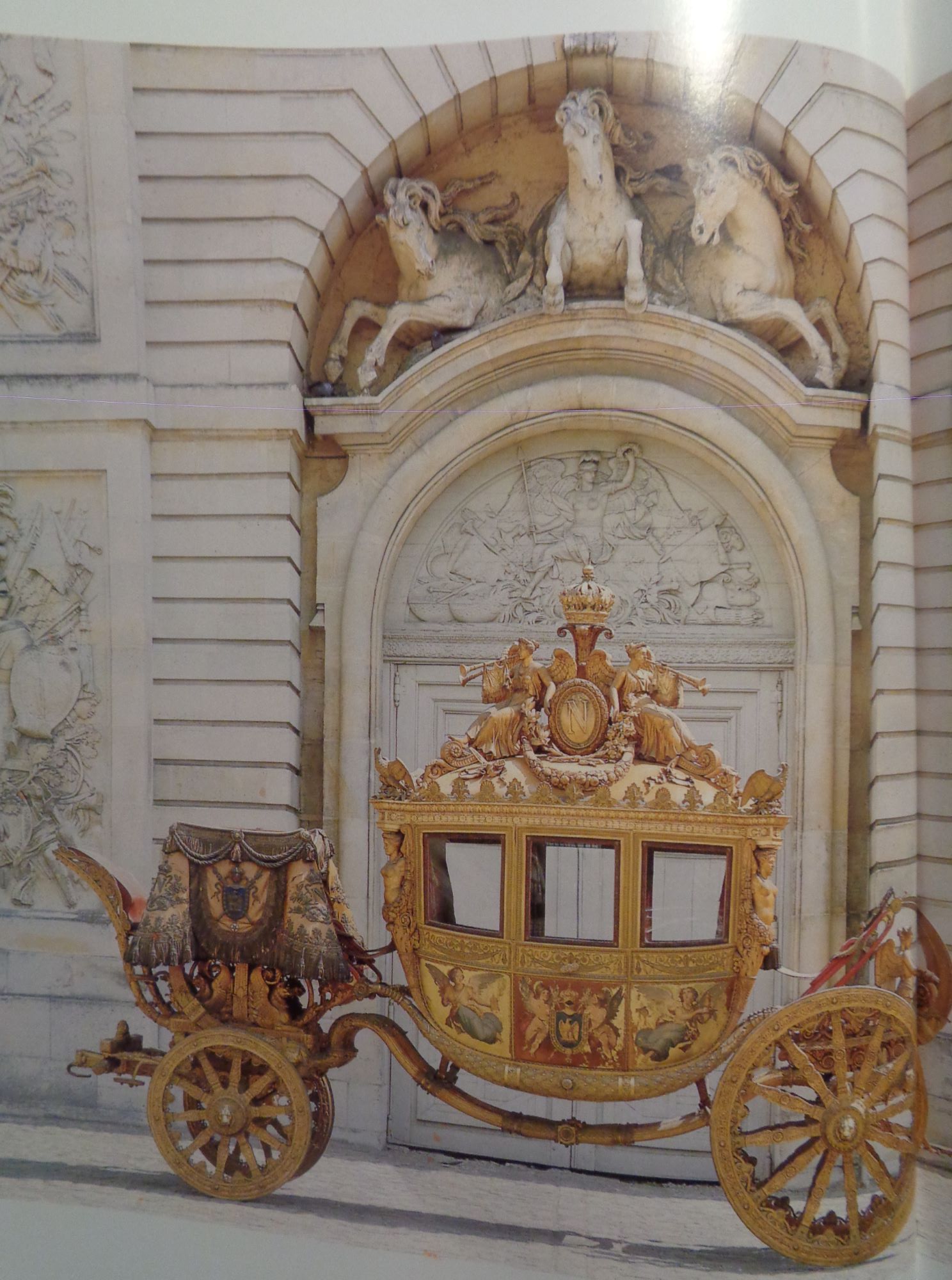
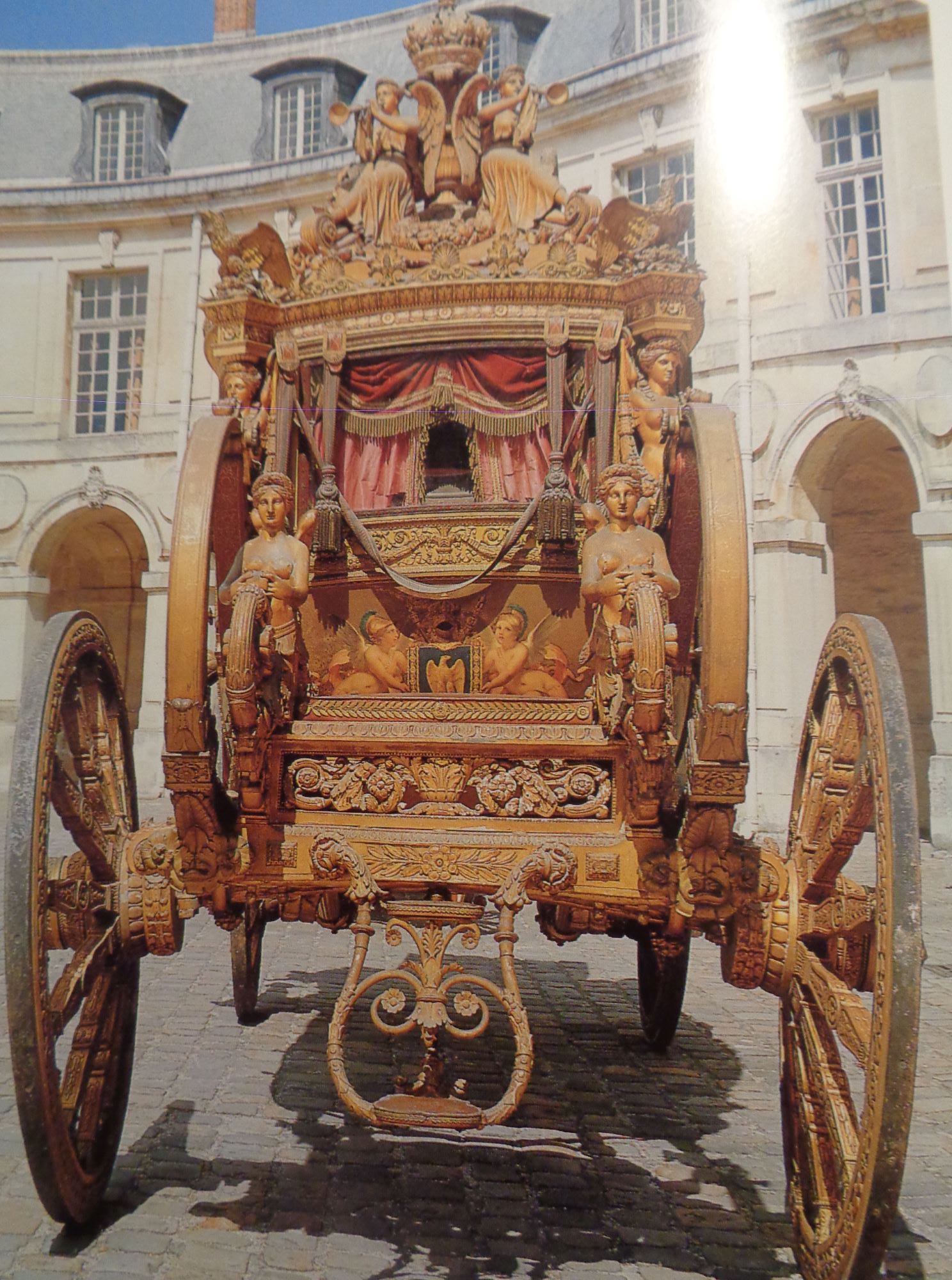
The carrosse sedan of the Baptism of the Duke of Bordeaux , This seven glass sedan, built in 1821, was decorated with a golden and chiseled bronze belt. The box was painted with the royal weapons of France and Navarre and adorned with cherubs. It currently appears to us in a different aspect since it was repainted and adorned with imperial insignia for the marriage of Napoleon III, In 1853 this sedan, with stretchers with Cygne tail and ressorts in C weighted 4 tons. Handle by 6 horses, his service was provided for 6 passengers, Imperial loves, bouquets and weapons are painted on the box in gold. The gallery is decorated with eagles and gilded bronze medallions. At the four angles of the body, gilded wood sculptures represent caryatids. The wheels have bronze brakes. The doors are equipped with sliding glass panels, and the steps are embedded in drawers ; the interior is in white satin and red , blue and gold. The imperial pavilion was embroidered by the ladies of the Legion of Honor.
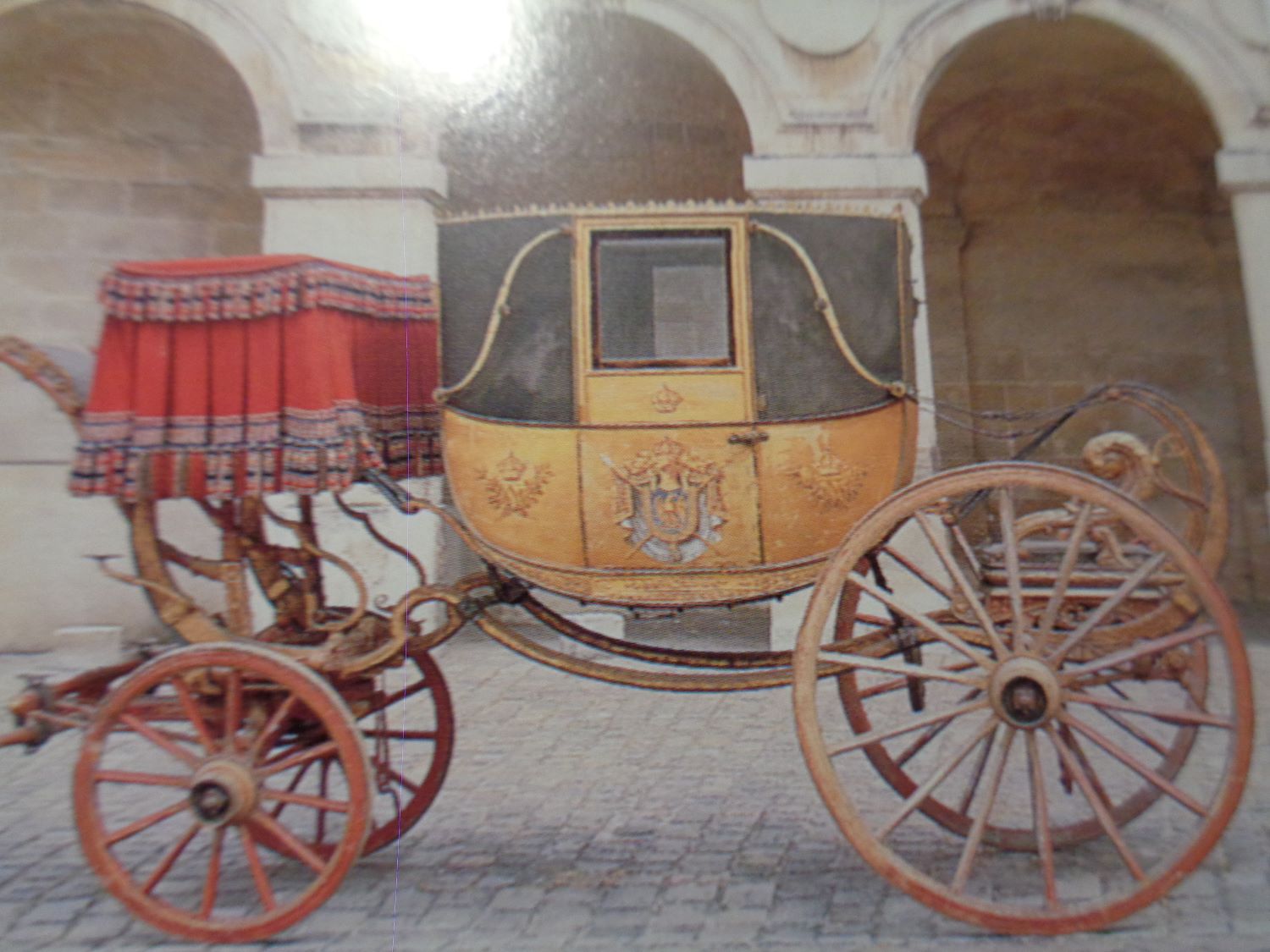
I have a post on the whole story but merits mention briefly here again for the history buff in me ! He was king that a few days, under the surname of Henri V. He was born under the name of Duke of Bordeaux ; in the castle of Chambord which was offered to him on this occasion by a group of royalists, hence the name of Count of Chambord that he will wear later.But, following different illegal by many political maneuvers, it is the Duke of Orleans who takes power under the name of Louis Philippe. The Duke of Bordeaux goes into exile in England with the whole of the Bourbons family, then in Prague. In 1844, he moved to Frohsdorf, Austria, From his majority in 1833, he “raised a solemn protest against the usurpation of Louis Philippe” Upon the fall of Napoleon III, the elected National Assembly contains only 240 Republicans against 400 royalists, supporters of Orleans and Bourbons combined. In 1871, the Count of Chambord can return to France and settles in his castle of Chambord where he prepares his future coronation but in front of his rigidity, mainly whose refusal to keep the revolutionary tricolor flag, and after many political conflicts, it is the Republic which was established definitively in France in 1875. The Count of Chambord, meanwhile, returned to Frohsdorf where he ended his life on August 24, 1883. The last king of France did not go out because of a revolution but a stubborn refusal to compromise, There is Louis XX waiting.
This collection, one of the most important in Europe, is brought together by King Louis-Philippe , king of the July monarchy from 1830 to 1848, before the 2nd Republic… in 1831 , at the time it transforms the royal castle into a dedicated museum “to all the glories of France” by deposits of the Royal furnishings then national furniture, carriages and fantasy sleds joined the collections in 1851, when the first Museum of Trianon Cars opened its doors to the public. In 1978, the collection was repatriated to the Grande Ecuries and the Questel building destroyed. In 1997, the Versailles Coach Museum opened to the public, an enlarged museum and redeployed in 2016 in two galleries in the Grande Ecuries. In 1978, the collection at the museum, built in 1851, was moved to the Grande Ecuries. In 1985, the Museum was opened to the public. In 2007, the Museum closed its doors for the expansion work. In 2016, the museum is open again to the public. The visit to the Galerie des Carrosis also offers a film retracing the history of the horse-drawn from the reign of Louis XIV, because beyond their artistic quality, these cars reveal the latest advances in French bodywork in terms of elegance , comfort and technique. The Galerie des Carrosses is open all weekends in high season from 12h30 to 18h30, and Tuesday to Sunday from 9h to 18h30, in the months of July and August 2024. Check for next year schedules.
The official Château de Versailles on the Grande Ecurie: https://en.chateauversailles.fr/discover/estate/great-stables
The official Château de Versailles on the galerie des Carrosses : https://en.chateauversailles.fr/discover/estate/great-stables/gallery-coaches
The City of Versailles on the galerie des Carrosses : https://www.versailles-tourisme.com/la-galerie-des-carrosses.html
One of the must to see in Versailles and worth it. Another masterpiece of my belle France, and hope you have the time to see it while at this huge property that is the Domaine de Versailles. Again, hope you enjoy this post on the galerie des carrosses in the Grande Ecuries part II !!! as I.
And remember, happy travels, good health, and many cheers to all !!!

 Paris1972-Versailles2003