
I like to update this older post with new text and links to tell you about an institution very much dear to us French ! I happened to visit and participate in meetings inside, a wonderful experience indeed, This found me an older picture in my cd rom vault and should be here so have added to this post. Therefore, let me tell you about the Institut de France!!! . Hope you enjoy the post as I
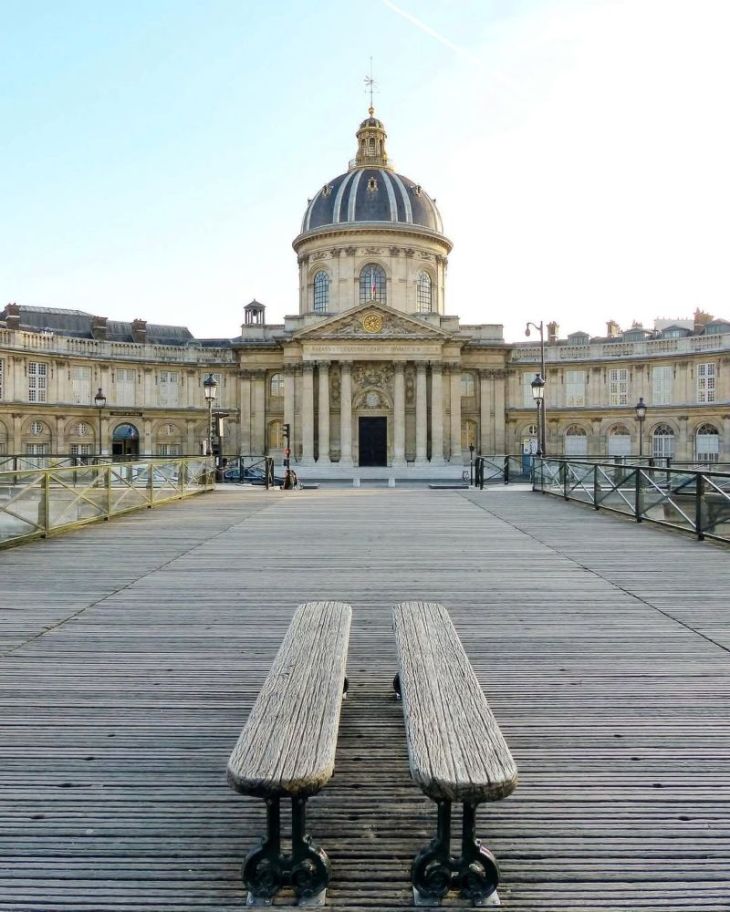
The Institut de France was created in October 25 1795 and house in an old building of the old school or Collège des Quatre-Nations located at 23 quai de Conti in the 6éme arrondissement just facing the Seine river. It includes the French Academy or Académie française (40 members), the inscriptions and noble letters academy or Académie des inscriptions et belles-lettres (55 members), Science Academy or Académie des Sciences (262 members), the fine arts academy or Académie des beaux-arts (59 members), and the moral and political sciences academy or Académie des sciences morales et politiques (50 members).
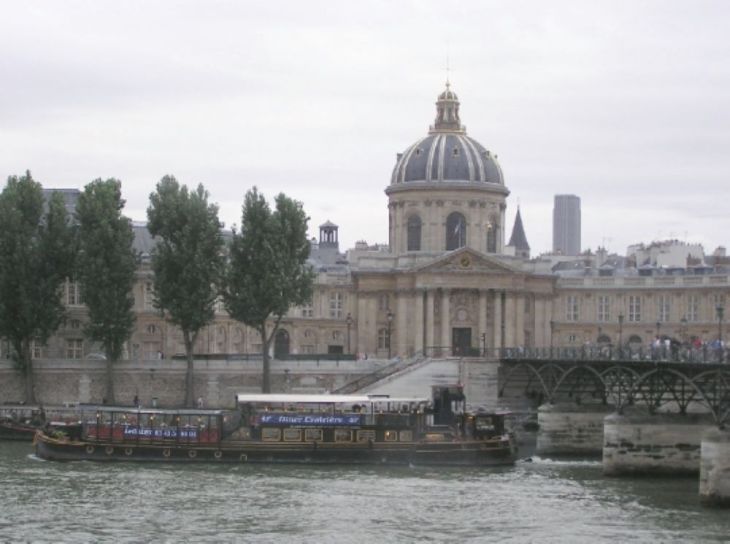
The long and illustrious history of the Institut de France tell us that in 1661, in his final will and last wishes and thanks to his great fortune the Cardinal Mazarin asked king Louis XIV ,the creation of a college to received the nobles of the four nations united in royal obedience by the treaties of Westphalia in 1648 and Pyrénées in 1659 that were Artois, Alsace, Pignerol, and Roussillon (included Sardinia). It was Colbert who hired architect Louis Le Vau (Vaux le Vicomte, Versailles et al) to design the college at the level of the square court of the Louvre on the other side of the Seine. The work took from 1662 to 1688. By 1796, the building house one of the three central schools of Paris under the name of the École centrale des Quatre-Nations or four nations central school. This school closed in 1802, and by 1805,upon the request of Napoléon Ier, the Institut de France came as tenant of the building. In the 19C, on a second court a wing was added connecting the two pavilions already there; and was inaugurated in 1846. It houses two rooms for work used for ordinary sessions of the Academies. While work was going on to built an auditorium by the INRAP in 2015 it was discoverd a section of the Paris ramparts wall of king Philippe Auguste including a wall, a tower, and a well dating from the reign of king Charles V.

The first session held here was on April 4 1796, for the museum of the French revolution or musée de la Révolution française. There is in the library of the Institut de France designed and engraved by Augustin François Lemaître, in a dictionary of the Académie française of 1835. The French Republic suspended all Royal academies under the new constitution of the year III article 298 established in our calendar year 1795 under the French revolution. The Moral and Political Academy having no loyalty towards the revolution was eliminated by the Consulat in January 1803. The classes remaining were of Classes des sciences physiques et mathématiques (physical science and math classes) ; Classes de langue et littérature française ( the language and French literature classes) ;Classes des langues anciennes et d’histoire (old languages and history classes) ; and the Classes des beaux-arts(fine arts classes). In 1816, king Louis XVIII ordered reorganised the Institut and the name Academy is again re established and used to name the different classes such as the Académie Française , Académie des inscriptions et belles-lettres , Académie des sciences, and Académie des beaux-arts ». By ordinance (order) of 1832 the Académie des sciences morales et politiques were ,also, re established. king of the French Louis-Philippe gives the Institut the current configuration.
The principal management groups of the Institut de France are the chancelier,elected for 3 years by a central administrative commission and confirm by the President of the French Republic. The Central Administrative commission is composed of Six secretaries for life and two delegates elected by the academy. The General Assembly includes the members of each academy except the Sciences that have 50 members on it. The office or board is composed of the President, Chancellor, for life Secretaries ,director of the Académie française , and the President of the other academies. The President is each year the president of one of the academies and especially heads the annual science event that by tradition is held on the Tuesday closest to the date of creation of the Institut de France (October 25), and since 2005 ,the event of prize giving to the Foundations of the Institut that is held in June. Also, the technical commissions, special commissions and jury’s. Nevertheless, the most important fonctions of the Institut de France are those of the Chancellor and the Central Administrative Commission. The first one is the authority on the personnel, orders and purchases ,and represent the Institut in legal contracts and in justice. The Central Administrative Commission fonctions are to bring together in voice call the budget and the modifications decisions as well as other financial dispositions and the use of the rooms, buildings , etc. The Institut de France is more than the Institut. It organises donation, bequests and legs with the form of foundations in charge of their net worth. The most famous in my opinion is that of the Fondation d’Aumale, created in 1886 and executed by Henri d’Orléans, as a full property in 1897. This foundation is in charge of the Domaine de Chantilly ,that includes the Château de Chantilly, collections of the museum Condé, the forest of Chantilly, as well as other real estate around Chantilly.
There are many others in addition to the above including: In 1904, legs of Jacques Siegfried that included the Château de Langeais under the Fondation Siegfried. 1905, legs of Félicie Dosne, that includes the Hôtel Thiers and its library under the Fondation Thiers. 1912, legs of Nélie Jacquemart, that includes the Hôtel Jacquemart in Paris, later museum Jacquemart-André ,and the abbey of Chaalis, under the Fondation Jacquemart-André. 1919, legs Edmond de Rotschild, that includes the Maison de l’Institut de France (house of the institut de France ) in London that is under the Fondation Edmond de Rotschild. 1920, legs Joseph Astor, that includes the mansion castle of manoir de Kerazan. 1928, legs Théodore Reinach, that includes the Villa Kérylos, from 1967, and under the Fondation Théodore Reinach. 1997, legs André Bussinger, that includes the Château de Braux-Sainte-Cohière, under the Fondation André Bussinger et Braux-sous-Valmy. In addition, to the above we have properties directly given to the Academies such as the Château d’Abbadia by Antoine d’Abbadie d’Arrast in 1897 , as well as the house of Louis Pasteur in Arbois (1992) to the Académie des Sciences; the museum Marmottan-Monet by Paul Marmottan in 1932, the Villa Ephrussi by Béatrice Ephrussi de Rotschild in 1934, and the house of Claude Monet in Giverny from 1966 to the Académie des beaux-arts; and the Château de Castries in 1985 and then sold to the city of Castres in 2013 with profits coming to the Académie Française.
In finishing, my own story of this is that back around 2007-2008 I was very much involved in Paris in different groups that supported culture, arts, and monuments. As we were trying to rebuilt the Palais des Tuileries , I met many French nobles (from the Orléans, Napoléon III side including Princess Napoleon) and business persons, old politicians and architects/lawyers what have you and we had our meetings at the Salon Victor Hugo of the Académie des sciences morales et politiques of the Institut de France in Paris. Of course these pictures are not for publication,
The official Institut de France: https://www.institutdefrance.fr/#
The Paris tourist office on the Institut de France : https://parisjetaime.com/eng/culture/institut-de-france-p1120
The official Institut de France library : https://www.bibliotheque-institutdefrance.fr/
The Academie channel connected to the Institut de France has a live broadcasts on the official Canal de l’Academie : https://www.canalacademies.com/
There you go folks, this is must to receive an invitation by the Institut de France or the Paris tourist office and visit/see this wonderful institution right in Paris, Again, hope you enjoy the post on the Institut de France as I.
And remember, happy travels, good health and many cheers to all !!!

 Paris1972-Versailles2003