
Looking at my vault, found some older paper photos of places written before but really need to include them in my blog. These are from my eternal Paris and brings back many memorable moments of my life. I have added a brief description of the places, but read my other posts for more information and photos on them. Nostalgia sets in and here I go on the curiosities of Paris, Part X !!! Hope you enjoy the post as I.
The Saint-Louis-Cathedral or Soldiers’ Church attracts many visitors. It is even one of the most frequented churches in Paris. This is due, of course, to the presence, nearby, of the dome of the Invalides, created by Jules Hardouin-Mansart, which hosts the tomb of Napoleon I. It is also due to the presence of the Army museum in the buildings that surround the magnificent courtyard. The Cathedral of Saint Louis is under the responsibility of the museum, it houses the burial of Napoleon I, his two brothers,Joseph and Jérome; his son (the Aiglon), which in December 1940, the ashes of his son known as the king of Rome or Napoléon II or the Aiglon (English) were transfered from Vienna in a funerary urn by an adviser to Hitler and the govt of Vichy (collaborator) as Paris was in occupied zone. As well as the queen of Westphalia and other members of the Bonaparte family. Marshals of France , Vauban, Turenne, Ferdinand Foch, Hubert Lyautey, Philippe Leclerc de Hauteclocque, Alphonse Juin, , the generals Robert Nivelle, Charles Mangin, Pierre Auguste Roques, and Henri Giraud, and the admirals Boué de Lapeyrère ,and Gauchet.

An anecdote worth repeating me think, The boundaries of the two world wars in the fore-nave and in the right aisle are placed two stone posts. The first dedicates the Sacred Way of War 1914-1918 . You can read the inscription: “In tribute to their sacrifice, there is enclosed in this marker a parcel of sacred land from the battlefields of 1914-1918”. The second stone post consecrates the Way of Freedom in 1944. The inscription at the bottom recalls that it contains plots of land from American cemeteries in France.
The Paris tourist office on the Saint Louis Cathedral: https://parisjetaime.com/eng/culture/cathedrale-saint-louis-des-invalides-hotel-national-des-invalides-p1012
This is the Panthéon de Paris! up Rue Soufflot right in front of the Place du Panthéon. The Panthéon, they have organised it into four stages in the life of the Panthéon existance, the first one and oldest is that was there before the Panthéon, in effect, the Church of Sainte Geneviève (1744-1790); which of course, was demolished during the French revolution. The second period is that of the transformation of monuments to use the scholar choice, meaning the used of these monument to enhance the French Republic from the initial years such as (1791-1885). The third period is that of the French Republic laique from 1885-1964 upon the death of the writer Victor Hugo , a huge crowd follows the funeral car to the Panthéon. The monument becomes laïque. This period extends all along the IIIe République (1870-1940) , and the IVe République (1947-1958). The fourth and final period we can call it the Panthéon under the Ve République (since 1958), when it was open to transfer the ashes of Resistant hero Jean Moulin ,in 1964. At the end of this ceremony the funeral speech done by the Minister of cultural affairs André Malraux , the Panthéon gain little by little its position of all consensus of all the political families.

The Paris tourist office on the Panthéon: https://parisjetaime.com/eng/culture/pantheon-p3494
In the courtyard of the Palais Royal have been installed since 1986, the columns of Buren.It is a place today frequented by Parisians and their families and by the many tourists The Palais Royal or Royal Palace is a set of monuments, palaces, garden galleries, theater, high place in the history of France and Parisian life, where the show has alwaysbeenpresent. Built by Cardinal de Richelieu in 1628 The Royal Palace and its gardens served as residence for royal families until the construction of the Palace of Versailles.
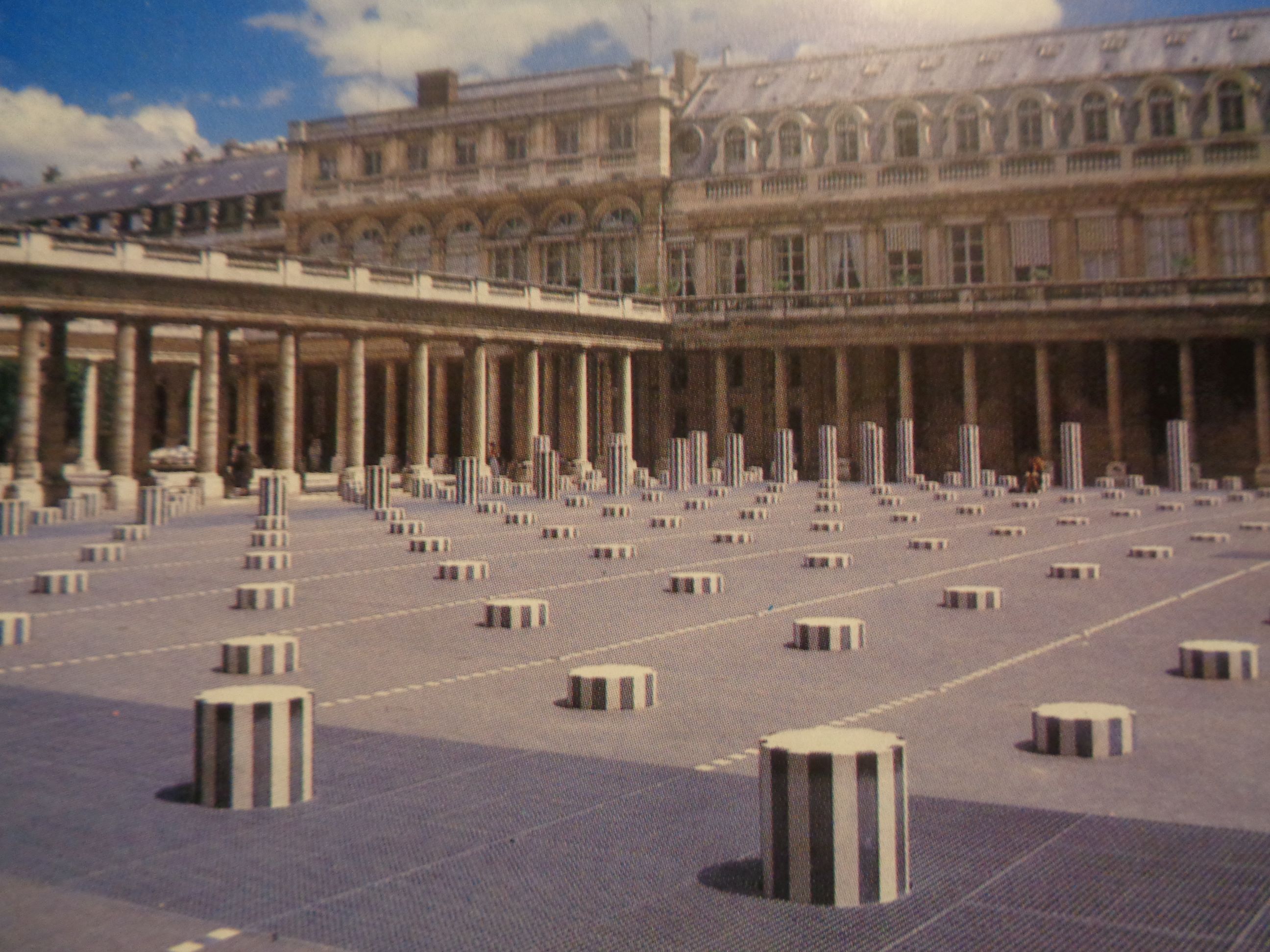
The two trays, commonly called the “columns of Buren”, is a work of art by Daniel Buren carried out with the help of Patrick Bouchain in the courtyard of the Palais-Royal. The work, which occupies 3,000 m2 of The courtyard consists of a network of 13 x 20 = 260 truncated columns of white marble with white and black stripes with a single width of 8.7 cm. The cylinders are introduced into this space, dynamically, with three heights varying from 9 to 62 cm2. The work is designed as a work in two planes: the first “plateau” at the level of the court is formed by the summits aligned with columns located in the central space; The second “plateau” in the basement consists of three dug trenches in which columns of equal height have been placed. Their gradual depression shows the slope of the basement on which a body of water reflects visually and in a sound, the upper level. each mesh band is installed a red or green luminescent nail. The trenches are illuminated by blue diodes placed under the grid.
The Paris tourist office on the Domain National du Palais Royal : https://parisjetaime.com/eng/culture/domaine-national-du-palais-royal-p991
There you go folks, a wonderful combination of beauties of my eternal Paris . Read my numerous posts on Paris in my blog, Again, hope you enjoy this post on the curiosities of Paris, part X !!! as I.
And remember, happy travels ,good health, and many cheers to all !!!

 Paris1972-Versailles2003