
Ah back to you with my beloved Versailles, a city I lived for almost 10 years and had visited upteen times over the years since 1990. A hugely memorable City for me never to forget the good times there. I have found me older pictures not yet in my blog and they should be , me think, Therefore, let me tell you a bit on the magnificent Coronation room or salle du sacre of Napoleon in the Château de Versailles !!! Hope you enjoy the post as I.
The Salle du Sacre or Coronation Room is a room dedicated to the glory of Napoleon I, and named after David’s painting It is located on the first floor (2nd US) of the Palace of Versailles, it is adjacent to the Queen’s Guard Room. The room was built on the site of the second chapel of the castle, transferred in 1682 to the North wing, on the site of the current Salon d’Hercule. It was then planked and the ground floor became the apartment of the Dauphine while the first floor then became a guard room, intended to bring together the guards of the castle to assign them to their day of service. The room was used for a few significant events: Louis XV dismissed the parliament there on April 13, 1771 and the revolutionary rioters entered the Queen’s apartments through this room on October 6, 1789,
The ceiling is a painting by Antoine-François Callet titled Allegory of the Eighteenth Brumaire or La France Sauve, commissioned under the Consulate for the Tuileries and dated 1801. On the wall are three paintings: The Coronation of Napoleon, or Coronation of the ‘Empress Josephine, at Notre-Dame de Paris, December 2, 1804, by Jacques-Louis David, moved to the Louvre in 1889 and replaced by a second copy commissioned from David by a group of American businessmen in 1807, begun in 1808 and completed in 1822 during his exile in Brussels; this painting gives its name to the room, The Battle of Aboukir, commissioned from Antoine-Jean Gros by Joachim Murat, The Distribution of the Eagles, or Oath of the army made to the Emperor after the distribution of the eagles, December 5, 1804 , by Jacques-Louis David. Above each door, other paintings are visible. They are allegories of courage, genius, generosity and constancy commissioned by king Louis XVIII: Warrior Courage (represented in the guise of a Gallic fighter), Genius rising despite Envy, Clemency s leaning on Strength, Constance leaning on an anchor. Portraits of Napoleon and his wives are placed between the windows.
The story goes that this was first the second chapel of the palace from 1672 to 1682, then large Guards room common to the King and Queen from 1682 to 1789, this large space which precedes the sovereigns’ apartments became in 1833 a room dedicated to the glory of Napoleon Bonaparte, First Consul, then Emperor of the French. It was planned to install there the largest paintings of his reign, which could not find a place elsewhere in the palace, the two immense canvases commissioned from the painter Jacques-Louis David to commemorate the ceremonies of the accession of Napoleon as Emperor of the French. It commemorates one of the most memorable cavalry charges of his youth, during the Egyptian campaign. The Napoleonic program in the room was completed by other works: on the ceiling, an Allegory of the Eighteenth Brumaire by Callet, also called La France Savee, symbolizing the seizure of power by Napoleon Bonaparte. Portraits of Napoleon and his wives are placed between the windows.
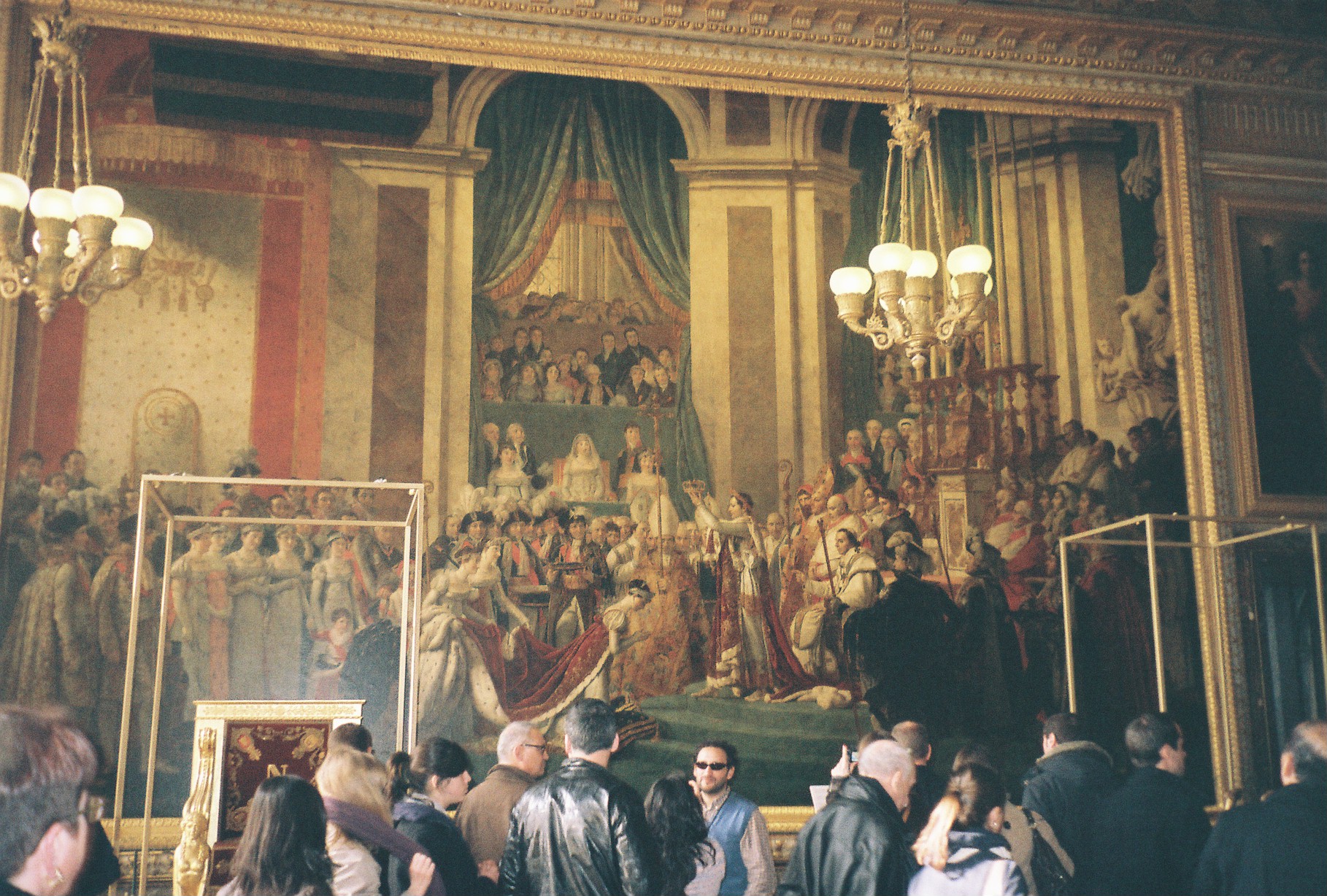
Finally, you see, between the windows, four portraits: General Bonaparte in Italy, by Rouillard; Napoleon 1st, Emperor of the French, by Dufay, known as Casanova ; and the two empresses Joséphine and Marie-Louise, by Dedreux-Dorcy. In the center of the room is the German Campaign Column, also known as the “Austerlitz Column”, commissioned by Napoleon from the Sèvres factory to commemorate his first imperial victories. based on a drawing by Alexandre-Théodore Brongniart, it is enhanced with mounts and bronzes ordered in 1806 from the Thomire house. Commemorating the campaign of 1805, it was delivered for the officers’ lounge of the Tuileries Palace in 1807 and placed the following year in the grand apartments of the Tuileries Palace, it is one of the great masterpieces of the production of Sèvres porcelain under the Empire, produced in collaboration by Bergeret (painting) and Thomire, Duterme et Cie (bronze mount). The coronation painting, which was in this room, and which in fact shows the coronation of Empress Joséphine, left Versailles for the Louvre Museum, in Paris, in 1889. It is today replaced here by the second copy , painted by David, in Paris then in Brussels, in 1808-1822. Commissioned from David by a group of American businessmen, this painting was shown throughout the United States and Europe throughout the 19C, before being acquired by Versailles in 1947. Placed in the gallery in 1948.
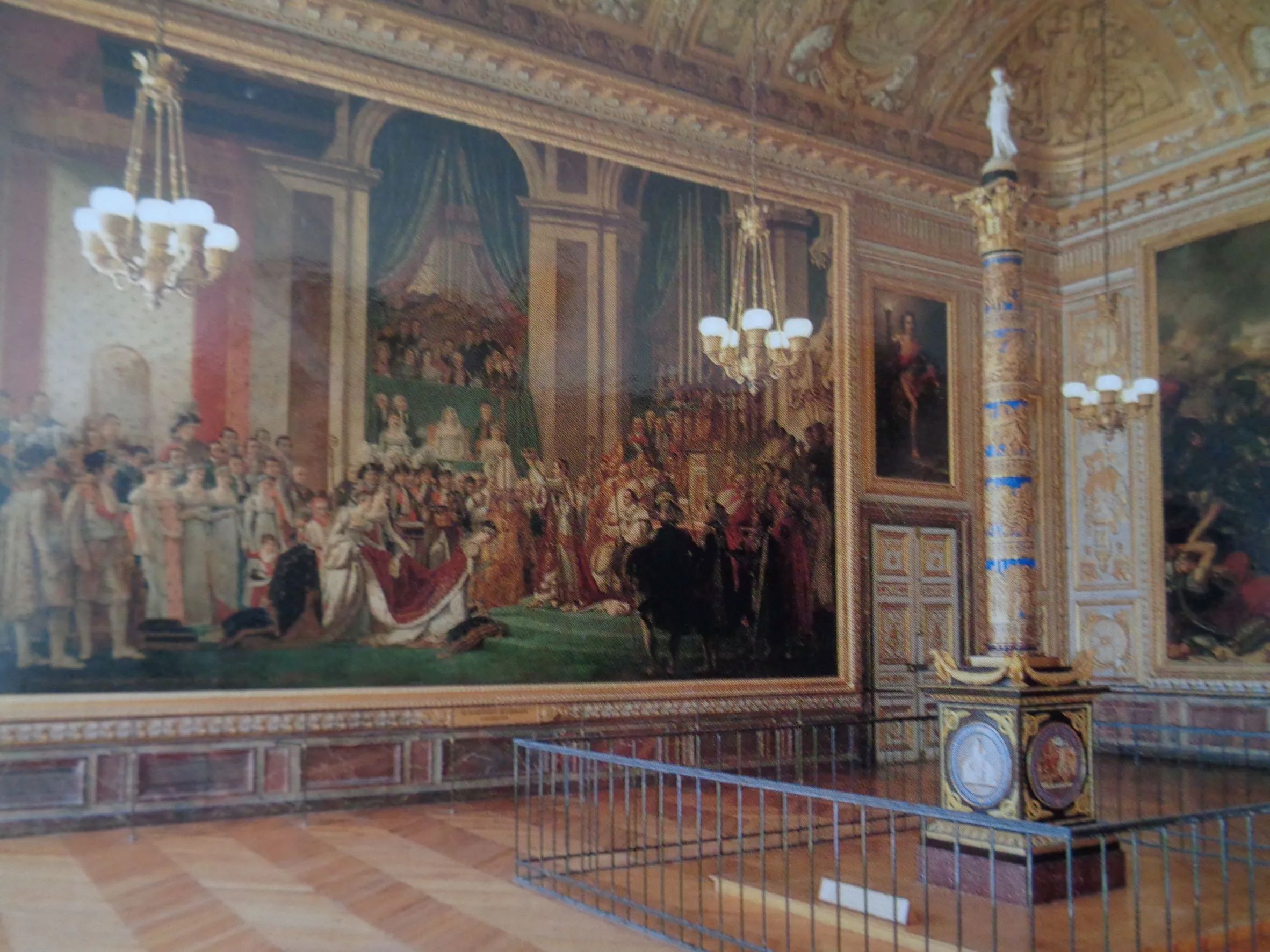
The Château de Versailles on the Coronation room : https://en.chateauversailles.fr/discover/estate/palace/coronation-room
There you go folks, the magnificent gorgeous as ever Chateau de Versailles This Salle du sacré or coronation room of Napoleon ,history in the making live. Again, hope you enjoy this post on the Coronation room of Napoleon as I .
And remember, happy travels, good health, and many cheers to all !!!

 Paris1972-Versailles2003