
Again, tackling this huge task of telling about the magnificent beautiful awesome Notre Dame Cathedral of Amiens Or Our Lady signifying the mother of Jesus, Mary, The biggest is in Amiens. , old region of Picardie, today in the Somme dept 80 of the Hauts de France region of my belle France, I have written little on the cathedral, this is due to new older pictures found not yet in my blog and they should be, Its a huge task, but here is my effort on the Cathédrale Notre Dame d’Amiens !!! Hope you enjoy the post as I.
The Cathedral Notre Dame of Amiens has lost most of its original stained glass, but it remains famous for its 13C Gothic sculptures adorning its western facade and the portal of the Golden Virgin on the south facade of the transept, as well as the stalls, work of art in cabinetry. Its architectural unity is evident, except for the upper parts of the two towers. The elevation of the nave of the choir and the transept reflects the ingenuity and boldness of the builders. It is 145 meters long ,with an arrow top at 112 meters, the nave vaults are 42 meters high. Wonderfully beautiful, a must to see in France ! One of the largest classical Gothic churches of the 13C. It is striking for the coherence of the layouts, the beauty of the interior elevation on three levels and the arrangement of an extremely clever sculpted program on the main facade and the south arm of the transept. Destroyed by lightning in 1528, the original spire of the monument was replaced by the one we still admire, one of the oldest wood and lead spires in France making the cathedral, the tallest building in Amiens. Admired since the 19C, considered a masterpiece of Gothic art, Notre-Dame Cathedral of Amiens is the largest French cathedral, with an interior volume of nearly 200,000 m3, double that of Notre Dame de Paris.
The tympanum of the central portal (13C) illustrates the Last Judgment. From top to bottom, it shows the resurrection of the dead, awakened by the blowing angel, and the weighing of souls by the archangel Gabriel. Above, the angels separate the righteous and the damned. These are directed by the demons towards the leviathan. Finally, at the top sits Christ surrounded by the Virgin and Saint John, both interceding for the salvation of men. Christ with two swords coming out of his mouth. This image is the illustration of a verse from the Apocalypse of John which can be interpreted in two ways: a double-edged sword held in the mouth of Christ as in Paris or two swords emerging from the mouth of Christ as in Amiens.Indeed, we see Saint Francis of Assisi on the left, designated by Saint Peter, entering Paradise . He is in Franciscan habit and barefoot. It is one of the oldest representations of this saint in France, canonized two years after his death, in 1228.

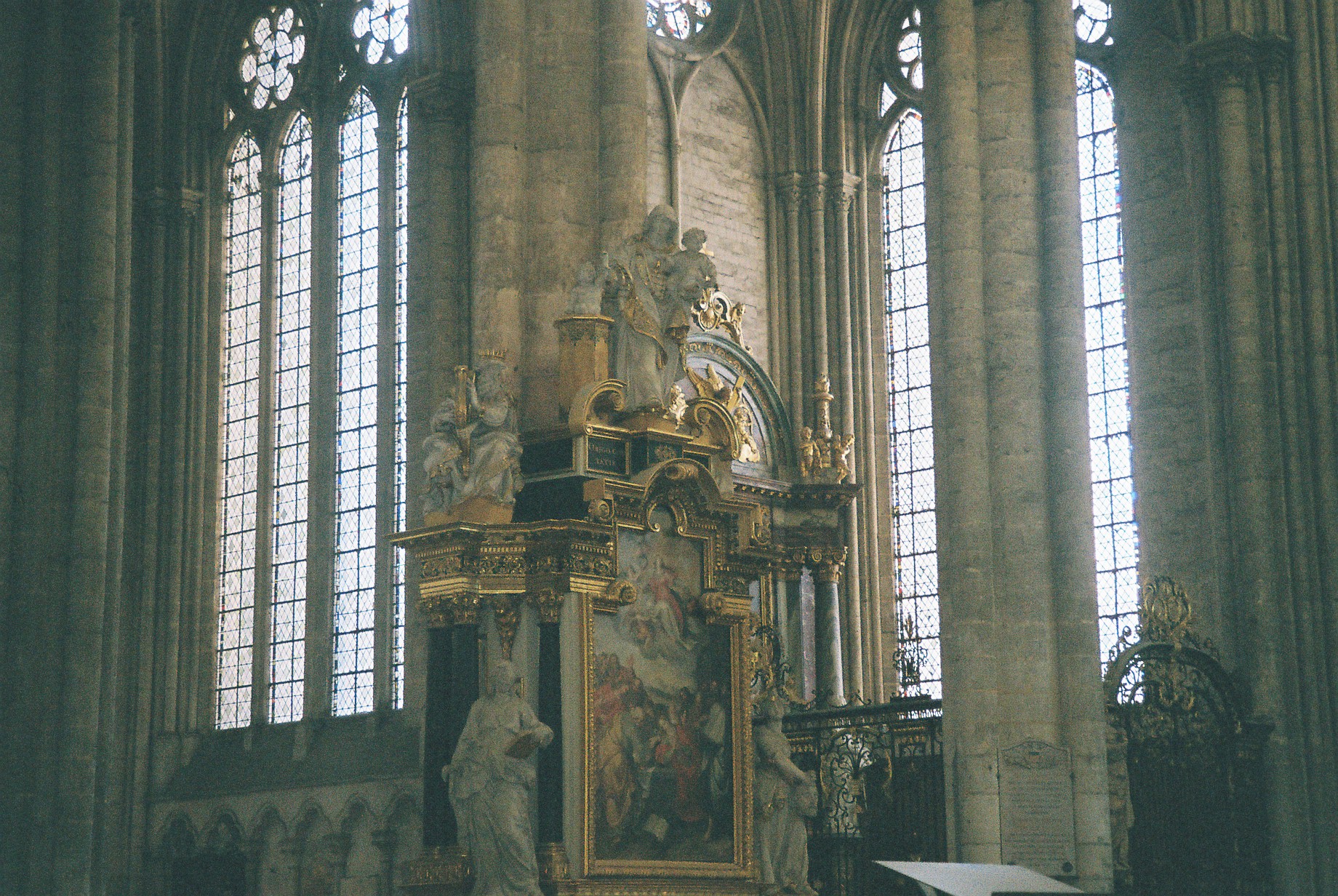
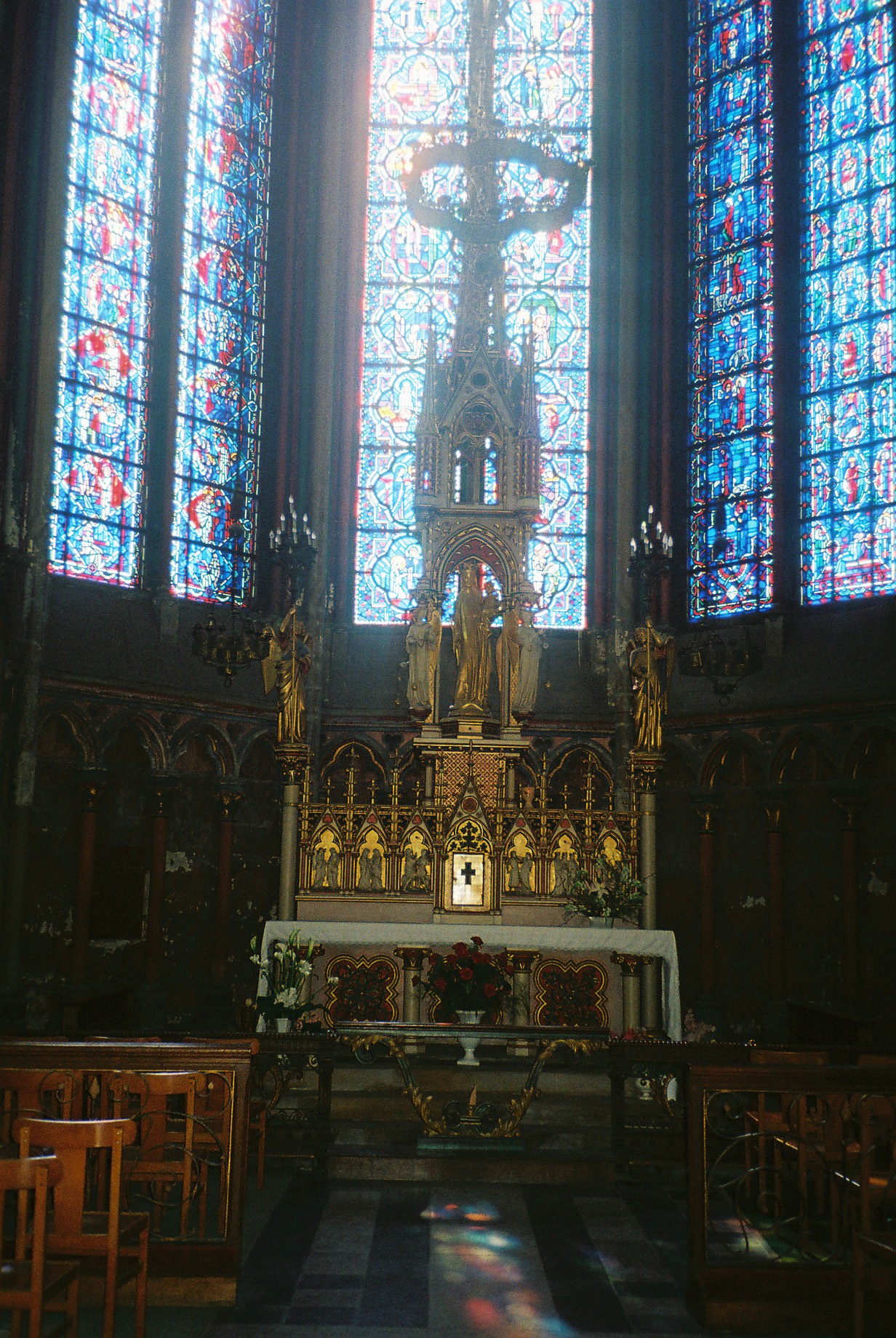
The altar or Chapel of the Green Pillar is dedicated to the martyrdom of Saint Sebastian. The statue of the saint is surrounded by that of Saint Roch and allegories of Justice and Peace. The large painting of Calvary is from the 18C. The altar or Chapel of Notre-Dame du Pilier Rouge was made in 1627. The statues of Notre-Dame-du-Puy, David, Salomon and Judith ,and Saint Geneviève comes from a convent in Amiens. There is ,also, a large painting of the Assumption The axial Chapel of Notre-Dame-Drapière (or of the Virgin) was completely redecorated between 1859 and 1862 under the direction of Eugène Viollet-le-Duc. By removing the woodwork, it was discovered the tombs of Simon de Gonsans, bishop of Amiens, and Canon Thomas of Savoy (14C). Very mutilated, they were restored and partially rebuilt, The stained glass windows installed during this restoration were replaced illustrating the life of the Virgin.

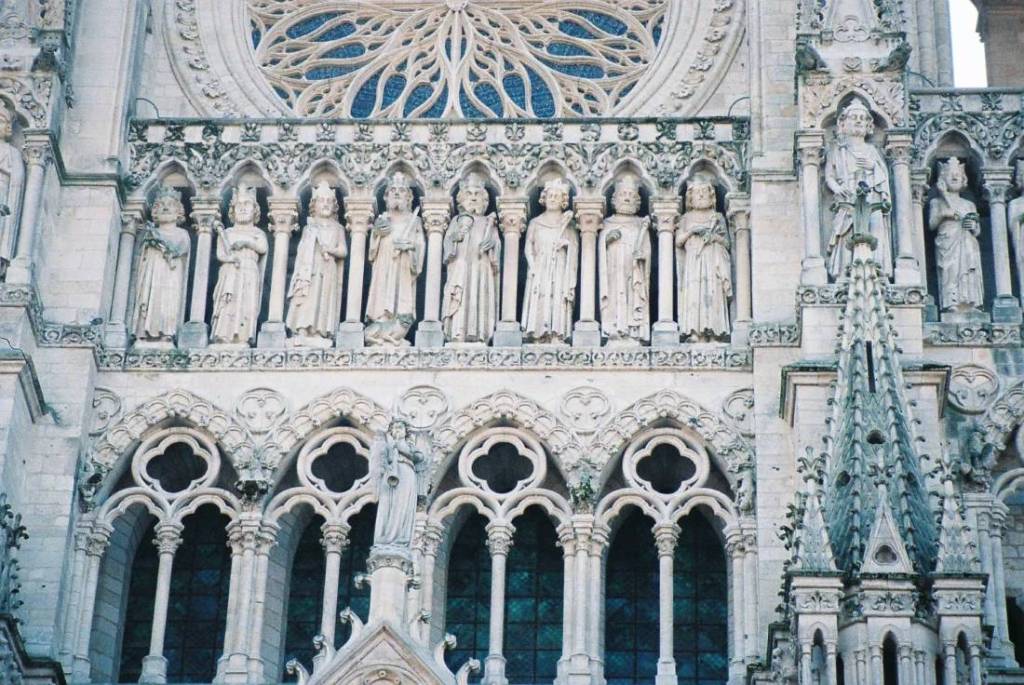
The facade of the Notre Dame Cathedral construction began in 1220, and went to 1288, but the top floor of the north tower was not completed until 1402. The statues in the gallery of Kings were almost all restored by Viollet-le- Duc in the 19C. The rose “network” dates from the 16C. Finally, the gallery of Sonneurs (or Musicians), located above the rose, was rebuilt by Viollet-le-Duc as well, The central portal bears the triumphal mark of the actors of the Apocalypse and the Last Judgment. To which we can add the reign of the elect and of Christ. The tympanum illustrates the resurrection of the dead, the Judgment and the triumph of Christ. As for the arches, the message it conveys is twofold: the bottom row shows Paradise, and Hell while the upper parts exalt the reign of the righteous alongside Christ. The first arch represents angels in prayer, the next one represents angels carrying souls . On the next three are sculpted martyrs, confessors and virgins. Finally, the exterior arch is made up of twenty old men from the Apocalypse.
The Notre-Dame Cathedral is a masterpiece of Gothic architecture for the beauty of its interior elevation, its prodigious sculpted decoration and its stained glass windows. It had an important influence on the later development of Gothic architecture. Several of the solutions adopted in Amiens herald the advent of the flamboyant style in architecture and monumental sculpture. The cathedral has preserved its architectural expression and religious functions over the centuries. The attributes that express its outstanding universal value display remarkable integrity. All key architectural elements are included within the property boundaries and are in good condition. Great authenticity and significantly illustrates the radiant Gothic style which marked the 13C. Numerous evolutionary episodes over the centuries that followed left their mark on the building without distorting it. From 1292 to 1375, the cathedral was enriched with a series of chapels built between the buttresses of the side aisles. With the spire erected at the crossing of the transept, the choir enclosure and the splendid canonical stalls in carved wood, at the end of the Middle Ages it took on the appearance that we know it. Minor interventions during the Renaissance and the 18C, particularly inside the cathedral, enriched the decor and consolidated the building. Overall, the cathedral was spared the two main episodes of vandalism, the Wars of Religion and the French revolution, which left it virtually undamaged. It was restored in the 19C by Eugène Viollet-le-Duc, who endeavored to clear the choir and whose most important intervention only concerned the Galerie des Sonneurs, at the top of the facade, of which he changed the style and appearance. The choir was completely enclosed, closed by walls which were decorated, on the ambulatory side, with the story of the adventures of St Firmin and St John the Baptist. These polychrome sculptures from the end of the 15C are superb and well preserved. With the exception of the 16C stalls, the rest of the choir is Baroque, a grille replaced the rood screen.
The existence of a Christian community in Amiens is by the end of the 3C, and the arrival of Saint Firmin, who would have suffered martyrdom at the end of the 3C or at the very beginning of the 4C. He is considered by Catholics as the first bishop of Amiens. During the barbarian incursions on Picardy in 407, we know that a first temple was destroyed. The evangelization of Gaul was going well from the 5C, historical sources indicate that a second monument , built on the site of the current cathedral, replaced the first. The first church was dedicated to Saint Peter and Saint Paul, later to Saint Firmin the Confessor; the second devoted to Notre Dame, and to Saint Firmin the Martyr. Following a fire which destroyed a large part of the city, a new Romanesque church was built between 1137 and 1152, the year of its consecration, It was within its walls that king Philip Augustus married the Danish princess Ingeburge in 1193. In 1206, the head of Saint John the Baptist, taken to Constantinople , takes place in the cathedral and significantly increases its prestige. This resulted in the establishment of one of the most important pilgrimages in northern France in the Middle Ages and a source of income for the chapter. The building being destroyed by fire in 1218, plans for a gigantic Gothic cathedral were immediately drawn up. Construction began in 1220. It was completed fifty years later. We started with the transept, then the nave (1240), and finally the apse (around 1269). After the Council of Trent, the sanctuary was renovated and the rood screen was replaced by a grille. The French revolution brought its share of vandalism, particularly to the statuary of the facade. Eugéne Viollet le Duc restored the cathedral, which for him embodies the Gothic church par excellence, according to his personal views. The western facade bears its mark.
A bit of history I like tell us that the current Notre Dame Cathedral occupies a site where several sanctuaries have followed one another and of which the historians knows little, due to the lack of texts and archaeological excavations. Catholic tradition, however, traces the Christianisation of Amiens to the arrival at the end of the 3C of Firmin who would have suffered martyrdom at the end of the 3C or at the very beginning of the 4C. He is considered by Catholics as the first bishop of Amiens. The first church was dedicated to Saint Peter and Saint Paul, later to Saint Firmin the Confessor; the second devoted to Our Lady and to Saint Firmin the Martyr. Following a fire which destroyed a large part of the city, a new Romanesque church was built between 1137 and 1152, the year of its consecration, but there are any document to determine what it was. The prestige increased dramatically with the arrival in 1206 of the chief of Saint John the Baptist. At the beginning of the 13C, period of the reign of king Philippe-Auguste, Amiens knew a period of prosperity. It was the bishop Évrard de Fouilloy who would have laid the first stone of the church under the pillar supporting the statue of the Golden Virgin at the south portal of the transept. It was necessary to offer the relic of Saint John the Baptist a case worthy of the importance of the character. And to welcome pilgrims from all over Europe, you had to think big. The construction work begins with the foundations in 1220 and the laying of the first stone takes place the same year as evidenced by the inscriptions in the labyrinth and above the portal called the Golden Virgin. During the French revolution: In December 1793, volunteers from Lille entered the Notre Dame Cathedral and mutilated with sabre the sculptures of the enclosure of the choir; they were restored in the 19C. The statue of Saint Louis in the Chapelle du Pilier or Chapel of the Pillar was destroyed, crosses were also removed, but most of the carved decoration was preserved. In 1793, the cathedral was transformed into a temple of Reason and Truth and then, in 1794, a temple of the Supreme Being. Catholic worship was restored there in 1795.
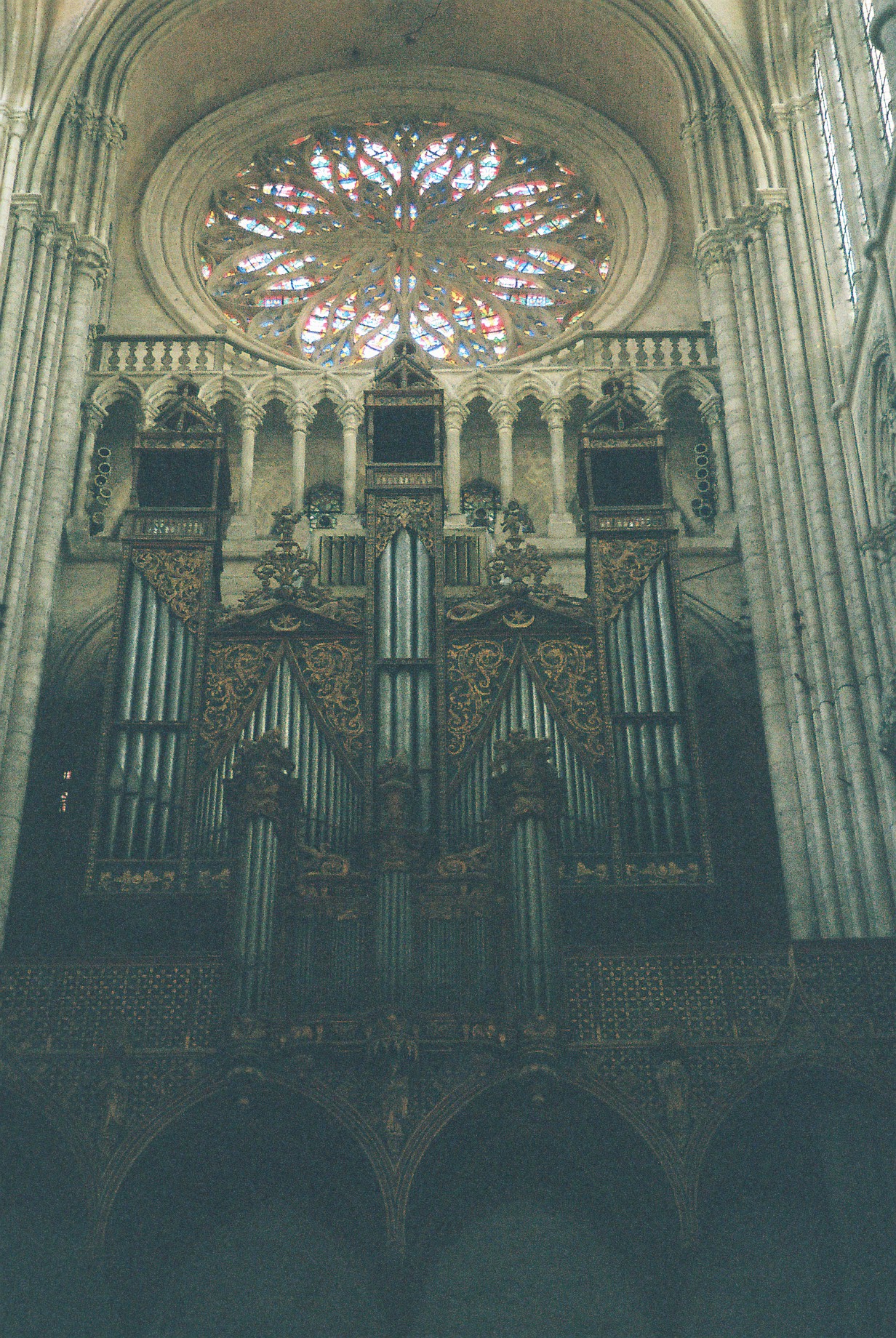
During WWI: In 1915 during an episode of intense bombardment, the three portals of the main facade as well as the portal of the Golden Virgin were covered with a formwork made up of dirt sacks, to protect as much as possible their sculpted decoration. In July 1918, during the last German offensive in the west, the cathedral fell under the fire of the German imperial troops, in spite of the intervention of the Pope with the Emperor William II. On April 4, a shell crossed the roof of the choir, without much damage. On the 25th of the same month, three shells reached the cathedral and a buttress was destroyed, the vault of the south aisle of the choir was pierced as well as the paving, a third shell destroyed the first span of the southern triforium and opened the wind tunnel of the organ placed there. A few days later, the vault of the Chapelle de l’Annonciation or Chapel of the Annunciation was pierced by a shell, the first flying buttress south of the apse was destroyed by another and a third touched the outside of the cathedral near the sacristy. The grandstand organ was dismantled by the Paris fire brigade, the stained glass windows were also dismantled and sent to Paris to be restored there before reassembly. Unfortunately, they were largely destroyed by an accidental fire in the Paris premises where they were stored. During WWII: In May 1940, during the Nazis bombardments which destroyed a large part of the city center. Many of the buildings surrounding the Notre Dame Cathedral were destroyed, but fortunately the cathedral was not affected. Allied bombing in 1944 also spared the cathedral. In 1981, the Notre Dame Cathedral of Amiens was inscribed on the World Heritage List by UNESCO. In 1998 it was registered a second time under the Routes of Compostela in France.
Some of the events and I pick my favorites are: king Charles VIII and Queen Anne of Brittany came to Amiens on June 11, 1493 and went to the Notre Dame Cathedral. On September 25, 1513, Louis XII attended, at the Notre Dame Cathedral of Amiens, the Mass of the feast of Saint Firmin. In June 1517, it was François I and Queen Claude of France who came to Amiens and went to the cathedral. King Henry IV came twice to the Notre Dame Cathedral of Amiens to attend a religious ceremony, the first time on August 18, 1594 after the city recognized him as king of France, the second time on September 25, 1597 after the city was taken over from the Spanish. King Louis XIII and Cardinal Richelieu attended a thanksgiving ceremony at the Notre Dame Cathedral after the fall of Arras, from the Spanish on August 9, 1640. Napoleon Bonaparte, First Consul, accompanied by Joséphine de Beauharnais, visiting the Notre Dame Cathedral and struck by the beauty and majesty of the cathedral, would have said this sentence : “Atheists must not be well here”, June 28, 1803. The October 12, 1854, Napoleon III and the Empress Eugenie, attended in the Notre Dame Cathedral the inauguration of the Chapelle Sainte-Theudosie chapel whose Empress Eugenie had financed, on her personal wealth, the refitting and decoration under the direction of Eugène Viollet -le Duc. On November 7, 1920, Marshal Foch attended the inauguration ceremony for the monument in memory of the Australian soldiers who died on the soil of the Somme department during WWI or Great War.
The official Notre Dame Cathedral of Amiens : https://www.cathedrale-amiens.fr/en/
The City of Amiens on the Notre Cathedral : https://www.amiens.fr/Vivre-a-Amiens/Culture-Patrimoine/Patrimoine-mondial/La-cathedrale-Notre-Dame-d-Amiens
The Amiens tourist office on the Notre Dame Cathedral : https://www.visit-amiens.com/cathedrale-notre-dame-damiens/amiens/pcupic0800010896
There you go folks just another effort on this wonderful beautiful awesome Notre Dame Cathedral ,which should be on anybody’s list of things to see in France. This is a huge wonderful gorgeous Cathedral that needs to be visited by all means, Again, hope you enjoy the post on the Cathédrale Notre Dame d’Amiens !!! as I.
And remember, happy travels, good health, and many cheers to all !!!


I visited Amiens several years ago and had the opportunity to visit the Notre Dame in the city. Such a wonderful architectural feat! Thanks for sharing. 🙂
LikeLiked by 1 person
You are welcome, glad you were able to see this marvel, thanks for stopping by Cheers
LikeLiked by 1 person