
I just found a couple of pictures from my previous visit to the beautiful City of Orléans not in my blog but they should be, It is a street we walked several times each time in Orléans, and we had found some familiar goodies nearby, Therefore, let me tell you about some curiosities of Orléans ,part II !!! Hope you enjoy it as I.
The rue de Bourgogne is a very long road that crosses Orléans from east to west. The short portion that interested me was the section that goes from rue Ducerceau to rue de l’Empereur ,and its corner with rue Sainte Catherine, There we discover several old houses full of charm. Already, from the corner with Ducerceau and Sainte Catherine streets, we can see several half-timbered facades. It is even interesting to take a short foray onto rue Ducerceau to look at the two houses which are located after the one on the corner 6 Rue Ducerceau (pic). Going up rue de Bourgogne, other beautiful half-timbered or stone houses appear, of which the story is unknown at least by me. We can still have the pleasure of admiring them. But the pearl, the treasure of this street, is No. 261, which is called the maison de la Prévôté.or provost house. It dates from the 15C and is decorated with pretty, very finely executed sculptures. Today it houses a business that suits it well: a bookstore specializing in old books Au cœur du Monde, .But my picture is of another unknown house mind you,
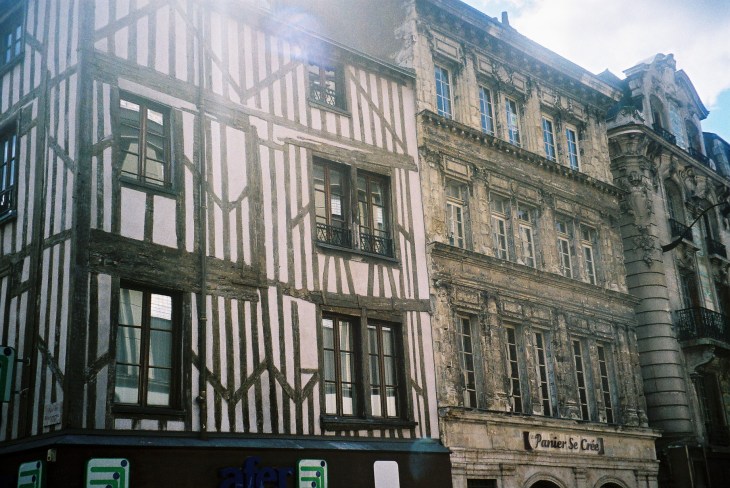
Due to its numerous shops, including restaurants and bars, it is one of the liveliest streets in Orléans. The rue Bourgogne begins on its western axis from Rue Royale and ends to the east on Square Charles-Péguy and Boulevard Saint-Euverte. The axis continues with Faubourg Bourgogne, which remains a more residential area. Its name is due to the fact that it was the main route to Burgundy during the Middle Ages. In 1429, Joan of Arc entered Orléans through the Porte de Bourgogne gate which was then located at the eastern entrance to the street. Many old buildings remain within the rue de Bourgogne, you can see there a Protestant Temple, the Prefecture where the south face of the Saint Etienne Cathedral is visible, as well as the thesis room, recalling the former location of the University of Orléans from the 15C where Jean Calvin studied law in 1528.
The very old rue de la Poterne from the 1st enclosure goes from the Quai du Châtelet to rue de Bourgogne. The street takes its name from a fortified door, “La Poterne Chesneau”, located nearby. It was once an important axis of the old town. It ended on the banks of the Loire;it is this door that will give the name to this street. The English sent their first cannonballs there. At the bottom of rue de la Poterne, the quays of the same name, could accommodate the mariners and their boats loaded with spices, pottery, coal, wheat and other grains The “Petites Sœurs des Pauvres” or Little Sisters of the Poor arrived in Orléans in 1855 at rue de la Poterne, then settled in 1870 rue Bellébat under the name of Ma Maison or my house.
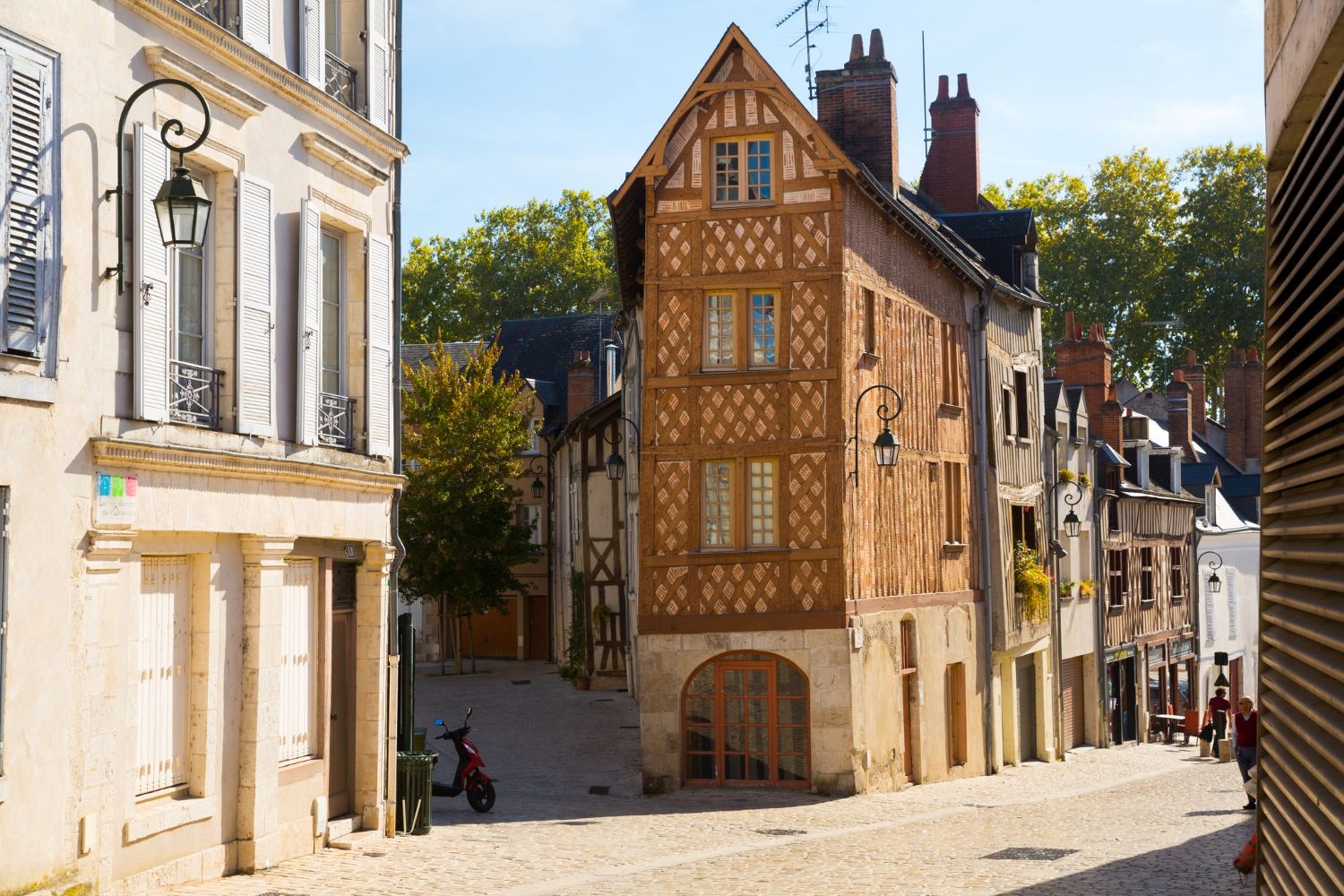
Domino’s Pizza Orléans Centre at 13 Place Châtelet, a huge square with parking shops and restos all around it Near quai Châtelet and the Loire river and Pont George V From the bridge take rue Jean Hupeau to the store at the corner. Here is the official Domino’s Pizza France on store in Orléans: https://www.dominos.fr/magasin/orleans-centre_45000

Domino’s Pizza was founded in 1960 when Tom Monaghan and his brother James purchased a pizza delivery store “DomiNick’s”, located in Ypsilanti, Michigan in the United States. Five years later, sole proprietor Tom Monaghan renamed his company “Domino’s Pizza, Inc, The brand is present in 86 countries with nearly 17,000 stores worldwide
.The brand arrived in France in 1989 where it now has more than 453 points of sale. Domino’s Pizza France belongs to the Domino’s Pizza Enterprises Ltd (DPE) group, a master franchisee which operates the brand for Australia, New Zealand, Japan, France, Belgium, the Netherlands and Germany. Today,this group has 2,150 stores and manufacture and deliver nearly 90 million pizzas each year!
France is the second consumer of pizza in the world, just behind the United States and ahead of Italy , With 881 million pizzas consumed each year, for an average price of 10.20 euros for the Queen (Reine) pizza, the most consumed, the market for this dish amounts to 5 billion euros per year.Essential recipes such as Cannibale (beef) or 4 Fromages (4 cheeses) still make the brand successful today. For the record, in France, the first mention of pizza appeared in 1903 in the heart of the old port of Marseille where Neapolitans ate pizza bianca and non rossa (with tomatoes).
The city of Orléans on its heritage: https://www.orleans-metropole.fr/decouvrir-sortir/tourisme-patrimoine
The Orléans tourist office on its heritage: https://www.tourisme-orleansmetropole.com/en/visit-orleans-get-inspired/heritage-and-culture/
There you go folks, and all this because I found 2 pictures in my vault that should be in my blog, me think Why not wonderful historical architecture in a beautiful City of Orléans in the Loiret dept 45 of the Centre Val de Loire region of my belle France and pizza we love it we have it near us, Again, hope you enjoy the post as I
And remember, happy travels, good health, and many cheers for all !!!

 Paris1972-Versailles2003