
We have come several times and always a must in Lavaur, our sentimental city as is the native town of Pierre, my dear late wife Martine’s father, The Saint Alain Cathedral is a majestic monument, a must to visit in town if anything else. A masterpiece that needs to be discovered by many. I found more pictures of it and feel should be in my blog for memories’s sake. We love it and sure will be back eventually, Of course, it is in the Tarn 81 of Occtanie region, in my belle France. Therefore, here is me again on the Cathedral Saint Alain of Lavaur !!! Hope you enjoy the post as I,
The Altar table, late 11C. Since 1967, the altar of the Choir of Saint-Alain has a table whose exact provenance we do not know. It was found in 1876 in the Chapel of the hospital of Lavaur, but this is not its place of origin. It is possible that it came from the Cathedral and may have been part of the donation of Bishop Izarn to the Benedictines, but another hypothesis would make it come from the Church of Sainte-Foy de la Salvetat founded in Lavaur in 1065 by the monks of the abbey Sainte-Foy de Conques, which then took the name of Sainte-Croix and served as chapel for the Brotherhood of the Blue Penitents. This Romanesque table, in white marble probably of Saint-Beat, is part of the continuation of the production of altar tables of the Ecclesiastical province of Narbonne. The main theme of the anterior face is a Christ blessing in a circular mandorla, is the same on both tables. A series of angels, complete this face. On the right side are represented two angels supporting the altar table itself, a motif found on the stone of one of the capitals of Saint-Sernin (Toulouse). The sculpture on the left side would represent two angels worshipping the bread of heaven. The fourth face was destined to be engaged in masonry and is not decorated.
The Saint-Alain Cathedral of Lavaur is the only city in the southwest of France, to have a Jacquemart, emblematic character, wooden automaton hoisted in the tower. The legend of the Jacquemart tells that, during the wars of religion, a Protestant prisoner locked in the tower of the cathedral had the obligation to ring the bells every hour, day and night. He devised a stratagem, by constructing a mechanical figurine to do it in his place, and could thus escape the jailers! Finally, the first mechanism and the bell that makes the famous Jacquemart ring, date from 1523. But it appears that the automaton (currently 3rd generation) will not take place until 1604. Take the time to admire this Cathedral as a whole!!
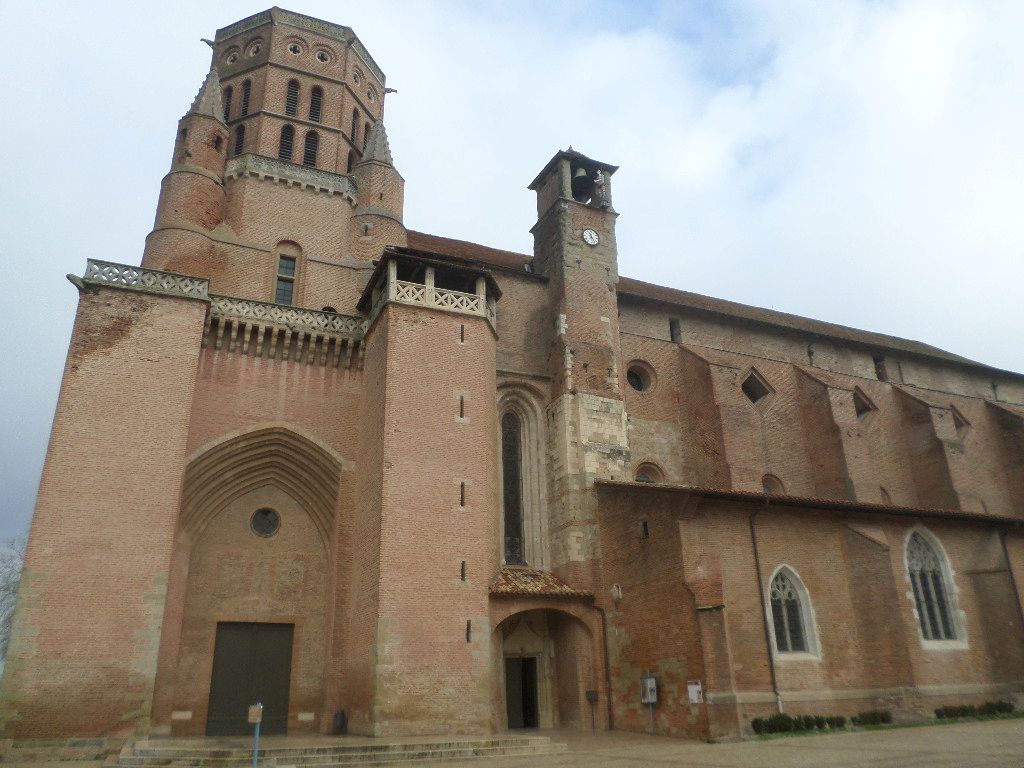
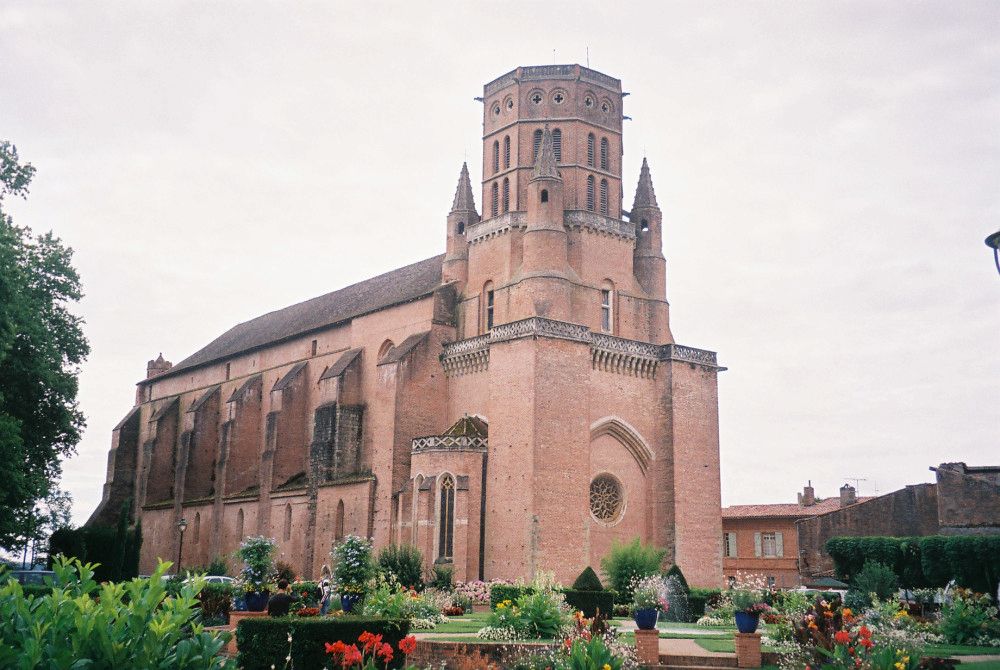
The Cathedral of St. Alain was built between 1255 and 1300. It is 73 meters long by 14 meters wide. At the front is the garden of the bishopric. The origin of honoring Saint Alain at Lavaur remains unknown. The foundation of the Priory of Saint-Alain is attested by a charter of 1098 where the bishop of Toulouse Izarn of Lavaur makes a donation to the Benedictine monks of the Abbey of Saint-Pons-de-Thomières, dependent for them to rebuild the Church of St. Elan of Lavaur, then in ruins, proving that the cult of Saint Alain in Lavaur is clearly prior to this date. The Saint Alain Cathedral is of southern Gothic style. At the front is the Bishopric Garden (see post). The structure overlooking the Agout river is characterized by a single nave lined with chapels, and a powerful bell tower with a monumental portal from the end 15C or beginning 16C. The restoration of all the decoration painted in the 19C was completed in 2016 The town of Lavaur is the only one in the South-West to have a Jacquemart, a wooden automaton hoisted in the tower of the cathedral at the beginning of the 17C , The Saint Alain Cathedral has a single nave lined with chapels (14-15C), flanked by a 14C apse. The nave of 5 bays plus the choir and the apse without pillars, typical of the first Languedoc Gothic. Its length is 85 meters, width: 114 meters, arch height 25 meters. The total length of the cathedral, including the chapel under the bell tower, is 73 meters,
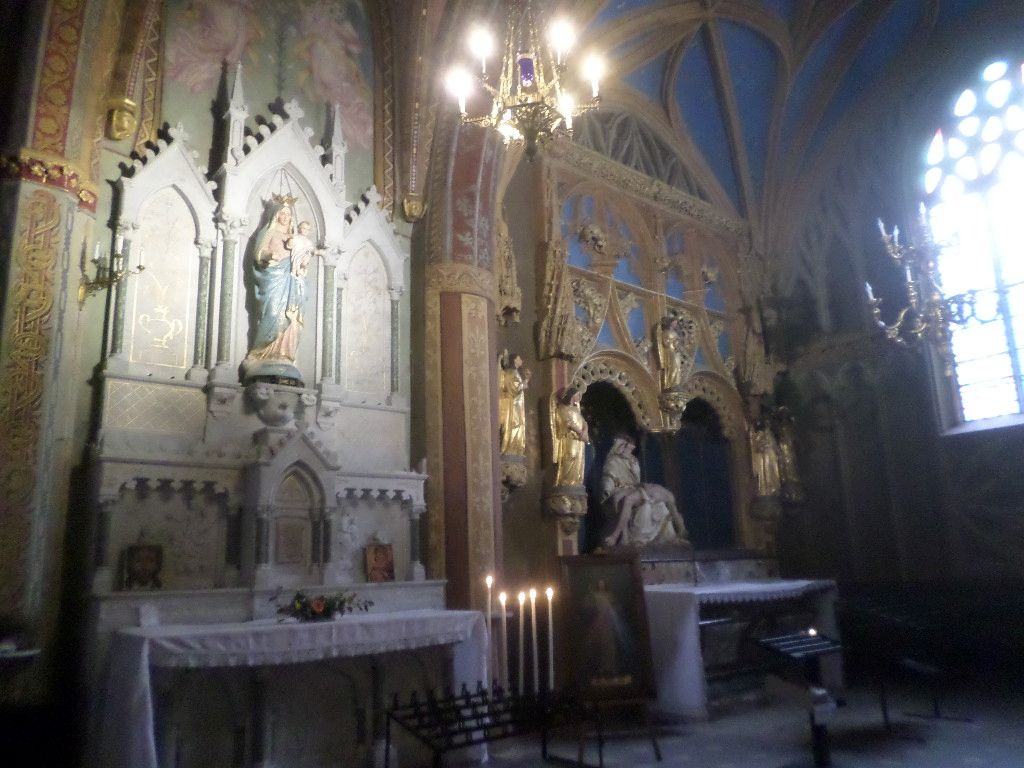
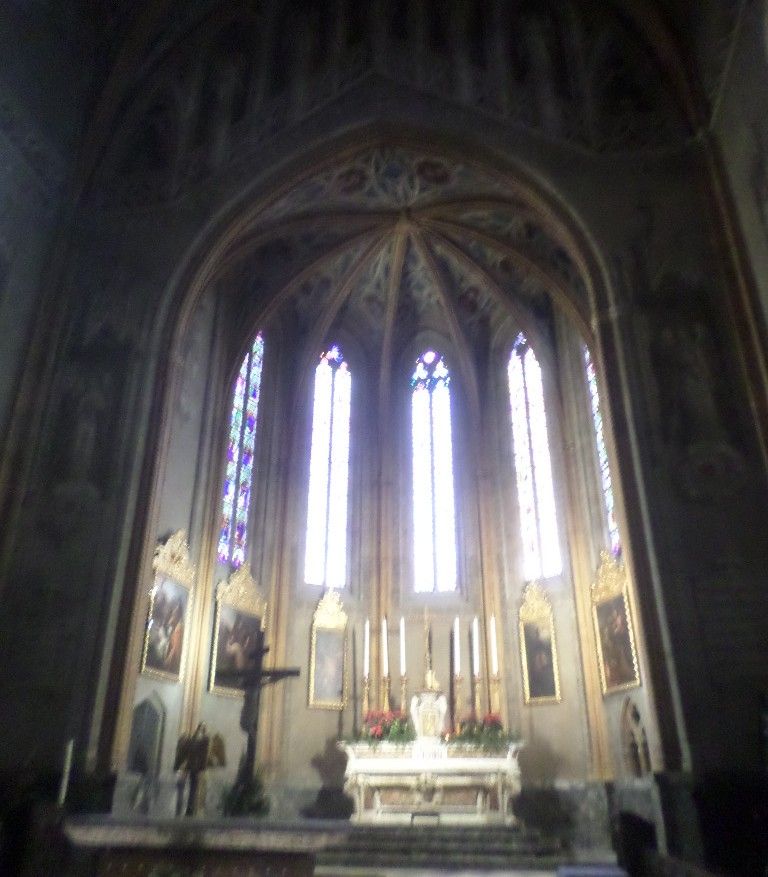
The frescoes created in the 19C in trompe-l’oeil, walls in grisaille and vaults with fine Gothic color decorations, shine with new brilliance, inviting visitors of all ages to re-read them. A vestige of an early Romanesque church, this altar table is exceptional. It is a sink-cut marble table, decorated on three of its chamfered edges. In the center stands Christ in glory in a medallion held by two angels who look away from the divine light. This set is placed on a marble platform. Small spotlights inserted into the marble highlight the sculpted frieze representing Christ served by angels.
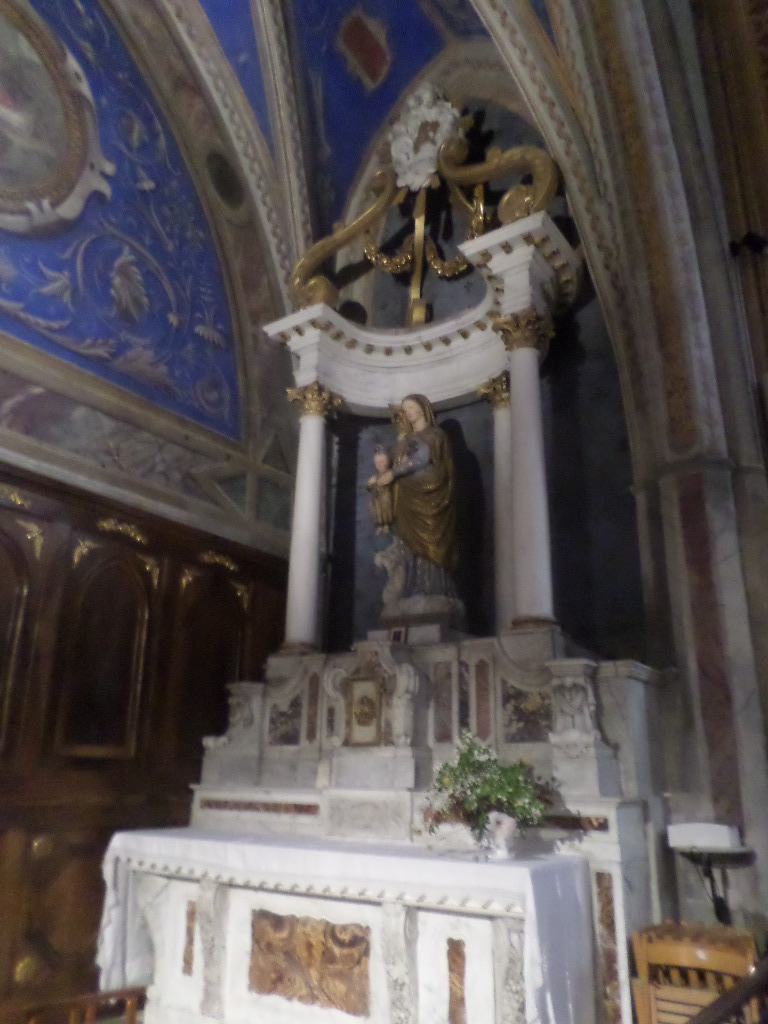
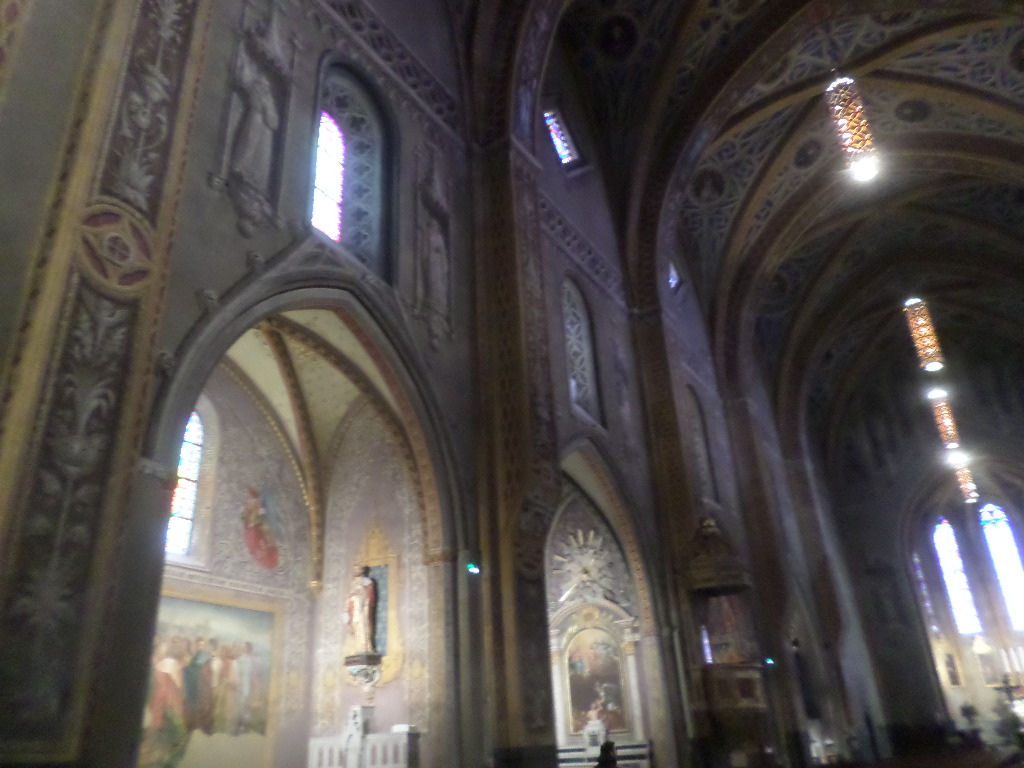
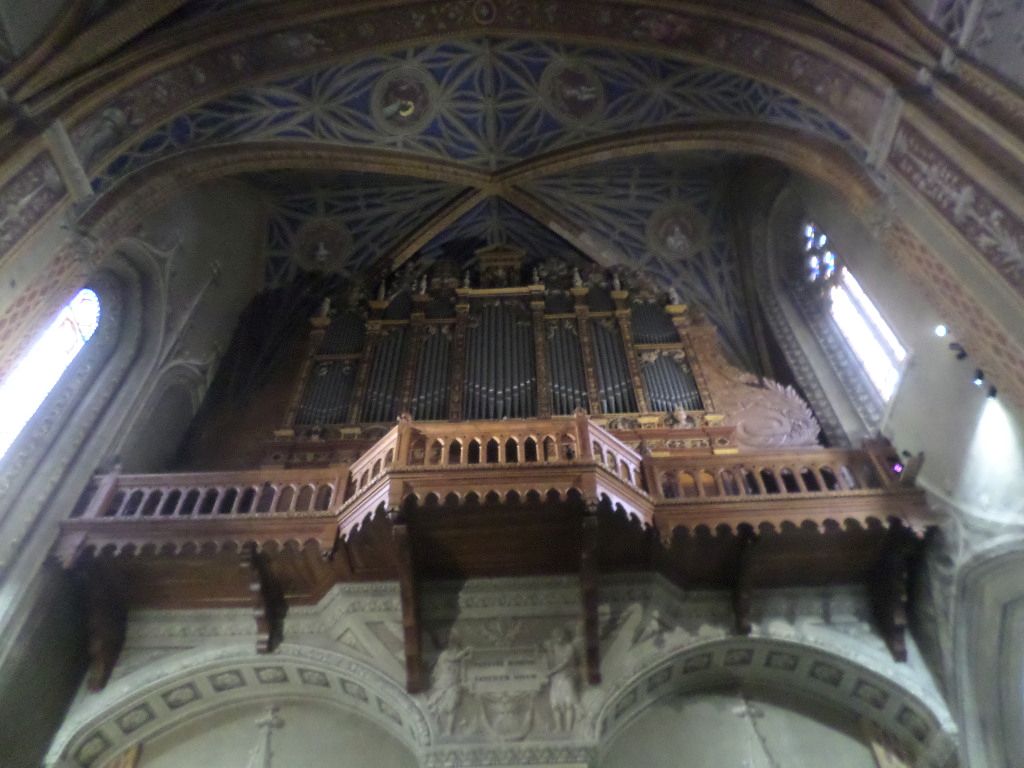
At the bottom under the organ loft, halfway up, the paintings of Moses and Aaron. On both sides of the nave, representations of the Fathers and Doctors of the Church: North Wall: Bernard, Fulgence, Léon, Augustine, Jean-Chrysosthome, Gregoire de Nazianze, Athanase, Cyprien. South Wall: Thomas Aquinas, Gregory, Caesarius, Cyril of Alexandria, Jerome, Ambrose, Basil, Hilaire. On the vault, 44 saints painted in medallions. The large Cavaillé-Coll organ was installed in 1876, behind a splendid polychrome carved wooden case from 1523 a masterpiece of Renaissance art.
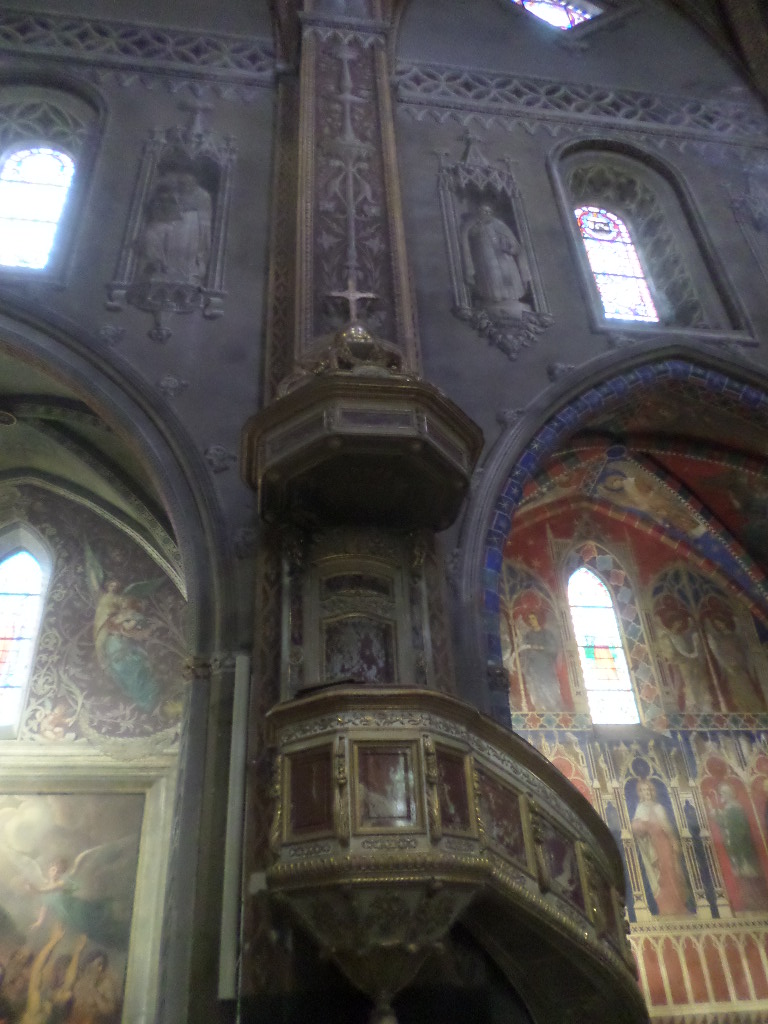
A very beautiful organ completes the overall arrangement with a high-quality Renaissance buffet by Toulouse sculptor Nicolas Bachelier ; instrument redone in 1889 by Aristide Cavaillé-Coll.
A bit of history I like tell us that a Romanesque church was built between 1099 and 1211 by the Benedictines of Saint-Pons for their priory at Lavaur, which was destroyed during the Albigeois (cathars) crusade during the siege of 1211. The present church was rebuilt in the middle of the 13C, begun around 1255, preserving the Romanesque footprint of the small bell tower south of the Jacquemart. It is of pure southern Gothic style with a large nave unique to slender proportions, the 13C church had only five bays closed at both ends by a straight wall. The erection of the priory in the bishopric of Lavaur in 1317 transformed the church into a cathedral, prelude to the expansion of the church, which would continue until the beginning of the 16C at the initiative of the bishops.
In the 14C, the chapels were built and by the middle of the 15C, the chapel currently serving as the sacristy, under the term of Saint Martial and in 1480 adjoining the canons established a chapter hall dedicated to Saint Gauthier. Fresco paintings performed in 1730 adorn its walls, narrating in episodes the story of Lavaur. They are erased on quite a large part by the humidity. It was especially in the last quarter of the 15C, on the initiative of Bishop Jean Vigier, that major works were undertaken giving the cathedral its present physiognomy. It is still the end of the 15C that a chapel was added adjacent to the south of the old Romanesque porch, well preserved, to the rich capitals evocative of the childhood of Christ. A new side entrance, adorned with pinnacles, surmounted by the Bishop’s shield, is then carried out on the southern flank of the connecting span.
It was especially in the last quarter of the 15C that great works are undertaken giving the Saint Alain Cathedral its present look. Its width is about 14 meters and its total length 73 meters. Passing from the construction of a new episcopal palace adjoining the cathedral to the north (destroyed at the beginning of the 19C) it undertook to build the imposing western bell tower with three terraces, 42 meters high and, to connect it by an additional span to the rest of the church, realizing at the same time a nave of a great extent. The curious crown carved in fleur-de-lis at the top of the tower recalls that it was completed under the episcopate and it was still at the end of the 15C that a chapel was attached to the south of the old Romanesque porch, well preserved, with rich capitals reminiscent of the childhood of Christ. A new side entrance, adorned with pinnacles, surmounted by the bishop’s shield is then made on the south flank of the connecting span.
Since 1967, the altar of the Saint-Alain Choir has had a table whose exact provenance we do not know. It was found in 1876, in the chapel of the Lavaur hospital, but it is not there its place of origin This Romanesque table, in white marble probably from Saint-Béat, is part of the rest of the production altar tables from the ecclesiastical province of Narbonne. The upper side is slightly hollowed out, but its great interest comes from the sculpture of its slice cut into a chamfer, The main theme of the front side: a blessing Christ in a circular mandorla, is the same on both tables. A series of angels, completes this face. On the right side are represented two angels supporting the altar table itself, a motif which can be found on the cutter of one of the capitals of Saint-Sernin Basilica in Toulouse. The sculpture on the left side is of a more delicate interpretation; it would represent two angels worshiping the bread of heaven. The fourth side was intended to be engaged in masonry and is not decorated.
The city of Lavaur on the cathedral: https://www.ville-lavaur.fr/la-cathedrale-saint-alain/
The Tarn dept 81 tourist office on the cathedral: https://www.tourisme-tarn.com/patrimoine-culturel/cathedrale-saint-alain
The Tarn dept 81 tourist office on the cathedral’s Jacquemart: https://www.tourisme-tarn.com/patrimoine-culturel/le-jacquemart-cathedrale-saint-alain
The Local Tarn Agout tourist office on Lavaur’s heritage : https://www.tourisme-tarnagout.com/decouvrir-et-visiter/nos-villes-et-villages/lavaur/
The Catholic Diocese of Albi on the Saint Alain Cathedral of Lavaur : https://albi.catholique.fr/eglises-du-tarn/lavaur-cathedrale-saint-alain/
There you go folks, a masterpiece and should be visited more , even if Lavaur is still in the off the beaten path of most visitors. It is a wonderful cathedral surrounded by beautiful buildings and gardens all walkable. A delight me think. Again, hope you enjoy the post on the Cathédrale Saint Alain of Lavaur !!! as I.
And remember, happy travels, good health, and many cheers to all !!!


