
And my continuing road warrior trip back into our nostalgic Normandy, we visited two main towns and stayed between the two, perfect timing and location. We arrive to Etretat on the road D940 , and we parked by parking Place de Gaulle easy and free , We then walked the city center all over ! Let me tell you about Etretat !!! I will use some chosen pictures to enrich this post, however, see my other particular posts on things to see in town. Hope you enjoy the post as I.
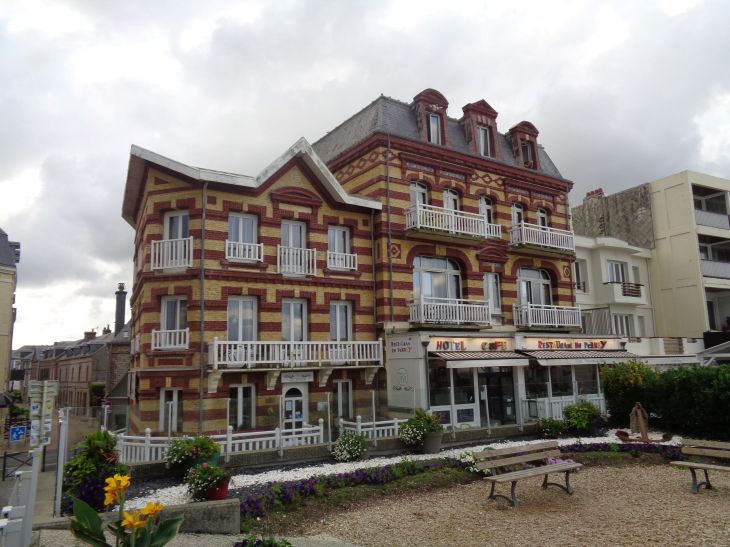
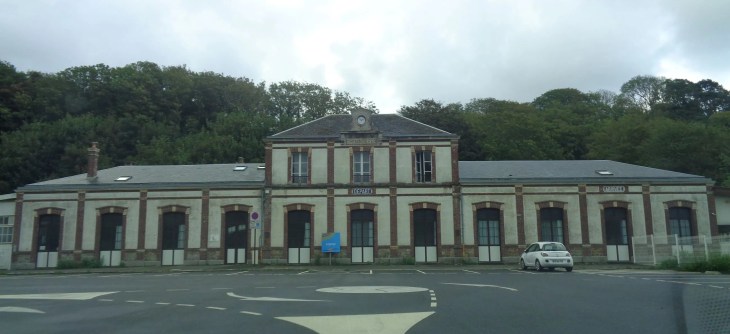
Étretat is located in the Seine-Maritime department 76 in the Normandy region of my belle France. It became a renowned seaside resort in the 19C. Jacques Offenbach or Guy de Maupassant organized parties there for their circles of friends. The white chalk cliffs and grayish pebble beaches have made it one of the places of international tourism. It is 25 km from Le Havre, 70 km from Rouen and the same distance from Caen. It is served by the former RN 40 (current RD 940). Which we took ! Above nice architecture beach hotel/resto. And below the train station or Gare d’Etretat.
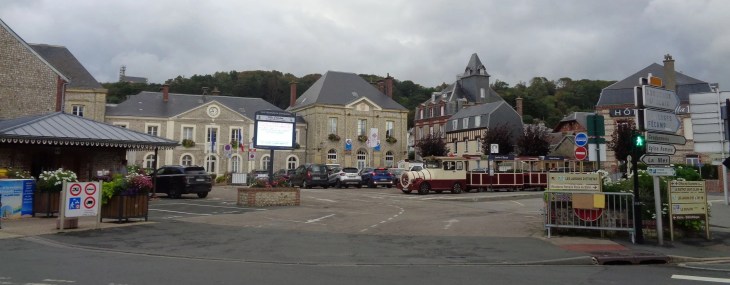
The existence of three successive arches: the Porte d’Amont, the Porte d’Aval and the Porte Manne would not originally be linked to marine erosion, but to the action of an underground river parallel to the beach which would have dug its bed in the cliff before the non-uniform retreat of the latter, materialized by three capes. Erosion on these capes weakened by the internal channel of the river would be the origin of the three arches in turn eroded more or less completely. This rugged rocky coast, in particular these two cliffs which frame the bay, have contributed to the fame of Étretat, The Porte d’Amont is looking to the right if facing the sea. It is a sloping promontory with a low arch. Opposite is the Porte d’Aval, a higher over 80 meters, and more spectacular cliff with its split summit known as the Aiguille. As the visitor approaches Upstream from Downstream, this peak moves until it is partly visible through the arch, Below the Mairie or city hall and the petit train base.
The town of Étretat was under the authority of the Dukes of Normandy in the 10C, before passing under that of the Abbey of Fécamp which established hermitages outside the village, including the church in the 12C and farms. Étretat, more than Fécamp, provided ships to the King of France, Philippe de Valois. Indeed in 1665 under Louis XIV, the beach was placed under his direct protection and became a captaincy with a garrison. The last military authority was Jacques-Nicolas-Joseph-Adam de Grandval who had the Château du Grandval built in 1786, where he died in 1811.
Oysters were delivered overnight to Versailles to be eaten fresh in the morning. Today, the remains of the oyster beds are clearly visible at the bottom of the downstream cliff. In 1777, the Marquis de Belvert, to satisfy the Queen, had the oysters transported by two sloops, “La Syrène” and “La Cauchoise” from the bay of Cancale, after several months of refining in sea salt water and fresh water from the underground river, he sent them to Paris, on donkey or horseback , The site was discovered by Eugène Isabey who came to paint there for six months in 1820. He introduced the place to his friends and to the romantic painters Bonington Paul Huet, Roqueplan… who highlight in their paintings the dark and tragic aspect of storms, shipwrecks and cliffs falling steeply into the sea. In 1831, Eugène Lepoittevin had a studio built there to study the sea. In 1840, the “Manuel de voyage de John Murray”, described Étretat to the attention of English tourists and recommended stopping there on route 18 Havre–Dieppe. Alphonse Karr, author of a successful novel about the city in 1836 Histoire de Romain d’Étretat, will contribute a lot to the launch of the small resort. His novel Histoire de Romain d’Etretat makes known the seaside resort, the quote “If I had to go up the sea to a friend for the first time, it is Etretat that I would choose”, Etretat and its cliffs have always inspired artists and the village is a land of asylum for many tourists but also for personalities who have savored its landscapes, its calm and the serenity which reign there. I will mention the painters who have represented the sea and its changing reflections, cliffs and numerous scenes of life: Claude Monet, Camille Corot, Henri Matisse, Eugène Boudin or Gustave Courbet. Jacques Offenbach, composer, stayed in his villa “Orphée” and livened up Etretat life during festivals sumptuous at the casino or at home. I can cite the writers who have walked the streets or imagined literary adventures in the town: Guy de Maupassant, Gustave Flaubert, Maurice Le blanc and his famous character, Arsène Lupin, and the memorable adventure giving birth to the Hollow Needle, Victor Hugo. Etretat, while crossing time, remains a place of expression both in literature and in painting.
When the road to Fécamp and the road to Le Havre were built. It was with Napoleon III, the Duke of Morny, the Count of Escherny and Lecomte-du Nouÿ that a seaside resort project was started, the first investors of which were musicians from the Paris Opera. It was also at this time that the construction of seaside-style villas began, at an increasingly sustained pace, whereas this was hardly the case before 1830. The village was also rebuilt, as were the villas, with cut flints and bricks. In 1852, a casino of planks and slates opened, under the aegis of the newly created Etretat Sea Baths Company. There are shows such as Orpheus in the Underworld by Jacques Offenbach. This comic opera will give its name to its author’s villa in Étretat. From that time, all those who mattered around the Paris Opera, singers, singers, composers, librettists had a villa built there, Gustave Charpentier, Jean-Baptiste Faure, Ludovic Halévy, Hortense Schneider, Madame Dorus… and commissioned painters to views of the cliffs Parisian society takes the “little train of pleasures” from Gare Saint Lazare to Le Havre on the occasion of the 1869 World’s Fair in Le Havre, where Étretat is praised for its picturesqueness as much by Courbet as by Alexandre Dumas . More and more, the place is taking on the appearance of an international tourist meeting place, stimulated by the celebrity of the cliffs popularized by the paintings of Claude Monet, whose rating has never been so high, and by Gustave Courbet. Finally, a railway line and a station in 1890 will complete the opening up of this already recognized holiday resort.
Étretat became, during the Great War or WWI a rear base and General Hospital No. 1 of the British armies and the Commonwealth, then No. 2 Base Hospital Unit of the American army, to which the 564 graves of the British and American cemetery bear witness today. WWII put a damper on the growth of tourism, and the villas are occupied and looted. Several naval battles took place in front of Étretat. The town was liberated in September 1944 by the Highlanders’ 51st Division (UK),
The villa La Guillette, built on order of Guy de Maupassant; his house, The Villa Orphée, which dominates the bay of Étretat with its view of the downstream cliff, was built for Jacques Offenbach in 1858 thanks to the success of Orphée aux Enfers. Jacques Offenbach organized many receptions there and stayed there many times until his death on October 5, 1880. The Manoir de la Salamandre is a house admired by tourists and located on the main street near the covered market , but on the opposite side. It is one of the oldest buildings in Étretat, but it is a reassembly in the 20C. Indeed, this residence, characteristic of a city dwelling in the Pays d’Auge, was formerly located in Lisieux, Grande Rue, at number 50. It was under the sign of Plantefor cirier. It was dismantled from its original location in 1889 to be rebuilt here, but modifying some elements, for example: a corbelling was added on the gable; the large skylight covered with an essentage of tiles ,and no longer slates, In addition, the name is usurped, because the Manoir de la Salamandre was another dwelling in Lisieux, located in the Rue aux Fèvres, now disappeared . Only a few sculptures are actually imitated from the Manor
The City of Etretat and its painters : https://www.etretat.fr/index.php/Les-personnalit%C3%A9s?idpage=28&afficheMenuContextuel=true
The local Le Havre-Etretat tourist office on Etretat : https://www.lehavre-etretat-tourisme.com/decouvrir/les-incontournables/decouvrir-etretat/
The Seine Maritime dept 76 tourist office on Etretat : https://www.seine-maritime-tourisme.com/en/i-visit/10-key-places/etretat/etretat.php
The Normandy region tourist office on Etretat : https://en.normandie-tourisme.fr/unmissable-sites/etretat/
There you go folks, a dandy town famous for its cliffs ,and a nice beach even with pebbles. This was an eventful find , Etretat, nice , friendly beach town we like it. Again, hope you enjoy the post as I
And remember, happy travels, good health, and many cheers to all !!!

 Paris1972-Versailles2003