
Again on my road warrior mode, we set out to new territories ! Well not per se but this time we were in town and saw many things which will share over the coming posts in my blog, We first came to Fécamp, and it was a blast !! We will be back for more for sure, eventually, As you know there is so much to see in my belle France, Let me tell you about a jewel of our time, the abbatiale de la Sainte Trinité of Fécamp, part I !!! Hope you enjoy the post as I.
As you know, Fécamp is located in the Seine-Maritime department 76 in the Normandy region of my belle France.
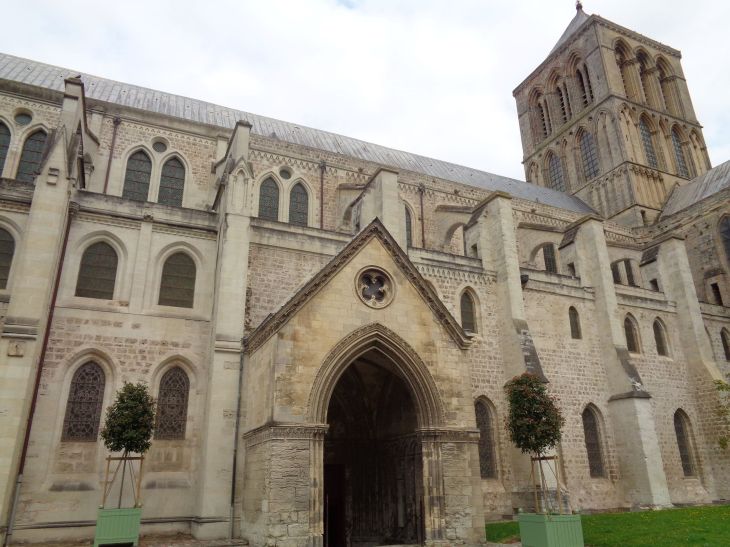
The Abbatiale de la Sainte Trinité or Abbey of the Trinity of Fécamp is a Benedictine abbey built within the walls of the castle of the Dukes of Normandy. In a primitive Gothic style with a few Romanesque chapels, it is also a ducal necropolis and a center of the Precious Blood pilgrimage. The abbey was born during the great wave of monastic settlements in Normandy which dotted the 7C. The construction of the sanctuary began around 658 around the relic of the Precious Blood, entrusted according to legend to the sea by Isaac, son of Joseph of Arimathea, and miraculously washed up on the beaches of the Pays de Caux. It was the work of Waneng, Count of Caux, who decided with the help of Wandrille and Ouen to create in Fécamp a monastery of nuns, placed under the rule of Saint-Benoît, and according to the texts of the 9C on one of Waneng’s estates. In 665, the first abbey was dedicated with Hildemarque du Bordelais as the first abbess.
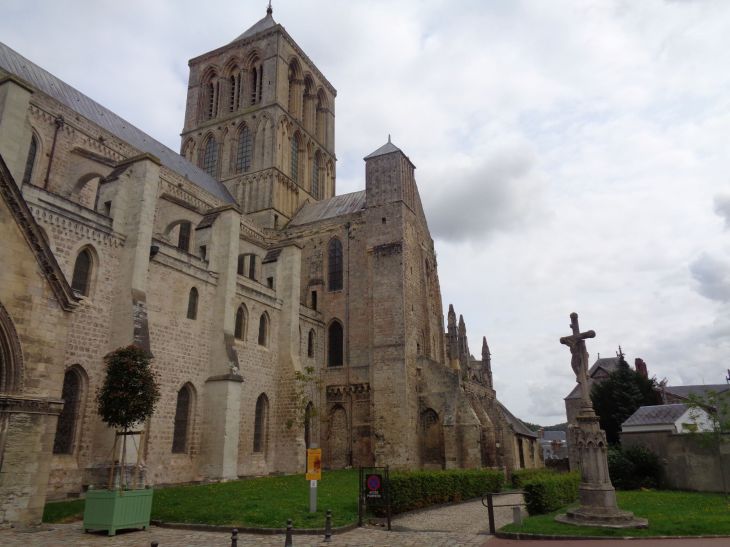

From the 9C, the first Viking raids began, and the abbey was devastated in May 841. The nuns abandoned the abbey in the last quarter of the 9C. They transferred the relics of Saint Waneng to Ham. Duke Richard II of Normandy transformed the collegiate church into a Benedictine abbey for men in 1001 ,however, nothing remains of this church, there are texts that survived the dispersion of the abbey’s library in 1789. The Saint-Sauveur altar would have was located on the floor of the abbey while the Saint-Taurin altar and the tomb of Guillaume de Volpiano were located in a crypt under the church. The abbey is the place of celebration in 1002 of the marriage of Æthelred II of England with Emma of Normandy, and of the remarriage of this one in 1017 with Knut II of Denmark. Guillaume de Rots, third abbot of Fécamp launched between 1087 and 1099 the reconstruction of the abbey. He destroys the choir and enlarges it in width and length and develops the nave. The ambulatory opened onto five chapels, alternately quadrangular and semi-circular.

In 1649, to restore the discipline which over time and the misfortune of the wars had greatly diminished in the abbey although it was once one of the most famous abbeys in the Kingdom, the commendatory abbot, Henri de Bourbon-Verneuil, son of King Henri IV and Bishop of Metz estimated, with the agreement of the King and the Holy See, that the most effective way is to unite it and incorporate it into the Congregation of Saint-Maur, to place it under the conduct of General Chapters and elected visitors. On November 2, 1790, the National Assembly declared all the property of the clergy acquired by the Nation and gave religious freedom to leave the cloisters. During the French revolution on January 11, 1791, at the Hôtel de Ville, before the municipal body and the mayor, the monks of the abbey of la Sainte Trinité de Fécamp appeared. On May 27, 1791, the churches of Fécamp were abolished except for the Saint-Étienne Church and the Abbey Church of the Holy Trinity, which took the name of the Church of the Trinity and to which eight parishes were added, On March 22, 1792, the town bought the abbey dwelling to establish the municipal office there. It was demolished in 1857. On September 20, 1792, the monastic buildings were sold to citizen Leplay. On December 11, 1792, the church was transformed into a Temple of Reason where the festival of reason took place. There remains only the choir for the exercise of worship. The Catholic worship is suppressed, there is a lot of destruction, statues, bells, pulpit, stone and metal crosses, the iron gates are dismantled, the rood screen which hides the choir is demolished. Finally , in 2007, a major restoration project begins that will last three years. The same year saw serious damage to the tabernacle housing the Precious Blood, the head of the Virgin present on the right acroterion being broken. On the night of June 1 to 2, 2022, criminals entered the abbey church and stole part of the treasure kept in a piece of furniture in the sacristy, including the reliquary of the Precious Blood. This relic discovered on July 19, 1170, would contain the blood of Jesus Christ, collected by Nicodemus.The legendary story of the Precious Blood of Fécamp took its definitive form following the discovery on July 19, 1171 of two lead cases containing particles of Christ’s blood. The first pilgrimages and accounts of miracles date from the end of the 12C. After a period of decline, the pilgrimage experienced a new success under the Second Empire. The Brotherhood of the Precious Blood was officially founded in 1906.


The Abbatiale de la Sainte Trinité or the Abbey of the Trinity of Fécamp, by its size and the richness of the details of its architecture and its decoration is one of the most curious monuments of the French Middle Ages. Its massive mass at 127 meters in length is larger than many cathedrals. Although as a whole it belongs to the primitive Gothic style, there are also Romanesque parts, chapels in flowery Gothic from the end of the 13C, a chapel of the Virgin in Flamboyant Gothic, which forms, according to Norman usage, a independent building in the extension of the church, Italian marbles and enclosures of the Renaissance, decorations of the 17C. Finally, the Louis XV style has left its mark on the facade clad against the Gothic nave and especially in the choir, with marble coverings trimmed with gilded bronze sconces, the altar and its bold canopy.

In the Chapel of the Virgin , there are 13C stained glass windows, three figures of Apostles under niches, accompanied by grisaille which are probably the oldest Norman stained glass windows with isolated figures. Three windows with small scenes are from more recent times, the best preserved of which is a Life of Saint Catherine with trefoil compartments, of a very small and graceful execution with English, Picardy or northern French influences. 14C art is represented by three incomplete stained glass windows at the back of the Chapel of the Virgin: a Legend of Saint Edward the Confessor where we find the subjects of the marriage of Edward and Edith with their vow of chastity, the reconstruction of Westminster Abbey, miracles of healing, acts of charity and the ring given by the king to Saint John the Evangelist. The Life of Saint-Louis from around 1310 is incomplete with eleven scenes including the giving of the crown of thorns to a bishop, the episodes of the king’s captivity and death, another canopy shows a holy hermit and a lion . From the 15C, only one very beautiful glass roof remains in the Saint André Chapel with the Virgin, Christ, Saint Peter and Saint John the Evangelist under richly decorated architectures. The style is from around 1450. In the 16C, the work of Arnoult of Nijmegen is present in three high windows of the choir showing the Trinity, Saint Suzanne and Saint Taurin, secondary patrons of the abbey which keeps the relics. They are from the Renaissance around 1510-1512 , An incomplete Trinity is in the Chapel of the Virgin and other smaller, more recent panels bear the arms of Cardinal Bohier, Cardinal de Lorraine and Archbishop François de Joyeuse. 18C panels bear the arms of the Becdelièvre family.
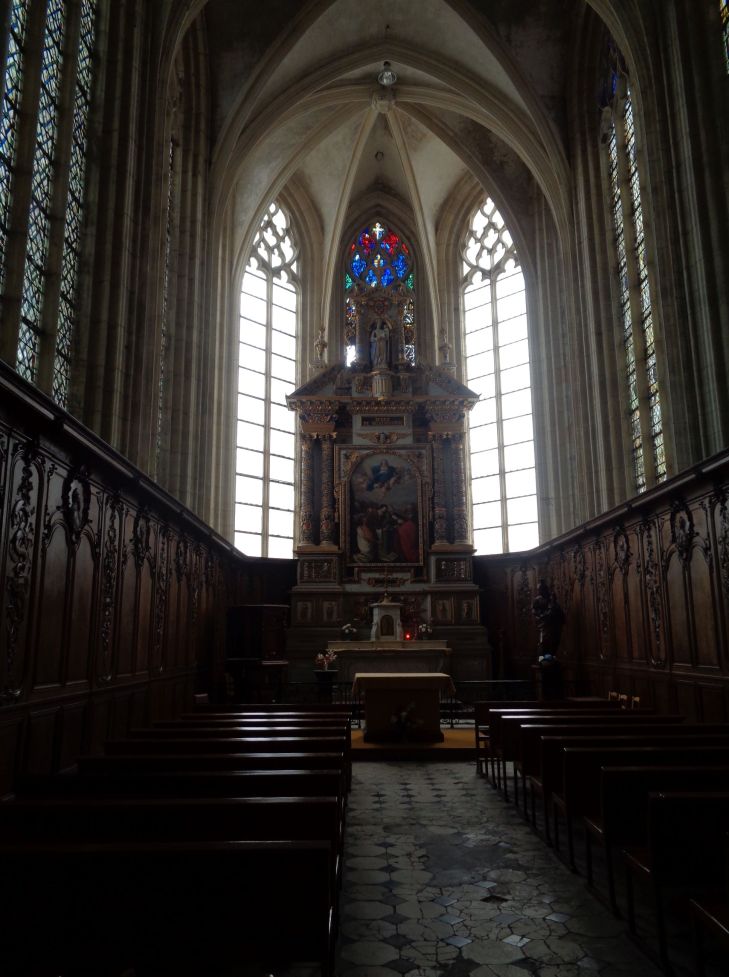
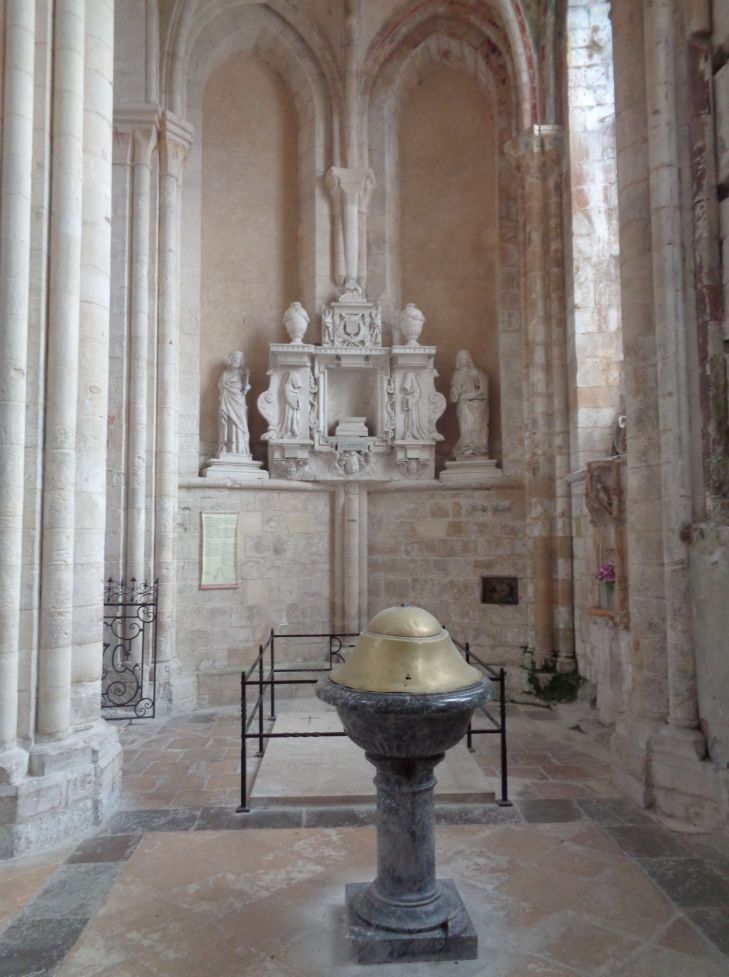
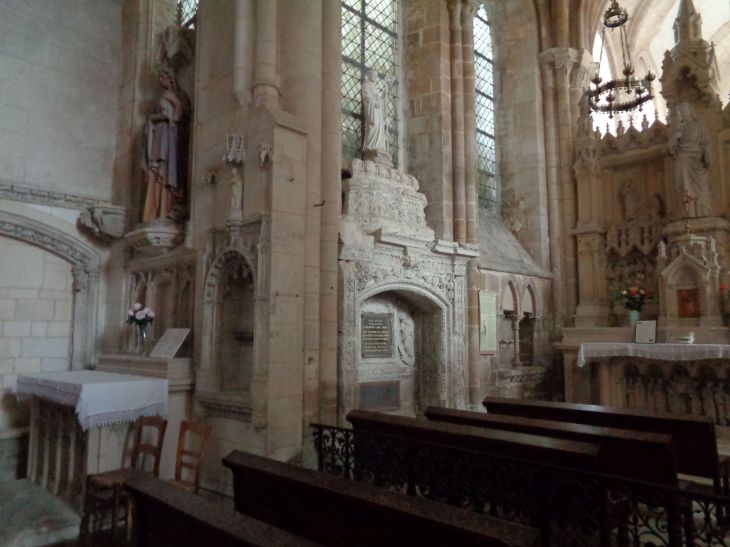
In the Chapel of Fonts, in the south arm of the transept, lie under a slab, the bodies of the Dukes of Normandy Richard I and Richard II. Alain III of Brittany, grandson of Richard I, was also buried in 1040 in the chapter house of the abbey. The 21st Abbot Estold d’Estouteville, 23rd Abbot Jehan de la Haule, buried in the nave of the abbey church. The Chapel of the Sacred Heart houses the mausoleum of Guillaume de Volpiano, first abbot of Fécamp as well as the last monk of the abbey, Dom Louis-Ambroise Blandin.
The city of Fécamp on the abbey: https://www.fecampclick.fr/trinite.html
The Fécamp tourist office on the abbey: https://en.fecamptourisme.com/experiences/our-must-haves/the-abbey-of-the-holy-trinity/
The Normandy abbeys on the abbey of Fécamp: https://www.abbayes-normandie.com/abbaye/abbatiale-de-la-sainte-trinite-de-fecamp/
There you go folks, a hugely must to visit in Fécamp and it was our first stop parking by the Place du Général Leclerc. One of the wonders of my belle France; indeed the abbey is beautiful. Again, hope you enjoy this post on the Abbey of the Holy Trinity of Fécamp, part I as I
And remember, happy travels, good health, and many cheers to all !!!

 Paris1972-Versailles2003