
Let me bring you back to my beloved and former home of Versailles. One can never be too far from it and that includes me. We simply love it, mind you not just the castle museum but the town in its whole! I like to update this older post for you and me ! One buildings quite related to the palace yet apart ; the Grand Commun. The building is much less known but equally important in the history of Versailles and France, at least… Hope you enjoy the post as I.

The Grand Commun, or as its official name the Grand Quarré des Offices-Commun , is a building located at 1, rue de l’independence-American and corner of Rue des Recollets. Built between 1682 and 1684 by Jules Hardouin-Mansart on the site of the former church of Saint-Julien, the building housed the kitchens and the tables of the officers who served the courtyard of the Château de Versailles, as well as rooms for the courtesans. This building took many years of renovations and now is splendid, do stop by.
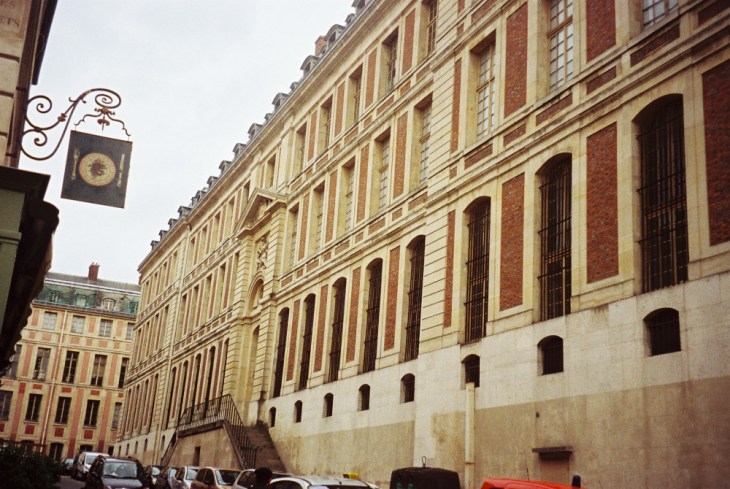
The building is organized around an inner courtyard. By conducting excavations in the courtyard of the Grand Commun in 2009, a team from the National Institute of Preventive Archaeological Research (INRAP) exhumed the remains of the Jeu de Paume game or palm/tennis game of king Louis XIII, built in 1630 as well as vestiges of the enclosure of its castle, and, under further again, a cemetery of the high middle ages, probably in connection with the church. The palm/tennis game or Jeu de Paume room comes in the form of a large rectangular building of 33 meters long by 14 meters wide with lateral walls of 1.30 meters thick. The presence of three galleries indicates that it is an indoor game. The floor is covered with stone-sized tiles and probably preceded by a terracotta tile floor. The house of the paumier (the one who maintains, manages and animates the playroom) was also found.

Manufacture of arms under the French revolution, the Grand Commun sheltered from 1843 a military hospital then became military hospital Dominique Larrey. Since 2015, various services of the Château de Versailles (DRH, conservation, staff changing rooms, research center of the Château de Versailles) are installed there since 2004 as of today. It is interested in research and training on the places and expressions of power in the 17C and 18C. Of course this is not visited now, and photos not allowed inside, but I had the opportunity to see the jeu de paume section while excavations were going on as I am a Friends of the Château de Versailles since 2004 !

As I am a lover amateur of history in my belle France, got me a book in my library that translated to show how it came to be build this Grand Commun and thought a must to include in this post. Enjoy it!!
The princely apartments were added to those of the King and Queen, there was still little room for other great lords. The latter were content with a few garrets. The growing affection that Louis XIV for his castle inspired even new constructions, In May 1665, the building was considered completed. However, the festivals of 1664 and 1668 were only the beginnings of a great upheaval. Indeed, the narrowness of the premises prevented the King from bringing together a large court and his servants as he wished. He enlarged the castle by doubling the surface area, on the garden side, of the south, west and north parts. But as in the time of Louis XIII, the builders had the greatest difficulty in imposing a functional building and above all more in line with current tastes. Between October 1668 and 1670, Le Vau’s project evolved significantly to reach its final state. Since its first elevation, the castle had developed with difficulty, as if limited by invisible limits. This time, the project took on a completely different scale. Then, during the month of June 1669, the project underwent a profound turnaround because the sovereign no longer only wanted to house his family: he was thinking of apartments reserved for holders of great offices. Likewise, the increasingly prolonged presence of the Court made it necessary to build real royal apartments for the sovereigns so that Louis XIV would impose Court ceremonial.
Colbert underlined the lack of space and the pharaonic works that would have had to be undertaken to satisfy the royal demand. Despite some criticism, it was Louis Le Vau who obtained royal assent. It preserves everything that was done. The new main buildings which fitted into the original castle took the name “Château-neuf” as opposed to the residence on the courtyard side now known as “Château-vieux”. The apartments of the king and queen were to be spread out to the north and south with a guard room, an antechamber, a large bedroom and a large cabinet.
At the same time, four large pavilions had to be built on the forecourt to house his secretaries of state. With the arrival of Mansart from 1676, the residence quickly took on a larger scale. In the obsession of housing as many people as possible in the castle or in the town, the king’s first architect tackled simultaneously the palace itself by creating the large South wing but also peripheral buildings such as the Grande and the Petite Ecurie or the Kennel. The reception capacity was far from negligible: up to 400 people at the Grande Ecurie and as many in the Petite and 200 people at the Hôtel du Chenil. The wing that was built to the south was renamed “Aile des Princes” when a symmetrical construction to the north was decided.
But as soon as the court was finally established in Versailles in 1682, the decision was made to build an important office building on the territory of the ancient town of Versailles. The old Saint-Julien parish church was destroyed to make way for the Grand Commun. Voilà !!!
The official CRCV centre recherche du Château de Versailles: https://chateauversailles-recherche.fr/english
The Château de Versailles Research Center: https://chateauversailles-recherche.fr/francais/le-centre
The Château de Versailles on the Grand Commun: https://en.chateauversailles.fr/discover/estate/palace/grand-commun
There you go folks, a wonderful building of glorius royal Versailles, unique in my belle France. The Grand Commun, history and architecture all for the better and the enjoyment of all. Again, hope you enjoy the post as I.
And remember, happy travels, good health, and many cheers to all !!!

 Paris1972-Versailles2003