Another of my favorite regions of my belle France, this is the new
Occitanie that is really very old… I found me some paper photos of old , older road warrior trips and decided to put them in my blog. After all, this is my life’s story and like to share it with the world. Therefore, here are some
curiosities of Occitanie, part I !!! Hope you enjoy the post as I
Lourdes is located in the Hautes-Pyrénées department, 65 in the Occitanie region. Located at the foot of the Pyrenees, in the historic region of Bigorre, on the Gave de Pau. The sanctuary is located at the exit of the city following the Gave de Pau. The origin of the city of Lourdes is certainly illustrated by a legend. However, it should be noted that this only dates back to 1118. It is a chronicle of the Irish monk, Marfin, and rediscovered in the 17C. In France and internationally, Lourdes is the Marian city par excellence. It is a world center of pilgrimages whose history began in February 1858,
In 1858,
Bernadette Soubirous said that a White Lady presented to her saying “I am the Immaculate Conception”, which is considered to be a designation of the Virgin Mary identified with her own conception appeared to her several times in the small
cave of Massabielle, bordering the Gave de Pau to the west of the city, Work on the sanctuary began the same year. A first chapel was replaced by the
Basilica of the Immaculate Conception below which the
Basilica of Our Lady of the Rosary was then built to accommodate the growing number of pilgrims. They are both located above the cave.
The site of the sanctuary covers 52 hectares, its center is the Grotto of Massabielle and the Basilica of Our Lady of the Rosary completed in 1889, overlooked by the Basilica of the Immaculate Conception. The huge Basilica of St. Pius X, inaugurated in 1958, is built entirely of concrete and extends even further underground. The Marian shrine welcomes several million pilgrims each year. The last building built is the Sainte-Bernadette Church.
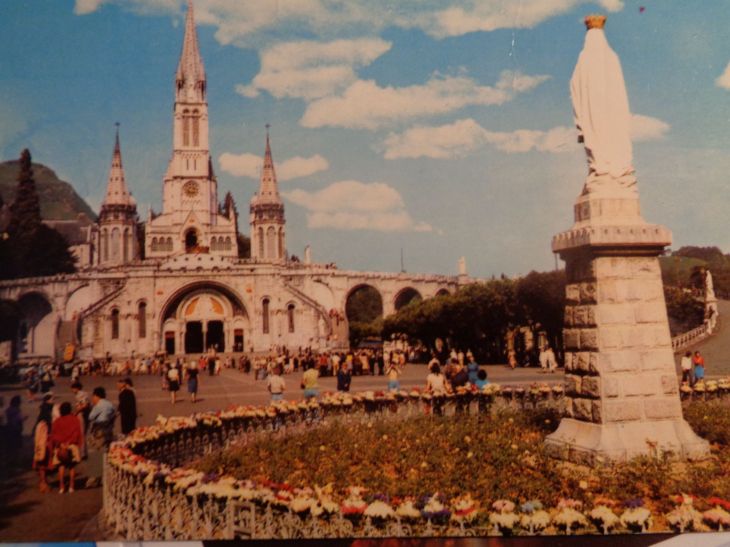 Other things to see are the Pyrenean Museum established within the walls of the castle, The fortified castle of Lourdes, in turn the main residence of the Count of Bigorre in the 11-12C, passing from hand to hand in the 13-14C, royal prison in the 17-18C, then Pyrenean Museum (arts and popular traditions of the Pyrenees) from 1921. The Nativity Museum: nativity scenes animated by sound and light, The Lourdes Museum: evoking the history of Lourdes from 1858 to the present day, The Wax Museum: 18 scenes and 100 wax figures, The Musée du Petit Lourdes: walk in the middle of nature around a miniature Lourdes in the year 1858. The House of Bernadette and family sites of Soubirous. At the Bernadette Museum, a diorama of 18 scenes presents the life of Bernadette Soubirous and the story of the apparitions. The small place of Marcadal, at the entrance of the rue de la Grotte and in the heart of the city is always animated, it is marked by the presence of a monumental fountain ,The parish Church of the Sacred Heart. The construction of this parish church in neo-Romanesque style, The church holds since July 13, 2011 a relic of Blessed John Paul II which was sent to it by the Holy See. It is a fragment of the cassock that the former Pope wore during the assassination attack of May 13, 1981.
The
city of Lourdes and its history:
https://www.lourdes.fr/lourdes/presentation
The
Lourdes tourist office on the sanctuary:
https://www.lourdes-infotourisme.com/explorer/vivre-une-experience-spirituelle/
The town of Moissac is located in the Tarn-et-Garonne 82 department in the Occitanie region. The town is known as the “city of Chasselas”, named after the table grape originating from the village of Chasselas (Saône-et-Loire); the production in AOC “chasselas de Moissac”, is practiced by the farmers of the canton. During WWII, Moissac was a refuge for the large community of Israelite Scouts of France (EIF). The latter, lodged at the Moulin de Moissac, or for the youngest at the Maison des enfants de Moissac, remained there during the war thanks, among other things, to the benevolence of the municipal authorities and the population , Ten inhabitants of Moissac were honored as Righteous among the nations
St. Peter’s Church, former abbey church with the portal from 1130, one of the masterpieces of Romanesque sculpture. Of the 11C church, all that remains is the massive bell tower-porch, a kind of keep with a walkway, built for defensive purposes but whose top floor only dates from the end of the Gothic period. Cloister late 11C, one of the best preserved in the Christian West.
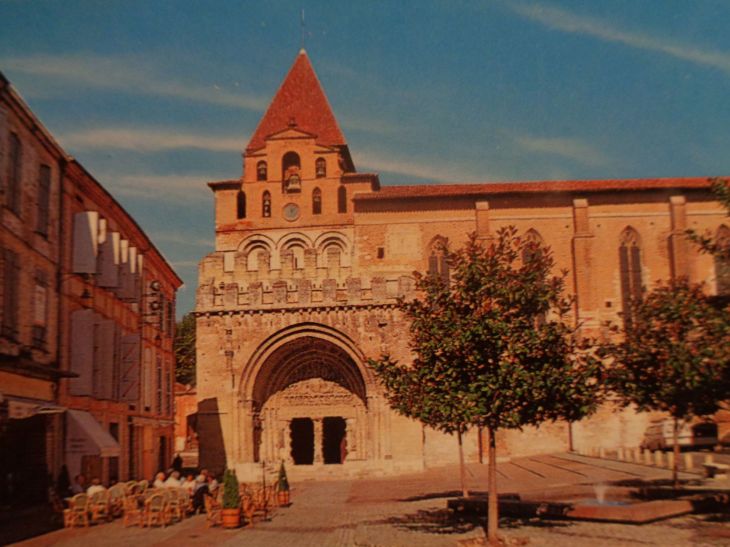 Other things to see here are : The Saint-Martin Church, The Saint-Julien Church, The Saint-Jacques Church, The 356 meters long, Cacor canal bridge allows the side channel of the Garonne to cross the Tarn, just outside Moissac, The Moissagais Museum is housed in the former Abbots’ House, an imposing building flanked by a crenellated 13C brick tower. Two maps show the influence of the abbey in the Middle Ages. The Napoleon bridge: decided by Napoleon I and finished by Napoleon III, we have a view of the quays and the Saint-Jacques bridge , Moissac is one of the few towns on the Via Podiensis where we find mention of a brotherhood of Saint Jacques. This association appears late, in 1523.
The
official Abbey Church of Moissac:
http://www.abbayemoissac.com/en
The
Moissac tourist office on the abbey church:
https://tourisme-moissac-terresdesconfluences.fr/fr/decouvrir/nos-incontournables/moissac-abbaye-et-cloitre-art-deco
The town of
Montesquieu-Volvestre is located in the
Haute-Garonne department 31 in the
Occitanie region. It is located 47 km from Toulouse . A Bastide, created in 1238 by the Count of Toulouse, Raymond VII, who decided to establish a new city in a loop of the Arize. From the Middle Ages until its disappearance in 1790 during the French revolution,
Montesquieu-Volvestre was part of the Diocese of Rieux. The architectural heritage of the town includes two buildings, the Château de Palays, and the
Saint-Victor Church
The
Saint-Victor Church dating from the 13C. The massive fortified brick facade reminds us that the church, a place of meditation, was also part of the city’s defense system. Its 32-meter bell tower with 16 sides, lit on the three upper floors by Gothic openings, is extremely rare. It has rich furniture, an entombment carved in stone (15C), a Baroque altarpiece and paintings, including the Deposition from the Cross by Girodet (18C).
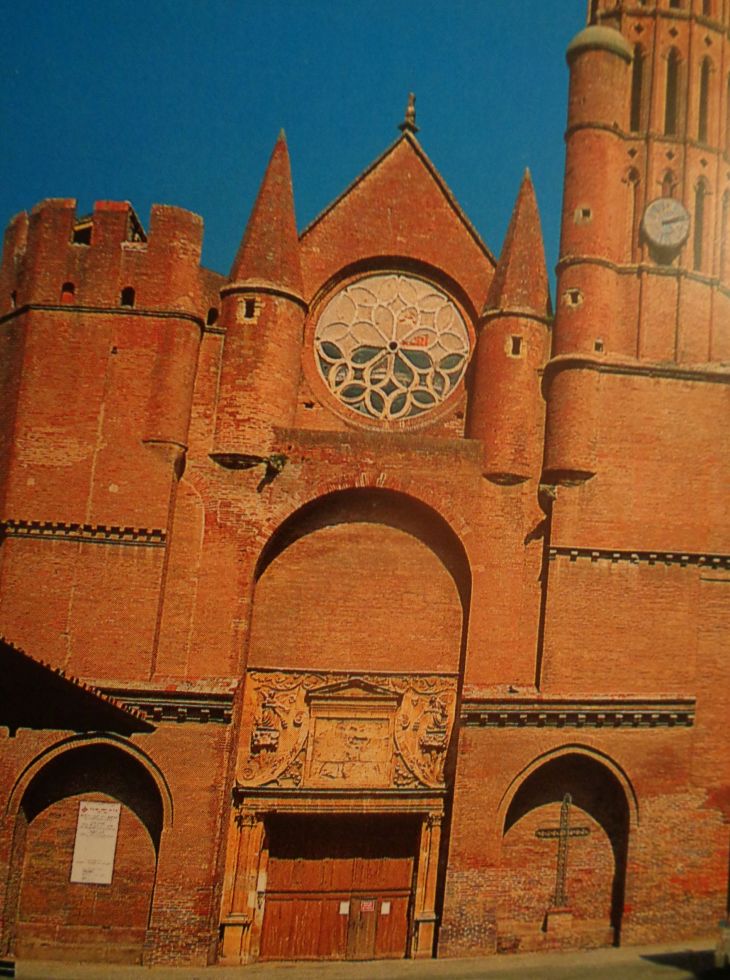
Other things to see here are the Moulin sur l’Arize Moulin de Barrau (15-18C) one of the few mills still in operation , The Château de Palays 13C at the confluence of the Arize and Pas-du-Rat rivers (private),
The
town of Montesquieu Volvestre on its heritage:
https://www.montesquieu-volvestre.com/presentation-de-montesquieu-volvestre
The
local Volvestre area tourist office on the church:
https://tourisme.volvestre.fr/contenu-tourinsoft/eglise-saint-victor/
There you go folks, another dandy road warrior trip in my belle France and gorgeous Occitanie region, And thanks for reading along my escapades, Again, hope you enjoy the post on curiosities of Occitanie,part I !!! as I.
And remember, happy travels, good health, and many cheers to all !!!
Published by pedmar10
I am a lover of travels to Europe , Americas , Africa and Asia as well ,who like to share my experiences of the last 53 years with the world, visiting so far 81 countries; living in 6, working in 5, and Citizen of 4, speaking fluently 4 languages. I can deal with sports especially football/soccer and love music, arts, wine collector/drinker, and go out to restaurants, and just visit the world.
My background comes all the way from Candelaria and Pajara in Tenerife, Spain where my grandparents came from ;not knowing each other then, to Punta Brava, west of Havana, Cuba. There , my parents born in Cuba met and later on I was born there too. 100% guanche (annexed Tenerife to Spain on April 10 ,1496). I left Cuba as many have to Madrid, Spain where I lived for 4 years. Then, move to Perth Amboy ,New Jersey USA (living there 13 yrs) ; where I completed high school, became a US Citizen, learned to drive a car, and learned English. Afterward, went to the university in Florida, ERAU, and upon graduation decided to moved there to Ormond by the Sea, near Daytona Beach, finally moving North Miami, then Hialeah, then another moved to Silver Lakes division in Miramar, Broward county, Florida; in Florida I lived a total of 18 years. Finally , moved to France in 2003 ,Versailles call me for its royalty, and working in Paris was great. It was time to seek frontiers again and moved to Brech near Auray, Morbihan in Brittany , and later move to not too far Pluvigner. Total so far in France has been 20 years, and counting.
Moving average a home every 5.5 years hopefully this will be my last. Cheers
All rights reserved. No part of this blog may be reproduced or transmitted in any form or by any means or stored in a retrieval system of any nature, without the written permission of the copyright holder, me. No part of this work may be modified, without the written permission of the holder, me.No part of this work may be exposed to public view in any form or by any means, without identifying the holder as the author, and with the before mentioned permission.
View all posts by pedmar10


 Paris1972-Versailles2003
I really like these old pictures. Real film?
LikeLiked by 1 person
Glossy paper pics
LikeLiked by 1 person