
And I really need to update this one in my blog. It was my first entry on the magnificent Chambord ,and I chose a historical subject that was not to be. France today has no king but it wasn’t because of the revolution, many came after, it was by a men’s decision of traditions. Let me tell you again on the Domaine National de Chambord ,part II !!! Hope you enjoy the post as I.
Chambord is a wonderful huge castle in the Loire region Centre-Val de Loire. Departmet Loire-et-Cher no. 41. It is only 14 km east of Blois, 47 km southwest of Orleans, and 164 km south of Paris (about 101 miles). It is about 381 km from my house. From Paris, exit or sortie 16 of the expressway A10 (on the road to Bordeaux) will put you at 14 km from the castle. With its 5 550 hectares and 32 km of walls, Chambord is the largest enclosed park in Europe. It has not less than 426 rooms and 282 chimneys!
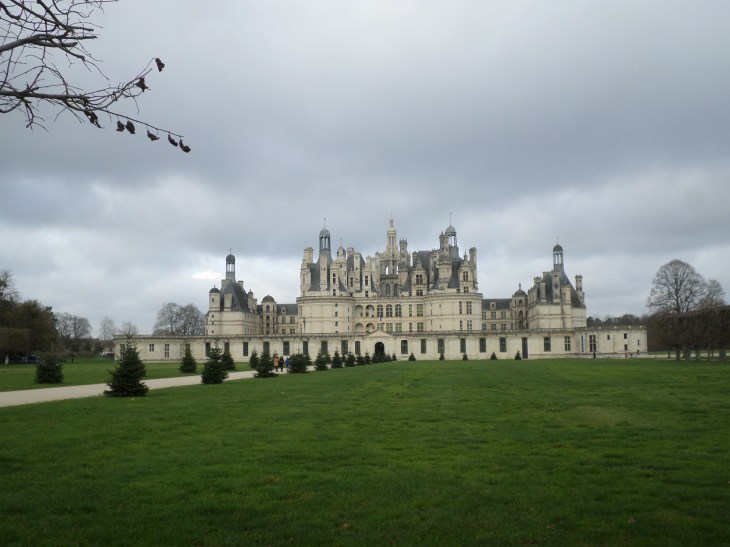
A bit of history I like tell us that in 1519, François I started not far from Blois in the middle of a desert with trees and marshes on a semi abandoned village a huge project. Victor of the battle of Marignan, the young king intends to seduce by stones as he seduce by arms. It’s time to dazzle the world by a new and perfect work. Chambord was the first castle of François I entirely done from scratch.
On the northern front you see what a looks like a military fortress surrounded by towers. During its construction François I visited 14 times!!! The towers give a impregnable view over the gardens and forest, great for the second vocation that of hunting. Coming out of the staircase to the top you see a lantern that is not inhabited but serve as lookout and has a fleur de lys the symbol of French royalty. On the southern front you see a lower cercle base where to see the garden at eye level. Here you see the donjon tower coming to the royal wing as a refuge and passing into the forest by the king. It has 156 meters (about 515 feet) of façade and inside a wonderful staircase.
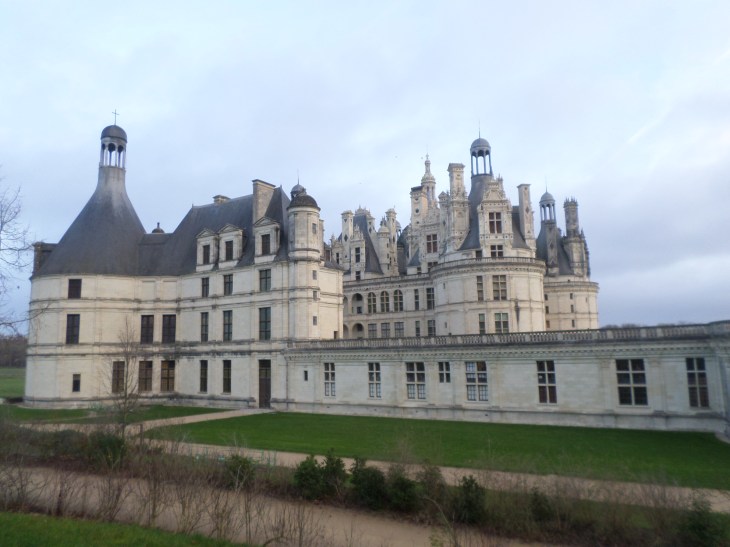
François I died in 1547, with finally only passing 72 nights in the castle in 32 years of reign. Work continue under Henri II but he ,also, died in 1559, consolidation work is still done in 1566 under Charles IX. Far from the court, Henri III and Henri IV do not lived in the castle. Louis XIII only spent two nights in the castle, and from 1639, the castle is only occupied by the brother of the exile king Gaston d’Orléans. We need to wait until the coming of Louis XIV to finished the project of François I;giving the work to famous architect Jules Hardouin-Mansard. Louis XIV stayed only 9 times here , first in 1650 and then lastly in 1685 (company of Madame de Maintenon) ; coming each time on the occasion of the play by Moliére, Monsieur de Pourceaugnac and le Bourgeois gentilhomme.
The king Louix XV used the castle to welcome host the father-in-law Stanislas Leszczynski, king of Poland in exile between 1725 and 1733. By then, the king of Poland leaves for its final place in Nancy. The castle stays uninhabited for many years until 1745, Louis XV gives it as donation to the Maréchal de Saxe that becomes governor for life and lives there permanently since 1748 until his death in 1750. After, the later passing, the castle is lived by the governors like his nephew Von Friesen died there in 1755, then the marquis de Saumery until 1779, and the marquis de Polignac chase out by the French revolution in 1790. After much destruction by the revolutionaries, the castle is in very bad shape by 1796 but still standing.
By July 1802 the first consul Napoléon Bonaparte gives the castle to the legionnaire that after two years finally comes to lived here ,General Augereau. Finding the castle totally deliberated and begins a period of renovation. Under the emperor Napoléon I, it was decided to use it as a school for girls of the legion of honor guard in 1805 but the decision was not followed. The castle comes into the legion of honor guards and rename the principality of Wagram and given in 1809 to the maréchal Louis-Alexandre Berthier, prince of Neuchâtel and Wagram; he comes only one time to the castle! in 1810. Upon his death in 1815, the castle was put up for sale by his widow not able to keep up with the costs.
In 1821, the castle is acquired by national subscription sale to the young Henri d’Artois, duke of Bordeaux, upon the death of Charles X, the prince is the chief of the senior branch of the house of Bourbons and takes in exile the courtesy title of Count of Chambord. He continues from afar to invest money for the renovation of the castle. During his period , the castle is open to the public. During the Franco-Prussian war of 1870, the castle served as a hospital and in 1871 the Count of Chambord lived briefly. He calls upon the French to bring the monarchy back under the white flag of the French monarchy; (bad decision the representatives wanted a constitutional monarchy similar to that of the UK). Upon his death in 1883, the castle passes to the descendants prince Bourbon Parma and nephews Robert I of Parma, Duke of Parma and Plaisance, and his brother Henri de Bourbon-Parma count of Bardi. Upon the death of the latter in 1907, it passes to his son Elie de Bourbon duke of Parma and Plaisance.

With financial situation the castle passes to the French State on April 13, 1930 after been used during WWI by the government. From the beginning of WWII the castle becomes the center of tri of the treasures of the national museums of Paris and the north of France to be evacuated and protected from the bombings of the Nazis. After the war, the objects of arts are re send back to their original places most of it to the Louvre museum.
You should not miss from the visit the audiovisual room (film presentation), the double revolution staircase, the apartments of François I and Louis XIV, the carved arches of the second floor, the terraces, and the North parterre garden at minimum. Chambord is originally dedicated to the arts. The Moliére’s Le Bourgeois Gentilhomme was played for the first time before Louis XIV in 1670! It, also, offers many nature activities in the park, like horse show, carriage ride, visit of reserves in a 4X4 vehicule , visit on foot or by bike etc. Today still open to the public the castle or domaine national de Chambord covers 5 440 hectares of which 1 000 hectares are open to the public, also, the biggest forest enclosed park of Europe. A marvel of our times and much needed to be visited while in France.
The Chambord castle practical information can be translated to several languages, time and prices can change so check the official site Chambord.org . Parking is 6€ per day the closest to the castle. Food inside at the Café d’Orléans is very nice for simple sandwiches snacks etc and soft drinks. The Café des écuries outside is very nice and can see the castle with good views. On the Village square approaching the castle you have several eateries as well and shops. There is a nice boutique inside by the entrance with all the trimmings including food local product, and there is the La maison des vins de Cheverny, very good for tasting and buying the local wines that are good and good prices. You can ,also, rent cottages just inside and at the door of the castle very nice; not use them but they look good.
The official Domaine National of Chambord: https://www.chambord.org/en/discovering/the-castle-visit/
The local Blois-Chambord tourist office on the castle: https://www.bloischambord.co.uk/discover-the-destination/the-loire-valley-castles/chateau-de-chambord/
The Val de Loire dept 41 tourist office on Chambord: https://www.val-de-loire-41.com/les-4-destinations/la-vallee-de-la-loire/le-chateau-de-chambord/
There you go folks, another dandy in my belle France and one of the must to visit here, me think. Again, hope you enjoy this post on the Domaine National de Chambord ,part II !!! as I.
And remember, happy travels, good health, and many cheers to all !!!

 Paris1972-Versailles2003