So this is a very popular spot in my eternal
Paris. It seems the world convenes here after a long walk along the
Ave de Champs Elysées or the
Rue de Rivoli! I was lucky enough to even worked just around the corner from it and walk to work from the
Gare Saint Lazare passing close and seeing it every day for almost 9 years! Of course, I have told you about it before but this is new text , more history and new photos not in my blog yet. Therefore, let me tell you a bit more on
the Place de la Concorde of Paris, part II !!! Hope you enjoy it as I
.
Well this is the most famous square in
Paris. It started out named “Place Louis XV” in 1763. Later named “Place de la Révolution” during the period of terror in the French revolution, and finally took the name of the
“Place de la Concorde” in 1795, to mark the reconciliation of a Nation. Again, it was re-named “Place Louis XV” in 1814, and further “Place Louis XVI” in 1826. It was not until the reign of king of the French Louis-Philippe in 1830, that it takes the current name for good of the
“Place de la Concorde”. As Concord or harmony of a nation.
All roads lead you here, I used to work for many years not far close, and use the metro
Concorde on bad weather when not walking by it to work. Sublime! Public transport passing by here or close are
bus lines 17, 18, 20, 21, 22, 24, 26, 27, and 28.
Metro stations Concorde- Line 1 | station Balard -Line 8 | station Porte de la Chapelle / Mairie d’Issy – Line 12. The Concord square or plaza de la Concordia or
place de la Concorde is sublime , beautiful ,romantic ,what
Paris is all about!!!
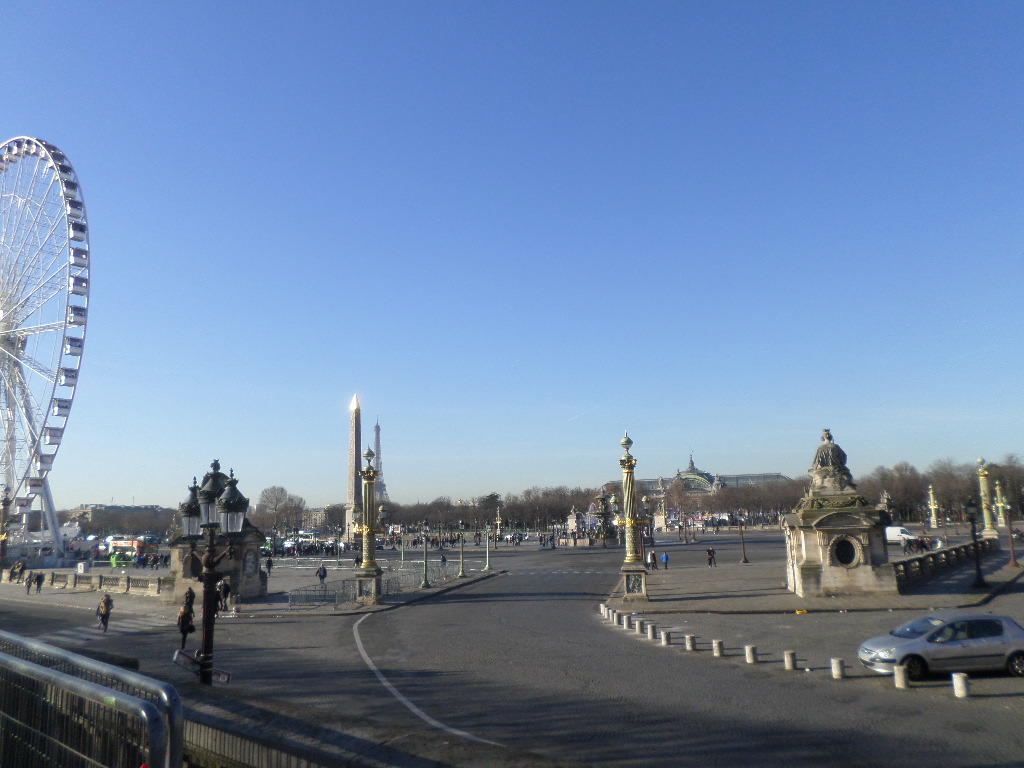
A bit more on the history I like and brief description tell us that the
Place de la Concorde was created between 1755 and 1775, on the initiative of King Louis XV!. King of the French Louis Philippe, under the July Monarchy, asked in 1839 to rearrange it. The two fountains in the
Place de la Concorde, inspired by those of Saint-Pierre in Rome, were installed between 1835 and 1840 at the request of King Louis Philippe. The maritime fountain on the side of the Seine and the Fluvial fountain on the rue Royale side. The
Tuileries Garden extends from the
Louvre Palace (east) to the
Place de la Concorde (west), it is bordered to the north by the
rue de Rivoli, the Place des Pyramides and to the south by the Seine river. The
Arc du Carrousel, built in 1806 in the Carrousel garden, marks the entrance to the Tuileries garden. The
Tuileries Palace which closed the Louvre on its west side was burnt down during the Commune(communists later use this word) of
Paris in 1871 and its ruins were razed in 1881 by the
city of Paris under the Third Republic. The rue Royale begins at
Place de la Concorde and ends in front of the
Madeleine Church. This road was originally called rue Royale des Tuileries. The current layout of the
avenue des Champs Elysées was completed in 1724, and extended the perspective of the Tuileries garden. its name comes from the place of the underworld where virtuous souls stayed in Greek mythology. Between 1766 and 1775 is erected on the
Place de la Concorde, two palaces with monumental facades separated by the rue Royale. In line with the Perrault colonnade in the Louvre.
Hôtel de Crillon – Hôtel Pastoret – Hôtel de Coislin and
Hôtel de la Marine. The
Luxor Obelisk was erected in 1836 at the initiative of the King of the French Louis-Philippe in the center of the square. It is a pink granite obelisk, dating from the 12C BC, offered to King Charles X by Mehemet Ali, Viceroy and Pasha of Egypt. The monument, weighing 230 tons and measuring 23 meters in height , was originally located in the Temple of Thebes (Luxor). another obelisk which was the pendant of the entrance to the Tuileries Palace is still there, it is covered with hieroglyphics. The
Pont de Concorde bridge, 153 meters long and 35 meters wide, was built between 1787 and 1791.


Eight statues are placed on the corner sentry boxes: They represent eight French towns. Lyon and Marseille by Jean-Pierre Cortot, Lille and Strasbourg by James Pradier, Lyon and Marseille by Pierre Petitot and Bordeaux and Nantes by Louis-Denis Caillouette. The seated figures represent: the Rhine, the Rhône rivers and the Harvests of Grapes and Wheat, as well as the Mediterranean, the Ocean and Fishing.

Following the French revolution of 1789, it became the epicenter of the turmoil. The statue of
Louis XV was brought down in 1792, and replaced by Liberty, a goddess draped in Roman style, wearing a Phrygian cap, who firmly holds her sceptre. King
Louis XVI was guillotined on January 21, 1793 as were Queen
Marie-Antoinette, the Girondins, Danton, Mme Roland, Robespierre and many others. During the reign of Terror, 1119 people died there. Under the Directory, Lucien Bonaparte removes the remains of the guillotine and the Statue of Liberty. Under the Restoration king Charles X plans to place a statue of his brother Louis XVI in its center but did not succeeded, the square was briefly named.
The
Paris tourist office on the Place de la Concorde:
https://parisjetaime.com/eng/transport/place-de-la-concorde-p1981
The
Île de France region tourist office on the place de la Concorde: https://www.visitparisregion.com/en/inspiration/itineraries/things-to-do-in-concorde-district
So now feel better fully describe this gem of my eternal
Paris, you can see the previous posts on it , and enjoy the wonderful square. Again, hope you enjoy the post on
the Place de la Concorde of Paris, part II !!! as I
And remember, happy travels, good health, and many cheers to all !!!
Published by pedmar10
I am a lover of travels to Europe , Americas , Africa and Asia as well ,who like to share my experiences of the last 53 years with the world, visiting so far 81 countries; living in 6, working in 5, and Citizen of 4, speaking fluently 4 languages. I can deal with sports especially football/soccer and love music, arts, wine collector/drinker, and go out to restaurants, and just visit the world.
My background comes all the way from Candelaria and Pajara in Tenerife, Spain where my grandparents came from ;not knowing each other then, to Punta Brava, west of Havana, Cuba. There , my parents born in Cuba met and later on I was born there too. 100% guanche (annexed Tenerife to Spain on April 10 ,1496). I left Cuba as many have to Madrid, Spain where I lived for 4 years. Then, move to Perth Amboy ,New Jersey USA (living there 13 yrs) ; where I completed high school, became a US Citizen, learned to drive a car, and learned English. Afterward, went to the university in Florida, ERAU, and upon graduation decided to moved there to Ormond by the Sea, near Daytona Beach, finally moving North Miami, then Hialeah, then another moved to Silver Lakes division in Miramar, Broward county, Florida; in Florida I lived a total of 18 years. Finally , moved to France in 2003 ,Versailles call me for its royalty, and working in Paris was great. It was time to seek frontiers again and moved to Brech near Auray, Morbihan in Brittany , and later move to not too far Pluvigner. Total so far in France has been 20 years, and counting.
Moving average a home every 5.5 years hopefully this will be my last. Cheers
All rights reserved. No part of this blog may be reproduced or transmitted in any form or by any means or stored in a retrieval system of any nature, without the written permission of the copyright holder, me. No part of this work may be modified, without the written permission of the holder, me.No part of this work may be exposed to public view in any form or by any means, without identifying the holder as the author, and with the before mentioned permission.
View all posts by pedmar10


 Paris1972-Versailles2003