
We were here several years back, sadly just passing and should be back eventually, Niort has a lot of wonderful things to see, read on,, It must have been one of those road warrior trips of yesteryear that made passed by city center and glad to have found me a paper picture in my albums to have in my blog for you and me, Therefore, this is my take on this is Niort !!! Hope you enjoy the post as I,
The city of Niort is in the Deux-Sèvres department No 79) in the Nouvelle-Aquitaine region of my belle France. It is an integral part of the Marais Poitevin Regional Natural Park, a vast wetland area spread across the three departments of Charente-Maritime 17, Deux-Sèvres 72, and Vendée 85 .A city well connected which I passed by numerous times over the years, the city is located near the interchange between the A10 and A83 autoroutes. The A83 towards Nantes (section of the autoroute des Estuaires via Rennes and Rouen): Exit/sortie 10: Niort-Nord, Parthenay, Bressuire; Exit/sortie 11: Niort-Est, Saint-Maixent-l’École. The A10 towards Paris (via Tours and Orléans) or towards Bordeaux (section of the autoroute des Estuaires linking Calais to Bayonne): Exit/sortie 32: Niort-Centre, Limoges; Exit/sortie 33: Niort-Sud, La Rochelle, Rochefort, Prin-Deyrançon via the RN 248 and RN 11 E601 roads. The city is ,alos, about 50 km from the Atlantic Ocean. 60 km from Rochefort, 62 km from La Rochelle, 70 km from Saintes, 77 km from Poitiers, 142 km from Nantes, 91 km from La Roche-sur-Yon, and 287 km from my current home from where have come often along the N165 highway to Nantes, get on the rocade on the N444 dir Nantes Atlantique airport continue becomes the N844 highway continue to exit/sortie 48a Porte de Soriniéres dir La Roche sur Yon and continue on the A83 autoroute to exit/sortie 9 Niort Centre to connect with the D148 road becoming the D648 or Avenue de Nantes continue becomes the D744 or Avenue du Maréchal de Lattre de Tassigny continue becomes Rue Gambetta continue cross the Pontmain bridge over the La Sévre Niortaise canal continue on Rue de l’Espingole on roundabout bear left onto Rue du Palais continue thru Place des Tribunaux continue passing by Place Martin Bastard and where we passed the cityhall,where we took a peek before continuing connecting with the A10 autoroute to Bordeaux,
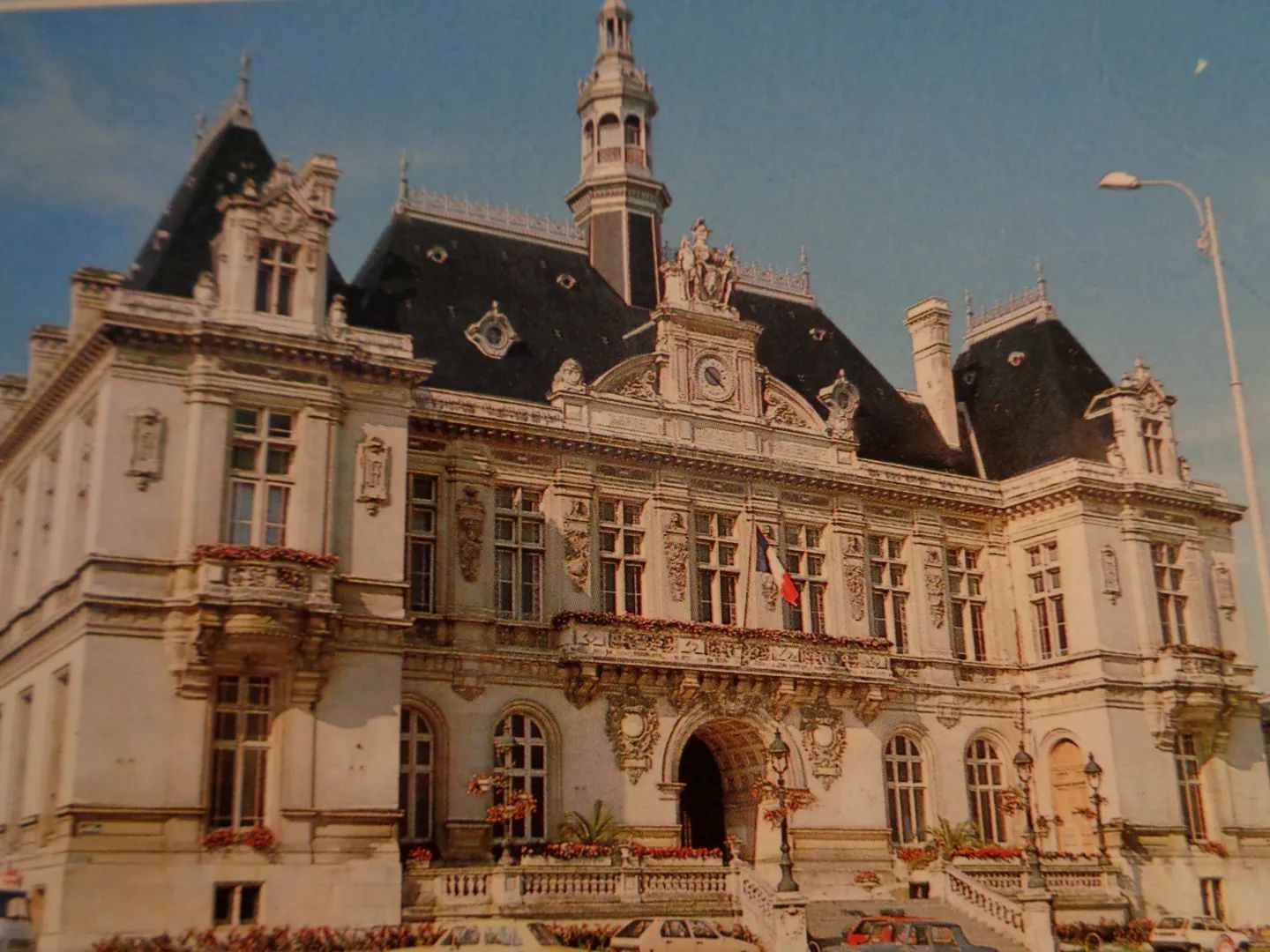
And of all these beauties in the City I just passed by theCity/Town Hall at 1 Place Martin Bastard in the City center ! Four other City/ town halls preceded it. From the 12C to the end of the 14C, the City/town hall stood at the corner of Rue du Rempart and Rue Ricard. No trace of it remains. The town council met there until 1370. The second City/town hall was located on the site of the current pillory. Partially demolished, the building was rebuilt in the Renaissance style between 1530 and 1535. It remained in use until 1789. During the French revolution, the City/town hall was moved to the Military Governor’s House, then located within the castle walls, on the current site of the market. In 1866, during the construction of Les Halles covered market, the City/town hall was temporarily housed at nos, 6 and 8 on Rue de l’Hôtel-de-Ville. The mayor, Martin Bastard, envisioned the construction of a building worthy of the capital of Deux-Sèvres in 1892. The City/town hall was built on the site of the old chapel and part of the House of the former College of the Oratory. On April 27, 1897, the first stone of the city hall was laid. The construction lasted 4 years from 1897 to 1901, The inauguration took place from May 25 to 28, 1901 The new City/town hall was designed in a Renaissance-style, inspired by the Paris City Hall (see pic)
Other things to see are the Dungeons, one of the finest sets of twin Romanesque dungeons in France, formed the central stronghold of a vast, quadrilateral castle measuring 700 meters long. The two dungeons are roughly square. The south dungeon is 28 meters high, the north dungeon 23 meters. The pillory, the former City/town hall, is a precious example of Renaissance architecture, built on the site of the medieval pillory and remodeled in the 16C. The upper part of the belfry dates from the 17C. After having housed a bookstore for a time, it is now used for temporary exhibitions. The Notre-Dame Church, in the Place Notre-Dame square, is in the Flamboyant Gothic style and dates back to the 14C, but owes much of its current appearance to the 15C and 16C. The Saint-André Church, on Rue Saint-André, is of an important Romanesque church; only a few sculpted fragments remain, preserved in the museum. The Saint-Étienne-du-Port Church on Rue Gambetta, is a 19C Neo-Gothic church consisting of a single nave and an ambulatory. The Saint-Hilaire Church, on Rue du 14 Juillet, was built between 1862 and 1866. The Saint-Florent Church, on Rue Camille Desmoulins, has its oldest parts dating back to the 11C. The Sainte-Pezenne Church, on Rue Centrale, is the oldest church in Niort, dating from the early 12C, and retains an archaic-style chancel from the Romanesque period. Its Romanesque bell tower-porch is a rare type in the region. The Halles or covered market, built in 1869 of cast iron and steel in the Baltard style, are Niort’s third covered market. The Du Guesclin barracks, Place Chanzy. Named after Bertrand du Guesclin, this Vauban-style barracks began construction in 1734. The Place de la Brèche, a former fairground, is a vast square that was overlooked by a public garden adorned with statues, accessed by a monumental staircase. It was transformed (2006-2013) to create an underground parking garage (530 spaces), a café, kiosks, a 12-screen cinema complex, and a large public garden. The Chappe telegraph tower, 22 Rue du Vivier, stands on the site of a former windmill. The former June baths, 28 Rue Baugier. This beautiful building, the first public bathhouse in Niort, built in 1804 between two branches of the Sèvre Niortaise river, is particularly remarkable for its tower-like front section, which housed the machinery.
A bit of history tell us that in 1137, Niort, along with the dowry of Eleanor of Aquitaine, came under the administrative authority of the King of France, Louis VII the Younger. Then, in 1152, it became part of the Plantagenet Empire following Eleanor’s remarriage to Henry Plantagenet, who in 1154 became King of England and, in the second half of the 12C, built the twin keeps of the fortress. Her royal husband, Henry II, and later her son, Richard the Lionheart, fortified the citadel with a castle and a wall that stretched for 2,800 meters. Today, only the imposing twin keep and a few traces of foundations remain in Place Saint-Jean. In 1199, John Lackland granted a charter of city to Niort, confirmed by Eleanor of Aquitaine in 1203. In 1200, Niort became part of the dowry of Isabella of Angoulême upon her marriage to John Lackland. In 1202, John’s continental possessions were confiscated by the King of France. Niort was finally annexed in 1204 by Philip II Augustus. In 1224, Constable Matthew II of Montmorency brought the city back under French control on behalf of Louis VIII. However, it reverted to English control with the signing of the Treaty of Brétigny in 1360. The city became a free port in 1285, allowing its economic and commercial development to continue. Bertrand du Guesclin recaptured Niort from the English on March 23, 1372. During the Praguerie (a war waged against the King of France by the great feudal lords of the kingdom between mid-February and mid-July 1440. The rebel princes were the Dukes of Bourbon and Brittany, the Dauphin Louis, and the great lords of Alençon and Vendôme, an uprising against the reforms of Charles VII), the Dauphin, the future Louis XI, made Niort his headquarters and granted it numerous privileges. Having embraced the Reformation in 1557, the city became Protestant, but was retaken by the Catholics in 1569. The arrival of the Oratorians in the city in 1624 raised some hopes for the establishment of secondary education. replacing the Huguenot institutions. It was only in 1717 that, thanks to subsidies from the city, the Collège de l’Incarnation welcomed its first students. It took the name Collège d’Artois (a middle school) in 1782. In 1807, Napoleon I transformed the Collège d’Artois into an Lycée imperial (a high school). Napoleon I passed through Niort on his way to exile on the island of Saint Helena and spent one of his last nights on French soil there (the night of July 2-3, 1815) at the Auberge de la Boule d’Or. It may have been his last night on the continent.
Niort is one of the strongholds of the French social economy, and in particular, since the 1970s, has been considered “the capital of mutual insurance companies.” The city is home to the headquarters of numerous mutuals, or companies linked to this economic sector, such as MAIF, founded in 1934 in Fontenay-le-Comte. and whose head office was moved to Niort the following year. MAAF, the first mutual insurance company founded in Niort, in 1950. The MAAF Group is also a founding member of Covéa (SGAM: Mutual Insurance Group Company), a structure designed to strengthen synergies between its constituent mutuals (MAAF-MMA in 2003, joined by GMF-Azur in 2005, Azur having since merged with MMA). MACIF, founded in Niort in 1960. SMACL, founded in Niort in 1974. Inter Mutuelles Assistance (IMA), founded in Niort in 1981. The Groupama regional office has also established one of its main IT centers (Groupama Supports et Services) at 50 rue du 14 Juillet in Niort; Darva, a company specializing in data exchange between insurers’ IT systems and those of their partners.
The city of Niort on the Hôtel de Ville: https://www.vivre-a-niort.com/services-publics/annuaire-des-services/coordonnees/hotel-de-ville/index.html
The city of Niort on its heritage: https://www.vivre-a-niort.com/cadre-de-vie/decouvrir-niort/index.html
The local Niort Marais Poitevin tourist office on the things to see in Niort: https://www.niortmaraispoitevin.com/en/explorer-la-destination/niort/
There you go folks, another dandy if in off the beaten path of my belle France ,indeed worth a detour, me think. We shall return to Niort eventually, Again, hope you enjoy the post on this is Niort !!! as I.
And remember, happy travels, good health, and many cheers to all !!!

 Paris1972-Versailles2003