
Another round in my road warrior trails of my belle France, We were staying close to explore the region and glad we did, wonderful memories,I , again, found me pictures in my cd rom vaults that should be in my blog for you and me. Therefore, here is my take on this is Autun !!! Hope you enjoy it as I
The City of Autun is located in the Saône-et-Loire department 71 in the Bourgogne-Franche-Comté region of my belle France, It is 48 km from Beaune, 61 km from Chalon sur Saône, 90 km from Dijon, 296 km from Versailles, and 667 km from my current home, However, I went by it in my road warrior trails while staying in Buxy 55 km away, which we came by the D977 road to exit/sortie 6 to connect with the N80 and at Montchanin we took the D680 road to Autun city center.
The Cathedral of Saint-Lazare from 1120, is a Romanesque style church of the Cluniac type, is famous in particular for its tympanum, sculpted with great detail representing the Last Judgment and signed by the artist Gislebert. This masterful portal owes its exceptional preservation to the canons of Autun, despite the destruction of medieval works committed in the 18C during the French revolution. The portal is the most remarkable element of the cathedral. Tympanum of the Last Judgment with a central scene represents the Last Judgment, with Christ in an immense mandorla dominating the scene: to his right, Saint Peter ushers the righteous into Paradise; above, a large space is given to the interceding Virgin Mary; To Christ’s left, the weighing of souls takes place: demons, embodying the weight of sins, weigh on the scales , but this weight is too weak and the scale, carrying the soul in a position of adoration, is nevertheless received in the hands of the Archangel Saint Michael. Beneath the tympanum, the lintel represents the souls at the Last Judgment. It features the classic elements of this subject: the resurrection of the dead, some of whom are already hiding their faces, others bearing the pilgrim’s emblems ; the woman with breasts bitten by snakes, representing Lust; the tympanum is bordered on the outside by a series of about thirty circular medallions, alternating seasonal scenes and astrological signs.
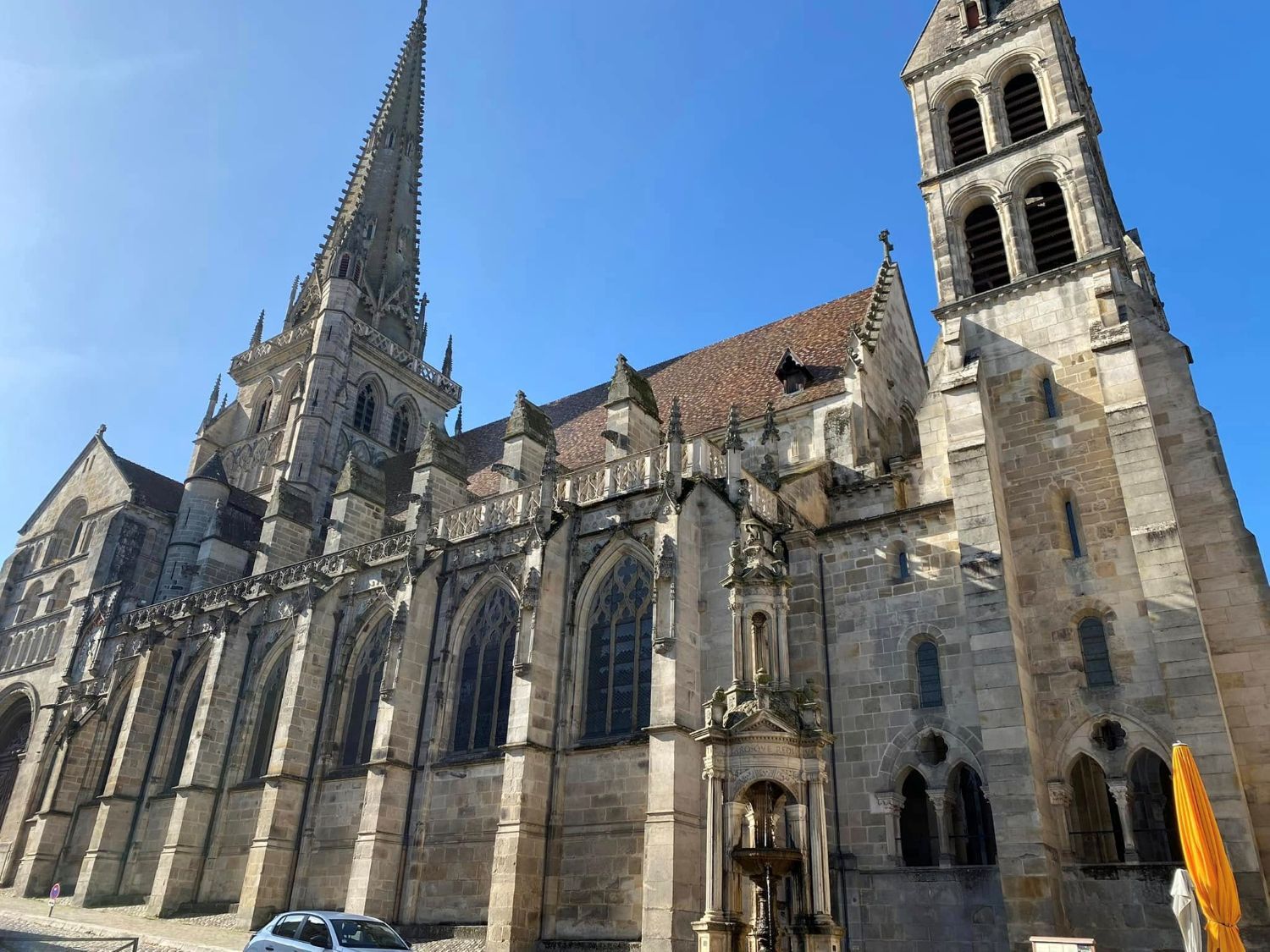
The Cathedral of Saint-Lazare of Autun has a Door of Mercy, a door which, in addition to the Holy Doors opened every 25 years or according to the exceptions set by the Pope during the course of the Holy Years or Jubilees, was established at the Cathedral following the desire of Pope Francis to see the current Jubilee of Mercy spread throughout the world. In short, this door, like all the other Doors of Mercy, supports the Holy Doors in their roles in the Jubilee of Mercy proclaimed by Pope Francis, which ran from December 8, 2015 to November 20, 2016
Inside ,the central and lateral aisles have pointed vaults, not originally counterbalanced by flying buttresses, making the whole structure rather unstable. These were added in the 13C. The choir was rebuilt in the 15C in Gothic style and the stained glass windows date from the 19-20C. The altarpiece is the only 16C altarpiece in the cathedral. Saint Mary Magdalene and Christ stand on either side of a tree supporting the coats of arms of the sponsors. On the partially broken phylactery is transcribed the phrase that Jesus pronounces to Mary Magdalene: “Noli me tangere” (“Do not touch me”). The stained glass windows, dating from 1868, represent the life of Saint Léger , martyred bishop of Autun, illustrating his consecration as bishop, his presentation to the king of the Franks Childeric II, his arrest by the soldiers of Ebroïn, mayor of the palace and rival of Saint Léger and his beheading.
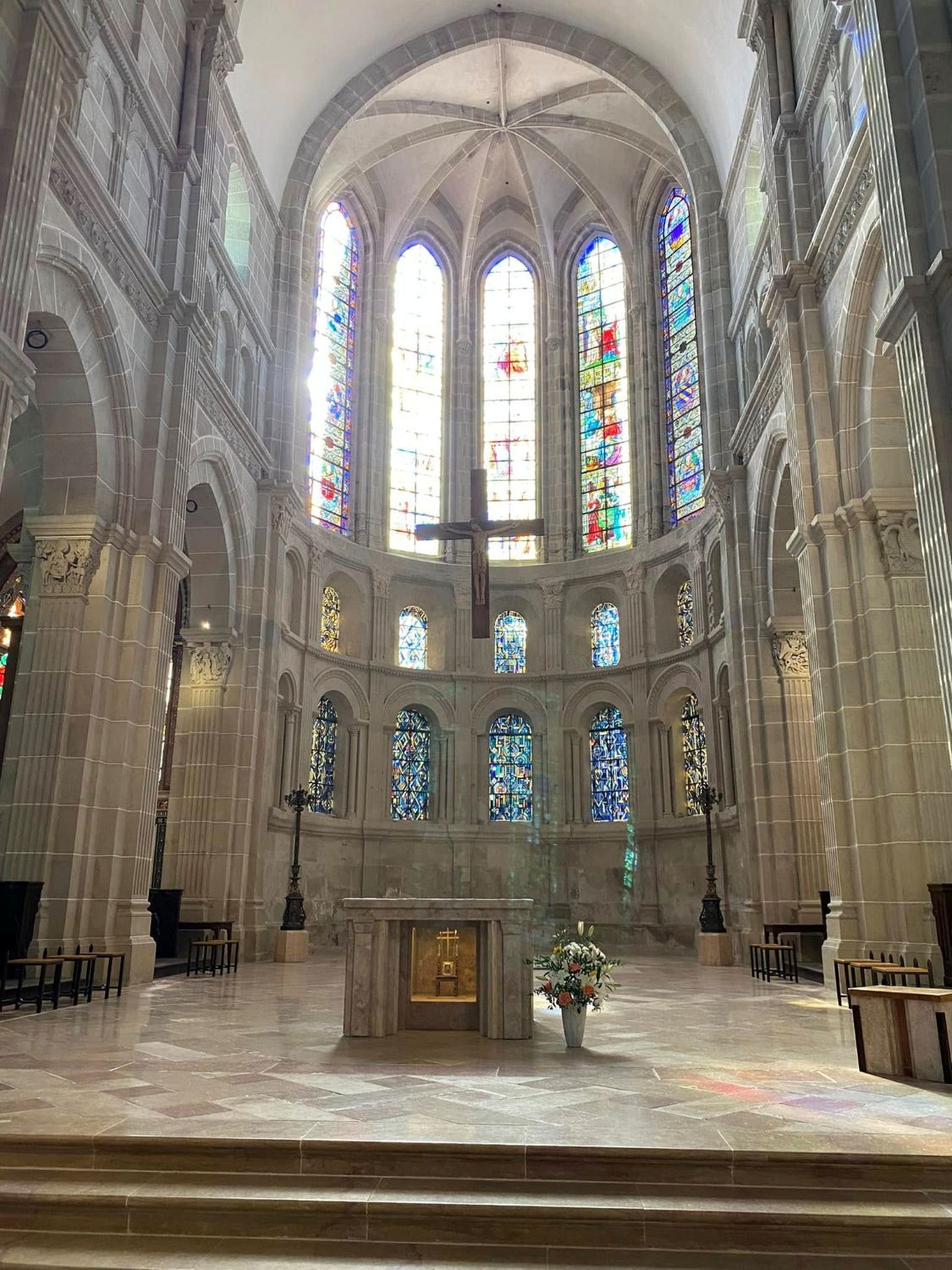
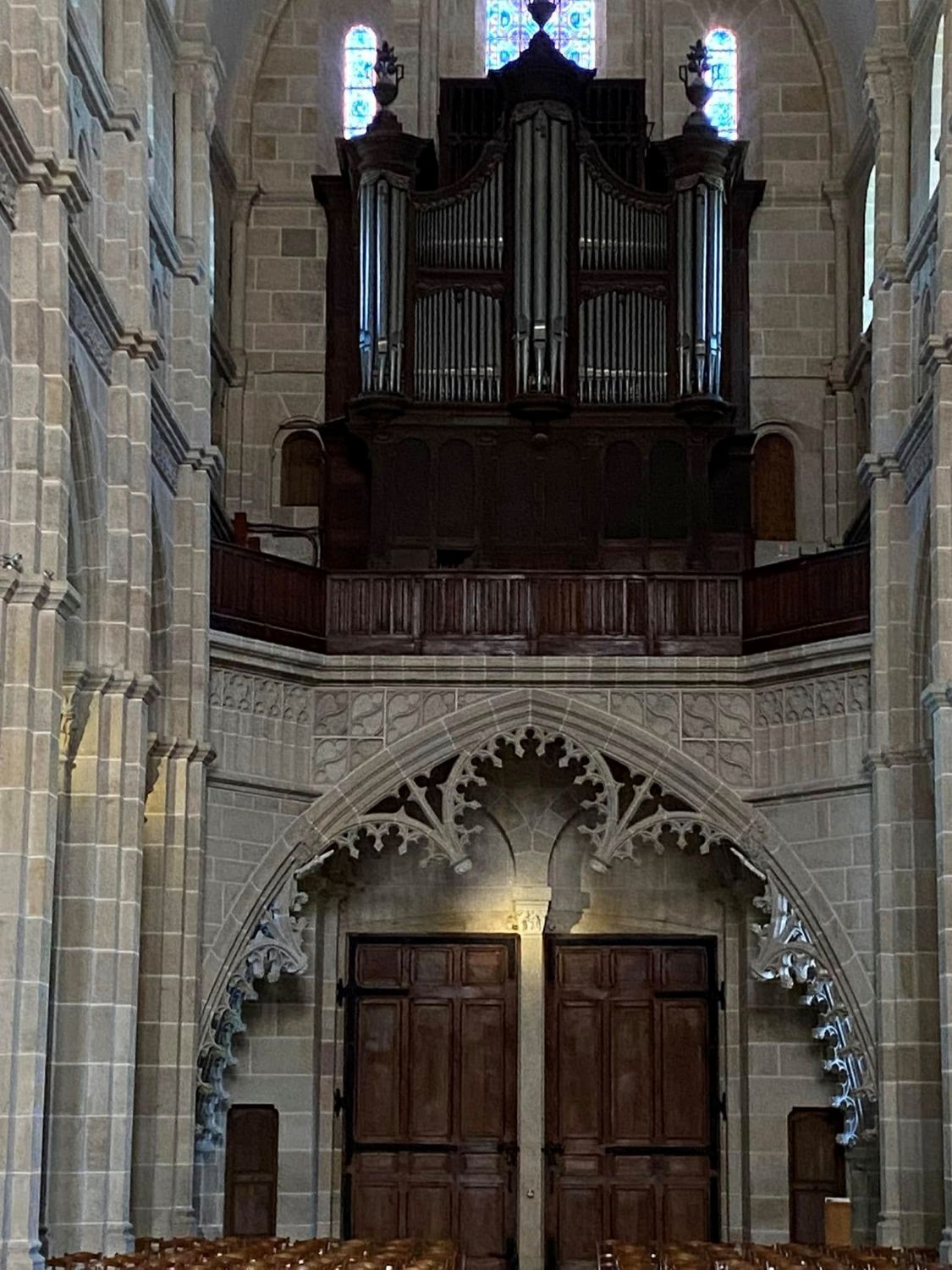
The Cathedral Saint Lazare of Autun has a large painting by Dominique Ingres depicting the Martyrdom of Saint Symphorien, located at the entrance to the sacristy. Another painting, by François-Joseph Heim, The Raising of Lazarus, is representative of the revival of religious painting in France in the 19C, although it depicts Saint Lazarus from the Gospel and not Lazarus of Aix, who is the saint honored in this cathedral. A Pietà by Guercino and a Dead Christ by Daniel Seyter are also featured in the cathedral. The cathedral has a large organ. An instrument dating from 1820 was replaced in 1876, but some parts of it are preserved. A lift was carried out in 1893, and the wind tunnel was electrified in 1921. Some transformations took place in 1943. New lift in 1952 then restoration in 1983.
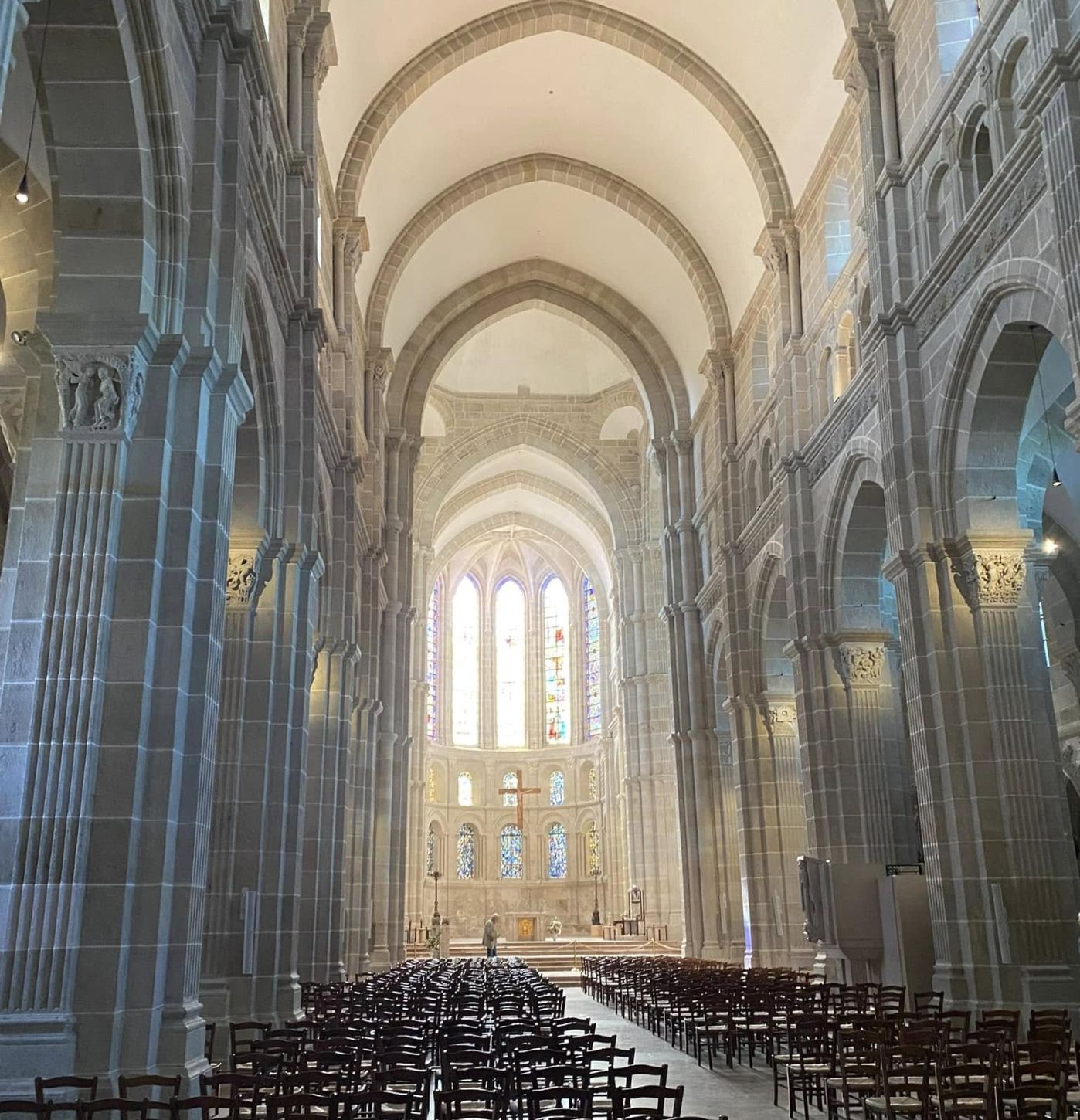
A bit of history of the Cathedral tell us that it was completed in 1146, it became the city’s only cathedral at the end of the 12C, replacing that of Saint-Nazaire. It is the seat of the diocese of Autun, Chalon and Mâcon. Although it preserves the relics of Saint Lazarus of Aix, since the 12C it has been under the invocation and patronage of Saint Lazarus resurrected by Christ, a patronage confirmed in 1801 by Pius VII in the bull Qui Christi Domini. A first cathedral was built in Autun from the 5C, later dedicated to Saint Nazaire of which a chapel from the 14C remains. The Church of Saint-Lazare (dedicated to Saint Lazarus of the Gospel) was planned by the Bishop of Autun, Stephen I of Baugé, to preserve the relics believed to be those of this saint, but which were in fact those of Saint Lazarus of Aix.
Other things to see here with more time are the 17C high school holds an important place in the history of the city and even of France, as Napoleon Bonaparte, after whom it is named, and his brothers Joseph and Lucien studied there. This high school continues to operate today. You can admire the wrought iron gates erected in 1772; the subjects taught here are indicated by various representations of objects along the top of these gates, The former Marquis de Fussey mansion located on Rue de l’Arquebuse, built in 1782, became the headquarters of the sub-prefecture in 1820. During the Franco-Prussian War, Garibaldi made it his headquarters in late 1870 and early 1871. The megalithic alignment of the Camp de la Justice. Around thirty megaliths were discovered in 1882, five remain today, The Ursuline Tower is an octagonal tower located on the heights of the city. The tower, surrounded by Roman ramparts, is surmounted by a 3 meters high statue of the Holy Virgin, dating from 1862, The Place du Champ-de-Mars, which is the heart of the city where the two pedestrian streets of rue aux Cordiers and rue Saint-Saulge coincide,see here the City/town hall and the Italian-style theater, inaugurated in 1884, are joined. The market is held there on Wednesdays and Fridays; The Saint-Nicolas Chapel at rue Saint-Nicolas depended in the 12C on a pilgrims’ hospital, the Saint-Nicolas hospital, the oldest known title dates from 1218. The hospital was abolished in 1668, The cathedral and canonical group of Autun is a religious complex located mainly on Place du Terreau, In its current state, the group includes: the remains of the canons’ refectories on Rue Dufraigne (now the Notre-Dame-des-Bonnes-Œuvres-et-des-Sept-Dormants Chapel), the house “maison des caves du Chapître”, former cellar and attic, the former chamber of accounts of the chapter (15C), the remains of the southern aisle of the Saint-Nazaire cathedral (14C, now the Saint-Aubin Chapel), the east gallery of the cloister (12C), a half-timbered house and the former rectory (15C), The Natural History Museum in the rue Saint-Antoine (zoology, mineralogy, paleontology, botany); Rolin Museum (archaeology, medieval art, history and fine arts), located on rue des Bancs in the Hôtel Rolin, which was the residence of this chancellor.
A bit of history I like tell us that Autun was founded by the Romans as Augustodunum, sister and emulator of Rome at the beginning of the reign of the Emperor Augustus, Gallo-Roman capital of the Aedui replacing Bibracte, a bishopric since Antiquity, the city quickly equipped itself with a wall approximately 6 km long and enclosing an area of 200 ha, comprising numerous towers. It was pierced by four gates – two of which, the gates of Saint-André and Arroux, still exist at the ends of the two main streets which intersected at right angles a Roman theater, 148 meters in diameter, capable of holding up to 20,000 people, the largest in capacity in the western part of the Roman Empire; an amphitheater, now disappeared, 154 by 130 meters, located about 50 meters from the theater; the Gallo-Roman temple called “Janus”, outside the ramparts, the theater of Haut-du-Verger, 150 meters northwest of the temple called Janus and of which no structure emerges in the open air, the pyramid of Couhard, which stands near the ancient necropolis called the “Field of Urns”, which tradition gives to be, among other hypotheses, the burial of the Aeduan druid Diviciacus, a friend of Cicero and Caesar, or even of a former vergobret. The city was supposedly sacked by the Saracens of General Ambiza on August 22, 725 or 731. Following this disaster, a few years later, in 733, Charles Martel entrusted Theodoric I, grandson of Bernarius, founder of the Thierry line, with the countship of Autun, of whom Thierry II of Autun was brother of the famous William of Gellone. It was sacked again by the Normans in 888. In the 10C, it became the capital of a county dependent on the Duchy of Burgundy.
During the Middle Ages, the city became a major ecclesiastical center and an important place of pilgrimage, as evidenced by its new cathedral in addition to the Saint-Nazaire cathedral. People came there to venerate the supposed relics of Lazarus of Aix, not those of Saint Lazarus of Bethany, the one from the Bible, but those of a 5C bishop of Aix-en-Provence. The cult of Lazarus of Aix, also known as Saint Lazarus of Autun, in the 12C, certainly echoed that of Mary Magdalene, present in Vézelay. In 1788, Talleyrand became Bishop of Autun. He was elected deputy of the clergy for the Estates General of France in 1789. In 1790, Autun was chosen to be the capital of one of the seven districts of the newly created department of Saône-et-Loire. During the revolutionary period of the National Convention (1792-1795), the city was provisionally named Bibracte, On the morning of November 27, 1870, the Vosges army, retreating to Autun, was pursued by the 3rd Baden Brigade commanded by General Keller. On November 30, General Garibaldi, commander-in-chief of the Vosges army, arrived in Autun and organized the defense of the city. During WWII, Autun was liberated on September 9, 1944, by French troops who had landed in Provence (the 2nd Dragoon Regiment of Colonel Demetz), the armed groups FFI (Pommiès Free Corps) and FTP (Valmy Regiment).
The official Cathedral Saint Lazare of Autun : https://cathedrale.autun-art-et-histoire.fr/
The City of Autun on its heritage : https://www.autun.com/sortez-bougez/decouvrir-autun/histoire-et-patrimoine/
The Autun tourist office on the Cathedral : https://www.autun-tourisme.com/en/discover/a-spiritual-moment-cultural-heritage-and-castles/saint-lazare-cathedral/
The Saône et Loire dept 71 tourist office on Autun : https://www.destination-saone-et-loire.fr/en/la-saone-et-loire/lautunois-morvan.html
The Borgogne-Franche-Comté region tourist office on the Cathedral of Autun : https://www.bourgognefranchecomte.com/sites-religieux/cathedrale-saint-lazare-7
There you go folks, a dandy area to explore and enjoy with the family, Memorable moments in passing by Autun, driving all over in my road warrior trails brings out sublime awesome spots with nice memorable family visits of yesteryear always remember and always looking forward to be back, eventually. Again hope you enjoy the post on this is Autun !!! as I. And remember, happy travels, good health, and many cheers to all !!!

 Paris1972-Versailles2003