
Always fun and memorable and sentimental to write about the Seine-et-Marne, I ,again, found me pictures in my cd rom vaults that should be in my blog for you and me. This is a memorable town of great cultural history that should be visit more including me, Thanks for reading my blog , always appreciated. Therefore, here is my take on this is Moret sur Loing !!! Hope you enjoy it as I
The town of Moret-sur-Loing is now a former town located in the Seine-et-Marne department no, 77 ,in the Île-de-France region of my belle France. It merged with Écuelles on January 1, 2015, to form the new town of Orvanne, then through a series of further mergers in 2016 and 2017 with Épisy, Montarlot and then Veneux-les-Sablons to form the current town of Moret-Loing-et-Orvanne, Always will be Moret sur Loing for me ! It is 12 km from Fontainebleau, 20 km from Milly-la-Forêt, 80 km from Paris, 79 km from Versailles, and 477 km from my current town, You can get here from Paris via the A6, exit/sortie no. 13 at Cély or exit/Sortie 15 at Nemours. The A5 is accessible via exit/sortie 17 at Forges, We came from Versailles by rue Maréchal Foch to Ave de l’Europe cross the ave de Paris and continue into ave du Général de Gaulle (D10) passing the rive gauch château RER C station turn right into Rue du Général Leclerc then left on Ave du Maréchal Joffre (D91) past the Potager du Roi and Parc Balbi continue to Ave du Maréchal Juin to connect with the N12 road continue same road becomes the A86 to connect with the A6b/A6 dir Fontainebleau to connect with the N37/D637.this becomes the D607 passing Fontainebleau round point connects with the D606 (Ave de Fontainebleau) direct to Moret sur Loing center,
The old town of Moret-sur-Loing, a place that could almost be described as perched on the water. If its name means anything to you, it is because it has inspired many artists, and in particular the painter Alfred Sisley, to whom it owes its notoriety. A real cloak and dagger film setting, Moret-sur-Loing promises you a total change of scenery and above all a real journey back in time to the Middle Ages: homes of yesteryear, remains of fortifications, old stone bridge, medieval church , old mills and washhouses… Everything here brings us back to the time of the knights, so much so that you would almost want to dress up to go and enjoy a period banquet !
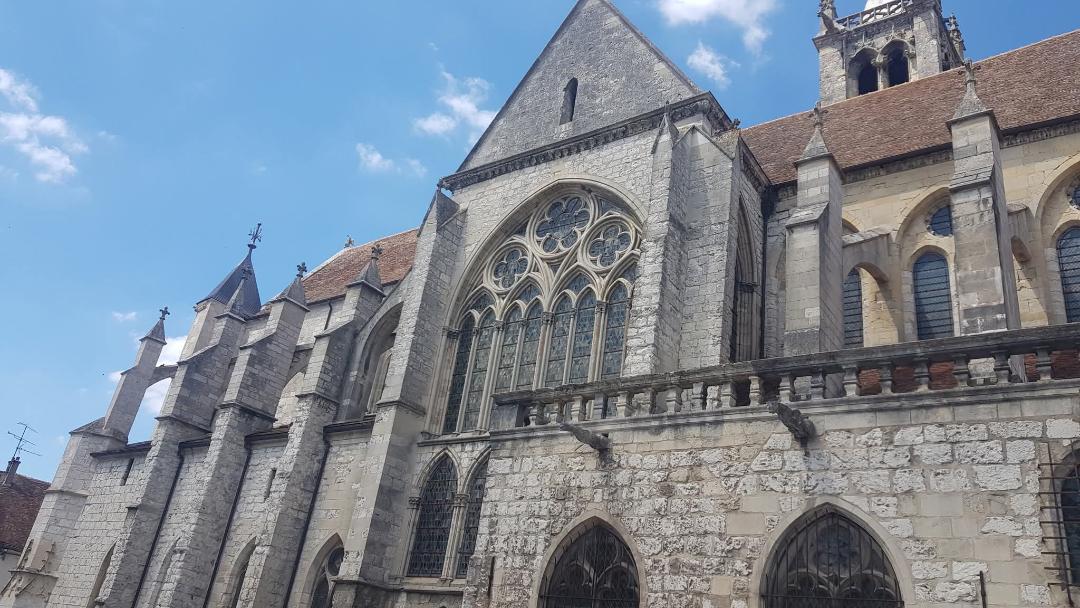
The Church Notre Dame de la Nativité ; construction of the church lasted a little over two centuries, from the 12C to the 15C, on the site of an old Romanesque church. The construction began with the apse and the choir in the 12C, then the transept in the 13C, and the nave in the 14C. The bell tower dates from the same period as the main façade, from the 15C. The choir, apse and transept of the church rise on 3 levels. The apse has a system of double offset oculi, allowing more light into the church. Light is also brought in by the presence of a glass roof. The nave has 8 columns, topped with vaults. One can notably see Saint Peter, holding a key, accompanied by a rooster at his feet. The sacristy door is decorated with two panels representing saints: Saint Apollonia, Saint John the Baptist the Forerunner, Saint Catherine, Saint Barbara and Saint Nicholas, plus a bishop. It was donated to the church in 1874. A first organ was installed along the wall. The gallery dates from the 15C. The organ case was built between 1530 and 1540. After the French revolution, the instrument was in such disrepair that it was no longer used, and then part of the pipework was sold. The town of Moret-sur-Loing decided to restore the instrument in the 1980s. It was not fully restored until 2000, but it was not returned to its place in the church until 2002. On August 24, 1944, (WWII) ,an explosion on a bridge near the church damaged the stained-glass window of the baptismal font, named “The Nativity of Saint John the Baptist.” A watercolor depicting part of it, dating from 1907, is preserved in the local museum. The explosion also affected the stained-glass window of the tympanum above the portal. All that remains of the original ornament, including a Trinity, are three elements of the terminal finial of a Tree of Jesse.

Other things to see here are a fortified half-moon enclosure, facing the Loing river, of which many elements remain ; 15 to 20 meters high, more than 2 meters thick; three gates: the Burgundy Gate, which blocks access via the Loing friver acing Burgundy; the Samois Gate or Paris Gate (5C), in the direction of Fontainebleau; the Samois Gate and the royal boundary stone at its right corner. the Grez/Orléans gate, towards the Grez fortress ,which unlike the other two, no trace of it remains today. The dungeon of the Moret castle, 12C ; partially destroyed during the French revolution and transformed during the 19C, the bridge over the Loing river dating from the 12C, even if local folklore has it that Julius Caesar built the first version, and widened in the 19C, The plan of the current town is still strongly marked by this period and its basement is pierced by numerous medieval cellars ; notably Rue Grande 35 and Logis Saint-Jacques. a royal sandstone road marker at 1, Grande rue against the old town gate. No. 37 is engraved on the back.
However, if anything else come for the painters ! In 1880, financial difficulties forced the Impressionist painter Alfred Sisley to leave Sèvres for Seine-et-Marne. He settled not far from Moret-sur-Loing in Veneux-Nadon. From 1882 to 1885, Sisley explored the banks of the Loing. Between Moret, a medieval country town, and Saint-Mammès, renowned for its boat building and traditional activities, he had a variety of viewpoints. In 1885, the group of houses near the locks captured his attention and provided the motif for a set of compositions that could be considered a series. He carried out a systematic survey of the premises, which he recorded in his sketchbooks and annotated with technical details. Of the thousand paintings signed with his name, more than four hundred evoke the landscapes of Moret and the surrounding area (Veneux-Les Sablons, Saint-Mammès and Thomery) , After staying in By and Veneux-Nadon, he settled permanently in Moret sur Loing in February 1889, first on rue de l’Église and then, probably from 1892, at 19, rue Montmartre. He is buried in the Moret cemetery. Many other painters have depicted Moret-sur-Loing; too many to mention, Other importance of the town, me think is the fact that Nicolas Fouquet (Vaux le Vicomte), imprisoned in the dungeon of Moret in the summer of 1664. D’Artagnan (captain of the muskeeteers), was in charge of guarding Fouquet in 1664 here.
A bit of history I like as much is reflected above tell us that Moret is a small medieval town of around 4,500 inhabitants whose origins seem to date back to the Gallo-Roman period. It gained importance ;particularly strategically in 1081 when it became part of the royal domain. Moret has preserved a large part of its fortifications dating from the 12C and 15C.
The new town of Moret-Loing-et-Orvanne on its heritage : https://moretloingetorvanne.fr/moret-loing-et-orvanne/patrimoine/moret-sur-loing/
The private site churches of the confluence on the Church of Moret sur Loing : https://www.eglisesduconfluent.fr/Pages/77-MoretSurLoing-NotreDame.php
The Moret sur Loing tourist office on its history : https://www.msl-tourisme.fr/en/discover-moret-seine-loing/history-heritage/msl-distillation-french-history.html
The Fontainebleau tourist office on Moret sur Loing : https://www.fontainebleau-tourisme.com/en/file/727355/moret-sur-loing/
There you go folks, Moret sur Loing is a nice town really! Still off the beaten path it is, but what a punch it carries in the history of France! You should give yourselves a shot of encountering it. You will be surprise, Again, hope you enjoy the post on this is Moret sur Loing !!! as I.
And remember, happy travels, good health, and many cheers to all !!!


