
Once again, coming back from my road warrior trails in my belle France. This one after many passing finally went in City center of Thouars, with great architecture and history to boot. You will see plenty in next posts stay tune, The City of Thouars is located in the Deux-Sèvres department no. 79 in the Nouvelle-Aquitaine region of my belle France. Thouars has been awarded the 4-flower flower town label and the Town of Art and History label, Therefore, here is my take on the Abbey Church Saint Laon of Thouars !!! Hope you enjoy the post as I.

The Abbey Church Saint-Laon in the place Saint-Laon,dates from the 12C (origin in 1021, which contains the tomb of Margaret of Scotland, first wife of Louis XI). It has a 12C bell tower and stained glass windows. .In the 11C, the Augustinian Abbey of Saint-Laon was founded. The relics of Saint Laon were placed in his abbey chapel. It was on this abbey that the Church Saint-Laon was built in the 12C. In the 15C, the church was extensively remodeled, retaining only the bell tower and the original south gable. On the exterior, the second level, corresponding to the dome, is decorated with blind bays. The belfry level is set back. It is pierced with four bays on each side, highlighted by arcades falling onto columns topped with sculpted capitals. The presence of a timber-framed nave justifies the choice of a lateral bell tower, this bay being reserved for the faithful. On the exterior, the second level, corresponding to the dome, is decorated with blind bays.
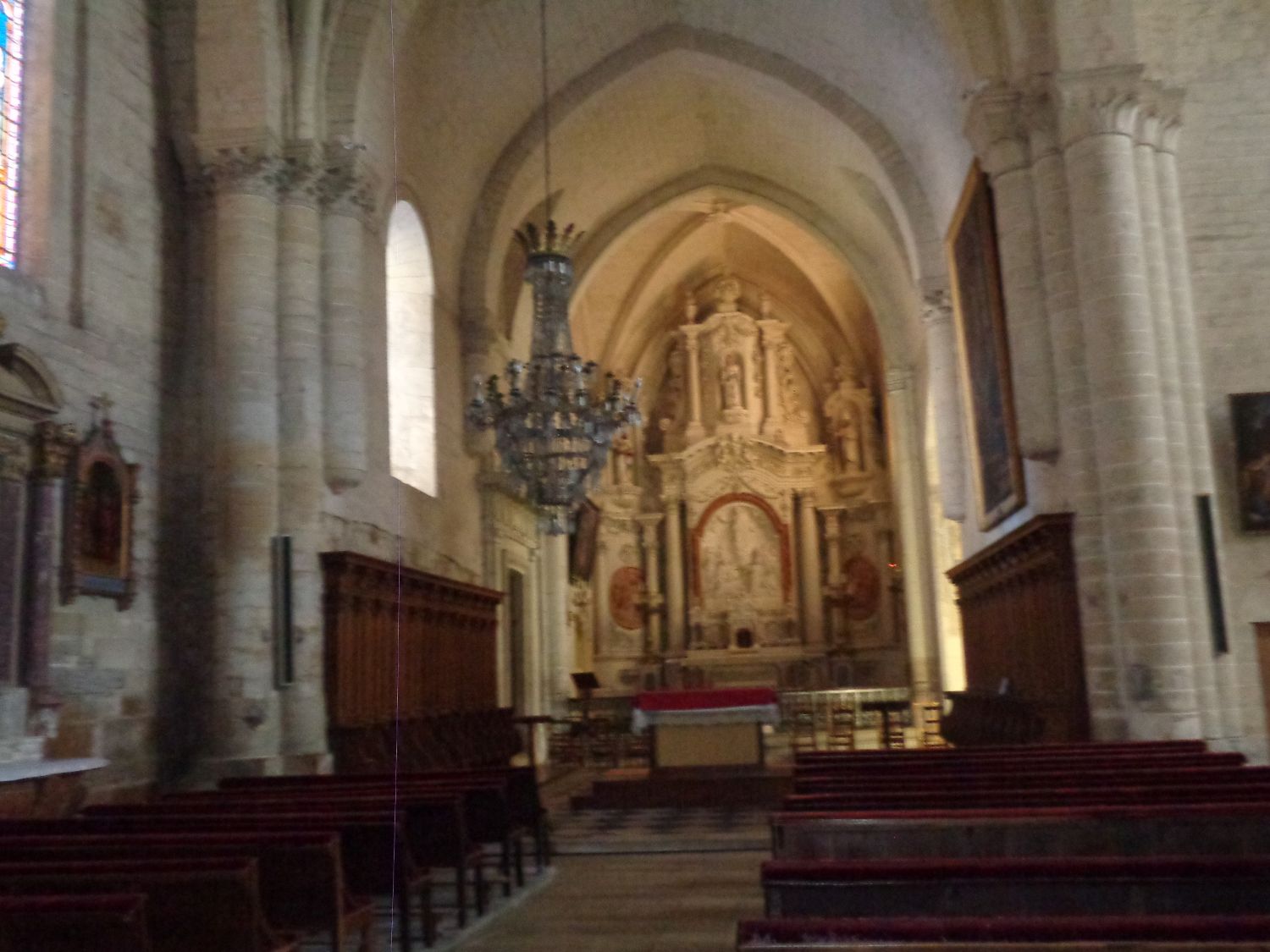
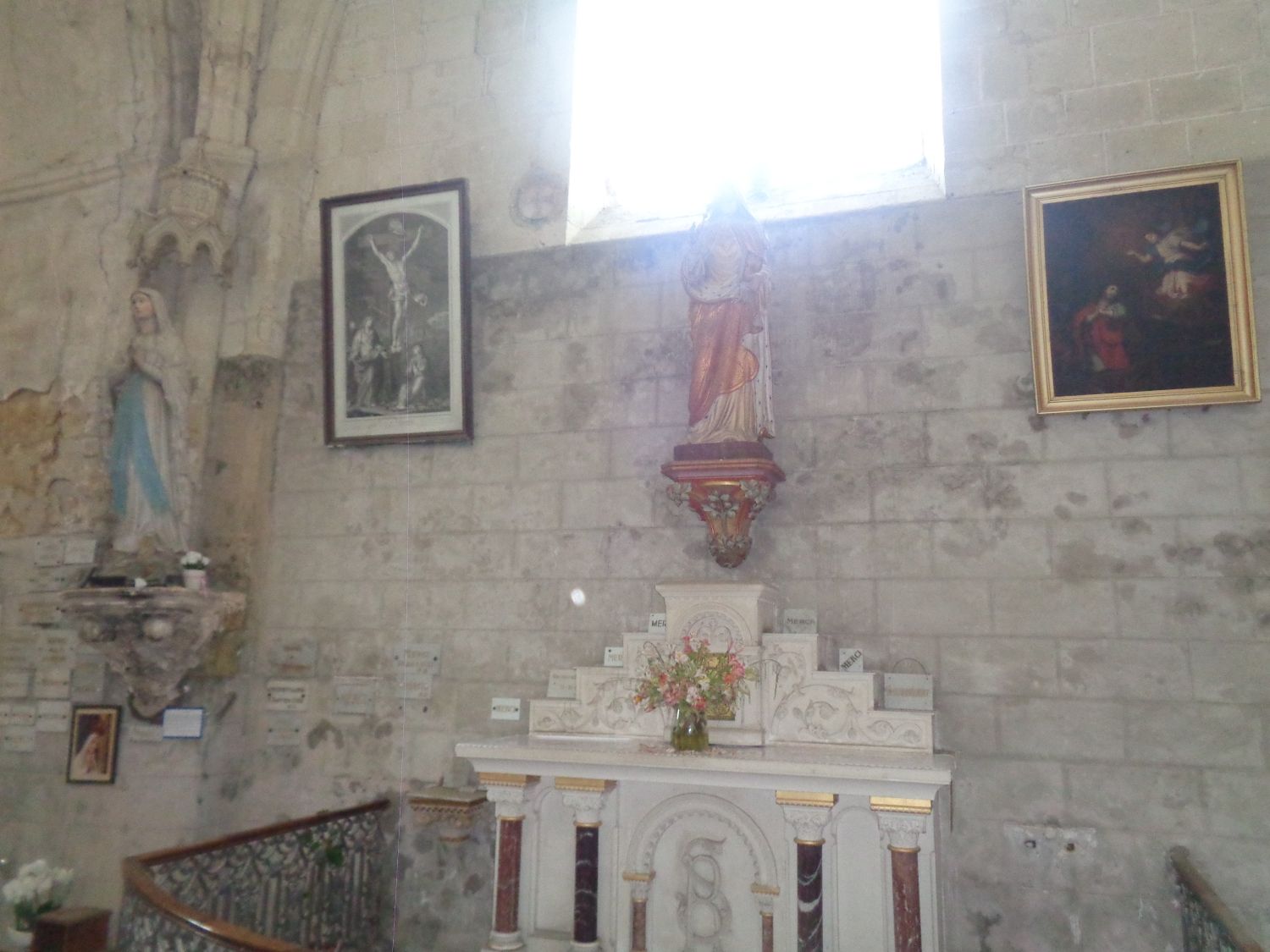
In the interior you see the painting of the descent from the Cross , The painting of Christ and the Canaanite woman ,This work, dating from the first quarter of the 17C. You have a fresco portrait in the Chapel of Margaret of Scotland was discovered during restoration work on this chapel in 1994. The lower register is dotted with fleurs-de-lis, representing the coat of arms of the French royal family. The tomb of Margaret of Scotland was built in the 15Cin a Gothic in style, decorated with fleurons and pinnacles. The black pigment band of the liter was decorated with coats of arms (now lost) on a yellow wash background. The sculpture burial of Margaret of Scotland which dating of this sculpted group is uncertain. In 1459, the monks of the Abbey of Saint-Laon undertook to install a sepulchre in the chapel, but the commission does not seem to have come to fruition. The ensemble was restored in the 19C and then incorporated a rock grotto. In 1970, the polychromes were restored and the figures were restored ,The scene echoes the Bible and the Gospels: the dead Christ is lying on a shroud that Saint Joseph of Arimathea and Saint Nicodemus have just placed on it. The Virgin Mary is supported by Saint John. Saint Mary Magdalene, with her hair down, stands behind a woman holding a pot of ointment, Saint Mary Jacobean or Saint Mary Salome. Saint Veronica (or Saint Joanna the Myrrh-Bearer depending on the source) holds a crown of thorns. The fourth man could be Gamaliel, a rabbi and doctor of the law, who was baptized at the same time as Nicodemus. A Roman soldier with his spear is part of the composition, smaller than the rest. The altar of the Virgin and Child dates from the 19C, is in the Neo-Gothic style. Surmounted by a Virgin and Child, it is composed of two registers. The lower register presents three figurative scenes, with a Pietà* in the center and four scholars. These represent religious figures, members of the main monastic orders (or the founding saint): a Cistercian, Saint Bernard of Clairvaux, Saint Gregory the Great, a Benedictine, Saint Benedict of Nursia and a Dominican, Saint Dominic. The upper register presents a decoration.
The entombment or mise au tombeau ,the dating of this sculpted group is uncertain. In 1459, the monks of the Abbey of Saint-Laon undertook to install a sepulchre in the chapel, but the commission does not appear to have been completed. The ensemble was restored in the 19C and incorporated a rock grotto. The scene echoes the Bible and the Gospels: the dead Christ is lying on a shroud just placed on it by Saint Joseph of Arimathea and Saint Nicodemus. The Virgin Mary is supported by Saint John. Saint Mary Magdalene, with her hair down, stands behind a woman holding a pot of ointment, Saint Mary Jacobean or Saint Mary Salome. Saint Veronica (or Saint Joanna the Myrrh-Bearer depending on the source) holds a crown of thorns. The fourth man could be Gamaliel, a rabbi and doctor of the law, who was baptized at the same time as Nicodemus. A Roman soldier with his spear is part of the composition, smaller than the rest.

You see an altar of the Virgin and Child dating from the 19C, is in the Neo-Gothic style. Surmounted by a Virgin and Child, it is composed of two registers. The lower register presents three figurative scenes, with a Pietà* in the center and four scholars. These represent religious figures, members of the main monastic orders (or the founding saint): a Cistercian, Saint Bernard of Clairvaux, Saint Gregory the Great, a Benedictine, Saint Benedict of Nursia and a Dominican, Saint Dominic. The upper register presents a decoration inspired by Romanesque architecture. See the portrait of Sainte Genevieve discovered in 1994, during the restoration of the chapel. It represents a haloed saint, with an angel and a demon on either side of her head. These figures allow her to be identified as Saint Genevieve. This decoration marks the passage of the abbey under the rule of the Order of Saint Genevieve in 1655. The Génovéfain order observes the rule of Saint Augustine. Following the Council of Trent, its aim was to reestablish rigorous observance of the rule in Augustinian abbeys.

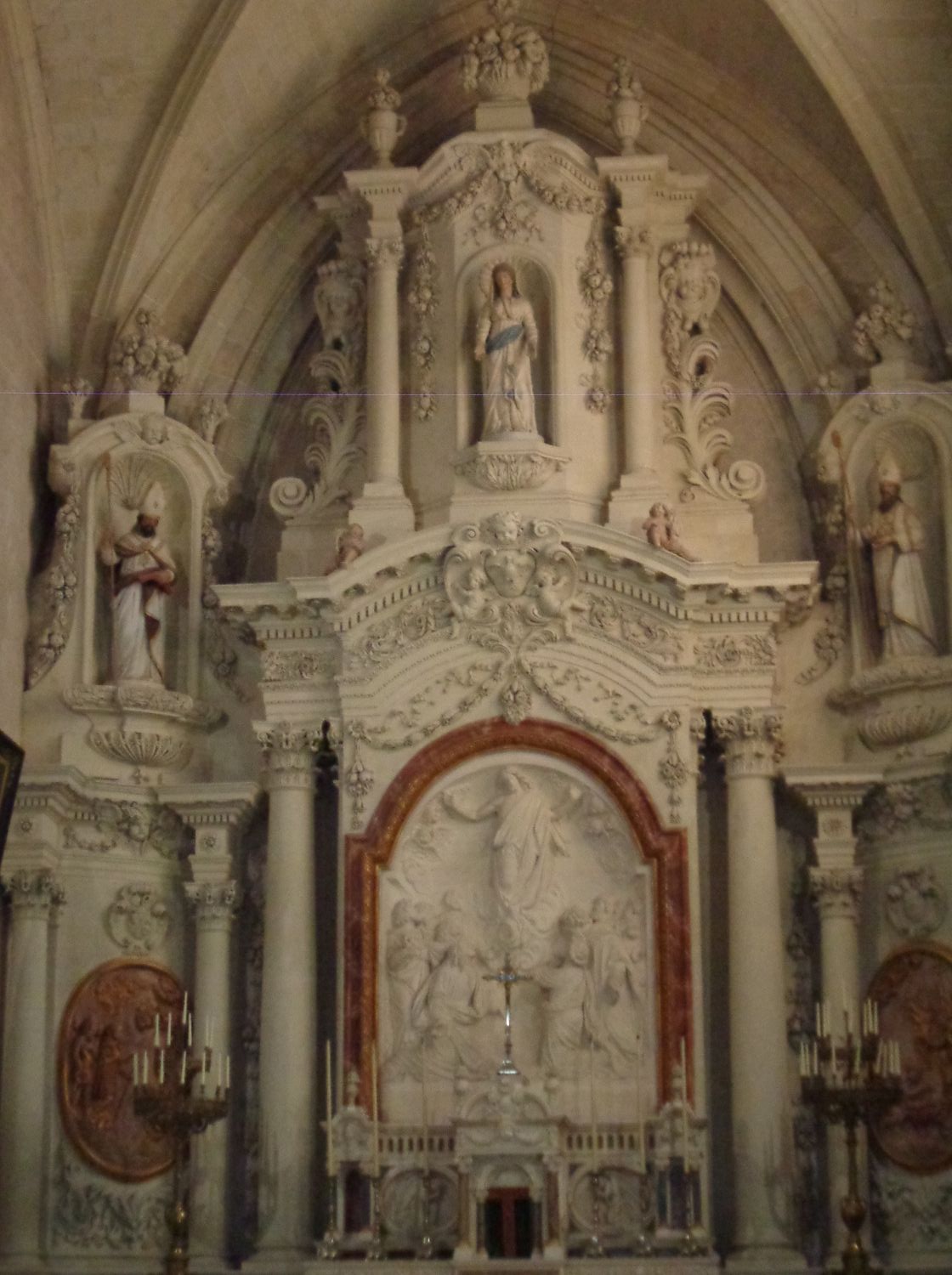
A fine example of a blend of Baroque and Classical styles, the 17C altarpiece, restored in 1995, stands out for its decorative richness. The scenes are set in a decor inspired by ancient architecture. The pink marble and gilt medallions depict episodes from the lives of saints: the baptism of Saint Augustine by Saint Ambrose on the right, Saint Hilary chasing away a monster on the left. In the center, a bas-relief added in the 20C represents the Ascension. It is surmounted by the dove of the Holy Spirit surrounded by angels. In the upper part, the altarpiece is crowned with three polychrome terracotta statues representing, from left to right, Saint Hilary, the Virgin in the central figure, and Saint Augustine. A rich repertoire of plant garlands completes this decor. The altarpiece was commissioned in the mid-17C by Duke Henri de la Trémoïlle The eleven stalls date from the 17C. They may have been financed by Duke Henri de la Trémoïlle. Carved in oak wood, with veneer, these stalls are in the classical style. An H adorns the upper part, the initial of Henri de la Trémoïlle and a symbol of ascension, of elevation towards God. See a 19C altar of Saint Joseph ,and a pulpit dating from the 19C, the pulpit is in the neo-Gothic style, inspired by Gothic art. The panels are decorated with the figure of Christ framed by two angels and Saint John. A Pietà: artistic theme of iconography in Christian sculpture and painting representing the Virgin Mary as a mother weeping for her child whom she holds on her knees, Christ taken down dead from the Cross before the Entombment The high altar from the end of the 19C is decorated in the lower part with a bas-relief representing the Last Supper. The organ was originally intended for the Church Saint-Médard, this instrument is a fine example of French craftsmanship between 1840 and 1880. Built in 1845, largely restored in 1864 and underwent several interventions in 1930 and 1947.



The town of Thouars on the religious monuments so Saint Laon: https://thouars.fr/ville-dhistoire/decouvrir-le-territoire/points-dinterets/monuments-religieux/
The Thouars tourist office on the abbey Church Saint Laon: https://www.maisonduthouarsais.com/decouvrir/patrimoine.html?alias=abbatiale-saint-laon
The Deux Sévres dept 79 tourist office on the Abbey Church Saint Laon : https://www.tourisme-deux-sevres.com/en/activite/abbatiale-saint-laon/
There you go folks, again, another gem of my belle France ! This is in wonderful City to be seen by all , rather staying in the off the beaten path trails, Again, great architecture and history as always, Again, hope you enjoy the post on the Abbey Church Saint Laon of Thouars !!! as I
And remember, happy travels, good health, and many cheers to all !!!

 Paris1972-Versailles2003