
I am becoming sentimental again, and even if mentioned in previous post do not have one alone on it and it so richly deserves one me think. I like to tell you a bit on the city of L’Isle Adam. I found some pics in my cd rom vault that should be in my blog for you and me. Therefore, this is my take on this is L’Isle Adam !!! Hope you enjoy it as I.
The town of L’Isle-Adam is located on the left bank of the Oise River in the Val d’Oise dept 95 of the Île de France region of my belle France, It is 35 km from Paris, 15 km from Pontoise, 43 km from Beauvais, 50 km from Versailles and 497 km from my current home. The main roads in the town are departmental roads 64 and 922. The D 64 connects L’Isle-Adam to Parmain crossing the Oise river, it continues through the forest to the N184, just before the junction with the N1 and the A16 autoroute, The D922 goes thru City center by the streets of rue de Beaumont and rue de Pontoise and intersects the avenue de Paris roughly in the center. It continues through the Bois de Cassan to the Le Grand Val shopping centre, allows a junction again with the A16 autoroute and the N 1, and, after taking the name of D922, continues all the way into Seine-et-Marne dept 77. The N184 connects L’Isle-Adam to Saint-Germain-en-Laye via Cergy-Pontoise, the N1 leads to Paris (Porte de la Chapelle), via the Croix Verte interchange, and, to the north, to Bray-Dunes (Nord, Belgian border) via Beauvais, Amiens and Boulogne-sur-Mer. The A16 autoroute, which begins in L’Isle-Adam, connects the towne to Belgium via Picardy and Nord-Pas-de-Calais. Lots of road warrior here especially the D922, N184, A16 roads.
The city of L’Isle Adam was the stronghold and then the holiday resort of princes of the blood and some of the greatest families of the French nobility before becoming in the 19C a bourgeois town attracting the inhabitants of Paris and many artists. I was rather quickly but got a glimpse of the Church Saint-Martin at rue Saint-Lazare,
The portal is perhaps the oldest part of the Church Saint Martin ,certainly not by the same architect as the rest of the church, it is probably a vestige of the previous church which was consecrated before its complete completion and which was probably only finished in 1537. The two sides of the walls have been transformed; the four statuettes representing: Death, the Last Judgement, Paradise and Hell which are modern. At the southern corner of the facade rises the bell tower, square at the base, octagonal at the top. The base alone belongs to the old work so badly damaged at the top by the fire which occurred in 1661. When the repairs were finished, the bell tower no longer exceeded the roof of the church which, itself, had also been completely redone.


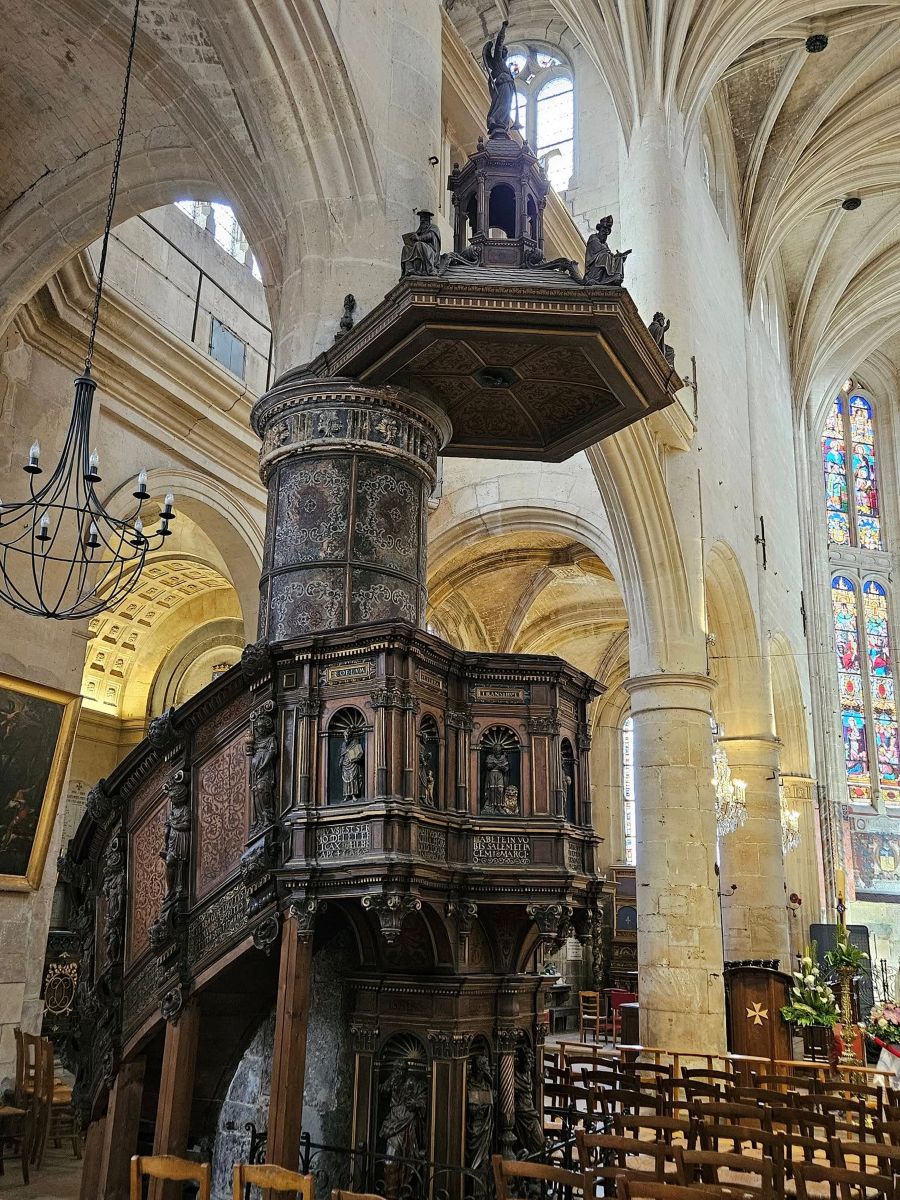
Still unfinished, it was consecrated on July 20, 1499, and finally completed in 1567, it was rededicated in the presence of the constable. In Gothic-Renaissance style, but very mutilated, it was largely restored from 1859 under the initiative of Abbot Grimot by a student of Viollet-le-Duc, Félix Roguet. The Church Saint Martin has wonderful items inside such as a 15C stalls, the Renaissance pulpit, the 16C chasuble, the wooden bas-reliefs of Henry II, and the mid-18C confessional. Over the years important renovation has taken place such as the restoration of the portal, elevation of the bell tower (1869), construction of the Chapel of the Virgin in the south transept (1878) and the presbytery (1869), installation of superb stained-glass windows in the main bays of the church (from 1854 to 1878),and the purchase of valuable furnishings (pulpit, stalls, confessionals, altarpiece, paintings, etc.). The Conti Funeral Chapel was built in 1776 at the north end of the transept to house the body of Louis-François de Bourbon Conti, the penultimate lord of L’Isle-Adam. The chapel is enclosed by a wrought iron gate, installed by Abbot Grimot. During the renovation work, on June 25, 2010, the crypt containing the coffin of Louis François de Bourbon, Prince of Conti, was opened. It was confirmed that the Prince’s coffin had not been desecrated during the French revolution. Prince Louis-François de Bourbon-Conti is buried in a chapel built for this purpose in 1777. Between 1848 and 1885, Abbé Grimot, parish priest of L’Isle-Adam, completely renovated the church, and uncovered the crypt of the Prince of Conti. In order to ensure the conservation of the crypt in optimal conditions and to prevent humidity from damaging this heritage, the tomb of the Prince of Conti will be closed.

Other things to see with more time are the Chinese Pavilion of Cassan, route de Beaumont, This is a Garden Factory in the Cassan park, dating from the 1780s. The Domaine de Stors, includes a castle from the beginning of the 18C, remodeled under the Second Empire; terraced gardens with two small Chinese pavilions and an underground room; a garden pond; a former parish chapel dating back to the Middle Ages and remodeled by Pierre Contant d’Ivry; as well as the former house of the ferryman of the Oise. The Louis-Senlecq Museum of Art and History at 46, Grande-Rue: it has been housed since 1951 in the Maison des Joséphites, a building erected in 1660 by the Prince of Conti, and which became the first free school for the children of the area. The Jacques-Henri-Lartigue Art Center at 31, Grande-Rue: It is located in an 18C property called the Petit-Hôtel Bergeret, then in 1899, the Maison Fritz, named after its last owner, Doctor Fritz, mayor of the town. The Château de L’Isle-Adam or Château des Princes de Conti, north of the Priory Island, rue de Conti, built in the 17C. Sold as national property during the French revolution, it was completely destroyed in 1812. Today, a small Louis XIII-style château stands on its site, known as “Château-Conti,” built in 1857 by the Ducamp family. Burned down by the Prussians during the Franco-German War of 1870, it was rebuilt identically and became a hotel, then a rest home. During the interwar period, it was converted into a restaurant. Cécile Sorel wrote part of her memoirs there. The castle now belongs to the city, The Pont du Cabouillet over the Oise river at rue de Conti, a 16C bridge connects the city center to the island of Cohue. The Plage or Beach, located at 1 avenue du Général-de-Gaulle, is now considered the largest river beach in France, the site of which was created in 1895, but is in reality a summer swimming pool in the immediate vicinity of the Oise river.
A bit of history I like but worth the extra me think, The story goes ,the village was part of the territories supposedly evangelized by Saint Denis in the 3C. A charter of Charles II the Bald dated 862, which constitutes the first written trace of the village, recalls that King Louis the Pious granted lands in Nogent in 832 to the monks of the Abbey of Saint-Denis. Viking attacks were at the origin of the military and then religious development of the longest of the islands of the Oise, today Priory Island. Following the signing of the Treaty of Saint-Clair-sur-Epte in 911, the Viking attacks ceased, Normandy was created and the Vexin was divided in two, it still is. The castle of the island was entrusted to Lord Adam, Adam de Moussy, related to the Capetian family recently installed on the throne. The castellany, then the island itself takes the name of L’Isle-Adam ,The Templars’ property in the lordship passes to the Hospitallers of the Order of Saint John of Jerusalem after the dissolution of the Order by Philip the Fair. Jean de Villiers is the father of Philippe de Villiers de L’Isle-Adam who is not lord of L’Isle-Adam, as a younger son but found his place as grand master of the Order of Saint John of Jerusalem in Rhodes from where he ensures the transfer to Malta. Pierre de Villiers, grand master of the King’s hotel is the first lord of this already powerful family to enjoy the Adamois lands. He had a chapel dedicated to the apostles Saint Peter and Saint Paul in the castle and received the King of France Charles VI there in 1386. Charles de Villiers (lord from 1510 to 1527) took advantage of the concordat signed between Francis I and Pope Leo X to be named commendatory abbot of the Abbey of Val and Bishop of Limoges. He received Francis I in his castle of L’Isle-Adam in 1519. Charles de Villiers sold his lordships to his cousin Anne de Montmorency in 1527, but kept the usufruct for the rest of his life. He died in 1535, before being able to be named cardinal as he wished. L’Isle-Adam then fully became a possession of the Montmorency.
Constable Anne de Montmorency had the castle and the banal mill located on the bridge connecting the priory island to the right bank of the river rebuilt in 1540. The castle welcomed Francis I in 1531, 1539 and 1540. King Henry II visited the Constable in his lands of L’Isle-Adam before his coronation in 1547 and then, the same year, on two other occasions, Henry IV, then King of Navarre, came to retake Pontoise and L’Isle-Adam, where he was on July 20, 1589. Having become King of France, he occupied the city again in January 1590 after the Battle of Ivry. In 1609, Henry IV returned to the city one last time. In revolt against Richelieu and royal authority, Henri II de Montmorency was executed in Toulouse in 1632. His property was confiscated by Louis XIII, who subsequently returned most of it to the deceased’s sisters. One of them, Charlotte-Marguerite de Montmorency, wife of Henri II de Bourbon-Condé, received the estate of L’Isle-Adam, which thus passed to the House of Condé, a younger branch of the House of Bourbon. Upon the death of Henri II de Bourbon-Condé in 1651, his property was divided between his three children: Louis II de Bourbon-Condé, Armand de Bourbon-Conti, and Anne Geneviève de Bourbon-Condé, Duchess of Longueville. It was Armand de Bourbon-Conti, the younger son and first Prince of Conti, who received the estate of L’Isle-Adam. He remained in this branch of the House of Bourbon until the French revolution. Cardinal Richelieu came to baptize Armand de Bourbon-Conti at the château in 1630 and Cardinal Mazarin attended his lavish wedding with his own niece in 1653. Louis-François de Bourbon-Conti known as the Father-Prince, lord from 1727 to 1776, made the château and its forests some of the most elegant hunting and party places in the kingdom, where Jean de La Fontaine stayed and where the young Mozart came to play in 1766. Works by Veronese, Titian, Le Nain and Watteau adorn the château’s grand gallery. The last lord of L’Isle-Adam, and last Prince of Conti, Louis-François-Joseph de Bourbon-Conti, in turn enlarged and embellished the estate: restoration of the castle, construction of gigantic stables for two hundred and fifty horses at the level of the current Manchez park, sold the rest of his heritage to the Count of Provence Louis-Stanislas-Xavier, brother of the King, who acted as a nominee for the King himself. The transaction was made in these terms: Louis XVI was to have the bare ownership of the lordships of L’Isle-Adam etc. The Prince of Conti reserved for himself the enjoyment until his death of the castles and parks of L’Isle-Adam. The French revolution and the First Empire intervening before the death of the Prince in 1814, the royal family was not able to enjoy the estates of L’Isle-Adam, nor the future Louis XVIII, This was the most splendid period of L’Isle Adam !
Administratively, L’Isle-Adam constituted a primary bailiwick at the dawn of the French revolution, it was attached to the secondary bailiwick of Pontoise and the principal bailiwick of Senlis. From 1789, the Prince of Conti emigrated. returning in 1790, he was appointed commander of the National Guard in L’Isle-Adam at the request of the inhabitants. Nevertheless, the prince gradually detached himself from his fief from this date and spent his last French years in his estate of La Lande in Villiers-sur-Marne. His property, previously sold to the King and his brother, was sequestered. He was imprisoned from 1793 to 1795 in Marseille. The advent of the Consulate and its deportation law led to his expulsion to Spain. He died in Barcelona in 1814, while his family’s splendid buildings in L’Isle-Adam were being dismantled stone by stone. Exactly eight hundred years after the construction of the modest priory on an island in the Oise by Adam I de L’Isle, the death of the last Prince of Conti shortly followed the end of L’Isle-Adam’s brilliant aristocratic history. The town was slowly recovering from the destruction of the Revolutionary period. During the Restoration, Louis-Philippe de Villers-la-Faye was appointed mayor of the city. A friend of king Charles X, he repeatedly invited the young Balzac to L’Isle-Adam, who, influenced by the place, later drew inspiration from it in some of his works. From the middle of the century, artists were interested in the site between the Oise and the forest and stopped there. This is the case of Jules Dupré, Théodore Rousseau, Honoré de Balzac or Daubigny.
The city of L’Isle Adam suffered particularly badly during WWII. In June 1940, the city welcomed French soldiers tasked with defending, as always in its history, the strategic passage of the Oise, thanks, this time, to the fortifications (casemates) of the Chauvineau Line, built in 1939 and early 1940 to be the first line of defense of Paris. Panic spread among the population: the city was practically emptied of its inhabitants, fleeing, while the nazis troops, coming from Parmain and Champagne-sur-Oise, attempted three times to cross the Oise. They were effectively held in check by the French army. On August 30, the enemy troops left the city for good, taking the same route that had led them there, via Parmain and then Champagne-sur-Oise. The same day around 17h, American troops entered the city without a fight from Mériel. On November 11, 1948, the city of L’Isle-Adam was cited in the brigade’s orders, with the award of the Croix de Guerre or War Cross medal with bronze star.
The City of L’Isle-Adam on its heritage : https://ville-isle-adam.fr/ma-ville/ville-touristique/les-lieux-remarquables
The L’Isle Adam tourist office on its heritage: https://tourisme-isleadam.fr/en/heritage/
The official association of Friends of the L’Isle Adam : https://amisdelisleadam.org/
The Val d’Oise dept 95 tourist office on L’Isle Adam : https://www.valdoise-tourisme.com/les-incontournables/lisle-adam-perle-de-bien-etre-et-de-tranquillite/
There you go folks, as said my blog is my life’s history ,here is a bit more of it, An off the beaten path city of my belle France, worth the detour for the history of it, me think. Again, hope you enjoy this post on this is L’Isle Adam !!! as I
And remember, happy travels, good health, and many cheers to all !!!

 Paris1972-Versailles2003