
I have come back in my road warrior trails of my belle France and Normandy is tops ; see my many posts on it in my blog, I needed to be back and did in grand style me think. Nice experiences which had made us come back again to historically and architecturally stunning Bayeux, From Pluvigner to parking Québec-Orangerie place de Québec Bayeux We got on the D768 then the N24 to A84/E3 en direction de D53 à Souleuvre en Bocage. Take the exit/sortie 41 and leave the A84 continue on the D53, D9 and D67 direction parking Place de Québec ,total of 3h20 and 303 km, and hit the cathedral first, Therefore, let me tell you about the Cathédrale Notre Dame de Bayeux , exteriors !!! Hope you enjoy it as I.
The City of Bayeux is from the department 14 of Calvados and the Normandie region, and in my belle France, It has been headquarters of bishopric since the 4C and a viscounty of the time of the Duchy of Normandy until 1749. Bayeux is famous for its tapestry depicting William the Conqueror’s conquest of England in embroidered form. It was the first town liberated by Operation Overlord and one of the few in Normandy to have remained intact after the fighting, thus preserving a rich architectural and cultural heritage. Bayeux is 15 km from Colleville-sur-Mer, 30 km from Caen, 261 km from Paris, and 303 km from my current home, Bayeux railway station is located on the Paris-Saint-Lazare – Cherbourg line and the Caen-Rennes TER line, but never taken it.
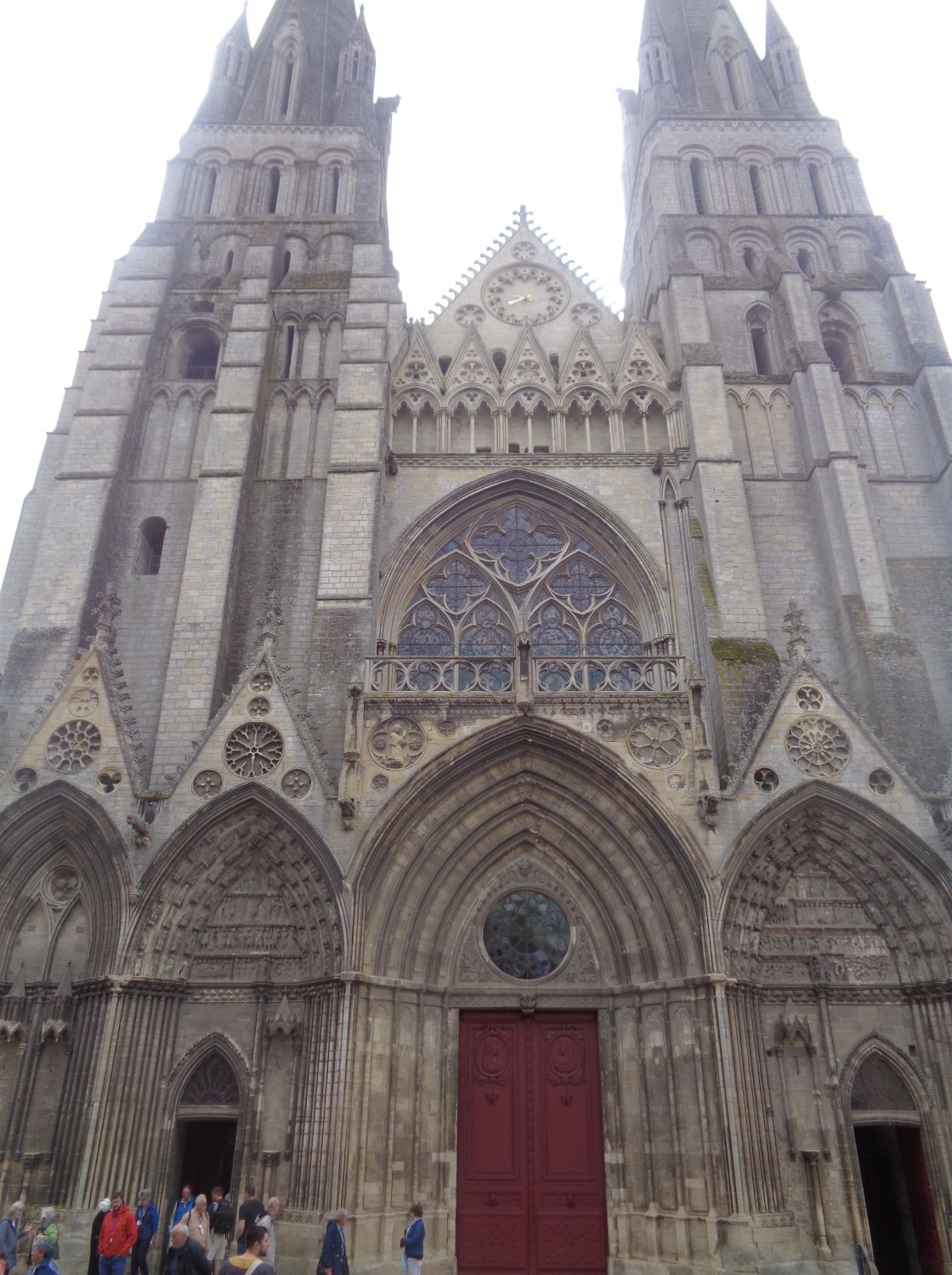
The western façade of the Notre Dame Cathedral, which faces a square located at the intersection of the streets of Cuisiniers, Chanoines, de la Maîtrise and Lambert-Léonard-Le-Forestier, is framed by two Romanesque towers with semicircular windows at the base of the Gothic spires. The lower level includes five porches, of which only the three in the center correspond to the entrance doors of the cathedral. The central portal was transformed in 1778. The two side portals, despite the loss of their large statues in 1562, retain the statues of the voussoirs and their tympanum. The tympanum of the north portal tells the Passion of Christ. The lower scene evokes the Last Supper and the washing of the feet, the scene above the arrest in the garden of olives, the flagellation and the carrying of the cross, the third the crucifixion and the last represents God the Father in majesty. The one on the south portal represents the Last Judgment. The first and second scenes depict the dead emerging from their tombs. To the right, under the door, is Hell with the Devil in the center. The third scene depicts a procession of the elect toward a heavenly Jerusalem. The last scene depicts Christ in Majesty, surrounded by two angels and two kneeling figures.
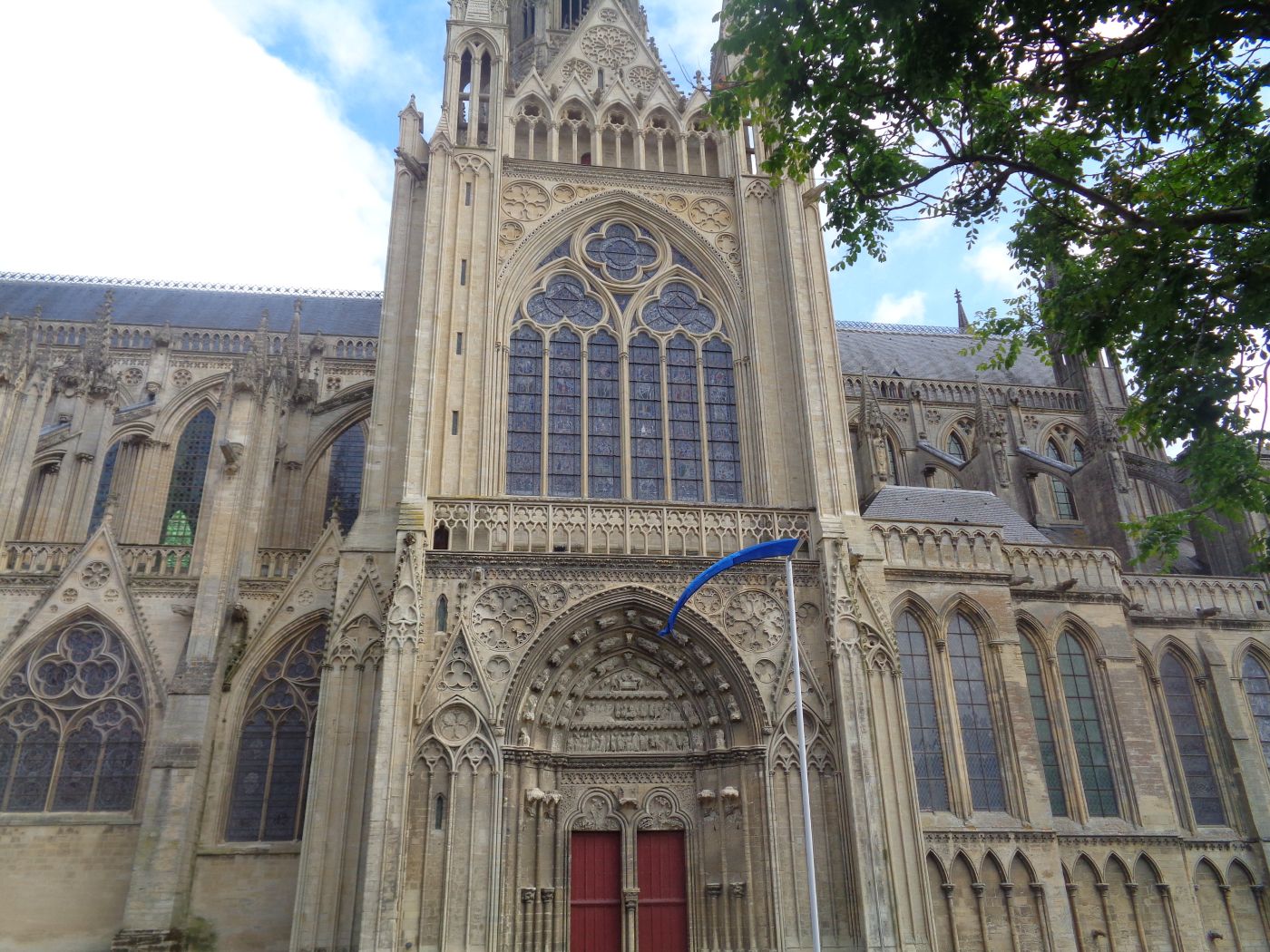
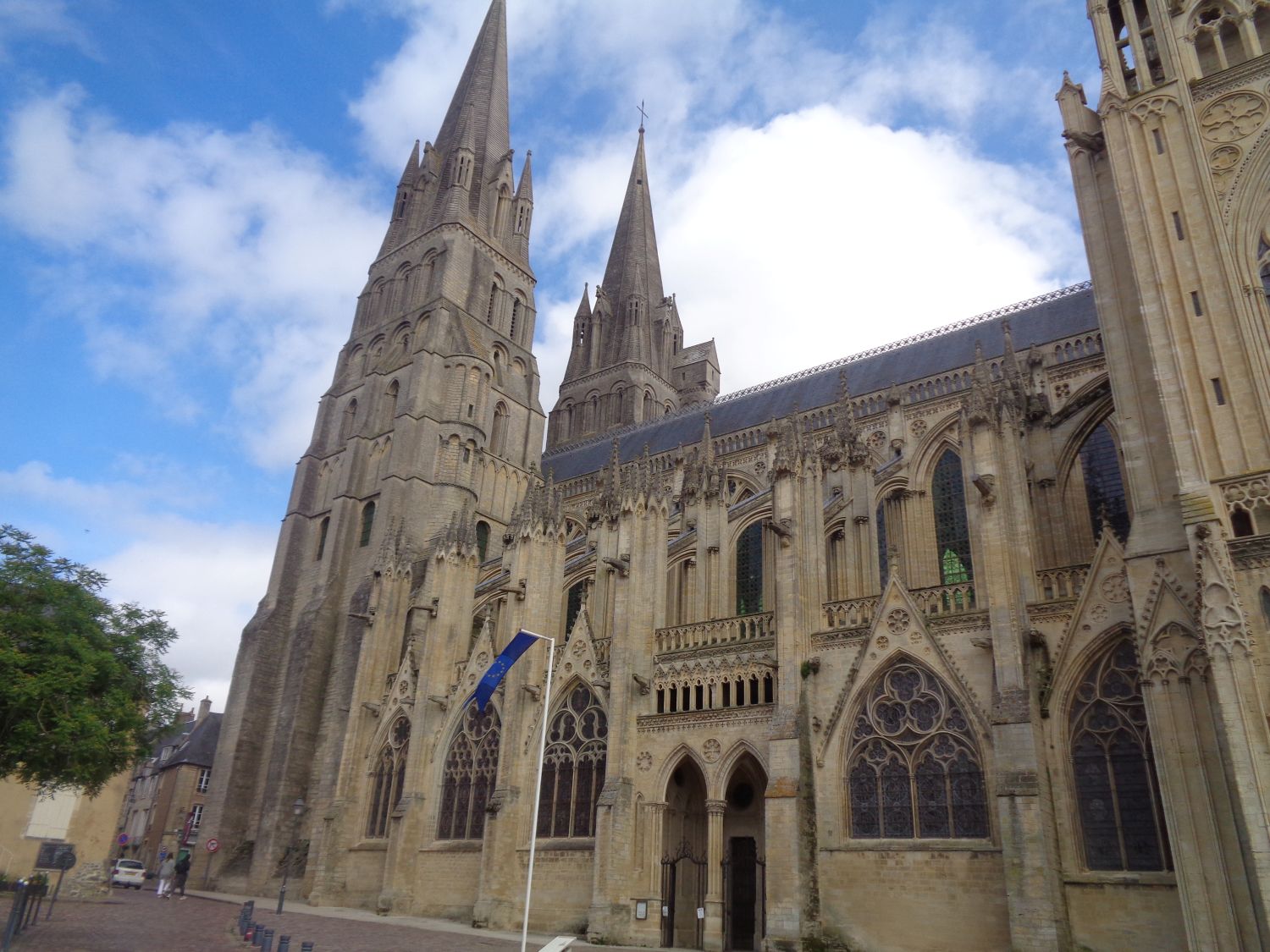
The nave, whose large arcades in the lower part are from the 11C and the upper parts from the 13C, is flanked by double-flight flying buttresses, the second built at the same time as the side chapels. The side portal is in the early Gothic style. Its porch, which has two bays, is aligned with the side chapels. It opens with two arches separated by a round pillar flanked by small columns and provides access to the two doors, each surmounted by an oculus. The transept rises on two levels. The south transept is occupied in its lower part by the Dean’s portal or portal of Saint Thomas Becket. It is surrounded by a radiant decoration of blind arches. The portal has two doors separated by a trumeau. Its three-frieze tympanum tells the story of the holy bishop. The first register tells of the assembly of Northampton (1164) which marked the break between Thomas and the King of England Henry II, then the assembly of Amboise (1170) which saw the reconciliation of the two men. The second register shows his crossing of the Channel on a ship, his ride and his martyrdom. The third register is a scene of veneration of the tomb. The portal is surmounted by an openwork balustrade and a large radiating window.
The Cathédrale Notre Dame of Bayeux is essentially Romanesque and Norman Gothic in style. We know nothing of the exact appearance of the pre-Romanesque episcopal buildings in Bayeux. The cathedral group is located in the heart of the city, just like the forum in the Gallo-Roman town of Augustodurum. According to tradition, the first bishop of Bayeux, Exupère, founded an ecclesiastical quarter there in the 4C in which three churches would stand, at the south-east corner of the city: one became the current cathedral; the second, dedicated to Saint Stephen, remained at the apse of the cathedral until the 17C; the third, Saint-Sauveur, gave its name to the parish. The Carolingian cathedral was destroyed by the Vikings and a new church was burned down in 1046. Hugh II of Bayeux decided to rebuild the cathedral, It was completed by his successor Odon de Conteville , half-brother of Duke William the Bastard, who took advantage of the economic benefits of the Norman conquest of England to quickly carry out this project. The extreme dates of its construction are between 1040 and 1080. The Gothic construction site began with the side aisles of the nave around 1180 in a style directly borrowed from the Île-de-France. The exterior walls were removed a century later for the gradual construction of the side chapels (around 1280-1350), between the old buttresses. During the French revolution, further looting occurred in 1790, and the cathedral then became a temple of reason. Subsequently abandoned, it suffered extensive deterioration. Restoration work was undertaken in the 19C.
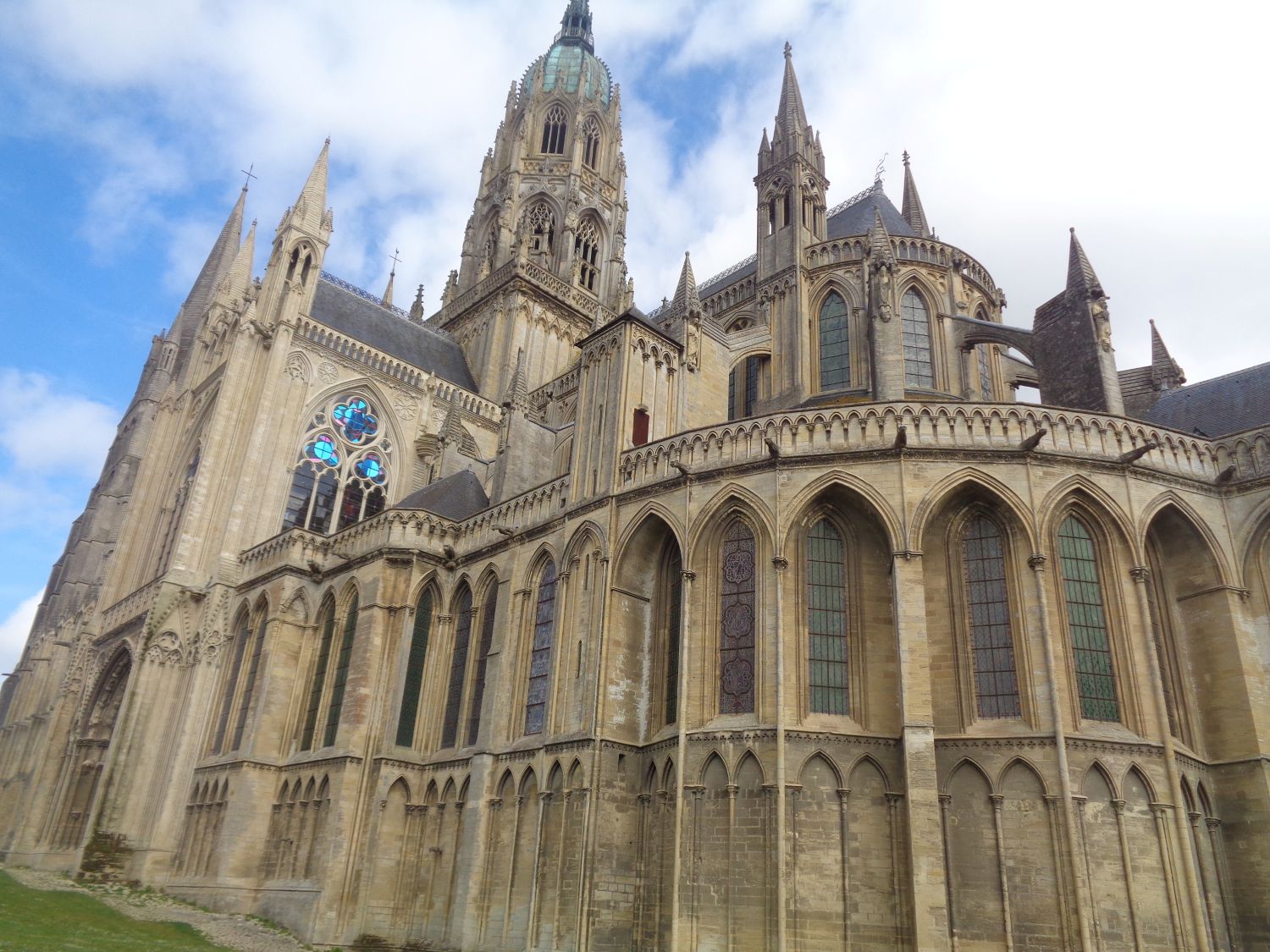
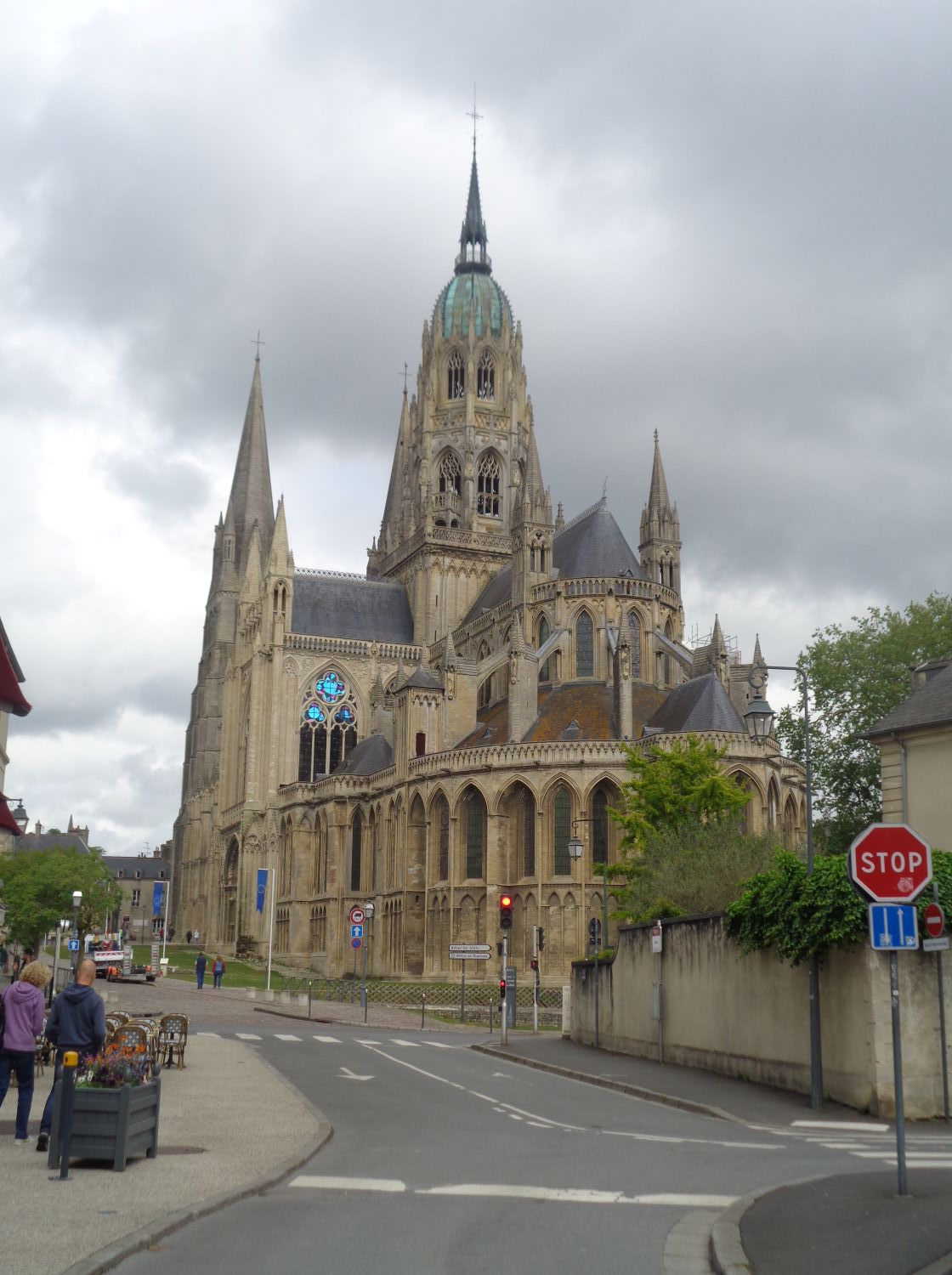
The central tower has a square base and is decorated with blind arches. The flamboyant-style balustrade allows for the transition from square to octagon. Its four corners feature busts of prophets and a Virgin and Child. The first floor (1477-1479) includes six bays with flamboyant tracery, restored in the 19C. A second level was built in the Neo-Gothic style in 1866. The tower is crowned with a copper dome surmounted by a turret and a spire.
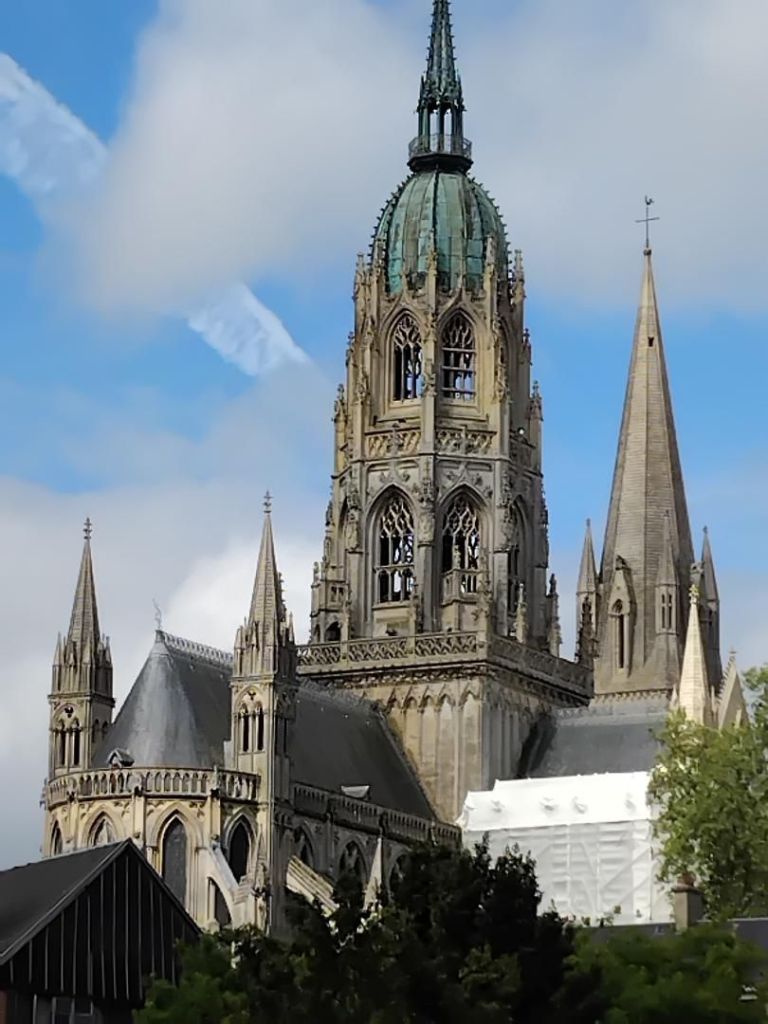
The chevet is derived from that of the Abbey Church of Saint-Étienne in Caen (see post). The radiating chapels, apart from the axial chapel, are part of the construction. The Gothic-style choir was built between 1220 and 1240. It exhibits the characteristics of Norman Gothic. The upper part of the buttresses of the flying buttresses houses statues representing the Virgin Mary, bishops and saints. They were replaced in the 19C by copies. Located in the current rue du Bienvenu in the extension of the main facade towards the north and perpendicular to the northern facade of the north tower where it has given onto the Flachat esplanade since the end of the 19C, the building of the chapter house (12–15C), doubled from the second half of the 12C, houses on the lower level a sub-chapter room, which gave access to the cloister which has now disappeared. An interesting lapidary deposit is exhibited there. The upper level is occupied by the chapter house, the exterior of which retains its primitive Gothic appearance. On the upper part of the tower, the north-east corner is flanked by the outside of the spiral staircase which leads to the “watch house” perched at the top of the tower, at the foot of the pyramidal spire.
The official Diocese of Bayeux-Lisieux on the Cathedral : https://bayeuxlisieux.catholique.fr/paroisses/notre-dame-du-bessin/patrimoine/eglises-lieux-de-culte-a-bayeux/
The City of Bayeux on the ND Cathedral : https://www.bayeux.fr/fr/decouvrir-bayeux/cathedrale-notre-dame
The official Friends of the Notre Dame Cathedral : https://www.cathedraledebayeux.fr/la-cathedrale
The local Bayeux Bessin tourist office on the Cathedral : https://bayeux-bessin-tourisme.com/en/visits/monuments/bayeux/cathedrale-de-bayeux
There you go folks, another dandy in beautiful Normandie, and my belle France,never enough time to see it all, This is a memorable spots that should be visited more, me think. Glad to be back, we had a great time indeed ! Again, hope you enjoy this post on the Cathédrale Notre Dame de Bayeux, exteriors !!! as I
And remember, happy travels, good health, and many cheers to all !!!


