
And we came back to mighty beautiful Chambord ! It has been said that the stretch of land on both sides of the Loire river passing by several famous towns for its castles was referred to as the valley of the kings. Well Chambord is the king of the valley! Chambord is a small village with a huge castle and even bigger forest in dept Loir-et- Cher,no 41 of the Centre-Val de Loire region of my belle France. As usual , I have written plenty but never enough when you consider the magnificent of Chambord. Therefore, here is my take on the Domaine National de Chambord ,part I !!! Hope you enjoy the post as I.
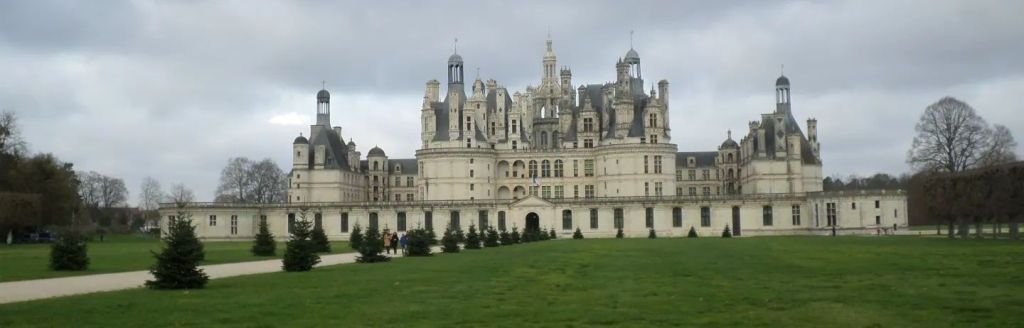
The village of Chambord is famous for its castle and its fully enclosed park, a national hunting reserve where presidential hunts once took place. The village and the entire territory are the property of the French State, administered in the form of a public industrial and commercial establishment called the Domaine national de Chambord. We follow in libre visit on our own, moved into the Keep and staircase right in the center. You visit the
coach room with carriages built by the Count of Chambord in 1871 with saddlery by Hérmes of Paris. The first floor you see how people lived in the 16C to 19C; move on to the Chapel completed by architect Jules Hardouin Mansart, the architect of Versailles! Continue to the bedrooms of François I and then the State Apartments done by Louis XIV same as in Versailles now decorated in 18C style as per Maréchal de Saxe. The original stair of François I is magnificent, but first some overall impressions. The castle has 156 meters long by 56 meters high and 77 stairs, 282 fireplaces, and 426 rooms !!!
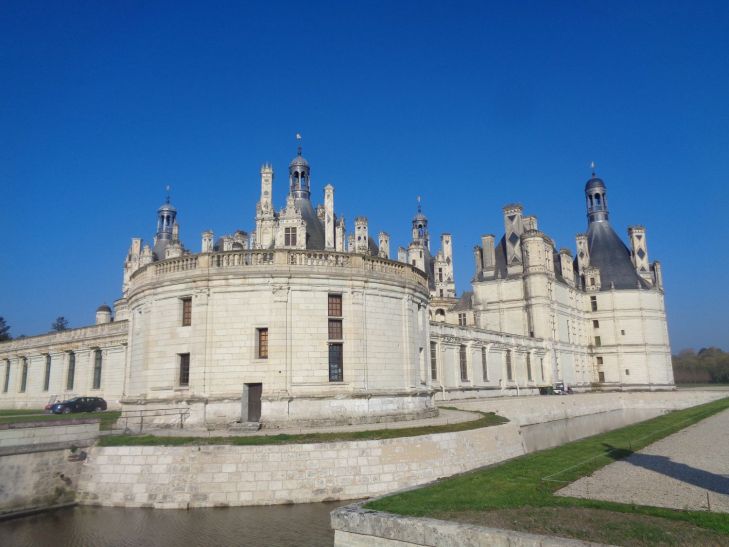
You arrive at the Queen’s apartments occupied by the two wives of Louis XIV, Maria Theresa of Austria and Madame de Maintenon. The Queen’s apartment is located in the tower adjacent to the King’s apartment. It would later serve as a 19C dining room for the Duchess of Berry. You reach the 18C apartments who hardly lived were occupied by visitors such as the exile king of Poland, and maréchal de Saxe. Then the wonderful historical museum of the Count of Chambord that were once his bedrooms. The Count own the castle from 1821 to his death in 1883 but spent only 3 days here. The last of the Bourbon Kings heirs of France, he died in exile in Frohsdorf, Austria August 24 1883 . Many items here some belonging to his mother the
Duchess of Berry.
The Molière’s Theatre tell the story first of one significant event in the history of Chambord, it is the premiere of the famous comedy-ballet Le Bourgeois gentilhomme, given for Louis XIV by the Palais-Royal troupe in 1670, a year after the creation, at the same venue, of Monsieur de Pourceaugnac. The plot of the new play was inspired by the recent reception of a Turkish embassy at Versailles. It was commissioned from Molière by the king himself and set to music by Lully. In that October of 1670, the sovereign came to Chambord to “spend the rest of the fine season in the entertainment that such a pleasant place can offer.” . A performance hall was specially set up in one of the vestibules of the keep, on the 1st floor: the stage faced the grand staircase while the musicians and then the spectators were seated in front. The premiere of Molière’s new play took place on the evening of October 14th. It received a reserved reception from the sovereign. Fortunately, the second performance given a few days later was a success, and Louis XIV declared: “Truly, Molière, you have never done anything that has entertained me more, and your play is excellent.” Its success has never waned. To commemorate this event, set designer Jacques Garcia wanted to recreate a small court theater on the very spot where the play was performed 350 years earlier. Through this evocation, Chambord invites its visitors to sit and admire the stage, as if a new performance were about to begin.

The former chapel of Louis XIV ,and later Theatre of the Maréchal de Saxe, The north vaulted room was converted in the 17C into a temporary chapel for Louis XIV and his court, pending the completion of the château’s great chapel. Then, in 1750, Marshal Saxe transformed the space into a sumptuous society theater to entertain his guests. In the evenings, light and entertaining plays by Marivaux or commedia dell’arte were performed here, performed by his own troupe. A large stage, with its orchestra, was set up on the window side. The spectators then took their seats in the stalls or in wooden side boxes. Finally, a majestic gallery crowned by a canopy was built for the Marshal and his most notable guests in front of the staircase. Many vestiges of the theater are still visible on the vault, walls, or window pillars with holes, hooks, hollowed out or painted coffers, leveled chimney, plaster, etc. Despite the considerable expense, the Marshal was only able to enjoy his theater for a few months before his death. The last textile and wooden elements were sold during the French revolution. On the second floor, the Greek cross room is covered with ample vaults with a slightly flattened, basket-handle profile. Despite their imposing dimensions, they remain airy and, moreover, the whiteness of the tuffeau stone helps to diffuse a beautiful luminosity here. Crafted in the Italian style in hundreds of square coffers, like ancient triumphal arches, they glorify François I by multiplying the royal emblem. The salamander, a family heirloom of the Valois-Angoulême, is the animal whose symbolic meaning is linked to that of fire, as devastating as it is benevolent. The royal motto, “nutrisco et extinguo” (“I feed the good fire, I extinguish, the bad fire ”), is clearly illustrated here: sometimes the salamander spits drops of water to extinguish the fire surrounding it, sometimes it feeds on the flames. The all-powerful king thus holds power over Good and Evil. The royal monogram “F” is surrounded by the knotted cord of the Franciscans. Because of his baptismal name, Francis 1er willingly places himself under the protection of his patron saint, Francis of Assisi, to whom he refers. The state of the vaults may be surprising: because they support the four terraces located just above, This is ,also ,part of the room of the theater of Maréchal de Saxe. 
The Chapel of the Château de Chambord located in the west tower on the first floor. Begun under François I, it was only completed under Louis XIV, by Jules Hardouin-Mansart. The statue, offered by its author to the Count of Chambord, commemorates the valiant act of Elisabeth of France, (Madame Elizabeth) younger sister of Louis XVI, during the French revolution. On June 20, 1792, at the Château des Tuileries (was demolished), invaded by rioters, she tried in vain to pass herself off as Marie-Antoinette by saying: “I am the Queen.” Finally imprisoned like the royal couple, she died by guillotine in 1794. This altar, commissioned by the Count of Chambord, was created by reusing an old altar stone and tabernacle. It is decorated with the Chrism, or “monogram of Christ”, formed from the Greek capitals X (chi) and P (rho), here framed by the letters a (alpha) and ω (omega) symbolizing the beginning and the end. The two armchairs and their “prie-Dieu” with cushions on the kneeler, are upholstered in tapestries made by Legitimist ladies in homage to the Count of Chambord. They are thus decorated with the crowned figures of Henri de Bourbon, Count of Chambord,(Duke of Bordeaux,and Henri V)), and Maria Theresa of Modena, his wife.

The external staircase of the chapel wing ,This simple spiral staircase, that is to say, consisting of a single flight of steps, serves all levels of the chapel wing from the ground floor to the attic, but also the passageway connecting the keep to the wing. Begun at the end of the reign of Francis I at around 1545, it remained unfinished at the death of the king. Like the adjoining wing and gallery, its construction continued during the reign of Henry II but was not completed until the following century (1684-1686). The ornamentation of the staircase adapted to the rhythm of the construction: on the ground floor and first floor, bases and capitals are sculpted with salamanders, emblems of Francis I, while the second floor is decorated with “H” and crescent moons in reference to King Henry II. As for the summit, it remained unfinished due to the definitive interruption of the construction site. Thus, the blocks left waiting to be sculpted were supposed to take the form of terms, human figures made up of the head and bust, as on the staircase of the royal wing.

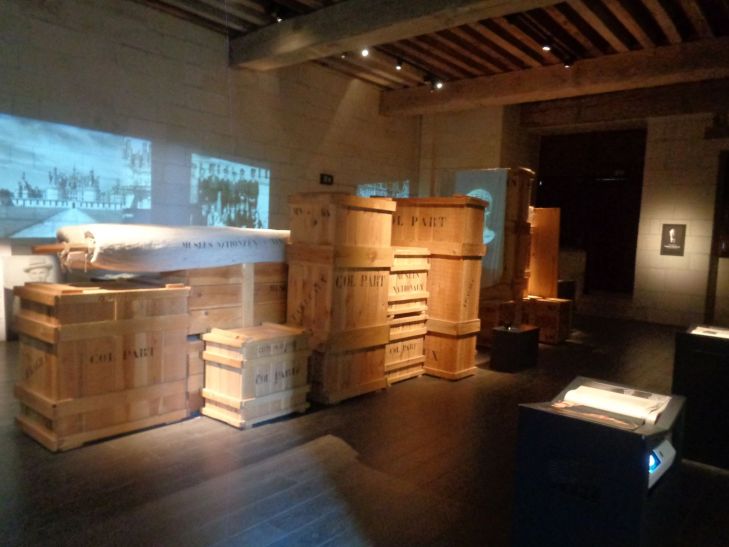
More than a decade after the temporary exhibition Hostages of War. Chambord 1939-1945, presented at the château in 2009-2010, the Domaine National de Chambord wished to include in the tour circuit, at the level of the famous terraces, four rooms which explain how it participated in the protection of the masterpieces of French museums during WWII. Thanks to precious archival documents completed over the years, photographs from French and German photographic collections, two short documentaries and an immersive scenography, these spaces highlight the question of art in Nazi policy, the protection of works from the National Museums and certain private collections from their evacuation to their return, as well as the daily life of Chambord –château and village until the dramatic days of August 21 and 22, 1944. Organized into nine themes, with a scenography allowing you to skim over them or delve deeper into them thanks to richly illustrated bilingual (French and English) leaflets, as well as a focus on the fate of two major works from the Louvre , the Mona Lisa and The Raft of the Medusa, this permanent exhibition for all audiences highlights different, rather unknown, facets of life in the castle and the village during this troubled period, but also pays a legitimate tribute to all those people in the shadows who, from from the director of the National Museums to the often war-disabled guards, from residents to resistance fighters, they watched over “the beauty of the world”. Thank you,
On the second floor of the castle is the museum of hunting and nature since 1971.

The history of hunting and else runs deep here and still very much practice in France with modern regulations. King François Ier hunt with hounds at his time. However, the French revolution of 1789 democratised this type of hunting. The creation of the national hunting and wildlife reserve in 1947 put an end to this mode of hunting in Chambord. Indeed, a population of deer and hinds grows about 30% per year. From 600 animals before birth, we can therefore take 200 individuals without endangering the species. The capture of live deer in the forest of Chambord began in the 19C and took off in the 1950s. The very sustained demand for animals for other sites has led to the capture since 1950 of nearly 100 deer and hinds per year. Chambord has now become the only French, and even European, site specializing in recovering wild deer. The management of the wooded areas of the park is currently carried out by agents from the National Forestry Office (ONF) , and the National Hunting and Wildlife Office (ONCFS) made available to the estate. A third of the forest area of the national domain of Chambord is covered with coniferous trees. In these plots, on average, thinning or stand regeneration is carried out every ten years, if it is mature. Between 12,000 and 15,000 m3 of wood are exploited per year. In 1969, the national domain of Chambord was one of the first French sites to install observatories in the forest. There are eleven observatories in the part of the grounds open to the public, five of which can accommodate fifty people, and six have a capacity of three to four people. These elevated platforms allow the observer to spot , if lucky ; a wild animal, without it being locked up, like in a zoo. The Stables of Maréchal de Saxe where equestrian shows are held for most part of the year but not when visited.
Upper floor see the wonderful ornamental ceiling vaults with monograms of François I and his salamander. Here on the second floor you see the hunting tradition of the castle. All kinds of artifacts and Tools used for hunting in the 16C is here displayed. And you can see spectacular views from the castle terraces over the domaine property. The park is 5440 hectares or 54,4 square kms or about 21 sq miles. All surrounded by a wall of 32 kms or about 19.8 miles been the largest enclosed forest park in Europe! with a national game reserve containing many types of animals living completely free. Open to the public there are 800 hectares or about 1 sq mile !!!
The towers give a impregnable view over the gardens and forest, great for the second vocation that of hunting. Coming out of the staircase to the top you see a lantern that is not inhabited but serve as lookout and has a fleur de lys the symbol of French royalty. On the southern front you see a lower cercle base where to see the garden at eye level. Here you see the donjon tower coming to the royal wing as a refuge and passing into the forest by the king. It has 156 meters (about 515 feet) of façade and inside a wonderful staircase. The surrounding wall of the national domaine of Chambord begun around 1542, is 32 km long. The construction work was long and yet it does not seem to have been interrupted after the death of Francis I as there are invoices from 1556 attesting that Henry II, his son, ordered the residents to continue the work in his absence. This wall of 2.50 meters of average height rests on foundations 70 cm deep. It is made up of small dry stones of limestone from Beauce. The gates created in the perimeter wall were lined with gates which remained in principle closed at night until the beginning of the 20C.They had lots of break-ins! They were then replaced by game grids placed on the roadway which both allow vehicle traffic and prevent the passage of animals.
A selection of products made according to the rules of the art from the natural resources of the domain is already offered for sale under the brand “Château de Chambord” in the castle boutique, (which is always great to buy), in a space identified as such. Honey, game terrines, wooden objects from the Chambord forest, deer antlers (key ring, walking stick, etc.) are currently marketed. From 2019, date of the 500th anniversary of the start of the construction of the castle, the wine was produced on the estate, and therefore the first vintage of wine from the Château de Chambord reach 50,000 bottles. The Sologne ewe is considered to be one of the current breeds closest to the old types of French sheep. In the 15C, its breeding was very important in the region. The rebirth and establishment of the Royal Court in the Loire Valley fostered the prosperity of the wool trade and sheep farming. Following the objective of restoring the domain to its agricultural vocation, 50 ewe lambs (six months old) and a ram arrived to form the basic herd to reach a goal of 200 ewes in 2026, divided into four herds, led in organic breeding!
You should not miss from the visit the audiovisual room (film presentation), the double revolution staircase, the apartments of François I and Louis XIV, the carved arches of the second floor, the terraces, and the North parterre garden at minimum. Chambord is originally dedicated to the arts. The Moliére’s Le Bourgeois Gentilhomme was played for the first time before Louis XIV in 1670! It, also, offers many nature activities in the park, like horse show, carriage ride, visit of reserves in a 4X4 vehicule , visit on foot or by bike etc. Today still open to the public the castle or domaine national de Chambord covers 5 440 hectares of which 1 000 hectares are open to the public, also, the biggest forest enclosed park of Europe. A marvel of our times and much needed to be visited while in France.
The Chambord castle practical information can be translated to several languages, time and prices can change so check the official site Chambord.org . Parking is 6€ per day the closest to the castle. Food inside at the Café d’Orléans is very nice for simple sandwiches snacks etc and soft drinks. The Café des écuries outside is very nice and can see the castle with good views. On the Village square approaching the castle you have several eateries as well and shops. There is a nice boutique inside by the entrance with all the trimmings including food local product, and there is the La maison des vins de Cheverny, very good for tasting and buying the local wines that are good and good prices. You can ,also, rent cottages just inside and at the door of the castle very nice; not use them but they look good.
And you can say the château de Chambord started out as an arts presentation place been the first show of Moliére Le Bourgeois Gentilhomme played in 1670 in front of king Louis XIV. It has more than 4500 objects of arts and furniture to show. A full children program is available ask at front office. Many activities in the property from equestrian shows such as the écuries of maréchal de Saxe, Drama shows, visites in 4X4! rides in horse wagon , boat or bike, walks with guide, concerts, and see the English garden done in 1889. A nice boutique store and restaurant on Le Café d’Orléans.
A bit of history I like tell us that in 1519, François I started not far from Blois in the middle of a desert with trees and marshes on a semi abandoned village a huge project. Victor of the battle of Marignan, the young king intends to seduce by stones as he seduce by arms. It’s time to dazzle the world by a new and perfect work. Chambord was the first castle of François I entirely done from scratch. François I died in 1547, with finally only passing 72 nights in the castle in 32 years of reign. Work continue under Henri II but he ,also, died in 1559, consolidation work is still done in 1566 under Charles IX. Far from the court, Henri III and Henri IV do not lived in the castle. Louis XIII only spent two nights in the castle, and from 1639, the castle is only occupied by the brother of the exile king Gaston d’Orléans. We need to wait until the coming of Louis XIV to finished the project of François I;giving the work to famous architect Jules Hardouin-Mansard. Louis XIV stayed only 9 times here , first in 1650 and then lastly in 1685 (company of Madame de Maintenon) ; coming each time on the occasion of the play by Moliére, Monsieur de Pourceaugnac and le Bourgeois gentilhomme. The king Louix XV used the castle to welcome host the father-in-law Stanislas Leszczynski, king of Poland in exile between 1725 and 1733. By then, the king of Poland leaves for its final place in Nancy. The castle stays uninhabited for many years until 1745, Louis XV gives it as donation to the Maréchal de Saxe that becomes governor for life and lives there permanently since 1748 until his death in 1750. After, the later passing, the castle is lived by the governors like his nephew Von Friesen died there in 1755, then the marquis de Saumery until 1779, and the marquis de Polignac chase out by the French revolution in 1790. After much destruction by the revolutionaries, the castle is in very bad shape by 1796 but still standing.
By July 1802 the first consul Napoléon Bonaparte gives the castle to the legionnaire that after two years finally comes to lived here ,General Augereau. Finding the castle totally deliberated and begins a period of renovation. Under the emperor Napoléon I, it was decided to use it as a school for girls of the legion of honor guard in 1805 but the decision was not followed. The castle comes into the legion of honor guards and rename the principality of Wagram and given in 1809 to the maréchal Louis-Alexandre Berthier, prince of Neuchâtel and Wagram; he comes only one time to the castle! in 1810. Upon his death in 1815, the castle was put up for sale by his widow not able to keep up with the costs.
In 1821, the castle is acquired by national subscription sale to the young Henri d’Artois, duke of Bordeaux, upon the death of Charles X, the prince is the chief of the senior branch of the house of Bourbons and takes in exile the courtesy title of Count of Chambord. He continues from afar to invest money for the renovation of the castle. During his period , the castle is open to the public. During the Franco-Prussian war of 1870, the castle served as a hospital and in 1871 the Count of Chambord lived briefly. He calls upon the French to bring the monarchy back under the white flag of the French monarchy; (bad decision the representatives wanted a constitutional monarchy similar to that of the UK). Upon his death in 1883, the castle passes to the descendants prince Bourbon Parma and nephews Robert I of Parma, Duke of Parma and Plaisance, and his brother Henri de Bourbon-Parma count of Bardi. Upon the death of the latter in 1907, it passes to his son Elie de Bourbon duke of Parma and Plaisance. With financial situation the castle passes to the French State on April 13, 1930 after been used during WWI by the government. From the beginning of WWII the castle becomes the center of tri of the treasures of the national museums of Paris and the north of France to be evacuated and protected from the bombings of the Nazis. After the war, the objects of arts are re send back to their original places most of it to the Louvre museum.
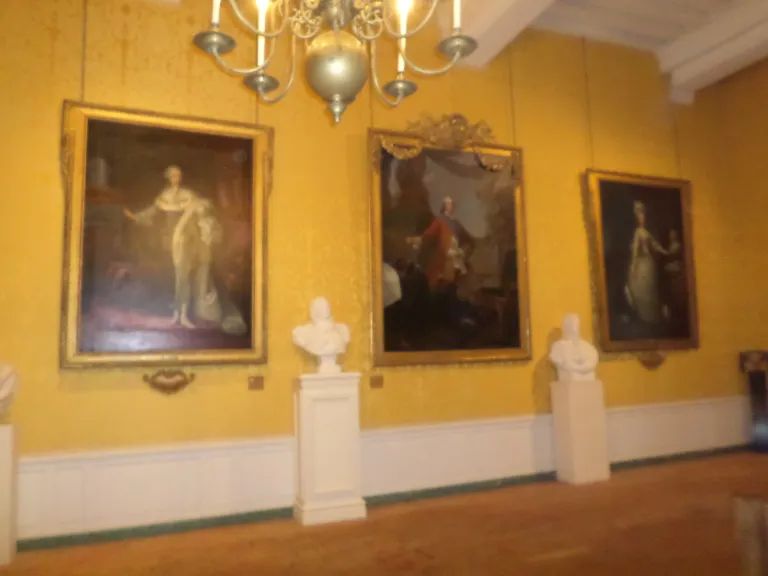
A very important historical event to explain the above statement of the Count of Chambord. A wished king Henri V born Henri d’Artois also called Henri, Count of Chambord. He is first known by the name of Duke of Bordeaux, grandson of King
Charles X who abdicated in his favor at the end of the French Revolution of 1830. Henri V said he was king of France not proclaimed from August 2, to August 7 1830. In 1873, he refused an attempt to restore the monarchy offered to him by the vast majority of the deputies of the National Assembly ; because he refused to serve under the revolutionary flag of France that we know today as the tricolore but rather the royal white crown flag of France. His letter explaining his decision is in his room at Chambord. Near me in St Anne d’Auray (Morbihan 56) there is a monument to his memory where royals still meet. This was the last chance of a king in France, never again has happened and very unlikely in our days.
The official Domaine National of Chambord on the castle: https://www.chambord.org/en/discovering/the-castle-visit/
The local Blois-Chambord tourist office on the castle: https://www.bloischambord.co.uk/discover-the-destination/the-loire-valley-castles/chateau-de-chambord/
The Loire Valley Centre Val de Loire region tourist office on the domaine de Chambord : https://www.loirevalley-france.co.uk/discover/loire-chateaux/national-domain-chambord/
The official Nature 2000 ecolo park system on Chambord: http://www.natura2000.fr/node/64038
There you go folks, I say the king of the valley of the kings, Chambord, undescribable. A must to visit while in France. We had come back, and will again. We were there even during Christmas magical, and concerts awesome. Again, hope you enjoy this post on the Domaine National de Chambord ,part I !!! as I.
And remember, happy travels , good health, and many cheers to all !!!

 Paris1972-Versailles2003