
We have walked/driven in the area and would like to have an imprint in my blog on the wonderful towns of my belle France, There is so much to see , doing my best, and glad found me these older pictures in my cd rom vault, which now transposing in my blog for you and me ; memories are forever, Therefore, here is my take on the Collegiate Church Notre Dame de l’Assomption of Crécy la Chapelle !!! Hope you enjoy the post as I.
The town of Crécy-la-Chapelle is located in the Seine-et-Marne department no. 77 in the Île-de-France region of my belle France. It is 15 km from Meaux, 42 km from Melun, 61 km from Fontainebleau, 51 km from Paris, 72 km from Versailles, and 521 km from my current home. The town of Crécy-la-Chapelle was born on October 1, 1972 from the merger between the former towns of Crécy-en-Brie and La Chapelle-sur-Crécy. I have visited from Meaux on the D360 then at Quincy-Voisins take the D228 bear right into Rue de la Chapelle to Boutigny here take the D33 past Bouleurs, onto Crécy la Chapelle, You can come here by train tram from Paris gare de l’est on line P dir Meaux stop at Esbly ,than tramway 14 to Crécy la Chapelle, never taken but the transilien says less than an hour.
We come to Crécy-la-Chapelle the little Venice of the Briarde fed by the Grand Morin. Along this river, worked and lived Camille Corot one of the precursors of the Impressionists movement, The town dates from the fortified village of the 12C, By the 15C several tradesmen such as tanners, and curriers worked the skins along the quai de la Tannerie taken via the Grand Morin to Meaux and Lagny to the great fairs of Champagne region and Paris. This valley of Grand Morin I came several times with my dear late wife Martine to visit a homeopath plant medicine doctor we followed, sadly he passed away too. He was at St Germain sur Morin.
The Collegiate Church Notre Dame de l’Assomptiongothic but with franco champenois styles from the 13C and 15C, Its belltower is 33 meters high with great arcades beneath it, Originally, there was the small oratory of Vignely, founded in 1123, dependent on the priory of Saint-Martin-du-Vieux-Crécy. This priory had been a dependency of the abbey of Saint-Martin-des-Champs since 1143. The general plan of the church includes a nave of six bays and a choir ending in a heptagonal apse. The two side aisles framing the nave are terminated by slanted apses. The choir is covered by a single ribbed vault of twelve branches radiating around a central keystone. The apses are covered by a seven-branched ribbed vault dating back to the 13C. You see the Descent from the Cross, oil on canvas by Jean Commère.
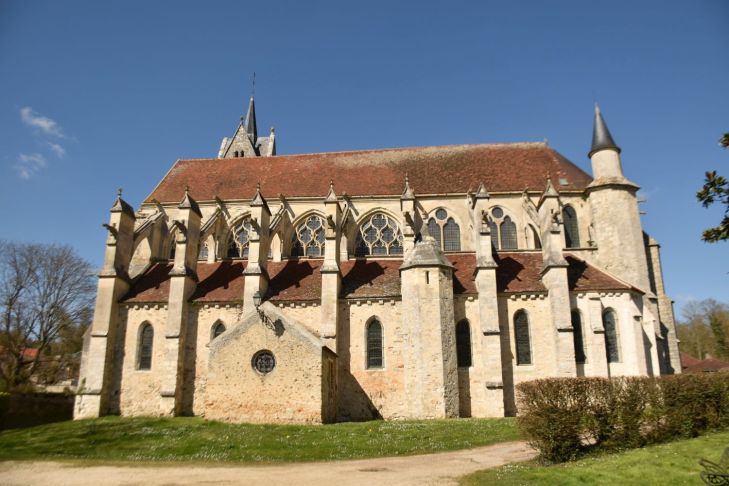
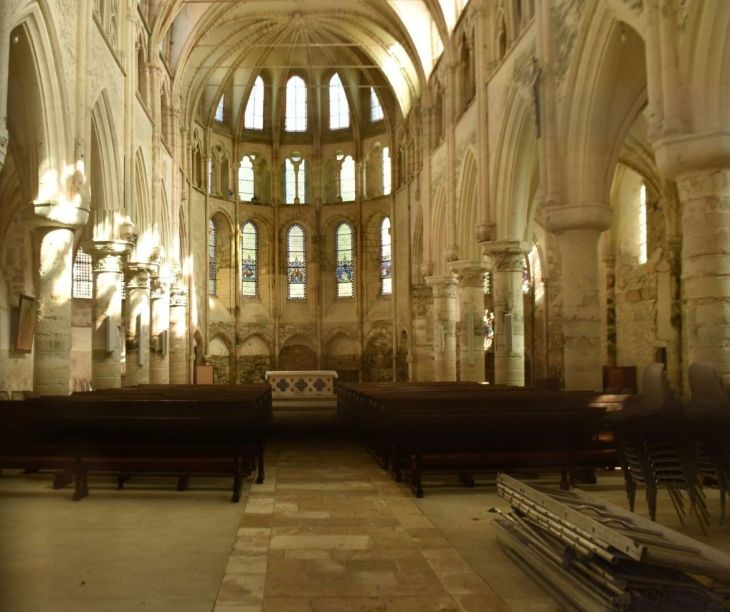
The collégiale Notre-Dame de l’Assomption or Collegiate Church of Our Lady of the Assumption is a Gothic jewel of Brie, built between 1202 and around 1250. The choir vault has the particularity of being supported by 12 ribbed vaults. In1421 during the Hundred Years’ War, the English burned it. On May 16, 1429: Jean de Briou, Bishop of Meaux, consecrated it after repairs. On October 28, 1684: Bossuet ,the Eagle of Meaux bishop came to preach there for confirmation. In the 20C, numerous interior and exterior works were undertaken to preserve the monument.

Other things to see in town are the Château de Crécy-la-Chapelle ,a 19C castle. Saint-Georges Church (see post) . The Belfry. The Passage du Guet, Catherine de Medici, Queen of France, who owned a residence and grew melons here, Charles Étienne Louis Camus, French mathematician and astronomer, was born in a house on rue des Barrois. You can go underneath the tour de la Reine aka Grosse tour one of the better preserve, and the tour de la Prison where stayed Camille Corot.
A bit of history tell us that according to legend, Crécy was founded in 930 BC by the Duke of Hibros who came to Gaul at the head of 2,000 Sicambrians. The left bank of the Grand Morin was the cradle of the village, then it moved to a small islet, fortified for the occasion. In 861 the Normans pillaged, sacked and burned Crécy, Meaux, Melun and the entire region. It was from the 9-10C that the first fortress was built. In addition to the castle, it had a formidable double rampart built, flanked by 99 towers, some of which still exist. Four vaulted gates with drawbridges allowed entry: the Meaux gate, the Chapel gate, the Dame Gilles gate and the Marchande gate which was removed in the 17C. Gaucher III of Châtillon, Count of St-Pol, son of Gaucher II, is said to have had the inner wall of the town restored or rebuilt and it was his son Hugues, Count of St-Pol and Blois, who was said to have commissioned the second wall, erected to protect the new market district and definitively include it in the protected perimeter of the town. It was probably between 1225 and 1230 that Crécy was then possessed by Thibaut V of Champagne-Navarre, then by his brother Henry III of Champagne. Upon the latter’s death, his daughter Jeanne of Champagne inherited it. The estate was added to the French Crown in 1284, upon the marriage of Countess-Queen Joan to Philip the Fair. The castle, neglected and poorly maintained by its various owners, became difficult to inhabit and began to fall into ruin. In 1429, Joan of Arc and Charles VII passed through the city on their way back from the coronation. In 1436, the English seized the city, and the Armagnacs and Burgundians fought over its possession. Later, the Écorcheurs tried to seize it. They were armed troops from the 15C, war entrepreneurs who practiced pillage, ransom, but also the customary forms of medieval warfare (siege, defense of strongholds, battles, rides) for their own profit and that of King Charles VII, to whom they claimed to belong. In 1574, Henry III, then Duke of Anjou, on his way to Poland, crossed the town accompanied by King Charles IX and his mother Catherine de Medici. Crécy survived the French revolution without major unrest. During the French campaign, the coalition armies occupied the town for 9 days. the final phase of the war waged by the Sixth Coalition against the French Empire, which took place from late December 1813 to April 1814, and during which Napoleon I attempted to halt the advance of the coalition troops into France and retain his throne.
The city of Crécy-la-Chapelle on its history/ heritage : https://www.crecylachapelle.eu/decouvrir-la-ville/histoire-de-crecy-la-chapelle/
The local Coulommiers pays de Brie tourist office on Crécy la Chapelle : https://www.coulommierspaysdebrie-tourisme.fr/les-villes-et-villages-du-pays-de-brie/crecy-la-chapelle/
There you go folks, a dandy area to explore and enjoy with the family, Memorable moments in my belle France, driving all over in my road warrior trails brings out sublime awesome spots with nice memorable family visits of yesteryear always remember and always looking forward to be back, eventually. Again hope you enjoy the post on the Collegiate Church Notre Dame de l’Assomption of Crécy la Chapelle !!! as I.
And remember, happy travels, good health, and many cheers to all !!!

 Paris1972-Versailles2003