
I take you to a new destination in my ever running road warrior trails, I found me some pictures in my cd rom vault and they should be in my blog for you and me, This is a wonderful area long ran over it all over and glad to tell you more of it, Therefore, this is my take on this is Surgéres !!! Hope you enjoy the post as I.
The town of Surgères is located in the Charente-Maritime department, no 17 in the Nouvelle-Aquitaine region of my belle France. It is 36 km from La Rochelle, 26 km from Rochefort, 34 km from Niort, 166 km from Bordeaux, 159 km from Nantes and 305 km from my current home. Two roads serve the city and are at the origin of its urban development. They also make this city a must-see place between the north and south of the department as well as between the east and west. This is the D911 connects Mauzé-sur-le-Mignon to Rochefort, and the D939 which goes from La Rochelle to Périgueux via Surgères and Angoulême. Furthermore, the city is directly accessible by the A10 autoroute located 30 km away, from exit 33 (Niort-La Rochelle).
The historic center of Surgéres ,site of a preserved medieval wall, famous Romanesque church, remarkable Renaissance gate, renovated and pedestrianised historic center, and cultural center with performance hall, cinema, music and dance schools, library, numerous festivals, etc, where tourism provides additional entertainment. The historic heart is structured on the one hand around its castle and its wall which constitute the original core of the town, then built on the right bank of the Gères, and on the other hand, around the town center, established on a slight eminence, overlooking the castle square.
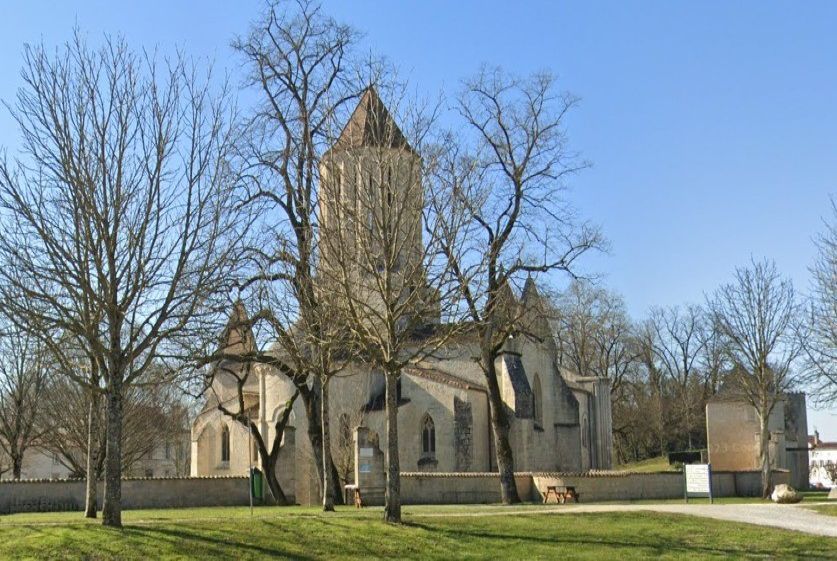
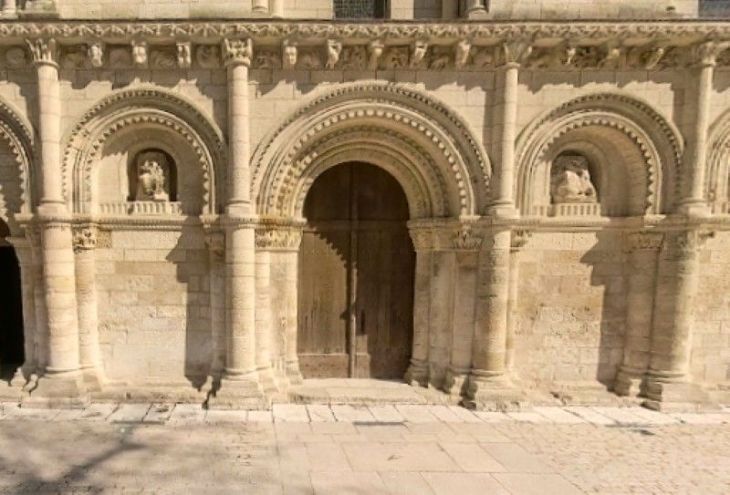
Located within the walls of the Château de Surgères, the Romanesque Church Notre Dame, built in the 11C and completed during the following century, is a pure jewel of Romanesque art in Aunis and probably the most beautiful church in this small province. The church stands out due to the scale of its 23 meters long façade. This astonishing frontispiece is made up of horizontal lines, marked by two cornices that extend to the buttresses made up of impressive bundles of columns. The bold restoration of the 19C should not make us forget the quality of inspiration of the modillions and metopes: detailed zodiac, atlantes, acrobats, musicians, bear tamers, lions, griffins, basilisks, monkeys, elephants, mermaids, etc.

The central window, which since the end of the 19C has replaced a large Gothic bay pierced around the 15C, is framed by two high reliefs depicting horsemen in which it is possible to see the founders of the church: Hugues de Surgères and Geoffroy de Vendôme… unless it is the Emperor Constantine, whose horse’s foot would trample heresy,… or Christ triumphing over death and evil, … or William of Aquitaine, overlord of the Counts of Surgères. Everyone will see what they want, unless a historian has the solution… The apse is built on a crypt where four large, lowered double arches rest on a central pillar. On the vaults, old paintings date back to the 16C. They were restored in 2003. They represent angels sounding trumpets and evoke the Last Judgement. Under the crypt there is a burial vault which was violated during the French revolution. Until that time, it housed the burials of the lords of Surgères.

Other things to see here with more time are : The aumônerie Saint-Gilles or chaplaincy is a former religious building from the 12C, now disused, owes its foundation to its vocation as a center for accommodating the poor and the sick as well as to welcoming pilgrims on their way to Santiago de Compostela during the Middle Ages. The prieuré de Saint-Gilles or priory an 11C enclosure wall and the ruins of a 16C chapel are the only remains of a hospice founded in the 11C and which remained active for 750 years. The hospice was built by the monks of the Maillezais abbey, on the way to Santiago de Compostela. The site of the Château de Surgères is the major attraction of the city, being both the historic heart of the city and still remaining today the administrative, cultural and tourist center of this small town of medieval origin. Les Halles or covered market from 1818, along the main street which became rue Audry de Puyravault. But due to the dilapidated state of this building, it had to be restored and enlarged in 1842. These new halles were opened to the public on November 26, 1842. After the fire of 1885, the market was enlarged by a metal structure in the style of the Baltard pavilion In 2001, in order to revitalize the city center it was restored stone building is visible, enhanced by a lighter and more open metal-framed hall. The city’s central artery, Rue Audry de Puyravault, owes its name to an illustrious member of parliament who distinguished himself in particular during the Second Republic. This long street that crosses the city from east to west is lined with typical 19C buildings due to the urban alignment that forced local residents to modify the facade of their buildings, some by lengthening them, others by moving them back, in order to provide overall harmony. Surgères train station, the oldest in the department ,built in 1857 during the Second Empire, in the stripped-down and simple style of the Compagnie des Charentes stations, has thus become one of the rare survivors of this feverish period of railway station construction. In the city center, the Le Palace cinema has occupied the premises of the old market hall, which has been refurbished since 2001. Behind the renovated market halls and with the cinema, the city has a cultural scene also called Le Palace.
A bit of history I like tell us that the site of Surgères appeared in the middle of the Middle Ages due to the incursions of the Vikings who scoured the coasts of Poitou, then of Aunis, from 830 during the Carolingian period. The oldest written traces mentioning the town and its region appear in 936 when the Duke of Aquitaine, wanting to preserve his lands of Aunis from Norman intrusions, built a bastion of stone and wood on this dry land that was not subject to flooding, which made it possible to monitor the marsh. At the end of the 10C, the Counts of Poitiers began to take control of the Aunis region and installed there. Two centuries later, this bastion had become a small, active city whose lords were among the great figures of the Parliament of Saintonge. It was at this time that they built a large castle, the ramparts of which still remain, as well as the Romanesque Notre-Dame Church. When Eleanor of Aquitaine married Henry II Plantagenet, the future King of England, in 1152, she caused her lands and Surgères to fall under the English influence. Returned to the French fold with Saint Louis, the town was taken by surprise by the English in the spring of 1352 (Hundred Years’ War). In 1471, Louis XI had the ramparts razed. Queen Catherine de Medici is said to have been behind the meeting between Ronsard, in his fifties, and the beautiful Helen, then a prominent figure at the royal court, where she was one of the queen’s maids of honour. Hélène was the daughter of René de Fonsèque, Baron of Surgères, and Anne de Cossé, maid of honour of Catherine de Medici. It was also at this time that the Renaissance-style gatehouse and portal with Tuscan columns were built. Surgères regained some prosperity during the 16C before suffering the Wars of Religion. A coveted stronghold, it was occupied by Calvinists and then by Catholic troops. It lost its importance with the fall of La Rochelle in 1628, when Cardinal Richelieu had the height of the ramparts demolished. King Louis XIII and Richelieu were welcomed at the Château de Surgères by the owner at the time: the La Rochefoucaulds. In 1748 the barony of Surgères was raised to the status of a marquisate. During the French revolution of 1789, the life of this small town changed from a feudal state to that of the domination of a rural bourgeoisie who, as everywhere in France, appropriated at a good price the lands of the Dukes of La Rochefoucauld-Doudeauville, the last lords of Surgères. In 1815, on the road to exile from Paris to Rochefort, the stagecoach of the now ex-emperor Napoleon I passed through Surgères. The Great War or WWI not only paralyzed the town’s economy by stopping the industrialization movement but also contributed to blocking the urbanization of the small dairy town. In the aftermath of WWII, Surgères actively participated in the post-war reconstruction effort and fully entered the period of the “Thirty Glorious Years”.
The town of Surgéres on the Church : https://www.ville-surgeres.fr/decouvrir/incontournables/patrimoine/eglise#tabs
The local Aunis Marais Poitevin tourist office on Surgéres : https://en.aunis-maraispoitevin.com/incontournables/surgeres/
The Charente Maritime dept 17 tourist office on Surgéres : https://www.infiniment-charentes.com/5-bonnes-raisons-de-decouvrir-le-patrimoine-de-surgeres/
There you go folks, another dandy spot in my world France road warrior trails, This was a nice visit and will be back, eventually. You too will be enchanted by stopping by, worth the detour. Again, hope you enjoy this post on this is Surgéres !!! as I.
And remember, happy travels, good health, and many cheers to all !!!

 Paris1972-Versailles2003