
Let me tell you about an off the beaten path City of my belle France , even if little pictures just found me some in my cd rom vault that should be in my blog for you and me, My dear late wife Martine love shopping and we went all over for it, including the outlet store here and took a peek around, The City of Troyes in the dept no 10 of the Aube in the region of Grand Est, It is located in the historical and cultural region of Champagne, of which it was the county capital. It is crossed by the Seine. Only 164 km from Paris, 126 km from Reims, 101 km from Épernay , 154 km from Dijon, 182 km from Versailles,and 610 km from my current home, Therefore, let me tell you about this is Troyes !!! Hope you enjoy the post as I.
Troyes is served 10 km away by the A5 towards Burgundy and the Île-de-France and provides access to the South of France (via Dijon then Lyon) as well as Paris via connections with the A6 , then the Francilienne or by the A4. It is connected to the North of Europe by the A26 , which crosses Champagne-Ardenne and Picardy, and also joins the A4 near Châlons-en-Champagne, providing access to the North-East of France like Strasbourg and Germany. Off the autoroutes or highways, the D 619 towards Provins and Paris provides connections with the Île-de-France without using the toll expressways. We came on the A86, to Fresnes, then A6 here on exit sortie 34 took the N104 (Francilienne) which connects with the A5 ,and into the D660 to Troyes Centre,
What we saw in town, and pity should have spent more time ,but we will be back, eventually, This is the former Abbey of Saint-Martin-ès-Aires founded in the 9C to house the relics of Lupus, Bishop of Troyes, who became Saint Loup (died in 478), the legendary defender of the city against Attila in the 5C and patron saint of the city. It had been built away from the city: an oratory of Notre-Dame where Saint Loup was buried. The miracles that took place there were then attributed to the saint and the oratory took his name, the Counts of Champagne came to make their solemn oaths there. The oratory was burned by the Vikings in 887. The relics were then transported to a new site inside the walls. The monastic community was reformed in 1135 by Bernard of Clairvaux. The abbey took the name of the saint of Tours on this occasion. In 1415, the abbot brought the sarcophagus of Maure de Troyes and Bishop Étienne de Givry extracted relics to give them to the abbey, a pilgrimage taking place for this saint in the parish of Sainte-Maure.
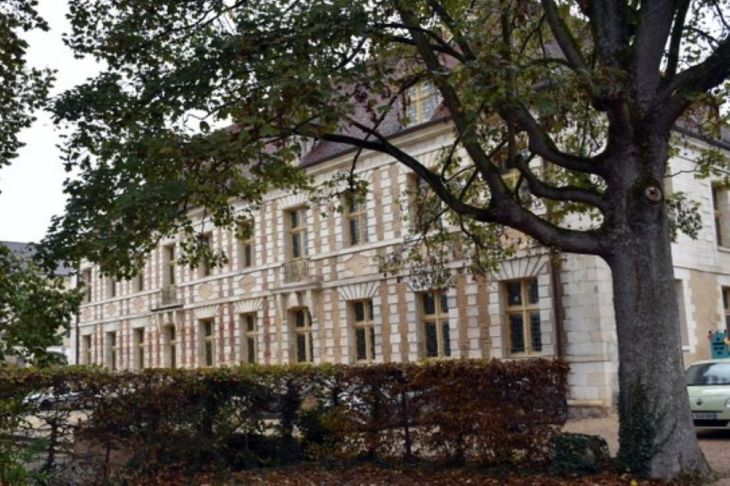
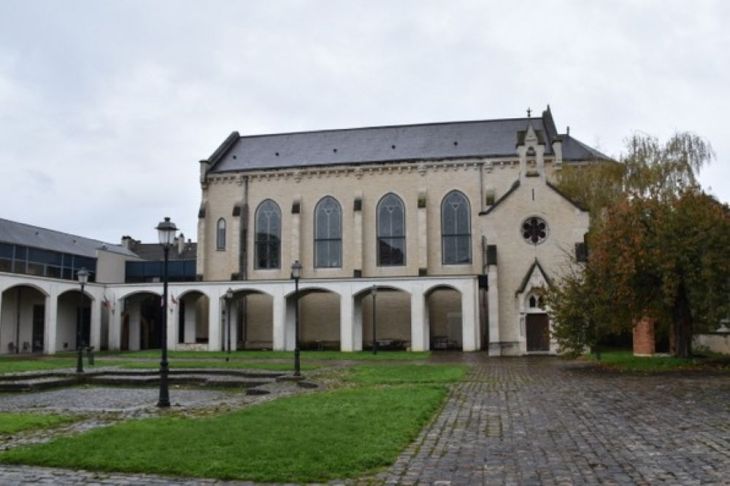
The former abbey of Saint Martin és Aires was seized as national property during the French revolution and was sold in two lots: one including the abbey house, the courtyard, two gardens and the treasury house to Mr. Aumont, who ended up being bought by the Ladies of the Sacred Heart. The second lot included the rest, that is to say the abbey church, the courtyard, a garden, the terrace, the sheds, the woodsheds. Everything was sold to Mr. Jacminot who set up a cotton spinning mill there, then around 1830 a children’s hospice. The abbey library in 1791, citizen Bramant drew up an inventory of the 1,124 manuscripts. The Ordo Processionum, the Remarks on the Councils of the First Six Centuries…, the Rhetorica Latina Rhetoribus Trecensibus and the Psalms of David xxplained to the letter remain here. The abbey church was 42.5 meters long and 12.5 meters wide, the portal on Rue de St-Martin and a door leading to the cloister. Thus, currently ,the buildings house the University Institute of Trades and Heritage (IUMP) and the Troyes School of Design in buildings dating from the 17C to the 19C.
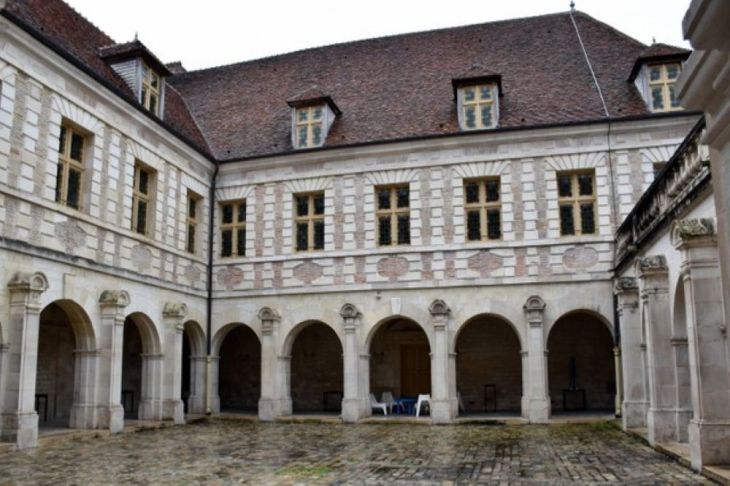
The official Ecole Superieure de Design de Troyes 360 view on the building :https://www.vir360.fr/ecole-superieure-design/troyes-360.html
The Aube Champagne historical site on the former abbey Superior school of design: https://www.aube-champagne.com/en/poi/ancienne-abbaye-saint-martin-es-aires-e-s-a-a/
Other things to see in Troyes huge a good reason to be back are : the City Hall dates from the 17C and was built from 1624 to 1672. With its statue of “Helmeted Minerva” on the façade, it is one of the few to have preserved the revolutionary motto in its original form above the entrance: Unity, Indivisibility of the Republic – Liberty, Equality, Fraternity, or Death. The Hôtel-Dieu-le-Comte was founded by Count Henri I of Champagne and was run by the nuns of the Order of Saint Augustine until the French revolution. Since 1992, it has been the university center of Troyes. Since June 29, 2013, the restored barn of this hotel has hosted a stained glass conservatory called the Cité du vitrail or City of stained glass, Built from 1208, the Saint-Pierre-et-Saint-Paul Cathedral is famous for its characteristic of having only one tower. It was built from the 13C to the 17C. The Basilica of Saint-Urbain is a Gothic church built from the 13C to the 20C by Pope Urban IV, on land where his father’s shop was located. Declared a basilica in 1964, Built in the 16C, the Saint-Nizier Church owes its name to the relics of Saint Nizier deposited in the 6C. In Gothic style, it has many remarkable stained glass windows that represent Christ, the lives of the saints, the legend of the three Marys, Our Lady of Sorrows or the Last Judgement as well as three sculptures dating from the 16C. The oldest church in Troyes is the Sainte-Madeleine Church built between the 13C and 16C. It is sculpted by Jean Guailde, with a statue of Sainte-Marthe, and the remarkable stained glass window of the Creation , It has a remarkable collection of stained glass windows that would not look out of place in a cathedral. The Visitation Convent of Troyes, founded in 1631, is still active. The city of Troyes has nine museums, four of which are municipal, to house the city’s rich and historical heritage: the Museum of Modern Art (MAM); the House of Tools and Workers’ Thought; the Vauluisant Museum, which includes: the Historical Museum of Troyes and Champagne; the Hosiery Museum; the Apothecary’s and the Cité du Vitrail in the Hôtel-Dieu-le-Comte; the Saint-Loup Museum (Museum of Fine Arts) housed in the former Abbey of Saint-Loup; the Aubois Museum of the History of Education. In addition, there is Passages, a contemporary art center in the city center, on Rue Jeanne-d’Arc. The theaters are managed by the city as part of the plan to improve the city’s culture. The two major theatres are the Théâtre de Champagne, with a capacity of 1,100 seats, and the Théâtre de la Madeleine, with a capacity of 600 seats.
Walking in Troyes on its tortuous streets and wooden houses recall the animated fairs which were held there in the Middle Ages. Today, the historic capital of Champagne thrives by valuing its religious, artistic and gastronomic heritage.Merchants from Flanders, Germanic cities or Lombardy installed their stalls sheltered from the cantilever enveloping the houses. The exchanges of sheets, spices, leather, wine, beasts are negotiated in all languages. The changers ensure that transactions end in the local currency, the ounce of Troyes, The Ruelle des Chats gives an idea of the medieval streets, Rue Émile-Zola (formerly Rue Notre-Dame) has been the most important shopping street in the city since the Middle Ages, A bandstand was erected in 1887 in the Jardin du Rocher In the district known as “Le Bouchon de Champagne”, an urban and historic area covering almost the entire town centre of Troyes, several half-timbered houses have been preserved in their original state.
A bit of history of Troyes I like, condense ! tell us that over the centuries, it has preserved an architectural and urban heritage that bears witness to its rich medieval and Renaissance past. The historic capital of the Counts of Champagne was designated a City of Art and History on June 5, 2009. The first inhabitants to leave tangible traces of their presence were the Tricasses, a tribe of Lyonnaise Gaul mentioned from the 1C BC in the writings of Greek geographers, although a few megaliths bear witness to an older settlement. The city is mentioned under the name of Augustobona, notably during the Gallic Wars from 58 BC, but the name derived from the name of the Tricasses gradually became established under the Late Empire. In 486, Clovis seized Troyes and its surroundings, which were called Champagne because of the immense chalky plains. Champagne was assigned to the Kingdom of Austrasia, after the division of Clovis’ possessions in 511, except for Troyes and its region, which were assigned to Clodomir. It was not until 524, following the death of the King of Orléans, that it joined Austrasia until 558, the year in which Clotaire I was proclaimed King of the Franks. In 567, the city of Troyes was placed in the Kingdom of Burgundy. Between 592 and 613, it joined Austrasia again. On the death of Clotaire II in 629, the city once again depended on Burgundy. The city was controlled and pillaged by the Saracens (moors) of Spain in 720.
In the 12C, the County of Troyes merged with that of Meaux to give birth to the County of Champagne. Hugh I of Champagne was the first to be proclaimed as such around the year 1102. In 1129, the second Council of Troyes, which took place on the site of the current Cathedral of Saint Peter and Saint Paul, took place in the presence of many religious figures, Hugh de Payns and Count Thibaut IV of Blois. This council would lead to the creation of a rule specific to the Order of the Temple. Champagne was attached to the royal domain by the marriage in 1285 of Joan I of Navarre with the future Philip the Fair. At the end of the 13C, Troyes was no longer the capital of the County of Champagne. The latter had in fact passed to the Kings of France and Châlons-sur-Marne was preferred as the administrative capital of Champagne. However, from 1417 to 1422, Troyes was the de facto capital of the Kingdom of France in the midst of the Hundred Years’ War. The Parliament of Paris was transferred to the city in 1787. Napoleon Bonaparte made several visits to the city in 1804 and 1814 during his campaign in France. Napoleon III gave a speech in Troyes in 1868. He declared that “Nothing threatens the peace of Europe”. The epic of Napoleon III ends with the occupation of Troyes by the Prussians from November 1870 to August 1871,
During WWII, on June 15, 1940, the nazi army, after taking Sens, Paris and a large part of the Aube department, entered Troyes. On August 24, 1944, the nazi army committed crimes at Buchères in the south of the Troyes urban area. The next day, the city of Troyes was definitively liberated by General Patton’s troops.
The City of Troyes on its heritage : https://www.ville-troyes.fr/decouvrir-troyes/troyes-un-patrimoine-et-une-architecture-exceptionnels/
The Troyes Champagne tourist office on its heritage : https://en.troyeslachampagne.com/discover/explore-troyes/
Oh yes what we came and got to know a bit of Troyes was the McArthur Glen outlet store looking for prices on Lacoste, Hugo Boss, Tommy Hilfiger ,Desigual, Le Cog Sportif, and Villeroy & Boch. We indulge in our favorites Amorino ice creams and Lindt chocolates. You have to know the prices and things you need as sometimes not as good as it seems. Since, then and going to Roubaix once too (see post) we stopped coming to these outlet stores. Here for the memories of always.
The official McArthur Glen outlet stores in Troyes: https://www.mcarthurglen.com/en/outlets/fr/designer-outlet-troyes/
There you go folks,another wonderful off the beaten path City of my belle France. It is worth more time especially the shopping and we will be back, eventually. Again, hope you enjoy this post on this is Troyes !!! as I.
And remember, happy travels, good health, and many cheers to all !!!

 Paris1972-Versailles2003