
We have driven and walked in this wonderful Normandy region for many years, more before as lived not far, Wonderful family times we had there, There is so much to see , doing my best, and glad found me these older pictures in my cd rom vault ,which now transposing in my blog for you and me, I thank you for your readership over the years and to bear with my rants! . Therefore, here is my take onthis is Vernon !!! Hope you enjoy the post as I.
The town of Vernon is located in the department no 27 of Eure in the Normandie region of my belle France. It is at the crossroads of the roads from Évreux to Beauvais, and from Paris to Rouen via the Seine Valley. It is close to Giverny. The town is 7km from Giverny, 66 km from Rouen, 66 km from Versailles, and 473 km from my current home on the A13, The A13 autoroute de Normandie connects Vernon to: Paris (by Porte d’Auteuil) ,Rouen ; Deauville; and Caen. The D 6015 roads takes you towards Mantes-la-Jolie and Paris and, Gaillon, Val-de-Reuil and Rouen. D181 towards Évreux and, Gisors, Beauvais, Amiens and Reims. D 313 towards Gasny and, Les Andelys. The Vernon – Giverny train station for info as never use it , is on the Paris-Le Havre line connecting Vernon to Paris-Saint-Lazare, Rouen-Rive-Droite and Le Havre train station.
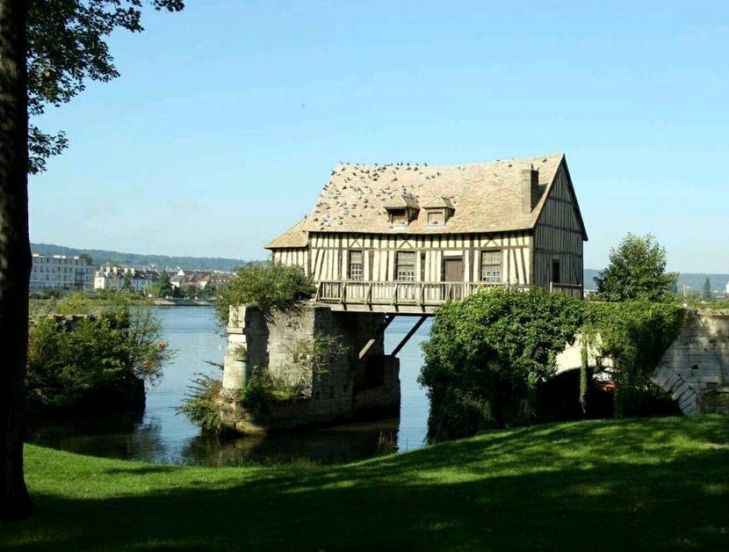
The Vieux Moulin or Old Mill, installed on the piers of the medieval bridge in Vernonnet, a rare monument of this type, a special symbol. To know, the crossing of the bridge was subject to a passing fee. The Old Mill is an old water mill, which has become emblematic of the town of Vernon. The mill, known as the “hanging wheel” mill, operated using the current of the river. In 1204, when Normandy entered the French royal domain, Vernon lost its military role. Philippe Auguste then granted one of his followers the possibility of establishing a mill on the bridge. The Old Mill is the last remaining example of the mills that existed in this location. Having become a simple half-timbered house, it was built around the 16C, straddling two of the piers of the 12C medieval bridge which, by crossing the Seine at the level of the Talus island on which it rested, linked the town of Vernonnet to that of Vernon (the former was attached to the latter in 1804) By October 1849, the completion of a dam built downstream at Notre-Dame-de-l’Isle led to the sudden shutdown of the four remaining mills and the millers were condemned to unemployment. Between 1925 and 1930, the Old Mill belonged to a composer of revues, Jean Nouguès, who set up a dance hall on a barge moored nearby. This barge sank on 6 February 1927. In 1930, it sold it to an American, William Griffin. Following the death of the owner in 1947, the town underwent renovation due to extensive damage caused during military operations in WWII. The site was notably used as a setting for the painter Claude Monet (1883 canvas) and for the filming of a 1962 film, The Mysteries of Paris, starring Jean Marais.
Other things to see in Vernon with more time as this was a rest stopping site for my road warrior trips between Versailles and the Normandy region, The Archives Tower, a vestige of the old castle. The ramparts and enclosures (in parts). The Maison du Temps Jadis dating from 1450-1460. Picturesque streets lined with old half-timbered houses dating from the 12C, 16C and 17C: Rue Potard, Rue Carnot, Rue Bourbon-Penthièvre, etc. Vernon has many castles scattered throughout its territory, in very different styles. The Château de Bizy, often called the little Versailles, dates from 1741 with the Neptune fountain. The medieval castle, dating from the 12C, was partly destroyed in 1752 during the creation of the stables and then during the two wars, only a few vestiges remain. The Notre-Dame collegiate Church, preserving parts from the 11c, 13C, 14-15C. The Saint-Nicolas Church, consecrated in 1861 and completed in 1863. The Vernon Museum, known as the Alphonse-Georges-Poulain Museum, created in 1862, in a former private mansion dating from the 15C, offers a rich and varied tour through three specializations: from the Impressionists of Giverny to the Nabis with a collection of around twenty works including two paintings by Claude Monet; a cabinet of drawings with nearly 250 works by Théophile-Alexandre Steinlen, Francisque Poulbot and Benjamin Rabier; a collection of animal art and local history.
A bit of history, condense as it has plenty, the small part I like tell us Vernon has an ancient origin attested by prehistoric, Celtic, Gallo-Roman and Merovingian remains. It became an important military town after the constitution of the Duchy of Normandy. The town, mentioned for the first time in the year 750 by Pepin the Short, was ravaged by the Vikings in 845. On July 11, 911, Vernon became a border post following the Treaty of Saint-Clair-sur-Epte between Charles the Simple and Rollo. In 1045, William II of Normandy gave his domain of Vernon to his cousin Gui de Brionne. Having emerged victorious from the Battle of Val-ès-Dunes, William himself transferred Vernon to Richard de Reviers in 1050, who from then on called himself Richard de Vernon. The latter accompanied William in 1066 during his conquest of England. It was nevertheless stormed in 1139 by King Louis VII of France, who held it until 1154. Restored to Normandy, the city was retaken by Philip Auguste in 1191, who had the fortifications modified. Following the Treaty of Gaillon in 1195, Richard the Lionheart ceded the city to the Capetians, which was attached to the royal domain. King Louis IX often stayed in Vernon. He stopped there thirty-two times during his travels in Normandy. In 1227, he decided to create the Hôtel-Dieu and became patron of this hospital.
During the Hundred Years’ War, the city was the scene of many bloody events. Following the Treaty of London of March 24, 1359, the city was ceded to the Anglo-Navarrese. On March 29, 1371, the Treaty of Vernon was signed between Charles V of France and Charles the Bad. During the second phase of the Hundred Years’ War, the city was conquered in 1415 by the English after the landing of Henry V of England, and became French again in 1449, following the victories of King Charles VII. In 1452, the city was chosen as the meeting place of the States of Normandy, and it was in Vernon that in 1467, Louis XI and Charles the Bold signed a truce. 1606: Henry IV founded a college on the site of the current Place de Gaulle. 1661: The Hôtel-Dieu was erected as an abbey (canonesses of the Augustinian order) by King Louis XIV, 1721: Charles Louis Auguste Fouquet, Duke of Belle-Isle, acquired the lordship of the city. On September 21, 1749 , the Duke of Belle-Isle received a visit from Louis XV and Madame de Pompadour in Bizy. 1785: On his way back to his country, farewell visit from Benjamin Franklin. 1788: the Duke of Penthièvre, Louis-Jean-Marie de Bourbon, becomes lord of the town. 1792: the Orléans family (Louis-Jean-Marie de Bourbon and Marie-Adélaïde de Bourbon) settles in the Château de Bizy. 1793: July 13, Battle of Brécourt on the southern plateaux, pitting Chouans (vs French revolution) against Republicans (for the French revolution). 1810: Napoleon I is received in Vernon. 1817: The Duchess of Orléans, who bought back her property sold during the French revolution to General Lesuire, regained possession of Bizy. 1830: Heir to the Château de Bizy, King Louis-Philippe made numerous visits to Vernon. 1858: The property of the House of Orléans, confiscated by Napoleon III, was put up for auction in Bizy.
In 1870: the city is defended by the Ardèche Mobile Guards who sacrifice themselves on November 22 and 26. 1871: on August 14, the city council decides to rename Avenue d’Ivry to Avenue de l’Ardèche 1873: on November 26, inauguration of the monument to the Mobiles de l’Ardèche 1875: on September 26, Patrice de Mac Mahon, Marshal of France and President of the French Republic, stays at the Hôtel d’Évreux for several days to prepare for the major maneuvers of the Third Army. 1875: a train carrying Elisabeth of Wittelsbach, known as Sissi, Empress of Austria and Queen of Hungary, stops at the train station. 1883: Claude Monet paints six canvases of the Notre-Dame de Vernon collegiate Church until 1894. 1940: The city was bombed by nazi aircraft on June 8 and 9, 1940, causing many neighborhoods to burn and 47 people to death. The nazis of the 46th Infantry Division of Generalleutnant Paul von Hase crossed the Seine at Vernon on the night of June 9 to 10, 1940, although the bridge had been blown up. The occupation began for more than four years. 1944: On May 7, the railway viaduct was destroyed during the bombings. On August 25, the city was liberated by British troops.
The town of Vernon on its heritage : https://www.vernon27.fr/la-ville/histoire-de-vernon/a-voir-a-visiter/
The local Nouvelle Normandie tourist office on the heritage of Vernon : https://www.nouvelle-normandie-tourisme.com/a-vivre-nouvelle-normandie/vernon-les-andelys-pacy-sur-eure/vernon/
The Eure dept 27 tourist office on Vernon : https://www.eureka-attractivity.com/cultural-heritage/vernon/
There you go folks, a dandy city to explore and enjoy with the family, Memorable moments in my road warrior trails and this area was on many times,driving and walking all over the countryside, towns and cities with sublime awesome spots with nice memorable family visits of yesteryear always remember and always looking forward to be back, eventually. Again hope you enjoy the post on this is Vernon !!! as I.
And remember, happy travels, good health, and many cheers to all !!!

 Paris1972-Versailles2003