
I continue to dig deep into my cd rom vault and got me one nostalgic picture that makes writing this post for you and me, There is a sentimental memorable moment passing by many wonderful towns in deep countryside. The town of Villeréal is located in the department of Lot-et-Garonne no 47 in the Nouvelle Aquitaine region of my belle France. It is located 35 km from Bergerac, 80 km from Périgueux, 128 km from Bordeaux, 60 km from Agen, 616 km from Versailles and 599 km from my current home. We came on road warrior mode passing by Villeréal on the N165, A83, A10, A89, N21 passing quick stop in Bergerac, and continuing to the town, On June 30, 2018, Villeréal officially joined the list of “most beautiful villages in France” thanks to its remarkable architecture and heritage, Therefore, let me tell you a bit on this is Villeréal !!! Hope you enjoy the post as I.
We went by the Church Notre-Dame which was built at the same time as the Bastide founded in 1264 by Alphonse de Poitiers, count of Toulouse by his marriage to Jeanne, daughter of Raymond VII de Toulouse. The church was built in the southern Gothic style with single nave and buttresses. It responded to two functions: Catholic church and refuge of the population in the event of war. It communicated with the fort, seat of the bailiff. It was surrounded by a ditch and one could only access it by a bridge. The church was restored in 1881. The current vault was built, the walls are enhanced by four meters and the soil which has become irregular is covered with tiles. It was added a forum and the windows are fitted with stained glass representing biblical scenes and the life of the Virgin. The church was pillaged by the Protestants on October 25, 1572. The fort was destroyed in 1794.
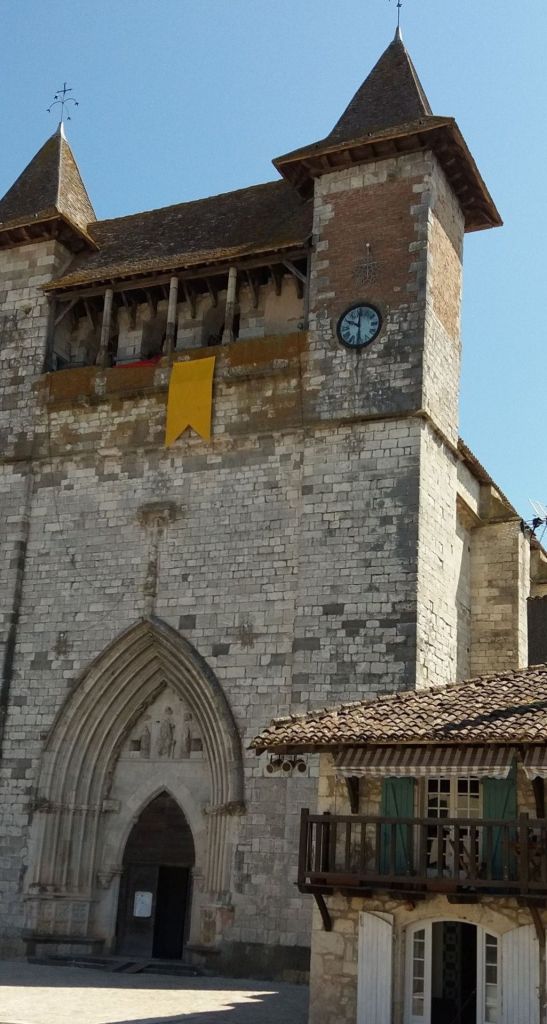
The Church Notre Dame has a Latin cross plan and has four chapels. It is flanked by corner turrets, the one on the left of the facade contains the screw staircase enlightened by loopholes giving access to the round walkway wearing a roof. The church could receive around twenty defenders. The right turret includes at its top a room used as a prison. The clock has been staying there. This protection had to become obsolete when the English undertook to surround the bastide at the beginning of the 14C. The tympanum of the portal in the arches was decorated with statuettes which were mutilated during the wars of religion. The side doors were walled in 1789. The church had three bells. The oldest was melted in 1711, another in 1864, the last in 1950. It is 39 meters in length, 26 meters wide, and 14 meters high ,The nave includes five spans. Restoration works were undertaken from 1881. The current vault was redone in 1884-1885. Tribunes were then built. The 17C caissons altarpiece was restored in 1994.
Some of the things to see here with more time are the Bastide (just walk all over is sublime !) whose construction begins in 1267. The city is first surrounded by ditches around seven meters widely dug by the inhabitants of the Bastide. This is grid by eight streets cutting up with right angles, dividing the city into the upper town and lower town. You could only enter the Bastide by rue Saint-Michel where a bridge made it possible to cross the west side moats. In the center was the square surrounded by moles above which were the houses of the merchants. The ground floor was used for trade and crafts. In a corner, on the north side, a house served as a watchtower. Near the church, with which communicated, had been built a fort with four towers. It was the bailiff’s home and the prison. The fort was demolished in 1786. There remains only the name given to the square.
The halles or covered market 14C was redone while retaining older elements, around 1515 according to the dendrochronological study of oak pillars. It served as a consular room, or Maison des Jurats, where the notables of the Bastide were meeting until 1908.The former couvent des Filles de la Foy or the daughters of fait convent, This convent was created on the west side of the Place de la Halle, in 1713, for teaching girls. The whole was fragmented, in 1908, at the time of the construction of the City hall which also led to the disappearance of three houses. See the house, at 34 rue Saint-Roch. This two -level house has a very beautiful facade. You can see on the first floor a cross window from the end of the 15C. Another window with two smaller quarters is on the second floor. The local tradition called it “Maison du Bayle”. It was probably the house of a rich merchant.
A bit of history I like tell us that Alphonse de Poitiers, brother of Saint Louis, has been count of Toulouse since 1249 by his marriage to Jeanne de Toulouse, daughter of Raymond VII de Toulouse. He built four country bastides to populate the region: Monflanquin in 1256, Castillonnès in 1259, Villeréal in 1267 and Eymet in 1270. On December 4, 1259, Saint Louis signed the Treaty of Paris with the King of England Henri III to stop the conflict. By this treaty, the King of France retrocede to the King of England the suzerainty on Limousin, Périgord, Guyenne, Quercy, Saintonge, and the Agen , Alphonse de Poitiers, husband of Jeanne de Toulouse (heiress of the ‘Agenais and the Quercy in particular), dies without heir. In exchange, the King of France will receive the feudal tribute to the King of England for his lordships in France and his renunciation of Normandy, Maine, Anjou and Poitou. This treaty brings Alphonse de Poitiers to develop the construction of bastides. At the end of August 1271, Jeanne de Toulouse and Alphonse de Poitiers died. The County of Toulouse is gathered at the Crown in accordance with the Paris Treaty of 1229. The King of England requires the application of the clauses of the Paris Treaty of 1259. Pursuant to the Treaty of Amiens, in 1279, King Philippe III cedes the Agenais, Saintonge and Ponthieu to the King of England. This “royal city” or Villeréal is English during the Hundred Years War. It changed overlords several times between 1279 and 1453. During the wars of religion, in April 1569, the Bastide was taken and residents were massacred by a group of Protestants coming from Bergerac, then, on October 25, 1572, they took the city again and fire the church, Between 1651 and 1652 , during the Fronde rebellion, the Marquis de Biron decides to have the Bastide occupied by a garrison of six companies of soldiers who ravages the region.
The town of Villeréal on its heritage : https://www.mairie-villereal.fr/histoire-patrimoine.html
The Lot et Garonne dept 47 tourist office on Villeréal: https://www.guide-du-lot-et-garonne.com/fr/tourisme/s-informer/offices-de-tourisme/villereal-476/office-de-tourisme-c-ur-de-bastides-bureau-de-villereal-1177.html
The most beautiful villages of France on Villeréal : https://www.les-plus-beaux-villages-de-france.org/fr/nos-villages/villereal/
There you go folks, a dandy spot in my belle France. Many memories of old in my early road warrior tours, a memorable region for us, and always looking forward to be back, eventually. There is so much choices that time is ticking, Again, hope you enjoy the post on this is Villeréal as I.
And remember, happy travels, good health ,and many cheers to all !!!

 Paris1972-Versailles2003