
I have written many post on this region dear to me as once was living closer and visit a lot more often ; this is Normandie of course, I found me some older pictures in one of my cd roms not yet in my blog, and they should be. Nice experiences which had made us come back many times to this region. This post will long but with brochures, and official sites wanted to give it all on it, Therefore, let me tell you about the Cathédrale Notre Dame de Bayeux !!! Hope you enjoy it as I.
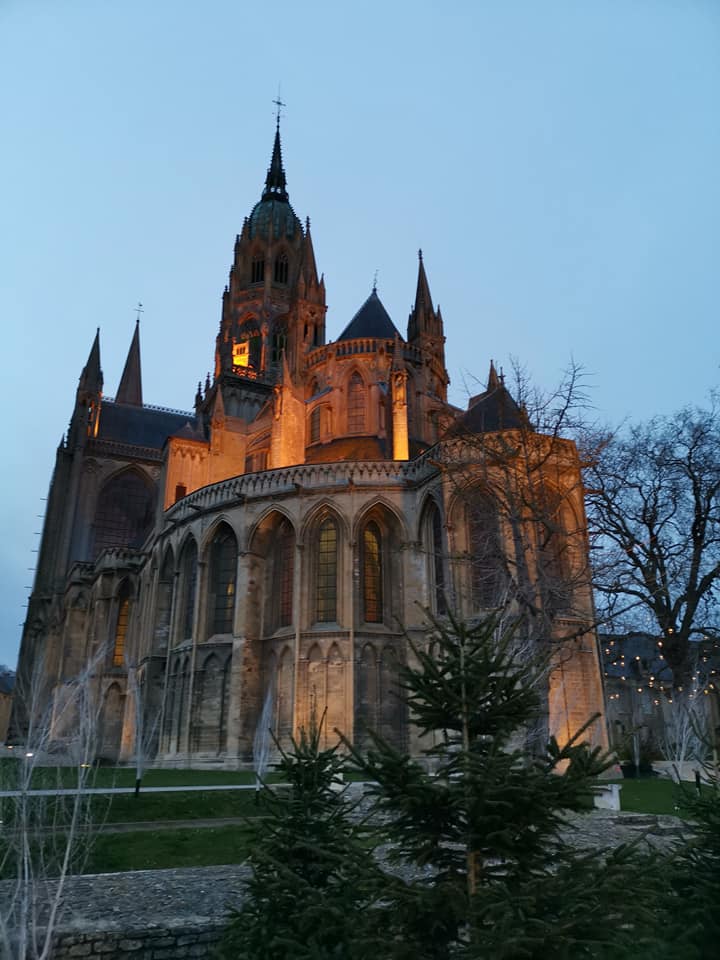
The City of Bayeux is from the department 14 of Calvados and the Normandy region, and in my belle France, It has been headquarters of bishopric since the 4C and a viscounty of the time of the Duchy of Normandy until 1749. Bayeux is 7 km from the Côtes de la Manche coast of the landing invasion beaches, and 30 km from Caen. The Cathédrale Notre-Dame at rue du Bienvenu is an essentially Romanesque and Norman Gothic style, it is part of a remarkably preserved episcopal set. It has kept the Bayeux tapestry for several centuries.
We ignore everything about the exact aspect of pre-roman episcopal constructions in Bayeux. The cathedral group is established in the heart of the city, in the same way as the forum in the Gallo-Roman city of Augustodurum. According to tradition, the first bishop of Bayeux Exupère founded there in the 4C an ecclesiastical district in which three churches stand, at the southeast corner of the city: one has become the current cathedral; The second, dedicated to Saint Etienne, survived the cathedral’s bedside until the 17C; The third, Saint-Sauveur, gave its name to the parish. The vita of Saint Regnobert, bishop of Bayeux in the 7C, indicates that the cathedral group of the High Middle Ages includes the two churches dedicated to Saint Etienne and Notre-Dame. Around the cathedral, the excavations of the 19C uncovered the vestiges of Gallo-Roman buildings and those of the city ramparts, near the bedside.
Again, it will be long but worth it me think, Here I go ! The western facade, which faces a square framed by two Romanesque towers with semicircular windows at the base of the arrows Gothic. The lower level includes five porches of which only the three in the center correspond to the doors of the cathedral. The central portal was transformed in 1778. The two side portals, despite the loss of their large statues in 1562, retained the statues of the are the ties and their tympanum of the northern portal tells the passion of Christ. The lower scene evokes the Last Supper and the enema of the feet, the scene above the arrest in the garden of olive trees, the flogging and the carrying of the cross, the third the crucifixion and the last represents God the father in majesty. That of the southern portal represents the last judgment. The first and second scenes evoke the dead leaving their tombs. On the right, under the door, is hell with the devil in the center. The third scene sees a procession of elected officials towards a “celestial Jerusalem”. On the last scene sits Christ in Majesty, surrounded by two angels and two kneeling characters.
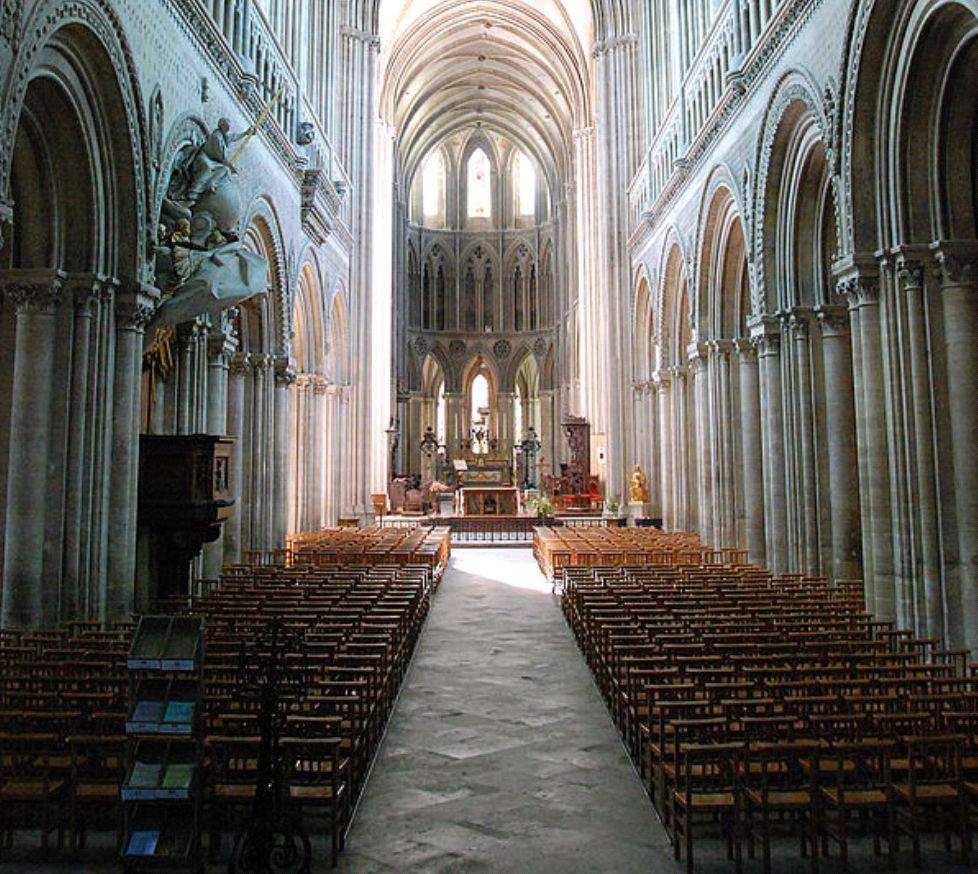
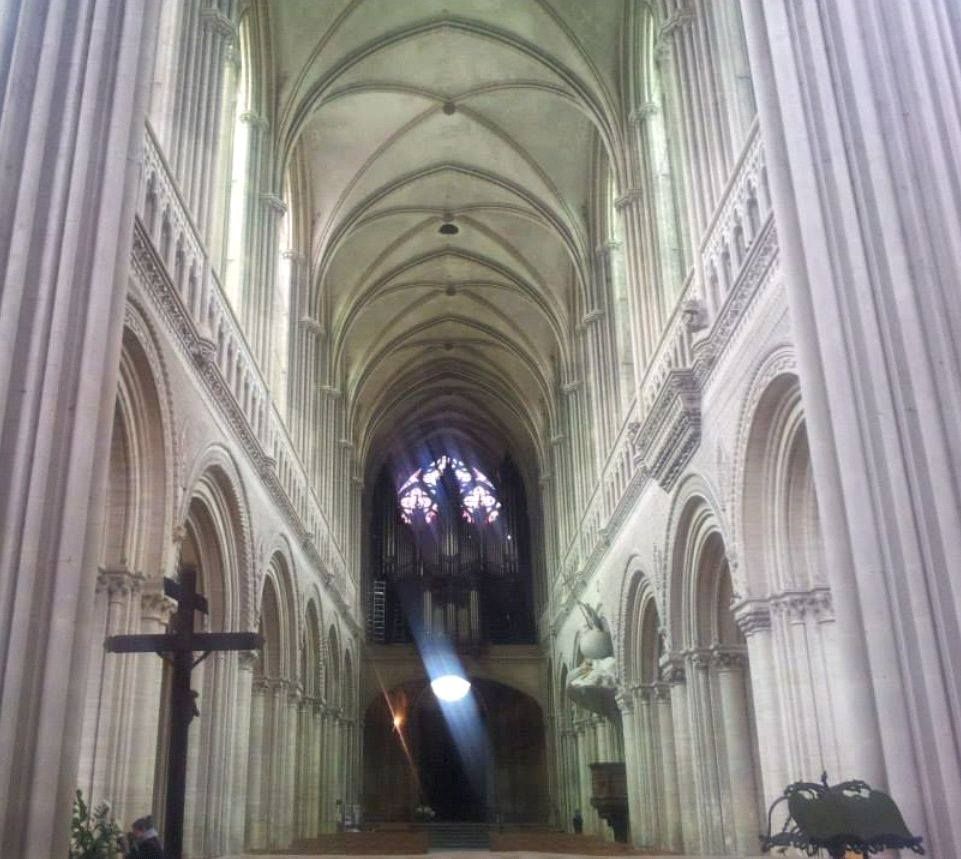
The nave, whose large arcades in the lower part are from the 11C and 13C in high parts. The lateral portal is primitive Gothic style. Its porch, which includes two spans, is aligned with the side chapels. It opens with two arcs separated by a round pillar confined with columns and allows access to the two doors surmounted by one oculus each two levels of seven step stair to descend between the narthex and the nave, and between the nave , and the transept; the transept received its new frame in 1226 for the southern cross and 1250 to the north, but the decor was only carried out in the second half of the 13C . The southern transept is occupied in its lower part by the dean portal or Saint Thomas Becket portal. It is surrounded by a radiant decor of blind arcatures. The portal has two doors separated by a trumeau. Its three -frieze tympanum recounts the history of the holy bishop. The first register recounts the assembly of Northampton (1164) which marks the rupture between Thomas and the King of England Henri II then the Assembly of Amboise (1170) which sees the reconciliation of the two men. The second register shows its crossing of the Channel on a ship, its ride and its martyrdom. The third register is a scene of veneration of the tomb. The portal is surmounted by an openwork balustrade and a large radiant window. The summit is crowned with a gallery of five arcatures wearing a gap and framed by two turrets. This portal gave access to the Dean hotel located further south.
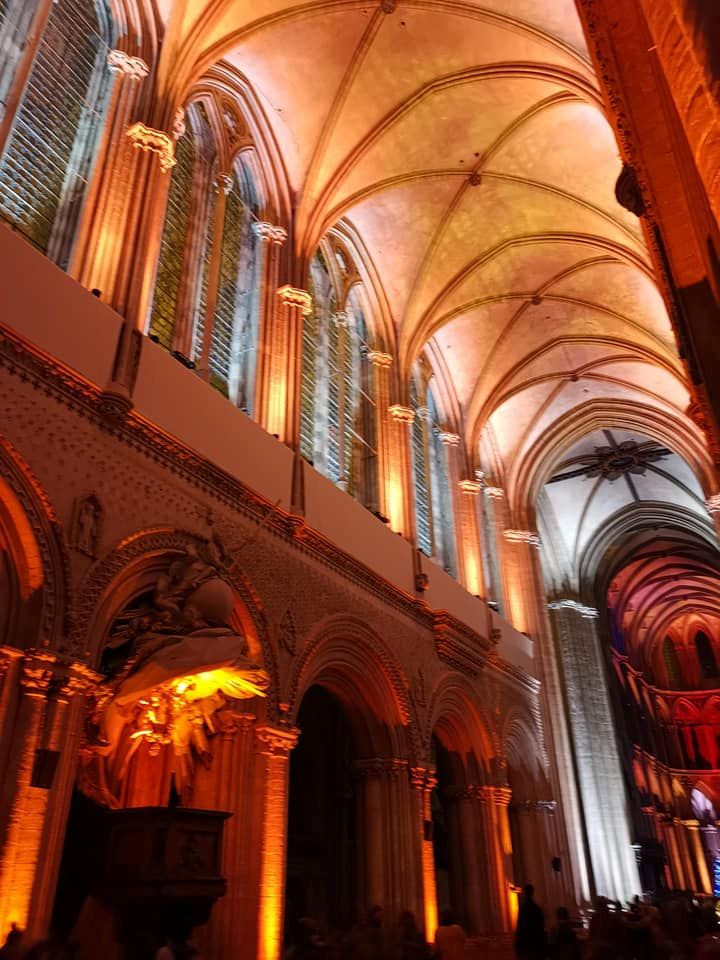
Note on the left side the pulpit dating from 1786, the dome neo-classical and the upper part is baroque inspiration. The lampshade is formed by a cloud housing stucco cherubs, surmounted by a globe bearing an allegory of religion which brandishes a cross,
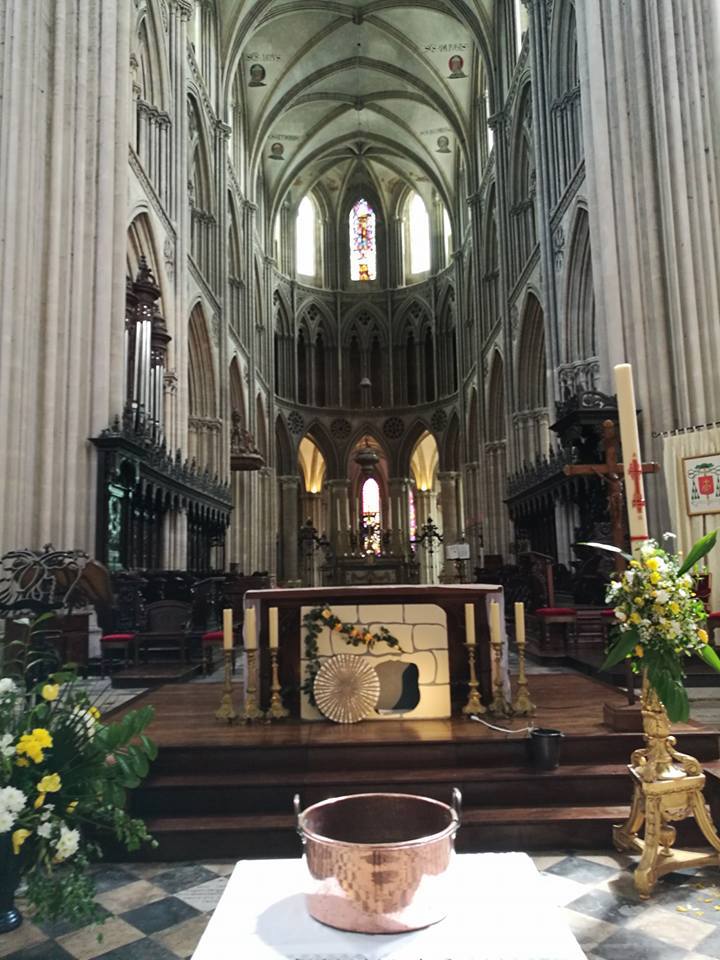
The central square tower, it is decorated with blind arcatures. The flamboyant style balustrade allows the transition from the square to the octagon. Its four corners include the prophet busts and a virgin and child the tower is crowned with a copper dome surmounted by a turret and an arrow ,The chevet or bedside derives from that of the Saint-Etienne abbey of Caen. The radiant chapels, apart from the axial chapel, are inscribed in the chevet. The Gothic style choir was built between 1220 and 1240. It has the characteristics of the Norman Gothic. The upper part of the buttresses hosts statues representing the Virgin Mary, bishops and saints. They were replaced in the 19C by copies.
Chapter room (12-15C), split from the second half of the 12C, sheltered a sub-capitular room at the lower level, which gave access to the cloister now disappeared. An interesting lapidary deposit is exposed to it. The upper level is occupied by the chapter room, the outside of which retains its primitive Gothic appearance, The interior is adorned with the remarkable wall painting of the coronation of the Virgin (15C) which represents Mary surrounded by angels with, at her feet, praying canons.

The library of the chapter of the cathedral built between 1429 and 1436 in the immediate vicinity of the northern facade of the place of worship rises at two levels: the first housed the scriptorium, lit by fourteen simple windows , the second the Library, which was refurbished in the 17C and 19C. Its medieval berries were replaced by large windows in the 1850s ; it is an exceptional monument, one of the only ones of this type remaining in France. The chapter library includes 5,693 works printed from 1476 to 1953, canon manuscripts on the Middle East and the Holy Land, more than five hundred mandates and pastoral letters and twenty-nine titles of religious and historical periodicals of the 19C and 20C.
The north aisle has the Chapel Saint-Pierre, Sainte-Trinité and Notre-Dame-de-Bonne-Nouvelle built before 1350, Chapel Saint-Martin-aux-Vicaires founded in 1309 , Chapel Saint-Jean-l’Evangelist founded in 1289 by which access the chapter library. Chapel of the Annunciation and Saint-Jean founded in 1328, Chapel Saint-Antonin-and-Sainte-Croix and the Annunciation , The last two chapels of the north side were built before 1350 and split in two levels. On the ground floor, the passage of Arthenay developed from the 14C, allowed the bishop to come directly from the episcopal palace to the cathedral. At the upper level is a high chapel in the stands.
The south aisle chapels are Chapel Saint-Jean-Prés-de-la-Tour-Saint-Cyr-and Sainte-Julitte-Saint-Martin-aux-Fonts , It is the first founded side chapel (1263-1274). The stained glass represents the life of Saint Manvieu, bishop of Bayeux (5C). The jube grille (1700). Chapel Saint-Hilaire-Saint-Contes-and-Sainte-Honorine dates from the second half of the 13C. The decoration is from 1839. The stained glass telling the life of Saint Contest, Chapelle Sainte-Marguerite-and-Saint-Maur date of the second half of the 13C, but included a flamboyant fenes. The stained glass represents the life of Saint Vigor from1847 . Chapelle Julien and Saint-Exupère last quarter of the 13C. Stained glass from 1848 representing the life of Saint Exupère. This chapel is dedicated to peace. Behind a painting of the 18C representative of Saint Exupère exorcising a possessed, we discovered in 2015 a fresco of the Middle Ages certainly showing the resurrection of Lazare at the top and below, the crucifixion of Christ, Chapelle Saint-Sébastien-Saint-Gerbold-and-Sainte- Radegonde, after the layout of the transept (late 13C). It includes a wall painting (19C) and a stained glass window representing the life of Saint Radegonde from 1873.
The Chapels Saint-Nicolas and Saint-Thomas Becket, at the south arm of the transept. The two chapels are included in a radiant architecture. Dedicated to Saint Nicolas de Myre and Saint Thomas Becket, they are decorated by interesting murals. The chapel on the left includes a beautiful 18C Annunciation surmounted by an impressive representation of the restored Trinity in the 19C. The one on the right includes in the bottom of the scenes of the life of Saint Nicolas surmounted by a crucifixion (13C). In the upper panel, the martyrdom of Saint Thomas Becket (19C) . Chapelles Saint-Pierre and Saint-Paul, northern arm of the transept. The two chapels were walled in 1756, The ambulatory and its radiant chapels: Saint-Vincent chapel it includes beautiful canopies of the 13C representing the bishops Saint Exupère and Saint Loup which come from the large windows of the nave (around 1260). This is where the treasure door is located.

The Treasury Room (only organized visit) divided into two ground level level: it served until 1902 of sacristy. There are notably the remains of polychrome statues from the 15C as well as a curious wig cabinet. It has always served as a treasure room. It includes the magnificent wardrobe with the relics of the 13C which served as a safe in the Middle Ages, the chasuble of Saint Regnobert (12-13C), the box intended to contain it (of Arabic origin) of the 11C, a folding iron seat of the 14C as well as the large trunk 13C ,which was used to store the tapestry of Queen Mathilde.
The Chapel Sainte Catherine and all the saints the only canopy includes six medieval figurines. Chapel Saint Jean-Baptiste, it includes restored paintings representing Saint Lubin, bishop of Chartres , Saint Geneviève, patron of Paris. We installed a relic of Saint Thérèse de Lisieux who went to the cathedral in 1887 to request authorization from the bishop, Mgr Hugonin, to return to Carmel. Chapelle Saint Pantaleon and Saint Antonin before 1562, the cathedral owned the body of these two saints. The chapel includes paintings from the 17C (Saint Pantaleon) and 19C (Saint Joseph), the reliquary of the Blessed Marie-Catherine de Saint-Augustin, née Catherine de Longpré, is exhibited there. She was a Norman nun who devoted her whole life to charity in Canada. Chapel Notre-Dame ,we find there the tombs of three bishops: Charles Didiot (1856-1866), Flavien Hugonin (1867-1898) and Thomas Lemonnier (1906-1927). and mysteries of the Rosary, Tree of Jesse, Litanies of Notre-Dame de Lorette and coat of arms of Pope Léon XIII. Chapel Saint-Éloi and Saint-Robert, it includes paintings from the 17C representative Saint Éloi and Saint Robert de Molesmes (founder of Cîteaux) as well as neo-gothic pastiches evoking two scenes from the life of Saint Etienne, there in craftsmen and in bishop. Michel and Saint-Blaise it includes old paintings: the martyrdom of Saint Blaise (14C) and the Visitation (15C). Other paintings from the beginning of the 20C is devoted to Saint Michael. A stained glass evokes its legend (1901). A statue of the Archangel dates from the same time. Chapel of Innocent Saints is decorated with a contemporary stained glass offered by the D-Day Normandy Fellowship and inaugurated by the Queen Mother of England nicknamed Queen Mum on June 6, 1989. Chapel Saint André and Saint Léon has a statue of Saint Cécile presenting the small buffet of the organ (17C) , Chapel of the Immaculate Conception is the old Revestiary (sacristy) of the Gothic cathedral. In 1462, it was transformed into a chapel devoted to the Immaculate Conception of the Virgin thanks to the generosity of two Italian humanists, Roland and Antoine de Talents brothers,

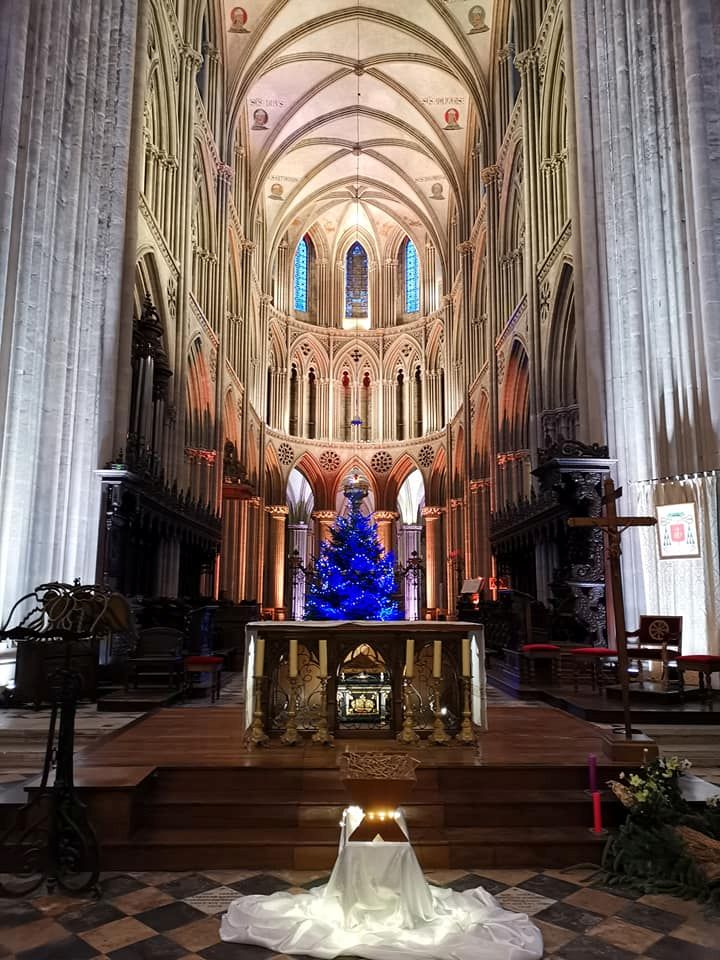
The crypt dates from the 11C therefore from the first construction of the cathedral. The pillars have capitals decorated with acanthus leaves. The crypt also conceals two historiated capitals of the 11C discovered during restoration work. The crypt consists of three vaulted naves of edges falling on capitals mainly decorated with acanthus leaves. Two 11C capitals are also kept in the crypt. They are among the most remarkable Norman historiated capitals of the ducal era (1060-1070). The other decorative elements, including frescoes, date from the 15C. The Gothic choir rebuilt in 1220/1228 is remarkable for its typically Norman elements: very high broken arches, profusion of columns and richness of the decor made up of medallions, rosettes or quadrilobes perforated in the covers, a vast triforium replacing the stands high windows.
The tribune organ it has re -employed elements of the buffet from 1597, rebuilt and enlarged from 1845 to 1848, and restored from 1996 to 1998, the entire choir organ (buffet and instrument) since December 23, 1998. The Notre Dame Cathedral of Bayeux has of a heritage of seventeen bells Thérèse-Bénédicte nicknamed “Bell of Peace and Liberty” is dedicated to the memory of the German philosopher and theologian Edith Stein who entered religion under the name of Sister Thérèse-Bénédicte de la Croix , died in deportation. It rings for the first time on Saturday June 14, as part of the 70th anniversary of General de Gaulle’s speech, introducing a Te Deum and Rose-Françoise in memory of Rosa Stein (Elder Sister of Edith Stein ), murdered in Auschwitz on 9 August 1942, and Father Franz Stock. This bell is sponsored by all anonymous donors and all the anonymous victims of the camps.
The official Bayeux Lisieux religious site on the Cathedral : https://bayeuxlisieux.catholique.fr/diocese/la-cathedrale-de-bayeux/
The official Association Friends of the Cathedral of Bayeux : https://www.cathedraledebayeux.fr/
The City of Bayeux on the Cathédrale Notre Dame : https://www.bayeux.fr/fr/decouvrir-bayeux/cathedrale-notre-dame
The Normandie region tourist office on the cathedral of Bayeux : https://www.normandie-tourisme.fr/sites-lieux-de-visites/cathedrale-de-bayeux/
There you go folks, another dandy in my belle France, never enough time to see it all, This is a memorable spots that should be visited more, me included. Again, hope you enjoy this post on the Cathédrale Notre Dame de Bayeux !!! as I
And remember, happy travels, good health, and many cheers to all !!!

 Paris1972-Versailles2003