
And here I go again , finding treasures in my cd rom vault of pictures that need to be in my blog for you and me. These are wonderful memorable moments of my family travels, and that is the essence of my blog. Therefore, without further due , let me tell you about this is Corral de Almaguer !!! Hope you enjoy the post as I.
The village of Corral de Almaguer is located in the province of Cuenca and on the Castilla La Mancha region of my kingdom of Spain,The village is located 60 km from Belmonte, 89 km from Toledo, 55 km from Aranjuez, 121 km from Cuenca, and 102 km from Madrid, from we came out on Paseo de Santa Maria de la Cabeza to connect with the M30 ring road at exit/salida 2A dir Cordoba or Avenida del Manzanares to exit:salida 12B dir 10 de Octubre to connect with the A4 highway dir Cordoba on the Autovia del Sur or A4 to connect by Ocaña with the A40 autovia de la Meseta Sur dir Tarancon but quickly bear right onto the servicio lane to connect with the local N301 road to entering Corral de Almaguer bear left onto Calle Real or CM 9314 road then turn left onto Calle de Tenerias or CM3000 road then right on Calle Mayor ,then right on Calle Ramon y Cajal then left on Calle Animas to the Plaza Mayor parking and church, You have several roads converging here such as the N301 connects the village with Madrid and Albacete. The AP-36, like the N-301, connects Corral with Madrid and Albacete. The CM-3000 connects the village with Tembleque, passing through Romeral and Lillo; and with Horcajo de Santiago, passing through Cabezamesada. From Madrid, take the A-4 to Ocaña, where you can connect with either the N-301 or the AP-36. From Toledo, take the N-400 to the A-4, then take the A-4 to Ocaña, where you can connect with either the N-301 or the AP-36.
The Parish Church Nuestra Señora de la Asunción or Our Lady of the Assumption , a transitional church between the late 15C Gothic style and the Plateresque-Renaissance style that was emerging at the time of its construction. Construction was completed in the early 16C with the addition of the main chapels. The vault of the main chapel was completed a few years before 1515. In 1528, the Gascan Chapel, was founded, and the south portal of the church, in the Plateresque style, was erected. The main portal is located on the south side of the church and is in the Plateresque style. The second, smaller door, next to the first, is Renaissance in style with a classical entablature and a triangular pediment. The interior of the church features three naves with prominent ribbed vaults, indicative of late Gothic architecture, supported by ashlar columns.
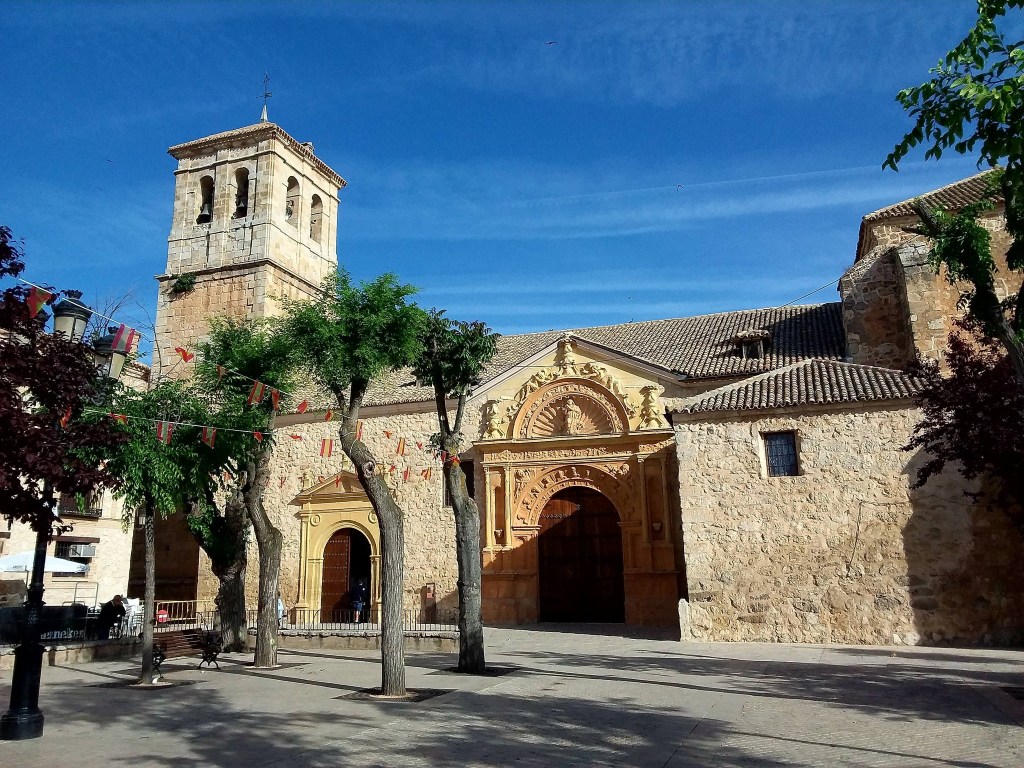
The main portal is in the Plateresque style, with eleven medallions of historical and mythological figures adorning the archivolt of the semicircular arch. On either side are two tabernacles, currently empty, where the images of Saint Peter and Saint Paul once stood. Above the cornice rests a shell-shaped niche that forms a semicircular arch crowned with garlands, ribbons, and other Plateresque motifs, sheltering the image of Our Lady of the Assumption. The second, smaller doorway is in the Renaissance style with a classical entablature and a triangular pediment containing an empty tabernacle. In the spandrels of the arch are two medallions with the symbol of the Order of Santiago. The tower was built in the 17C from unpolished ashlar. It has a square floor plan and three sections that decrease in thickness as they rise. The uppermost section has eight windows.
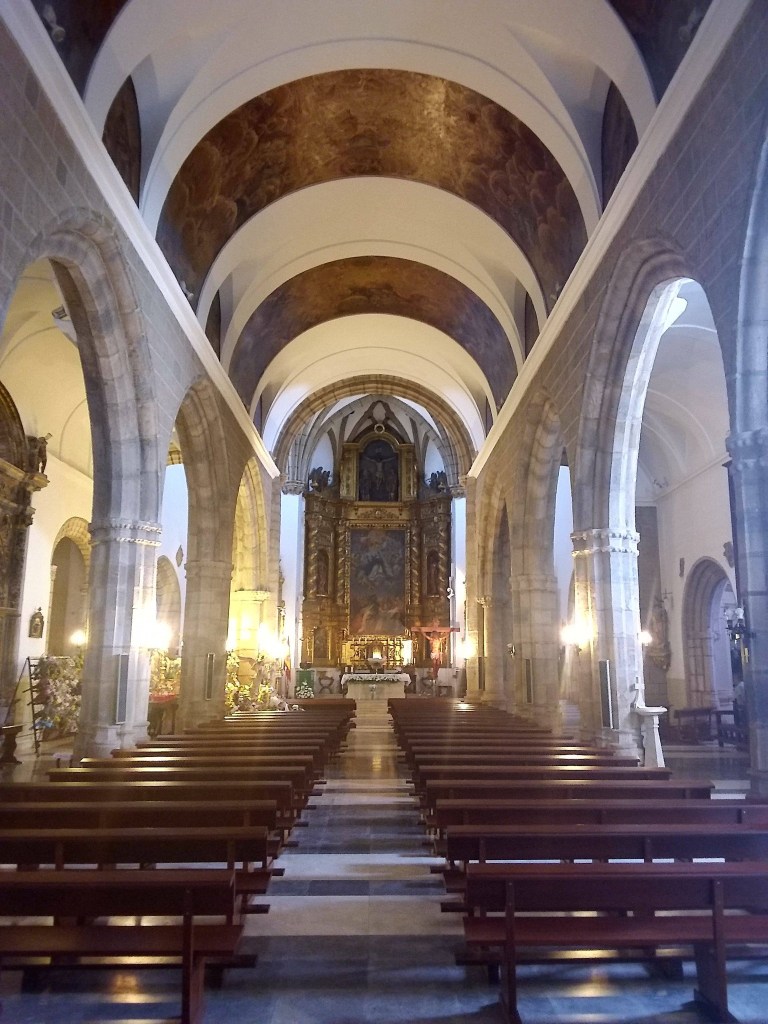
The Collado Chapel was built at the end of the 15th century, during the expansion of the church. It served as a burial place. The chapel has a square floor plan, with a ribbed vault of carved stone in the Gothic style. It is accessed through a semicircular arch with two rows of splayed archivolts. On either side of the arch are two coats of arms of a member of the Collado family, who was a clergyman. Inside the chapel, on the opposite wall, is the coat of arms of Don Juan Collado. Since 1988, the year the chapel was remodeled, it has housed the processional floats of the Brotherhood of Our Lady of Solitude and the Holy Sepulchre. The Chapel of Don Francisco Suárez features a stained-glass window depicting the Virgin Mary with her dead Son. Next to this is the Chapel of Don Martín Gasco, considered the artistic jewel of the church. It features a wrought-iron gate and a Plateresque stone portal from the 16C. Its structure is similar to that of the main portal but much finer and more elaborate in its execution. On the front wall are two niches with alabaster statues of praying figures representing Don Martín and Don Antón Gasco. Currently, these niches house the images of Christ Bound to the Column, Jesus Praying in the Garden of Gethsemane, and Ecce Homo. On the Epistle side, directly opposite the Chapel of the Collados family, is the Chapel of Don Juan Ayllón, covered with a pointed vault and featuring a transitional Gothic window. Here are located the images of Christ in Agony and the Kiss of Judas. Finally, we find the fifth chapel, the Chapel of Don Francisco Briceño, with a curious roof, a mixture of a Gothic vault and a Baroque sphere. In its glass niches are the images of Our Father Jesus of Nazareth and Veronica.
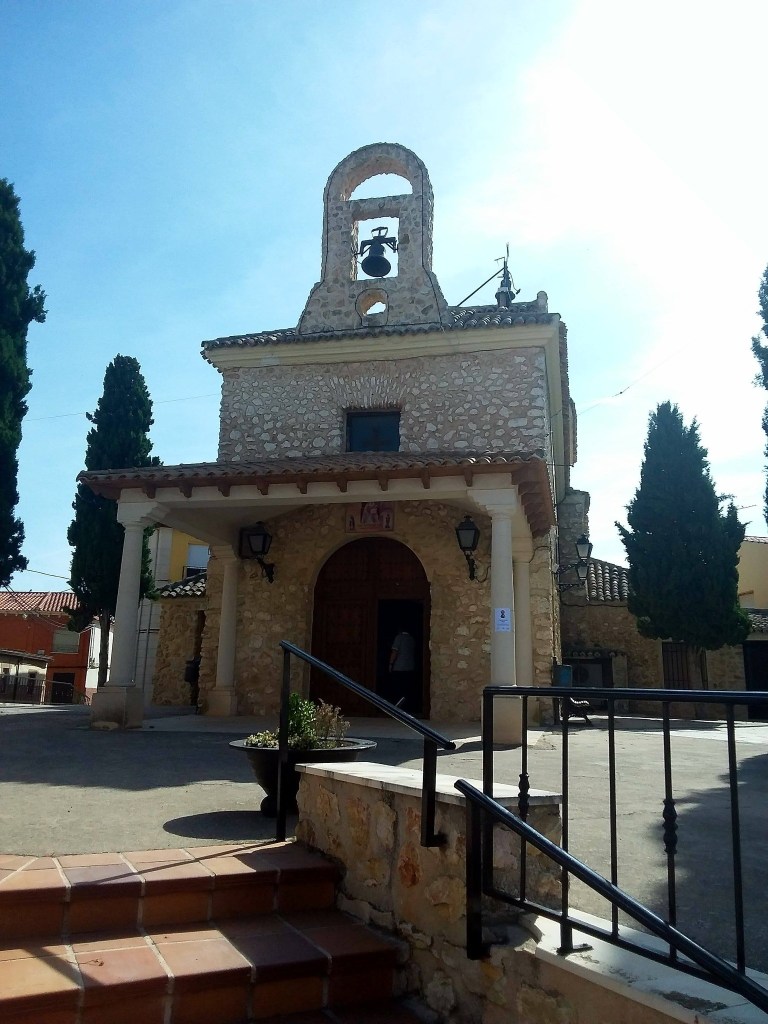
The Ermita de San Anton and San Sebastian or Hermitage, in the popular Baroque style of the 17C, has a single nave, with three pilastered sections, a continuous cornice, covered by a vault of lunettes and housing a raised choir in the last section.
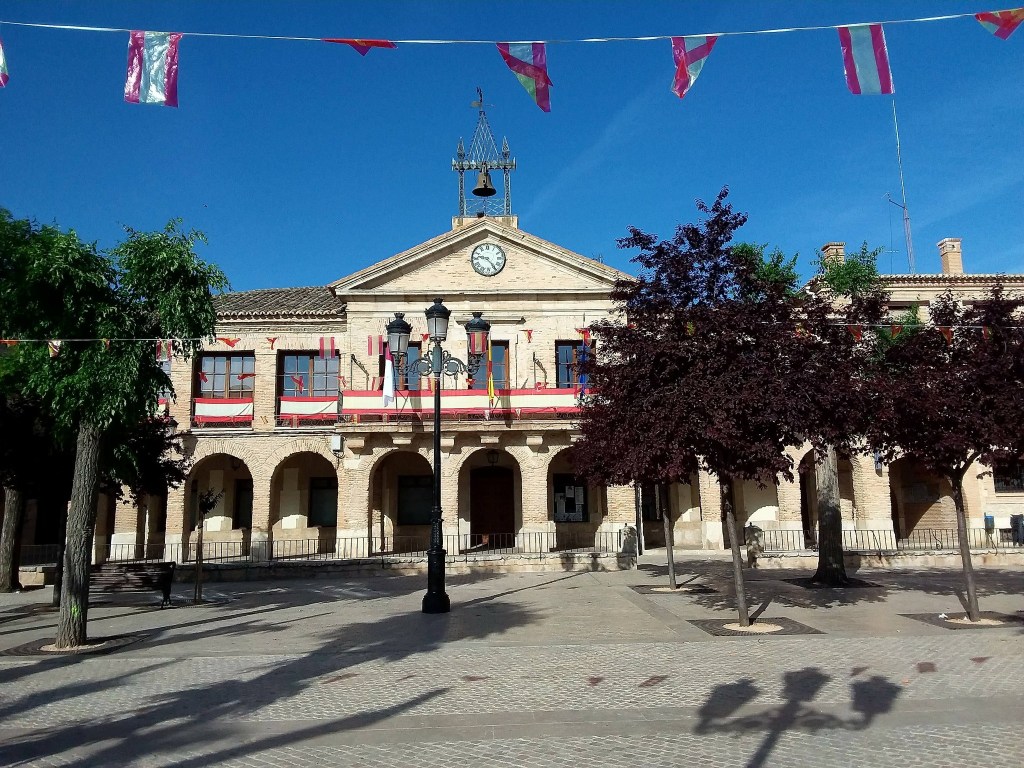
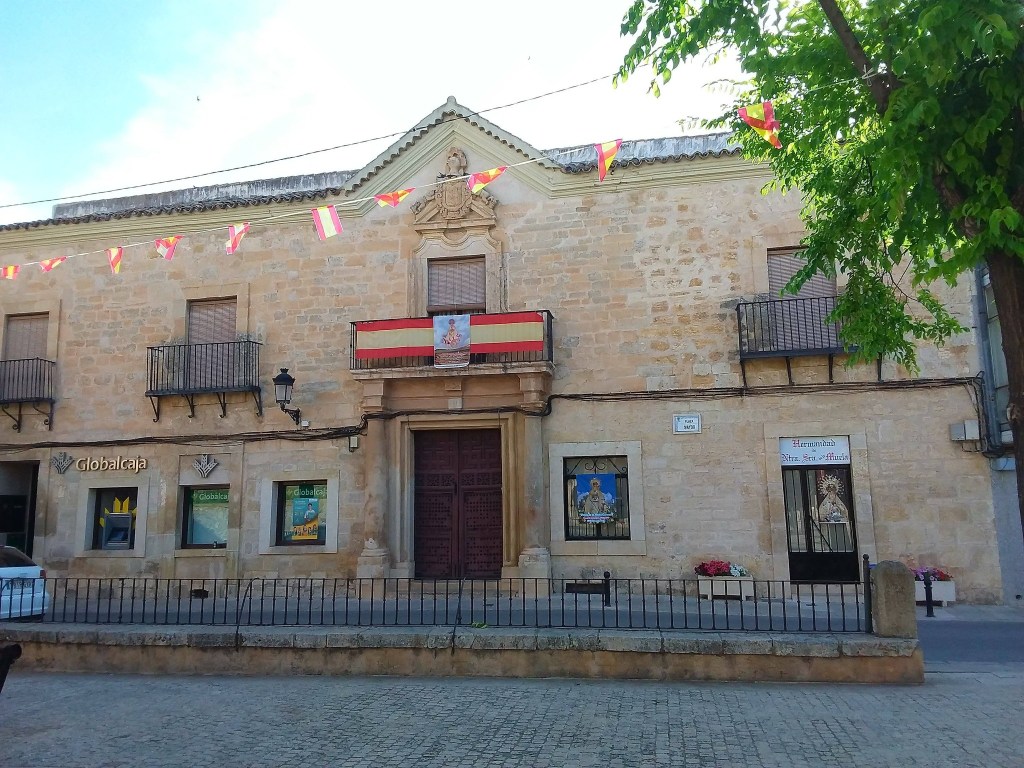
The neoclassical City/Town Hall was designed in 1777. It is a two-story building with arcades supported by columns. It retains its original exterior design, while the interior has undergone several renovations. It is located in the Plaza Mayor. Next to the church. Corral de Almaguer boasts a remarkable collection of stately homes, such as the Collados house (15C); the Chacón house (Renaissance style); the Encomienda house (15C, Gothic style); the Casa Barreda (17C, Baroque style); the Casa de los Fuentes aka Casa Higueras, 17C, vernacular Baroque style ; and the Casa Maldonado y Medrano (18C, Baroque style). The Casa de Postas is also located by the church, Other monument to see here is the Almaguer Castle: crowns a small natural hillock that forms part of the hill overlooking the town,
Other interesting thing to see and I have tried one is that the village has 12,430 hectares of vineyards. It has a cooperative and four wineries that produce wines from diverse varieties such as Airén, Sauvignon Blanc, Cencibel, Garnacha Tintorera, Tinto Velasco, Syrah, Cabernet Sauvignon, and Merlot, which hold the La Mancha and Tierras de Castilla Designations of Origin. My experience has been with the Bodegas Altovela’s facilities have been equipped with the latest technology and include two bottling lines: a 5,000-bottle-per-hour bottling line for still wines, and an isobarometric line for sparkling and frizzante wines. Since 1965,
A bit of history I like tell us that although the name Almaguer is of Arabic origin, the first inhabitants of the area were the Iberians and Celts, later mixed with the Romans and Visigoths. The founding of the very noble and royal town of Corral de Almaguer is officially dated to the beginning of the 8C. Given its strategic position, it was decided to build a castle, which remained on the hilltop until the 15C . However, from this initial period until the 14C, that is, for approximately 600 years, there is no further record of this place. In 1312, Diego Muñiz, Grand Master of the Order of Santiago, granted it the privilege of town status. In 1342, Alfonso XI of Castile granted it two annual fairs, one on Saint Andrew’s Day and the other on the feast days of Saints Philip and James, a privilege that would be confirmed by the Catholic Monarchs. It was also granted other privileges, such as the right to bear arms, bestowed by Charles V, and the right of the roundabout, which consisted of using a semicircular area for grazing livestock without requiring the consent of neighboring villages. Most of its monuments and stately buildings date from the 15-16C, coinciding with its period of greatest splendor. Families from this area emigrated to Latin America starting in the 16C and settled in northern Mexico, where they founded communities. These connections with the Americas remain in the local memory and show how the villagers shaped the history of an entire region.
The Village of Corral de Almaguer tourist information : http://www.corraldealmaguer.es/areas/turismo/video-re-conoce-corral-de-almaguer
The province of Toledo tourist office on Corral de Almaguer : https://turismoprovinciatoledo.es/localidades/corral-de-almaguer/
The Castilla La Mancha region tourist office on Corral de Almaguer : https://www.turismocastillalamancha.es/es/destinos/encanto-rural/toledo/corral-de-almaguer
There you go folks, something more in my road warrior trails of my dear Spain. These are quant pretty villages that are worth a detour, me think. Again, hope you enjoy the post on this is Corral de Almaguer !!! as I
And remember, happy travels, good health, and many cheers to all !!!


💙
LikeLiked by 1 person
Thanks for stopping by Cheers
LikeLike