
This is a very memorable City for us going way back many years, My dear Mom Gladys told me about it and we came eventually and have ever since with the family. I am glad found me this picture in my cd rom vaults that should be in my blog for you and me, This church needs more and we shall return, eventually, The City of Calatayud is in the province of Zaragoza in the autonomous community of Aragon , and in the kingdom of Spain, Therefore, here is my take on the Basilica Colegiata del Santo Sepulcro of Calatayud !!! Hope you enjoy the post as I.
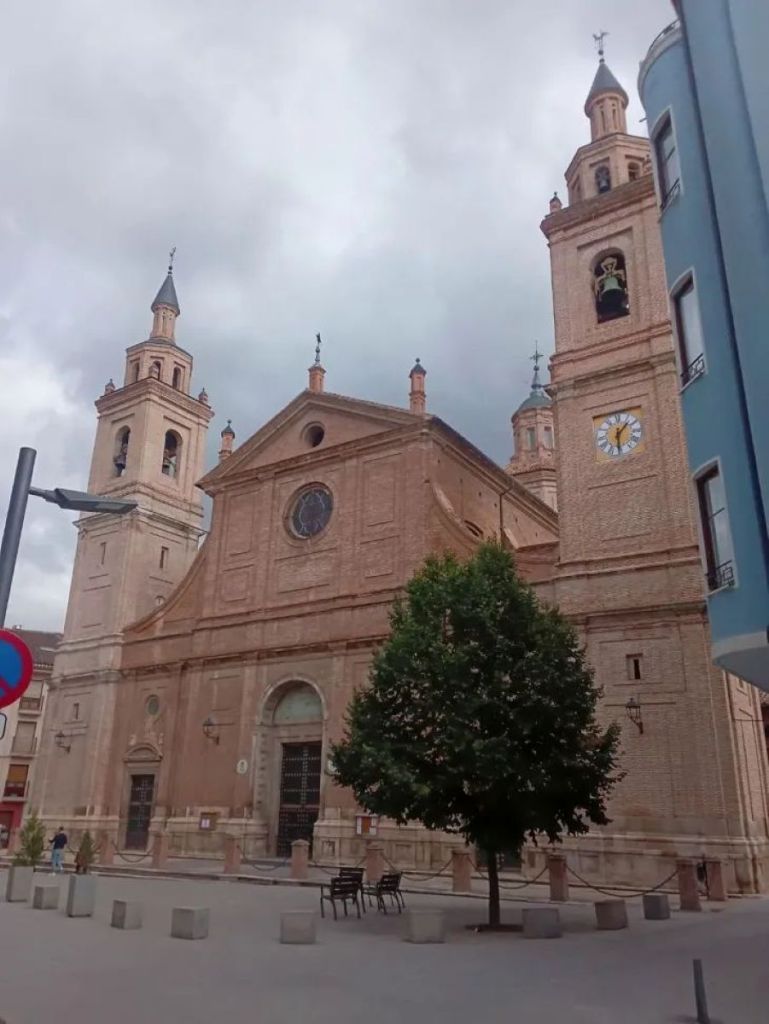
The Basílica Colegiata del Santo Sepulcro or the Collegiate Basilica of the Holy Sepulchre. The main façade is very austere, with vertical lines predominating over horizontal ones. The first level features three doors, each providing access to one of the naves. The central door, the tallest, has a limestone relief in its tympanum depicting the Entombment of Christ. The side doors are surmounted by the patriarchal cross. The second level is rectangular, with a large central oculus and a triangular pediment crowned by three pinnacles. Two towers flank this façade, each consisting of three square sections and an octagonal spire topped with a conical slate finial. The entire façade is decorated simply with square and rectangular panels of raised brick.
The Basilica of the Holy Sepulchre inside, it is a monumental three-aisled church, the central aisle being wider, with a transept that is not prominent in the floor plan and a deep presbytery that houses the choir. The central aisle is covered with a lunette vault, while the side aisles have groin vaults. The crossing is covered by a large dome on pendentives, with a drum and lantern. Eight windows and eight niches, each containing sculptures of angels with the symbols of the Passion, open in the drum. The pendentives feature the cross of the Holy Sepulchre. may well be a unique church in the world, as all its altarpieces, located on the sides of the transept and in the side aisles, depict different scenes from the Passion of Christ, forming an elegant and uniform ensemble.
The church is dominated by the main chapel. A sumptuous space, built around 1770, features a monumental gilded wooden baldachin on jasper columns, which shelters the image of the recumbent Christ with Nicodemus and Joseph of Arimathea and is topped by a stucco-covered wooden image of the Risen Christ. The altarpieces make this church unique, as they depict the complete cycle of the Passion of Christ. There are eight side altarpieces: six commissioned by Prior Juan de Palafox and executed immediately after the church’s completion, and two (The Entry into Jerusalem and Jesus before Caiaphas) by Canon Francisco Yago de Soria, finished in 1666, but following the same typology and style. They are fine examples of the Calatayud school of sculptors, gilders, and altarpiece painters of the 17C. Two chapels open onto the sides of the transept; the one on the epistle side is dedicated to Virgen del Carmen or Our Lady of Mount Carmel, although Nuestra Señora de Guadalupe or Our Lady of Guadalupe can be seen in the altarpiece behind the titular image. The relics of Saint Valentine are kept in the predella of this altarpiece. In the Gospel chapel, there is a 17C altarpiece dedicated to Nuestra Señora de Bolduc or Our Lady of Bolduc, and 18C Neapolitan images of the Immaculate Conception, Saint George, Saint Michael, and Saint Joseph.
A baldachin, constructed in the mid-18C stands in the presbytery. It is a fully Baroque structure made of marble and gilded wood. The image of the recumbent Christ is flanked by carvings of Joseph of Arimathea and Nicodemus, and the ensemble is crowned by an image of the resurrected Christ and two angels with the shroud and tombstone. On either side of the baldachin are two doors leading to the choir, carved in walnut wood with bas-relief busts of Mary Magdalene and Mary Cleophas. Behind the high altar lies the choir, with a double row of stalls, whose original 17C structure was enriched with 18C ornamental details.
The story goes that following the controversial will of Alfonso I the Battler, in which he bequeathed the kingdom to the Orders of the Temple, the Hospital, and the Holy Sepulchre, Count Ramon Berenguer IV of Barcelona, husband of Queen Petronila, granted the Order of the Holy Sepulchre of Jerusalem some land in Calatayud, in addition to other properties, in compensation for renouncing the rights in the aforementioned will. The first church was consecrated in 1156 and later enlarged in 1249. After the War of the Two Peters (1356-1369), the church was again replaced by a new convent complex, of which only remains of the Mudéjar cloister and a space known as the stables survive. The current church was built between 1605 and 1613, following the models of Classical Mannerism. It has three doors, and above the central one rests a marble relief of the Holy Sepulchre.
The City of Calatayud on the Basilica Colegiata del Santo Sepulcro: https://www.calatayud.es/turismo/ficha_visitar/colegiata-del-santo-sepulcro
The Aragon region tourist office on the Basilica Colegiata del Santo Sepulcro: https://www.turismodearagon.com/ficha/via-basilicarium-real-basilica-y-colegiata-del-santo-sepulcro-de-calatayud/
The province of Zaragoza on Calatayud: https://www.turismodezaragoza.es/provincia/comarcas/comarca-calatayud.html
The Spain National Tourist Office on Calatayud: https://www.spain.info/en/destination/calatayud/
There you go another jewel in my memorable Calatayud, yes indeed. We shall meet again if you are going by Calatayud ,eventually, This is worth the detour, and we will, Again, hope you enjoy this post on the Basilica Colegiata del Santo Sepulcro of Calatayud !!! as I
And remember, happy travels, good health, and many cheers to all !!!


