
And again taking you back to nice pretty Lisbon, which lucky to have done so much travel here over the years, Again, it all started with my many interactions with this community since earlier days and a godfather of my oldest son, I am glad to be able to moved these pictures here to do this post well deserving on this square, Therefore, let me tell you about the Praça de D Pedro IV of Lisbon !!! Hope you enjoy it as I.
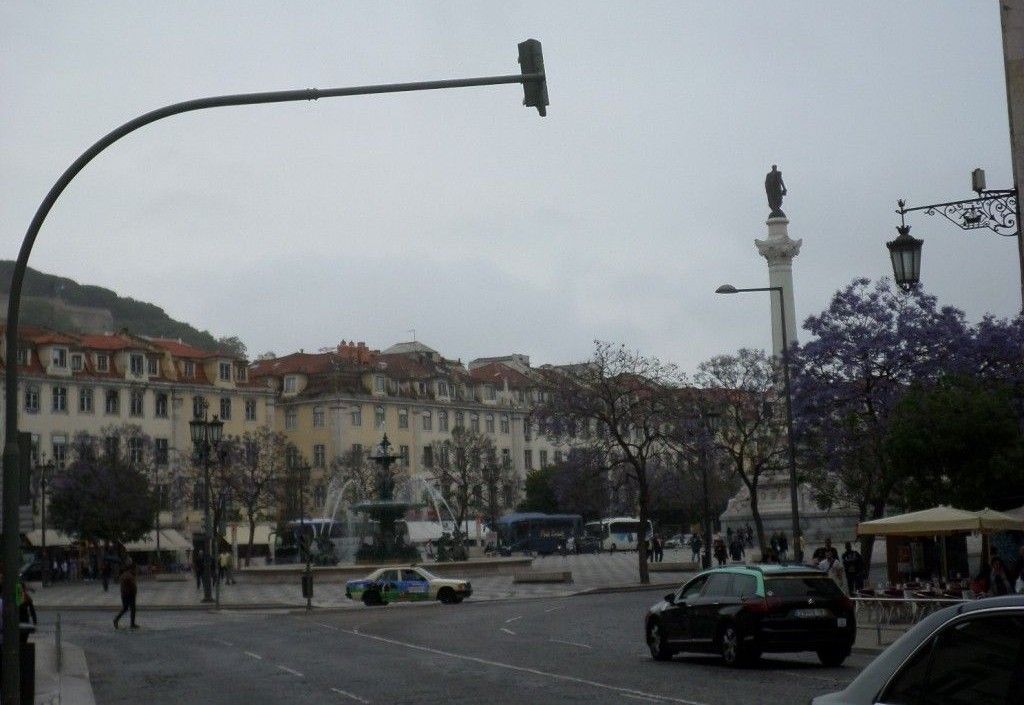
Dom Pedro IV Square better known as Rossio is a square in the Baixa district that has long served as one of the city’s nerve centers. A hippodrome stood there during the Roman period. Standing in the center of the square is the statue of D. Pedro IV, the twenty-eighth King of Portugal and the first Emperor of independent Brazil which was inaugurated in 1870. The monument is 27.5 meters tall and consists of a base, a pedestal, a column, and the statue itself; the pedestal is made of Montes Claros marble, the column of *lioz* stone from Pêro Pinheiro, and the statue of bronze. At the base of the pedestal, four female figures serve as allegories for Justice, Prudence, Fortitude, and Moderation.
The Pedro IV Square or Praça de D. Pedro IV is one of the main squares since the Middle Ages. It has been the setting of popular revolts and celebrations, bullfights and executions, and is now a preferred meeting place of Lisbon natives and tourists alike. The current name of the Rossio pays homage to Pedro IV, King of Portugal.
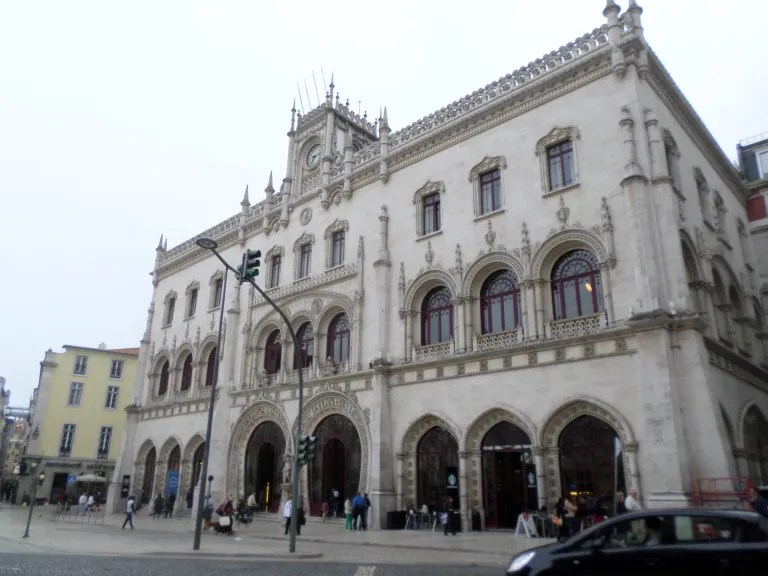
Not my experience with trains in Portugal but the train station in Ferro de Rossio is a wonderful architectural gem worth seeing. Praça de Dom Pedro IV (better known as Rossio). officially is the Praça de D. Pedro IV , Here you have another metro station Rossio on the Green line as well as the train station by same name (previously called Central)
A bit of history I like tell us that aAs early as the Middle Ages, the area began to be surrounded by various types of buildings. In the 15C, the Royal Hospital of All Saints was established there; built during the reigns of John II and Manuel I, it rested on twenty-five pointed stone arches and featured a central church of splendid Manueline architecture, with a Flamboyant Gothic portico on its façade displaying the founders’ emblems. To the north of the hospital stands the Convent of São Domingos, founded in 1242 by King Sancho II, later expanded by Afonso III, and enlarged again by Manuel I. The earthquake of 1531 caused severe damage, necessitating reconstruction in 1536. Everything was destroyed during the 1755 earthquake, with only the chancel surviving; in earlier times, when the kings resided at the Estaus Palace, this chancel had served as the royal chapel. The earthquake caused it great damage, and it was eventually demolished in 1834 to make way for the building that wraps around the corner from Rossio to Largo de São Domingos. At the northern end of the square , where Largo D. João da Câmara is located today stood the Estaus Palace, with its three-story towers; it was built in 1449 by Prince Pedro (the Regent) to accommodate court members lacking their own homes, as well as visiting monarchs and foreign ambassadors. John III lived in this palace from 1540 onwards receiving Saint Francis Xavier there that same year, and it was the site of many court festivities. It was there that D. Duarte, son of D. João III, died, and where D. Sebastian received the governance of the kingdom from the hands of Cardinal D. Henrique. In 1571, the Tribunal and Headquarters of the Inquisition were established there, and it was officially named the *Casa de Despacho da Santa Inquisição* (Administrative House of the Holy Inquisition). It was severely damaged by the 1755 earthquake. In 1807, the *Paço da Regência* (Regency Palace) was installed on the site of the *Palácio dos Estaus*, followed by the Chamber of Peers in 1826; the Royal Academy of Fortification, the Police Superintendency Secretariat, the Army School, and the Public Treasury were also housed there. In 1836, while the Treasury was operating within the building, it burned down completely. The *Teatro Nacional D. Maria II* (D. Maria II National Theatre) was built in its place and inaugurated in 1846.
The Lisbon tourist office on Rossio (Pedro IV): https://www.visitlisboa.com/en/places/rossio
The Portugal tourist office on Lisbon: https://www.visitportugal.com/en/destinos/lisboa-regiao
There you go folks, another memorable spot of my trips to Lisbon always looking forward to be back,eventually, You should come to see it too ! I was lucky to come several times, see my several posts on it in my blog, Lisbon is catchy, Again, hope you enjoy this post on the Praça de D Pedro IV of Lisbon !!! as I,
And remember, happy travels, good health, and many cheers to all !!!

 Paris1972-Versailles2003
Lisbon is beautiful!
LikeLiked by 1 person
I agree! Thanks for stopping by Cheers
LikeLiked by 1 person