
I once again in my dear search found pictures in my cd rom vault that should be in my blog for you and me, This is an off the beaten path town that is worth the detour at least for the castle. I came here later on visits from France and in my road warrior trails of my dear Spain. Therefore, let me tell you on this is San Fernando de Henares !!! Hope you enjoy the post as I.
The City of San Fernando de Henares, traditionally and historically known as the Royal Site of San Fernando, is located in the Community of Madrid, and kingdom of Spain, The City is divided into two main areas: the residential urban center that makes up the city, where almost the entire population registered in the municipality resides, and the industrial parks south of the A-2 autovia ,and east of the M-45/M-50, beltways bordering the neighboring City of Torrejón de Ardoz (see posts). There is direct access from the A-2 autovia at km 15, M-40, and M-45 exits/salidas 27 and 32. It also has a nearby exit from the R-3 radial highway of Mejorada del Campo-Velilla de San Antonio., The City is 7 km from Torrejon de Ardoz, 17 km from Alcalà de Henares, 51 km from Aranjuez, 100 km from Segovia, and 17 km from Madrid from where we came from around the Retiro park and getting right onto the Calle de O’Donnell continue past City limits becomes the M23 road continue take left land briefly on the R 3 road dir Valencia then at exit salida 4 bear left onto the M45 beltway this connects right into the M50 beltway road to exitSalida 32 dir San Fernando de Henares on the M206 road then bear right onto Calle de Eos into City center next roundabout bear right onto Calle Valle del Jerte continue to next roundabout and bear right onto Calle Valle del Cabriel continue to next roundabout call Escudo de Torrejon or shield and continue straight into calle de Joaquin Blume which becomes Camino Rio same road making a left turn onto Calle Duque ,continue bearing left onto Carretera del Castillo (castle’s way) where you see the entrance to the castle palace of Aldovea,
The Castillo Palacio de Aldovea castle-palace dates back to the 15C.The Aldovea castle-palace, located to the east of the city and bordering Torrejón de Ardoz, near Parque de Europa Park After serving as a country retreat for the Archbishop of Toledo, it fell into disuse until the 17C when the Infante Cardinal (Fernando) Ferdinand of Austria, brother of Philip (Felipe) IV, expanded the building and transformed it into a palace. A subsequent period of inactivity affected the property and its preservation. In the mid-18C, the Infante Cardinal Luis de Borbón restored the palace as a place of leisure. It features a quadrangular floor plan with a central courtyard, prominent square towers at the corners, and a three-tiered main façade topped by a broken pediment bearing the Bourbon coat of arms.

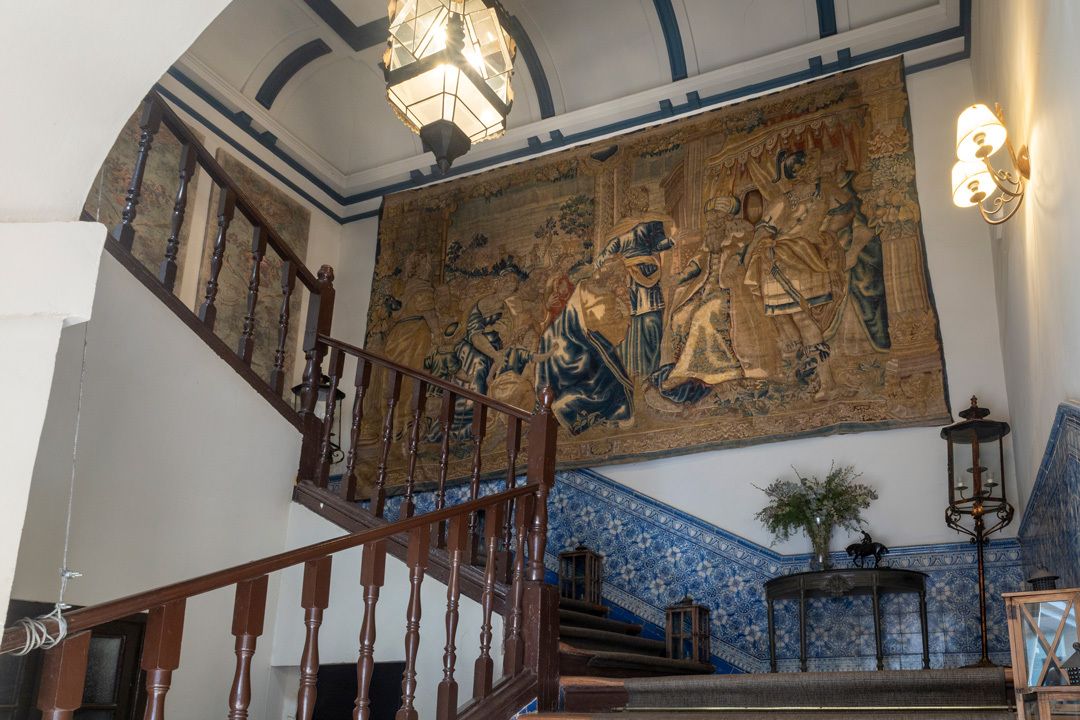
The Castillo Palacio de Aldovea is structured in three stories, separated by a continuous impost and topped by a projecting cornice, its lower section adorned with corbels. Its main façade, slightly set back from the two side towers, features a central portal flanked by banded columns and topped by a broken pediment. In the center of this pediment is the coat of arms of Spain, surmounted by the royal crown. A sculptural group of cherubs holding a hat surrounds the pediment, flanked by pedestals with spheres characteristic of the 18C.On the ground floor, three windows with grilles open above the main entrance and the base. Above each window on the main floor are simple balconies, while those on the upper floor have grilles. The balconies at the ends of the towers are crowned with triangular pediments, an 18C addition. Regarding the layout of the palace-house, we know that the rooms are arranged around a courtyard, which provides air and light to the rooms and is accessed through a vestibule from the main entrance. The distribution is as follows: on the ground floor, stables, coach houses, and a kitchen; on the main floor, the reception rooms, chambers, antechambers, offices, and main bedrooms; and on the upper floor, the servants’ quarters and other ancillary spaces. Access between the floors is via a main staircase with wooden steps, a secondary staircase leading to the kitchen, and two spiral staircases that connect the main floor to the towers and attics. Another distinctive feature is the French-style fireplaces.
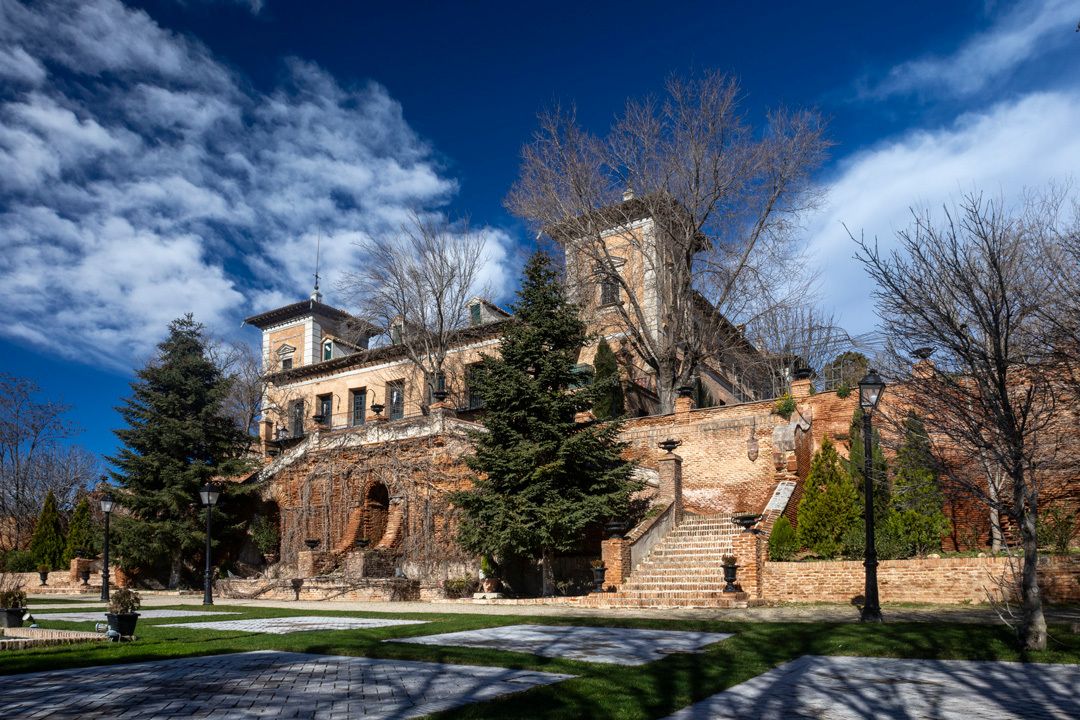
This castle must have been built towards the end of the 11C or beginning of the 12C; it was probably a fortress, whose importance was strategic due to its location on the banks of the Jarama River. The first references to Aldovea Castle appear around this same time in a document stating that in 1154 the town of Mejorada, along with the nearby castle, was given to the Archbishop of Toledo, In 1804, Manuel Godoy sold it to King Charles IV, and from then on, it was incorporated into the royal patrimony at the Royal Site of San Fernando, along with its surrounding woodlands. It remained part of the Royal Patrimony until 1869, when, due to the Confiscation of Crown Property, it was auctioned off, The castle and its lands were acquired by the Figueroa Bermejillo family, Marquesses of Gauna and Dukes of Tovar (a branch of the Romanones family). This Duke of Tovar, owner of a famous fighting bull ranch in the area surrounding the castle, converted it into a palatial residence. It is still owned by the same family, the Dukes of Tovar.
Other things to see here with more time are the Federico García Lorca Theatre and the Rafael Alberti Central Library located on Calle de la Libertad in the old town, in the renovated building that housed the City/town hall from the 19C until it moved to its current location in 1999, incorporating the remains of the Real Fábrica de Paños or Royal Cloth Factory. The Royal Site’s urban complex comprises the Plaza de España and its buildings, the remains of the Royal Cloth Factory, the Plaza de Fernando VI, and the streets radiating from it. In the round Plaza de Fernando VI, symbolically located at its center, is the statue of King Fernando VI, who promoted the founding of the Royal Factory and the new settlement linked to it. The statue was moved from the Royal Palace to the town in 1844 during the reign of Isabel II. The square is the geometric center of the town’s current urban layout, from which the eight streets that structure it originate.
A bit of history I like tell us the first evidence of the Ancient Age were Roman remains, specifically some purple-glazed ceramics. This could be because San Fernando was located within the territories of Complutum, present-day Alcalá de Henares (see post). No Visigothic remains have been found in the city, only what could be a kind of refuse heap, ceramics, and documented cereal storage. Regarding the Arab presence, it is known that they were present in the city. During the Reconquista, San Fernando initially became part of the Kingdom of Castile (Castilla), but in 1109 the Almoravids took Alcalá and the surrounding lands, including San Fernando. However, finally in 1118, San Fernando returned to the Kingdom of Castile. After this, San Fernando was incorporated into the community of town and land of Alcalá de Henares.
The City of San Fernando de Henares owes its name to Philip (Felipe) V of Spain, who, in one of his last acts as king, issued a royal decree on June 29, 1746, ordering the purchase of Torrejón de la Ribera for the establishment of a superfine cloth factory, thus eliminating dependence on foreign imports. His successor, Ferdinand (Fernando) VI, took possession of the site on August 30. The Royal Cloth Factory building was located on what is now Plaza de España, in the section where the square was crossed by the now-vanished Calle de Pavía, which is currently part of the pedestrian area of the square. A square now called Plaza de España was opened in front of the factory’s main facade, connected by an axis to a second, round square now Plaza de Fernando VI. In 1753, the factory moved to Vicálvaro due to low productivity. The building was used as a reformatory, where people were taught to read and write, or learned trades. This service remained active until 1801, when the inmates were transferred to Madrid.
During the French occupation (war of independance or peninsular war), the Royal Site of San Fernando de Henares suffered greatly. The name San Fernando is used in honor of the patron saint of the founder of the Royal Site, Fernando VI of Spain, whose name corresponds to that of another medieval king, Fernando III of Castilla, known as the Saint; and the addition of Henares comes from the Henares river, although the river more closely linked to the historical development of the city has been the Jarama river, which borders the town center. Indeed, the city was called “San Fernando de Jarama” until 1916, when the City Council, decided to change the river’s name to that of the Henares river.
The City of San Fernando de Hénares on its heritage : https://www.ayto-sanfernando.com/lugares-de-interes/
There you go another of my gems of my dear Spain and still memories that will not go away. Again, hope you enjoy this post on this is San Fernando de Henares !!! as I. And remember, happy travels, good health,and many cheers to all !!!


