
Oh yes another wonderful old town of my dear Spain; this is deep country and our road warrior trips at its best. There are so many towns that will take you a life time to see them all, and each is unique ; I am working on them ! .Once again, glad, found me some pictures in my cd rom vault that should be in my blog for you and me. I go around these towns a lot on my roundtrips between France and Spain, and sometimes wish I could have spent more times in them. Do read/see my other post on this wonderful town in my blog. Therefore, let me tell you my bit on this is Sigüenza !!! Hope you enjoy the post as I.
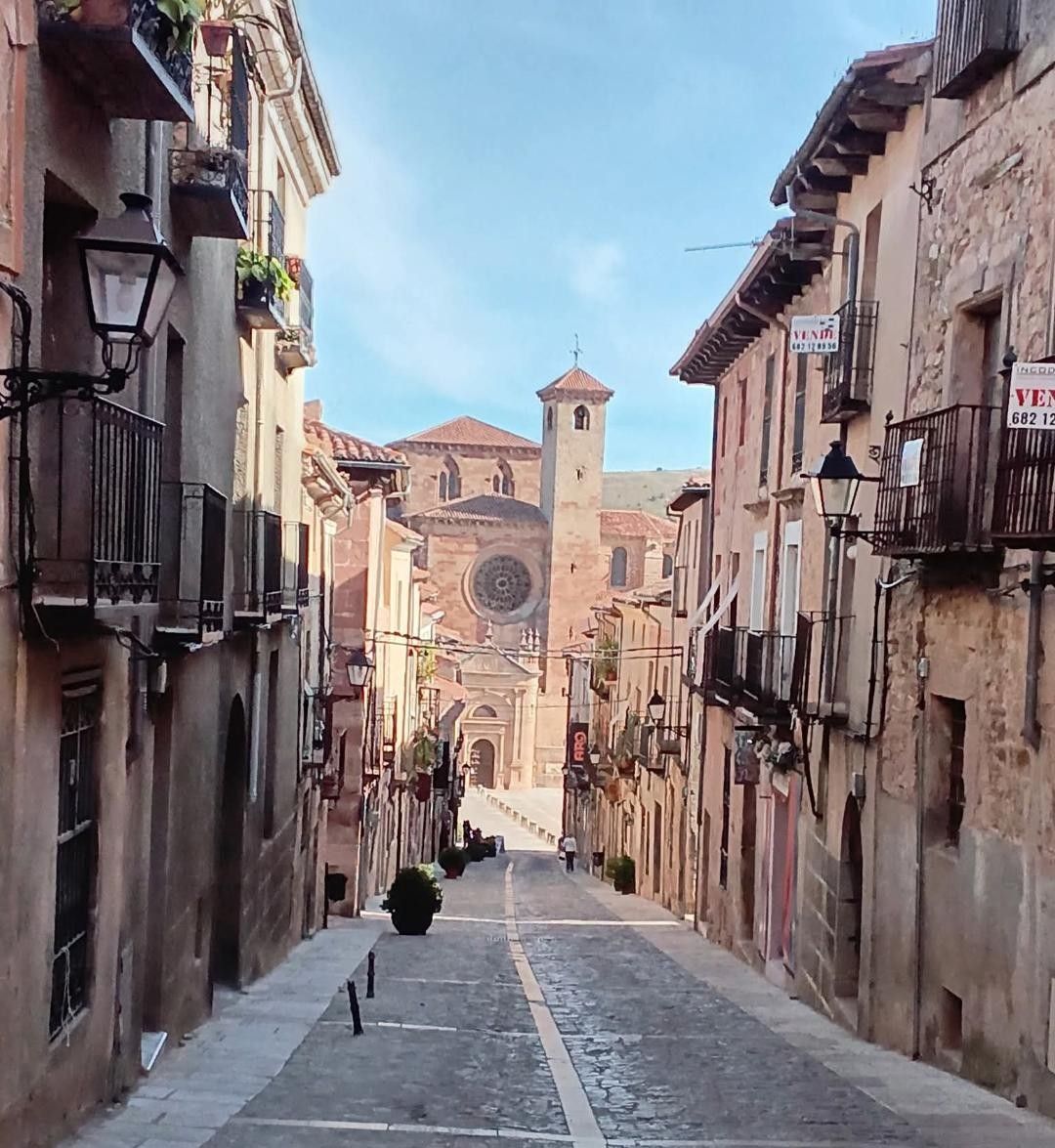
The town of Sigüenza is located in the province of Guadalajara, in the autonomous community of Castilla-La Mancha of the kingdom of Spain. It has a total population of 4,830 inhabitants (INE 2024). The town is located 130 km from Madrid, 74 km from Guadalajara, 198 km from Zaragoza, 324 km from Valencia, and 173 km from Cuenca from where we came from. By road: It has five road connections to the autovía del Nordeste or northeast highway, A-2 (Madrid-Barcelona). The exits or salidas are to Atienza and the Sierra de Ayllón and to the Duero (Almazán, in the province of Soria). From Cuenca I took the N320 to Sacedon,exit/salida 220, here took the N204 going around the embalse de Entrepañas dam and the smaller embalse Pareja dam, continue on same road around the dams, with beautiful scenery until it gets dry and plain to Cifuentes continue along dry plain road until connection at exit/salida 103 briefly on the A2 and get off at exit/salida 104 into the CM1101 road and more dry plain road into Sigüenza,
The town of Sigüenza was declared a historic-artistic site, a precursor to the status of a cultural asset of interest, on May 20, 1965. Its important monuments include the cathedral, a valuable and authentic museum, already included in the Monumental Catalogue of Spain, and the castle-palace-fortress, the residence of the bishops until the mid-19C. Also noteworthy are churches such as Santiago and San Vicente, Romanesque; its Plaza Mayor, ordered by Cardinal Mendoza and one of the most typical of Castilla La Mancha; the Municipal House, the Episcopal Palace, the small hermitage of Humilladero, the visible remains of successive walled enclosures with some of its gates and towers; sectors such as the small Jewish quarter and Calle de las Travesañas, which include the Plazuela de la Cárcel, the old medieval Plaza Mayor, around which the buildings of the old City/Town Hall, the prison and the Posada del Sol are still preserved; the Plazuela de las Cruces; and the Baroque neighborhood of San Roque, where La Alameda, or the city’s main park, is located.
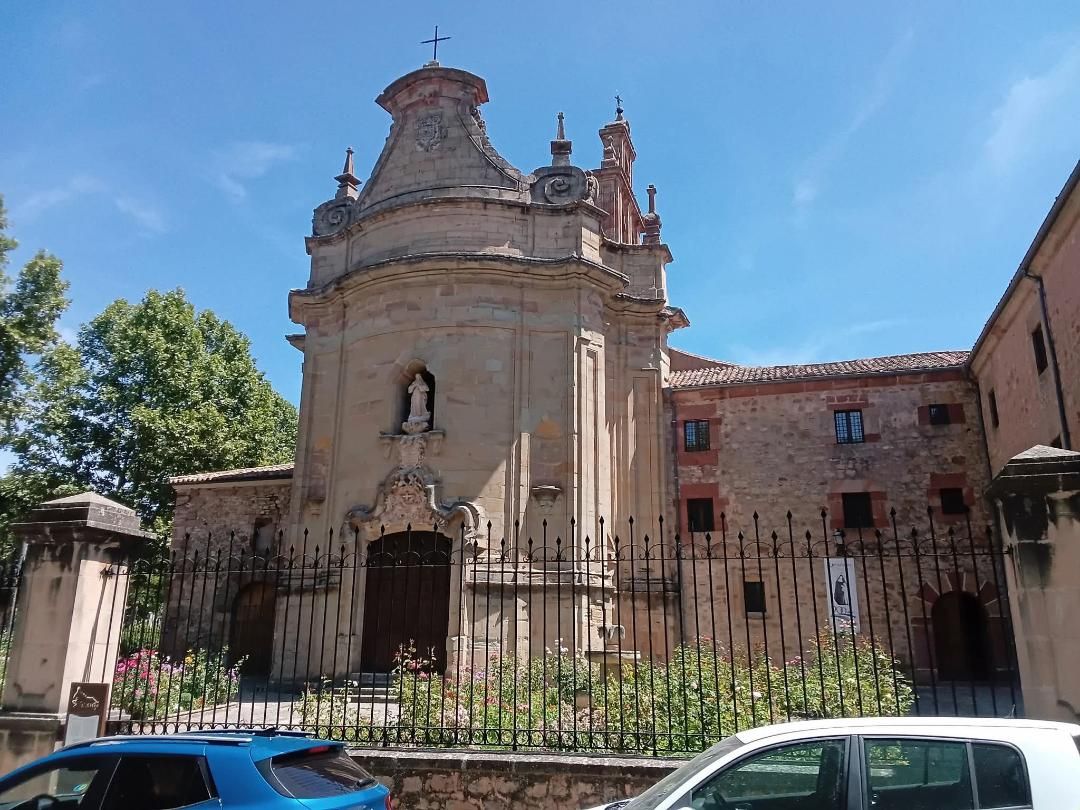
The Monasterio de Jesus, Maria y José (Jesus, Mary, and Joseph), better known as the Monasterio de las Ursulinas located at Paseo de la Alameda, 36, built in baroque style, The Ursuline Monastery was a former Carmelite convent that later passed into the hands of the Franciscans, whose coat of arms appears on the undulating Borrominesque façade of its church. It was on February 24, 1818, 205 years ago today, that the Ursuline nuns, from Molina who took charge of the convent, began their educational work in the mitred city. It was built in 1512, and was not occupied until 1606 by Carmelite friars. However, the rise of the Counter-Reformation led the Papacy to request that Franciscans and Dominicans be installed at the entrances to cities to watch over the faith of those who approached them and as an ideal location for the Inquisition. Thus, due to its location in Sigüenza, the Carmelites had to give way to the Franciscans. With the confiscation of Mendizábal, (State/Church) all monasteries with fewer than 12 monks were closed, so the monastery passed into the hands of the Ursulines, who converted part of the monastery into a girls’ college. The complex was divided into a chapel, monastery, and college, parts that are easily visible from the outside. To see the inside, it’s worth remembering that there is a daily Mass at 20h, except on weekends and holidays, when it is held earlier than 9h.
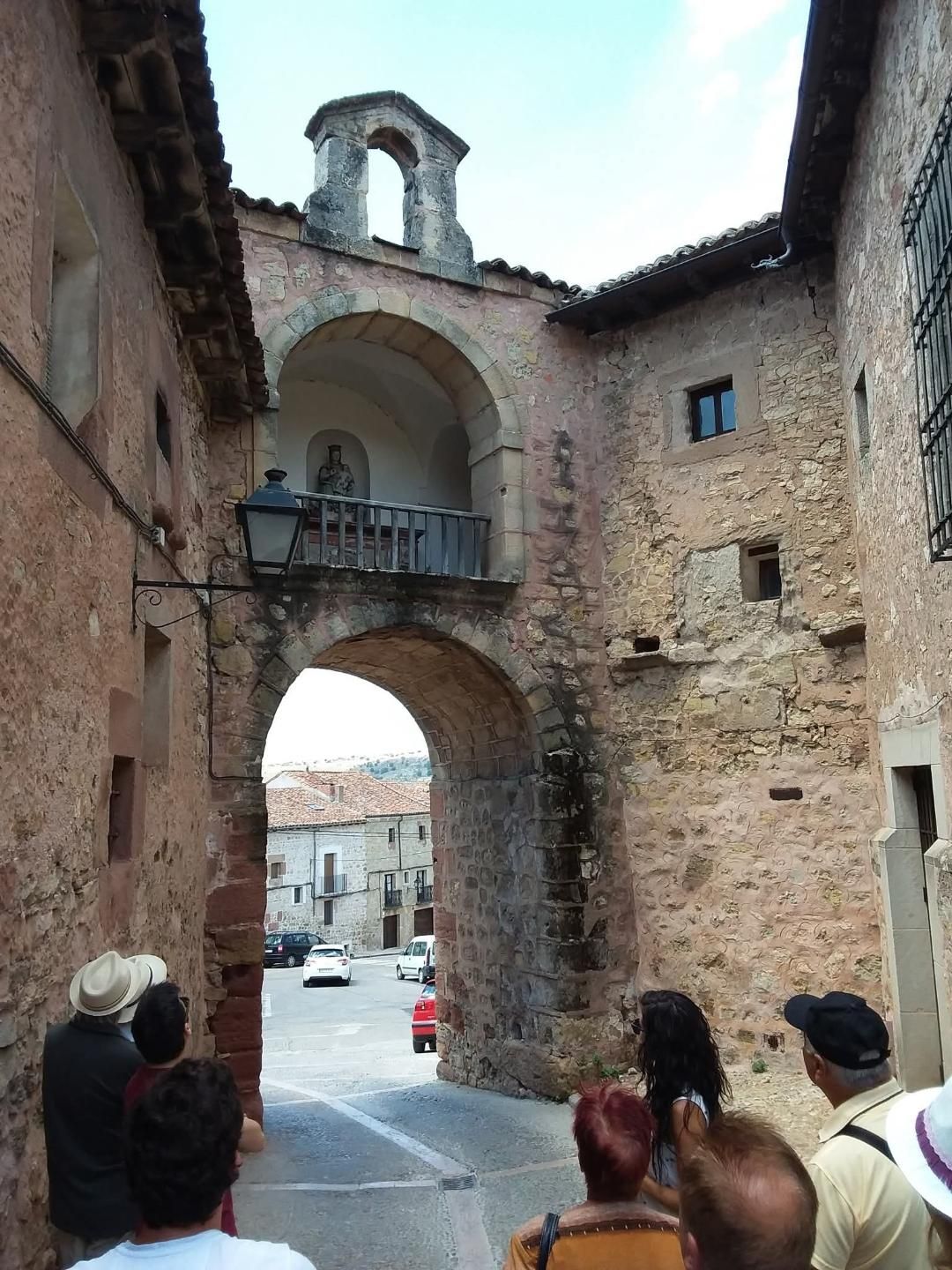
The Portal Mayor de la muralla or the main gate of the wall is the result of the expansion of the walled enclosure in the 14C. On the interior side, the most striking feature is a niche above the semicircular arch with an image of the Virgin of Victory, and a small bell tower above the red-tiled roof. It was built by order of Bishop Girón de Cisneros. On both sides of the interior, supported by the wall, magnificent masonry and stone mansions were built, with doors and windows framed by semicircular and pointed arches. Some of their windows are decorated with grilles, creating one of the most beautiful and photographed corners of Sigüenza. The Portal Mayor was the exit route from the medieval city to the Arrabal (suburb), which was used as a Moorish quarter. The Main Gate was the main entrance of the nine that existed in the 15C and divided the city into the upper and lower towns.
Other things to see here with more time are the Cathedral of Santa María , initially Romanesque-Cistercian in style with a Gothic finish and numerous Renaissance elements in its interior. Its origins date back to January 1124, when Bishop Bernard of Agén (France) conquered the city from the Muslims during the reign of Doña Urraca, daughter of Alfonso VI of León. The Museo Diocesano de Arte Antiguo or Diocean Museum of Ancient Art is located at Plaza del Obispo D. Bernardo s/n in a beautiful neoclassical palace from the 16C. Known as the “Old House of the Barrenas”. The Castle or fortress of the bishops of Sigüenza, now a National Tourist Parador. The Plaza Mayor, Renaissance-style, commissioned by Cardinal Mendoza, it houses the Municipal Palace, with a Renaissance courtyard. Casa del Doncel ,the usual name of what was the late-Gothic palace of the Marquises of Bedmar, now belonging to the University of Alcalá de Henares. The Parish Church of San Vicente; Church of Santiago Apóstol;both in Romanesque style. Church of San Juan; Parish Church of Santa María; in ruins. Chapel of San Pedro Apóstol; Neoclassical, and attached to the Cathedral and reused as the Parish Church of San Pedro. Monastery of Nuestra Señora de los Huertos (or Our Lady of the Gardens or Our Lady of the Poor Clares), Gothic-Renaissance. Ermita del Humilladero, now the Tourist Office. The Episcopal Palace, which was the former University of San Antonio de Porta Coeli.
A bit of history I like ,condense, tell us that Pliny the Elder (1C, BC) mentions in his Naturalis Historia the city of Segontia as an important Celtiberian city, inhabited by the Arevaci; it was taken by the Romans following the fall of the Celtiberian city of Numantia in 133 BC. The Carthaginian penetration of the 3C, BC (prior to the Second Punic War) led Hannibal and then Hasdrubal to besiege it. In the Celtiberian Wars (153-133 BC) the submission to the Roman Republic took place. In the time of the Visigoths its growth continued around the central nucleus founded by the Romans. In Visigothic Hispania it was the episcopal see of the Catholic Church. The latter was alluded to for the first time in the Third Council of Toledo in the year 589 although it is considered probable that the diocese already existed in the 4C or at least at the beginning of the 5C. During the Muslim domination, Sigüenza lost importance in favor of Medinaceli. It constituted a defensive settlement whose importance was military, its castle dominating from the height of the Henares valley near its confluence with the Vadillo stream. The construction of the fortress dates from this period, although its current appearance is later than the Christian Reconquest. With a chronology after the conquest of Toledo in 1085, the conquest of the city by the monarch Alfonso VI of León is considered feasible and probable. Sigüenza was reconquered on January 22, either in the year 1123 or the year 1124 by Bernard of Agén, the bishop of Aquitaine origin already elected around 1109 as head of his diocese. In the second half of the 15C, Cardinal Mendoza was bishop of Sigüenza – and later archbishop of Toledo, during whose lifetime the city experienced its greatest splendor. In 1489, by virtue of the bull granted by Cardinal Mendoza, the University of Sigüenza was founded, which until then and since 1476 had been a college. The university survived beyond the modern age; It disappeared as such in 1824 when it became a college dependent on the University of Alcalá. In 1936, during the Spanish Civil War, the Republican side that had entered the city on July 25 maintained a garrison in the city. The Bishop of Sigüenza was shot on July 27. The final entry of the Nationalists troops into the cathedral, where no one remained, took place on October 16, 1936.
The Sigüenza tourist office on its heritage : https://www.visitasiguenza.es/que-ver-nuestras-propuestas/
The town of Sigüenza on tourist areas : https://siguenza.es/pagina/8/33/
The Castilla La Mancha regional tourist office on Sigüenza : https://en.www.turismocastillalamancha.es/patrimonio/siguenza-82231/descripcion/
The Spain National tourist office on Sigüenza : https://www.spain.info/en/destination/siguenza/
There you go folks, another dandy in the wonderful region of Castilla La Mancha, in country Spain from its foundations. This is a town that should be visited more and will come back,eventually, Again, hope you enjoy this post on this is Sigüenza !!! as I,
And remember, happy travels, good health, and many cheers to all !!!


Another one for my list
LikeLiked by 1 person
It will be a long list in my dear Spain lol !! Hope you can make it. Cheers
LikeLike