
Here I go again , finding treasures in my cd rom vault of pictures that have not told you about it and they should be in my blog for you and me. These are wonderful memorable road warrior trails of my dear Spain and wonderful family travels, and that is the essence of my blog. Therefore, this is my take on this is Oropesa !!! Hope you enjoy the post as I.
The town of Oropesa is located in the province of Toledo, and the Castilla La Mancha region of the kingdom of Spain, The town has less than 3k inhabitants, It is 93 km from Placensia, 144 km from Caceres, 99 km from Trujillo, 130 km from Avila , 117 km from Toledo, and 158 km from Madrid, We passed by here on our way to Madrid from Trujillo along the A5 autovia del Sudeste (southeast),
The main thing here and the reason of our passing is the castle! The Castle of Oropesa is a complex of two buildings: the old castle, or “Muslim courtyard,” dating from the 12-13C, and the new castle, dating from the 14-15C. Both are attached to each other. The old castle was built upon a Roman structure with a rectangular floor plan and circular towers. The new castle, begun around 1402 by one of the branches of the Álvarez de Toledo family, the later Counts of Oropesa, also has a rectangular floor plan, but its towers are different. Inside, there is a large plaza accessible only through a gate, always guarded by one of its towers, which is reached by a stepped ramp said to be one of the most famous in Spain. The parade ground, where cultural events are held today, is a large rectangle that encompasses the fortress’s infrastructure.
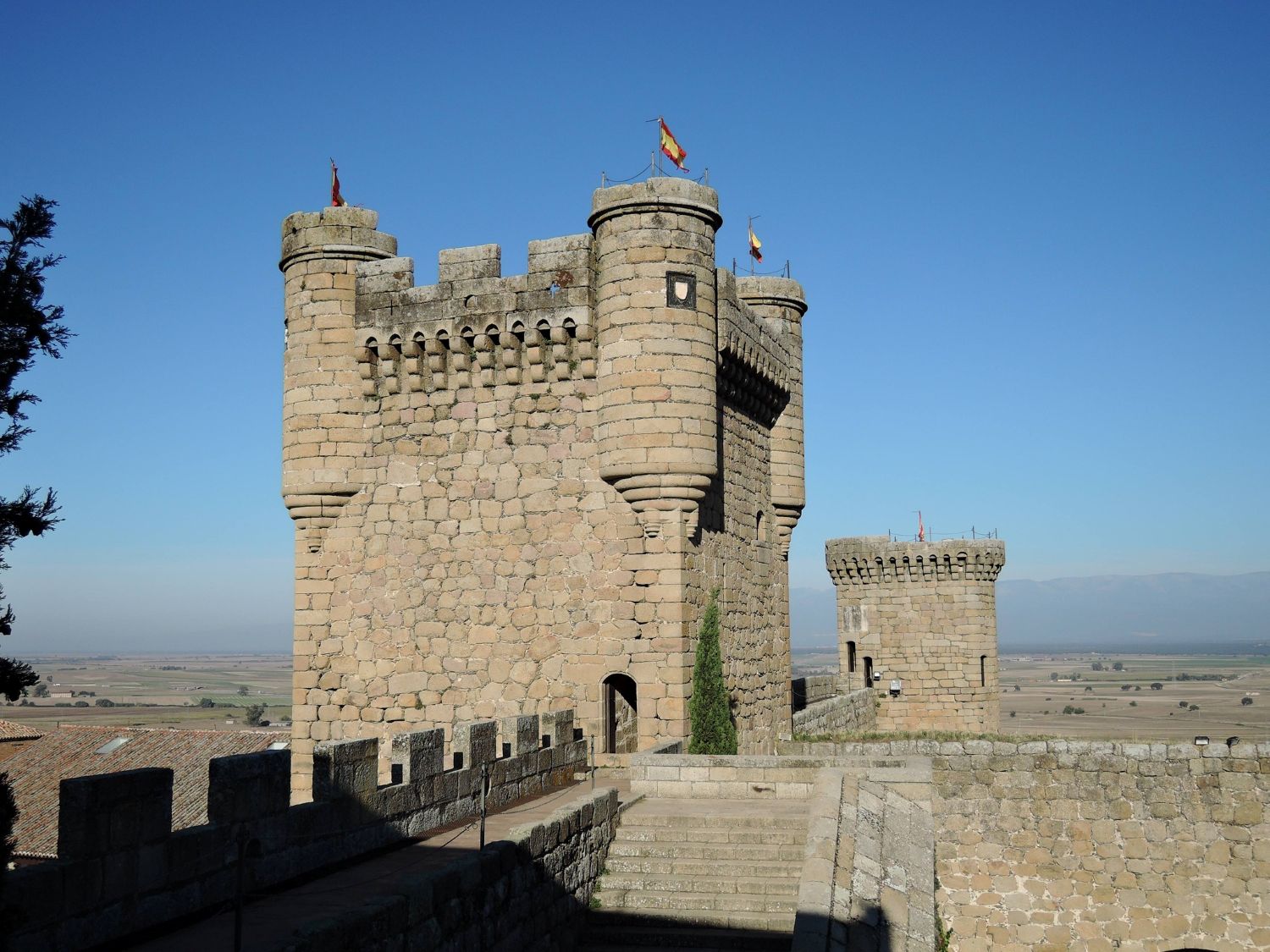
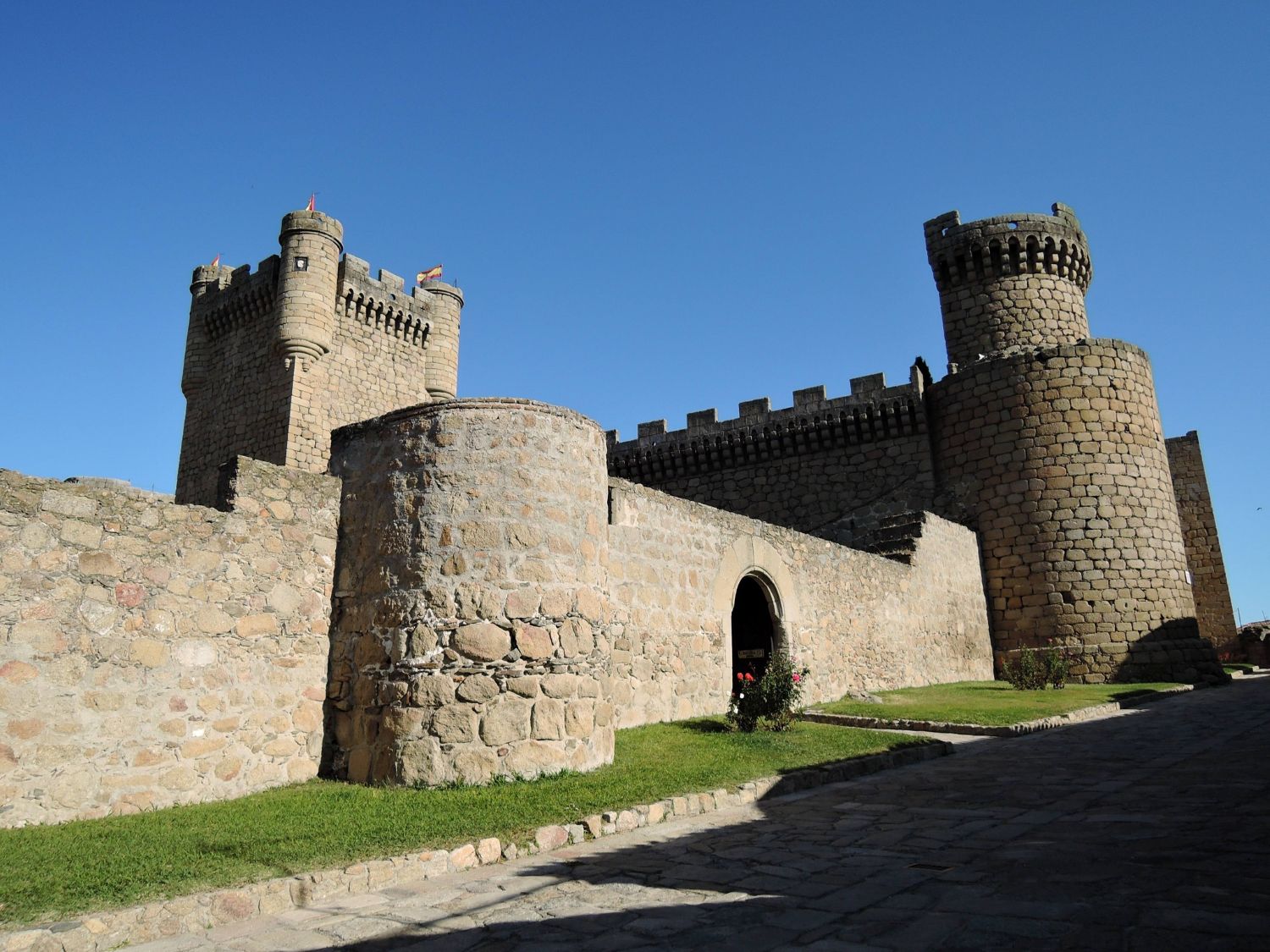 The torre del Homenaje or the keep, standing 25 meters tall, is the most prominent feature of this architectural complex. It has a square floor plan and a doorway at ground level, providing access to the vaulted ceiling. A staircase leads to the first floor. The wall-walk is reached via a wide stone staircase, supported by arches, which ascends from the castle’s inner courtyard. This walkway runs the entire length of the castle wall, passing through small arched doorways to the keep. Its interior features four floors, some of them made of wood, connected by staircases of varying arrangement, constituting a truly original and unique defensive system. At the top of the keep is a crenellated terrace, with two circular turrets attached to its corners, on which are carved the coats of arms of the Álvarez de Toledo and Zúñiga families, corresponding to the fourth lord and first Count of Oropesa, Fernando Álvarez de Toledo y Herrera, and his wife, Leonor de Zúñiga Manrique. This coat of arms, located on the keep, corresponds to the count who built it in 1402.
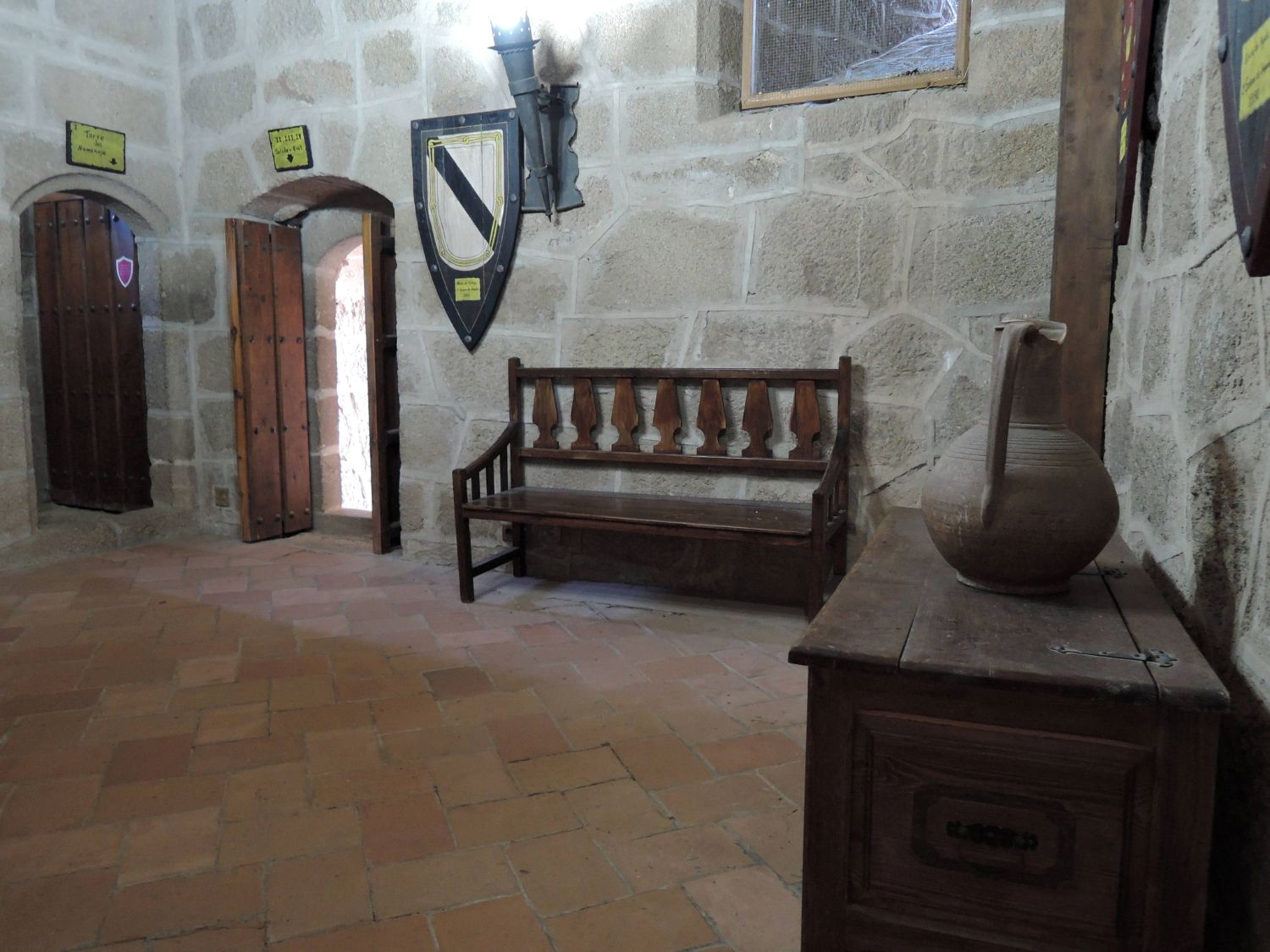
A bit of history I like on the castle tell us that the Castle of Oropesa, aka the Old Castle or the Castle of the Álvarez de Toledo family, forms a complex with the so-called New Palace or Palace of the Álvarez de Toledo family. For four centuries, the Álvarez de Toledo family held the title of Count of Oropesa. From the beginning of the 19C, with the extinction of the Álvarez de Toledo lineage’s entailed estate, the lordship passed to the town itself, although the Dukes of Frías later claimed and obtained it in 1806. The Castle of Oropesa was severely damaged after being sacked by French troops in 1808 during the Spanish War of Independence aka Peninsula War (see post). The lordship disappeared entirely after the Constitution of Cádiz in 1812. Consequently, the Dukes of Frías sold the palace to the City Council, which used it as a bullring. Later, it was acquired by the Spanish State. In 1930, it was incorporated into the National Network of Paradores (state-run hotels), becoming the first parador built on a historic-artistic building. The Old Castle became the Virrey Toledo National Parador, but this was closed and then reinstated in 1966. After several renovations, the castle became a National Parador in 1966, and it is currently in a remarkable state of preservation.
Other things to see here with more time are the Church of Our Lady of the Assumption: 15C, Plateresque style. Jesuit College: 16C, Renaissance style. New Palace: 16C, Renaissance style. Hermitage of La Peñitas: 18C, Baroque style. The Plaza del Navarro: the main meeting point of the town; its most significant feature is the clock tower built in 1901, which forms a pointed arch over a narrow street.
A bit of history I like on the town tell us it was conquered by the Romans, then by the Arabs, and reconquered in the 11C. It formed part of the Community of Towns and Land of Ávila. It is first mentioned in a document dated July 9, 1277, in which Alfonso X orders Pedro Martínez to go to Oropesa and Torralba and compel those who had entered the Velada estate to make restitution for the damages caused to Velasco Velázquez. At that time, it belonged to the Order of Saint Mary of Spain. In 1366, Henry II granted the lordship of this town to García Álvarez de Toledo as a reward for his resignation as Master of the Order of Santiago and also for other services rendered. His descendant, Fernando Álvarez de Toledo y Herrera, was the first Count of Oropesa, appointed by the Catholic Monarchs (Fernando II and Isabel I).
The town of Oropesa on its heritage : https://www.oropesadetoledo.es/conoce-oropesa/
The Castilla La Mancha region tourist office on Oropesa : https://en.www.turismocastillalamancha.es/patrimonio/oropesa-9631/descripcion/
The Castilla La Mancha region cultural heritage on the castle : https://cultura.castillalamancha.es/patrimonio/yacimientos-visitables/castillo-de-oropesa
There you go folks, something off the beaten path in glorious Castilla la Mancha region, a region that is a must to visit while in my dear Spain !. These towns are part of its history with great architecture and we were glad to drived/walked by them. Again, hope you enjoy the post on this is Oropesa !!! as I
And remember, happy travels, good health, and many cheers to all !!!


