
One site that has been overlook by me as always in a rush in the city of Barcelona on business trips only is this Cathedral, it deserves more. I am glad found me an older paper picture that should be in my blog for you and me. Therefore, here is my take on the Metropolitan Basilica Cathedral of the Holy Cross and Saint Eulalia of Barcelona !!! Hope you enjoy the post as I.
The Metropolitan Cathedral Basilica of the Holy Cross and Saint Eulalia, aka La Seo, is the Gothic cathedral of Barcelona, seat of the Archdiocese of Barcelona. The building comprises the church and the cloister, perfectly united by a single style. The cathedral measures 90 meters long by 40 meters wide, and the cloister garden is 25 meters on each side, with each of the four surrounding galleries measuring 6 meters wide. The 40-meter-wide Neo-Gothic façade consists of the main portal flanked by two towers with tall pinnacles. It is ornamented with all kinds of Gothic elements with vertical lines and a profusion of images of angels and saints.
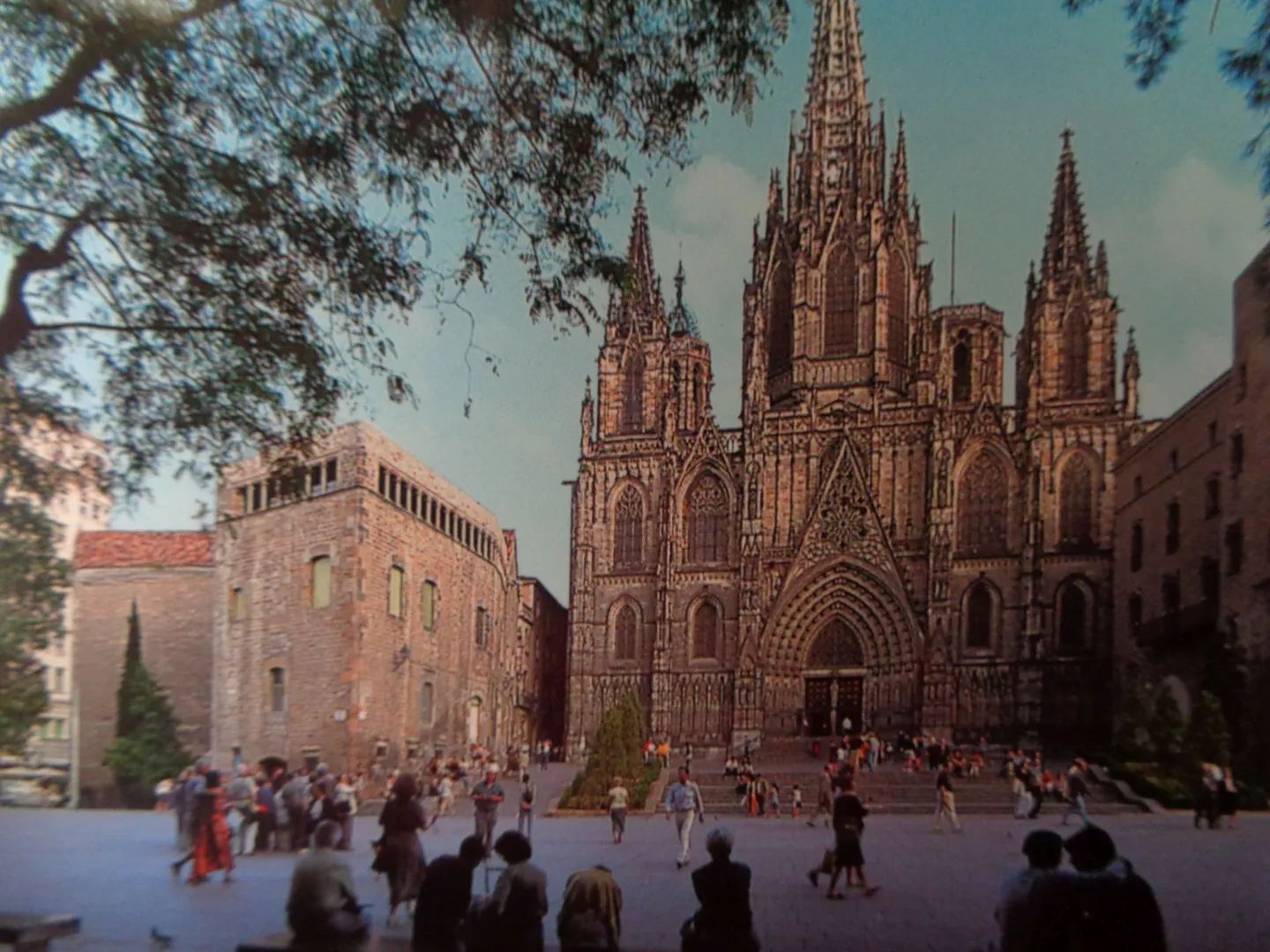
The Barcelona Cathedral has five doors: The Puerta Principal or Main Door, located in the center of the façade facing the Plaza de la Catedral square. The Portal de Saint Ivo: this is the oldest and for five hundred years was the main entrance to the cathedral, through the transept on the Gospel side. The Puerta de La Piedad or Piety, this is one of the exterior entrances to the cloister, with an ogee arch flanked by tall, finely carved pinnacles. The Puerta de Santa Eulalia: located on Calle del Obispo, the entrance is through the cloister, similar to the Door of Piety; it is built with an ogee arch and features a sculpture of Saint Eulalia in the tympanum. The Puerta de Santa Lucia (Lucy), this is the entrance to the exterior chapel of this saint, and the third door to the cloister. The door is Romanesque. The two bell towers, dating from the early Gothic period, are located at the ends of the transept. Both are octagonal and 53 meters high.
The Cathedral of Barcelona or Seo consists of three naves of the same height, the central nave being twice as wide as the side aisles. From the transept, the circular naves join in an ambulatory, passing behind the presbytery and forming a semicircular arch. Within this arch are nine chapels covered by pointed arches of four bays. Above these chapels are the Gothic stained-glass windows that fill the apse with light. There is a U-shaped gallery above the side chapels, and above this gallery and the radiating chapels of the ambulatory, which encircle the entire central nave, is a false triforium. There are another 17 chapels, covered by six-bay pointed arches, with pointed arches at each entrance. There are two chapels located between each buttress with inward projections. To these chapels must be added the chapel of Saint Lucy with an entrance from the outside,
A bit of history I like tell us that the current cathedral was built between the 13C and 15C on the site of the former Romanesque cathedral, which in turn was built on the site of a Visigothic church. This Visigothic church was preceded by an early Christian basilica, the remains of which can be seen underground in the City History Museum. The completion of the imposing facade in the same style, however, is much more modern 19C. It has been dedicated to the Santa Cruz or Holy Cross since 599 and from 877 onwards to Saint Eulalia, patron saint of the city of Barcelona (currently the Virgen de la Merced or Virgin of Mercy is more celebrated as such, who, strictly speaking, is the patron saint of the diocese of Barcelona, but not of the city). The cathedral was reformed again in the Romanesque style, although there is not much information about this new construction, except that it was consecrated in 1058, which allows us to suppose that it must have been a different cathedral from the Paleochristian or Pre-Romanesque one. It likely occupied the central space of the current Gothic cathedral. Construction of the Gothic cathedral began in May 1298, during the reign of James II and under the episcopal mandate of Bernardo Pelegrí , starting with the apse. The old Romanesque cathedral was demolished at the same time, and some sculptural elements, such as the imposts of the Portal de San Ivo Gate, were reused.
The official Catedral de Barcelona: https://catedralbcn.org/
The Barcelona tourist office on the Cathedral: https://www.barcelonaturisme.com/wv3/en/page/585/cathedral.html
Thecity of Barcelona on the Cathedral: https://www.meet.barcelona/en/visit-and-love-it/points-interest-city/santa-esglesia-catedral-basilica-de-barcelona-92086000934
There you go folks ready to visit is a must in the City if I only had more time, always rushing here, will come back, eventually. Again, hope you enjoy the Metropolitan Basilica Cathedral of the Holy Cross and Saint Eulalia of Barcelona !!! as I.
And remember, happy travel, good health, and many cheers to all !!!


I stayed near the Cathedral when I was in Barcelona and the plaza in front is a busy place. There was music, traditional dancing, a Palm Sunday ceremony, etc. The church itself was impressive, as were the geese in the cloister.
LikeLiked by 1 person
Great! It brought you back memories is a wonderful part of traveling! Thanks for stopping by Cheers
LikeLiked by 1 person