
I bring you back to this wonderful mountain town of Huesca . I have been by here several times and did came in with my usual road warrior trails going elsewhere. This will be another memorable post of my travels in my dear Spain, The City of Huesca is in the province of Huesca, the area of Hoya de Huesca, located in the autonomous community of Aragon and in my dear Kingdom of Spain, Therefore, let me tell you a bit on the Monasterio de San Pedro de Siresa of Huesca !!! Hope you enjoy the post as I.
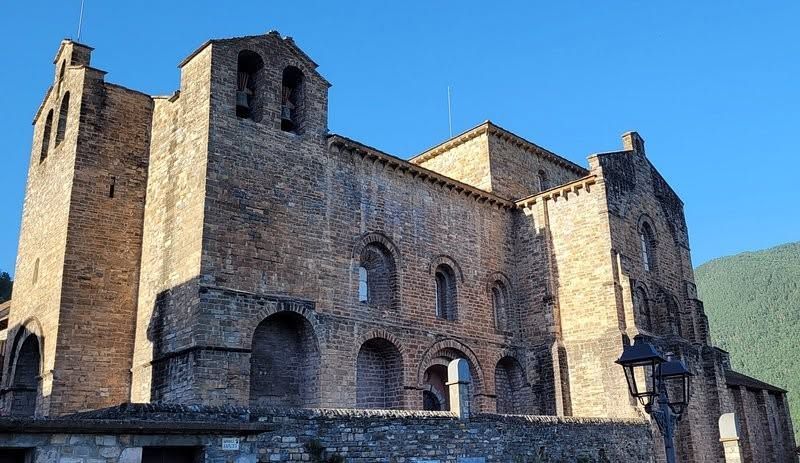
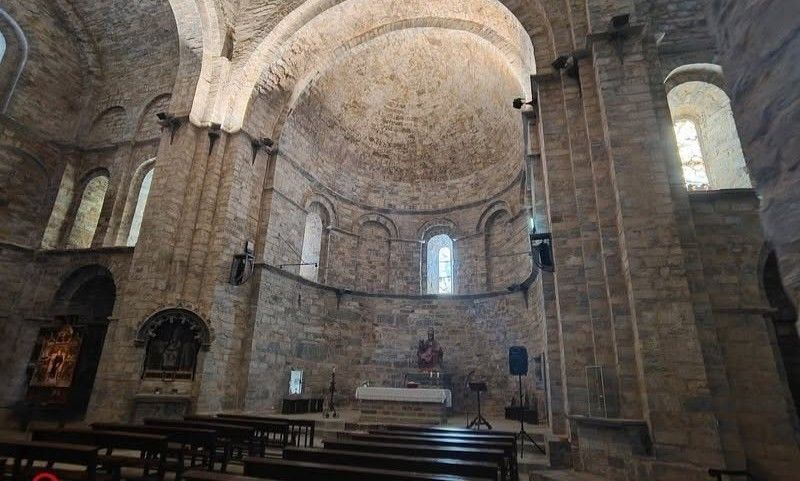
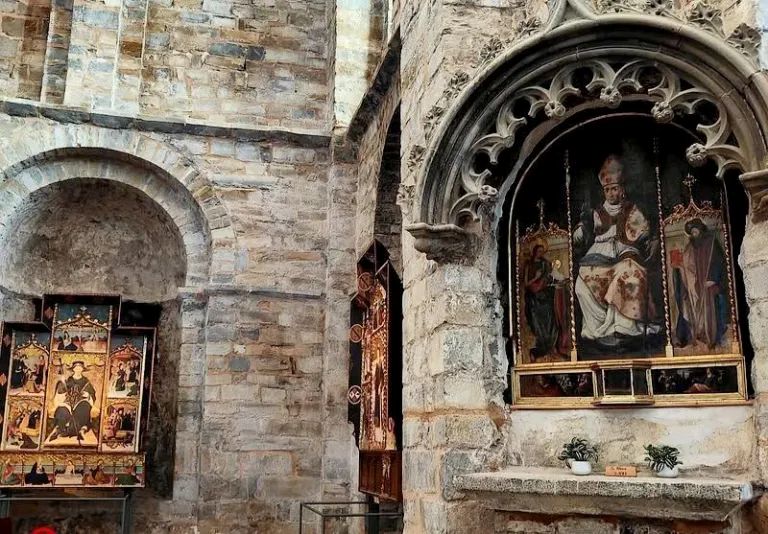
The Monasterio de San Pedro de Siresa is a Romanesque monastery located at an altitude of 822 meters in the Pyrenean valley of Hecho, in the town of Siresa, within the Valle de Hecho ; this is so small will use Huesca as the origin. We came by it on our way back to France along the N240 highway and at Jaca to connect with the N330 highway home, Construction began in 1082 as a renovation of the old Carolingian abbey. It is a large monastery with a cruciform floor Latin cross plan and a single semicircular apse on the interior, although it is polygonal on the exterior, beneath which lies the crypt. This church preserves remains of pre-Romanesque constructions at the foot of the nave. Above the main entrance, a projecting section stands out, topped with a pair of semicircular arches, and a small bell tower equipped since 1920 with a working mechanical clock. A chrismon appears in the tympanum of this doorway. The crossing once had a lantern tower with a hemispherical dome which, after collapsing in a fire, the central section of the transept was replaced with a groin vault, and the side sections with barrel vaults. It still retains some of its furnishings, most notably a Christ figure from a Descent from the Cross, possibly from the 13C, a 13C Virgin Mary, and Gothic altarpieces dedicated to Saint John the Evangelist, the Trinity, Saint Stephen, and Saint James.
The Monastery Saint Peter of Siresa is an ancient foundation, possibly Visigothic, and in fact, the excavations carried out in 1991 confirmed this, although the remains found were subsequently reburied. The first documentary evidence of this establishment is found in a land donation made in 833, specifically on November 25, by Galindo Garcés, Count of Aragon between 833 and 844, and his wife, Guldegrut. The first abbot of the monastery was Zacharias, who organized the monastery according to the rules established in 816 at a synod held in Aachen, inspired by the rule of Chrodegang of Metz, From its library ,it was found works of Greco-Latin tradition that had not been preserved in Caliphate Córdoba, such as the preservation of the Aeneid, a masterpiece of Latin epic literature, poems by Horace and Juvenal, fables by Avianus, and The City of God by Augustine of Hippo, which from that moment on became part of Andalusian Hispanic culture. As a consequence of Almanzor’s expedition against Pamplona in 999, the monastery of Siresa was depopulated. In 1063, it came under the jurisdiction of the diocese of Jaca, and later, in 1077, King Sancho Ramírez of Aragon established a community of canons who followed the rule of Saint Augustine. He placed his sister, Countess Doña Sancha, at its head, who led the monastery between 1082 and the end of 1083. In 1095, it held the status of a Royal Chapel, effectively becoming independent from its dependence on Jaca. Prince Alfonso was educated in this monastery, and upon becoming King of Aragon as Alfonso I the Battler, confirmed the monastery’s privileges in 1113, in addition to granting it other properties and benefits. The monastery began its decline after its definitive union with the Diocese of Jaca in 1145. It is said that the Holy Grail was found in a niche in the apse, and it is also associated with some other nearby religious buildings until its later transfer to Valencia, specifically to its cathedral.
The City of Huesca on its history/heritage : https://www.huesca.es/la-ciudad/historia-y-patrimonio
The Huesca tourist office on its heritage see San Pedro de Siresa: https://www.huescaturismo.com/MapaNuestraProvincia/index_zoom_FRA.html?PID=13
The local Jacetania region tourist office on the monastery: https://turismojacetania.com/lugares.php?idio=en&Id=96
The Aragon region tourist office on the Monastery San Pedro de Siresa : https://www.turismodearagon.com/ficha/monasterio-de-san-pedro-siresa/
There you go folks, a wonderful, terrific, glad had stop by to architecturally and historically stunning Huesca of my dear Spain, A good spot to enjoy the gorgeous Pyrénées and winter sports, Again, hope you enjoy the post on the Monasterio de San Pedro de Siresa of Huesca !!! as I.
And remember, happy travels, good health,and many cheers to all !!!

 Paris1972-Versailles2003
Sheree wasn’t wrong this morning. What a well travelled and knowledgeable man. Pleased to meet you, sir xx
LikeLiked by 1 person
Thanks so much for your kind words. Thanks for stopping by Cheers
LikeLiked by 1 person