
I take you back to my dear Madrid !! love it !! I like to continue the saga of my dear Madrid with new pictures from my cd rom vault that should be in my blog for you and me, This is again my lost walking trails of wonderful sublime Madrid, Therefore, let me tell you about curiosities of Madrid, part XIII !!! Hope you enjoy the post as I.
The glorieta de Bilbao or Bilbao roundabout is a star-shaped square located where the districts of Centro and Chamberí converge and the streets of Fuencarral, Carranza, Luchana and Sagasta. It takes its name from the Puerta de Bilbao Gate, located at the end of Calle de Fuencarral , or the Puerta de los Pozos or Gate of the Wells. The history of the roundabout is linked to that of the Seventh District, Chamberí, mostly built and urbanized during the 19C as an expansion of the city. In 1808 it was called “Puerta de los Pozos” (Gate of the Wells), because one of the entrance gates to Madrid was located there, its name due to the installation of snow wells in its vicinity to supply the city with ice. An important hub of Madrid’s nightlife, adjacent to the entertainment areas of Malasaña and Tribunal, it housed the Café Comercial, located at no, 7 , Another notable building is the Regional Central office of Ocaso Insurance. The Bilbao metro station at the roundabout, connecting to lines 1 and 4. Since the urban redesign of the metro in 2000, it features a fountain with seven aligned vertical spouts and several pedestrian access points.
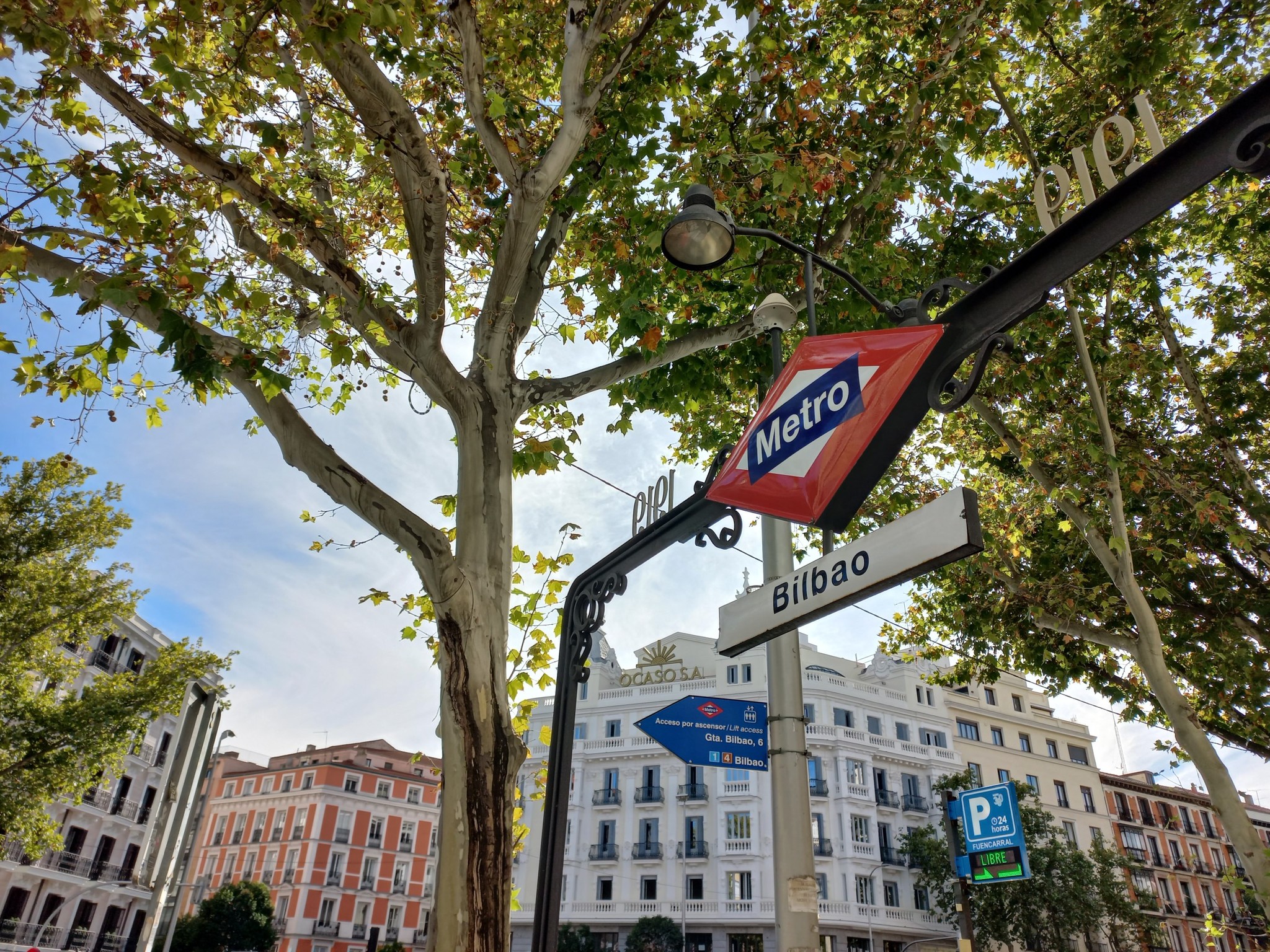
The station is one of those on the first section inaugurated in 1919 by King Alfonso XIII between Sol and Cuatro Caminos, which forms part of line 1. The platforms corresponding to line 4 were inaugurated on March 23, 1944, and put into service the following day, situated perpendicular to those of line 1 along the Carranza-Sagasta axis. The access points are Vestibulo Central or Central Hall, with elevator/lift, Glorieta de Bilbao, 2 ,corner of Luchana and Sagasta Streets, Fuencarral, Glorieta de Bilbao, 5, Manuela Malasaña Bilbao, 7 near the corner of Manuela Malasaña and Fuencarral streets), The Luchana Vestibule: Luchana, odd numbers;Calle de Luchana, 21 corner of Trafalgar, even numbers. Access to Line 1 platforms. Francisco de Rojas, Luchana, 22 corner of Calle Francisco de Rojas . Access to Line 1 platforms. Trafalgar, Luchana, 23. Access to Line 1 platforms.
The official Metro de Madrid on Bilbao see line 1 and 4 : https://www.metromadrid.es/es/linea/linea-1
The Madrid tourist office on using the metro in Madrid : https://www.esmadrid.com/en/getting-around-madrid-metro
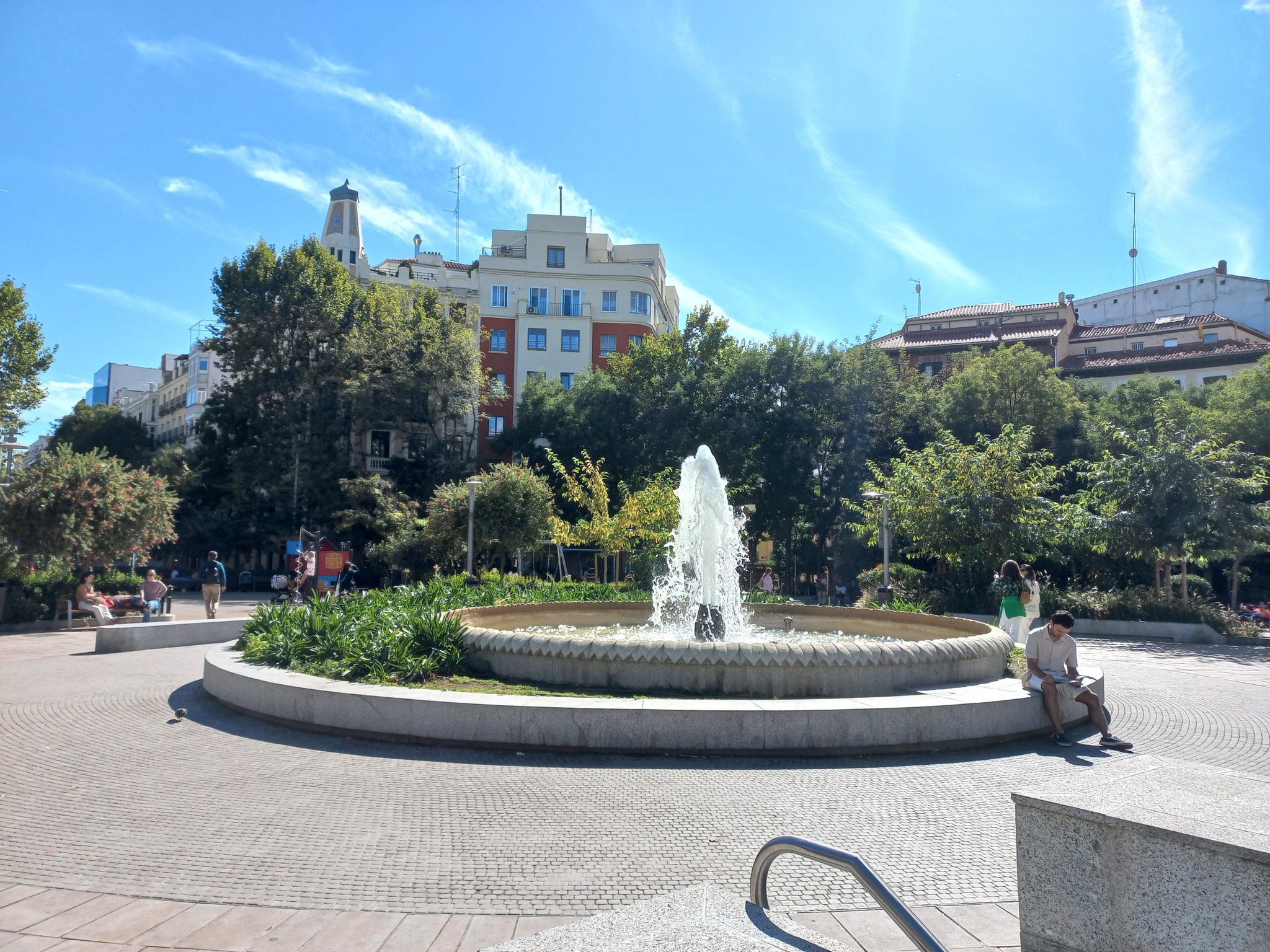
The Plaza de Olavide Square ,formerly Plaza de la Princesa and Plaza Industrial is a large octagonal roundabout, the heart of the Trafalgar neighborhood, in the Chamberí district. The streets of Trafalgar, Raimundo Lulio, Santa Feliciana, Murillo, Palafox, Jordán, Gonzalo de Córdoba, and Olid converge there. It is named after the 18C Spanish Enlightenment figure Pablo de Olavide, a writer, translator, jurist, and politician. The area, originally known as the Los Tejares neighborhood, evolved after the implementation of the Ensanche de Madrid , an expansion plan ,approved in 1860 and carried out from 1871 onwards. Photographic documentation shows that by 1875, hardly any residential buildings had been constructed, but by the late 19C and early 20C, its perimeter was defined by many of the buildings that still surrounded the square at the beginning of the 21C. Named Plaza de Olavide in 1860 following a proposal from local residents, the former Plaza Industrial was developed as the epicenter of the Trafalgar and Cardenal Cisneros neighborhoods. In 1977, the square’s new appearance was inaugurated with an underpass for Calle de Trafalgar, and a municipal parking garage. Subsequent renovations have shaped it into a sunny square with flowerbeds , A striking ornamental fountain from 2002 stands at the center of the square, and the spacious open area is used for a variety of activities throughout the year. At one end, there is a colorful and modern children’s play area equipped with swings and other play equipment, where children can have fun safely. At the other end, there is an outdoor fitness area for adults, designed to encourage outdoor exercise. As above you can reach it on metro lines 1 and 4 Bilbao station, There are plenty of restos and bar with terraces on it and around it
The Madrid tourist office on the Chamberi neighborhood of Madrid : https://www.esmadrid.com/en/madrid-neighbourhoods/chamberi
The Calle Santa Engracia begins at the Glorieta de Cuatro Caminos roundabout, crosses Ríos Rosas and José Abascal streets, and reaches the Glorieta del Pintor Sorolla roundabout, from which Eloy Gonzalo Street and Paseo General Martínez Campos branch off. After crossing Plaza de Chamberí Square, from which Luchana Street and Paseo de Eduardo Dato originate, it ends at Plaza de Alonso Martínez. Santa Engracia is the name of a Christian martyr born in what is now Portugal, who was tortured in Zaragoza during the reign of Diocletian to force her to renounce Christianity. According to the Count of Montarco, she was named after an estate called Quinta de Santa Engracia, owned by her great-grandfather, which supposedly existed in the area. Starting at Plaza de Alonso Martínez (formerly Glorieta de Santa Bárbara roundabout) and ending at Glorieta de Cuatro Caminos roundabout, at the intersection with Calle de Bravo Murillo, it runs entirely through the barrio de Chamberí neighborhood.
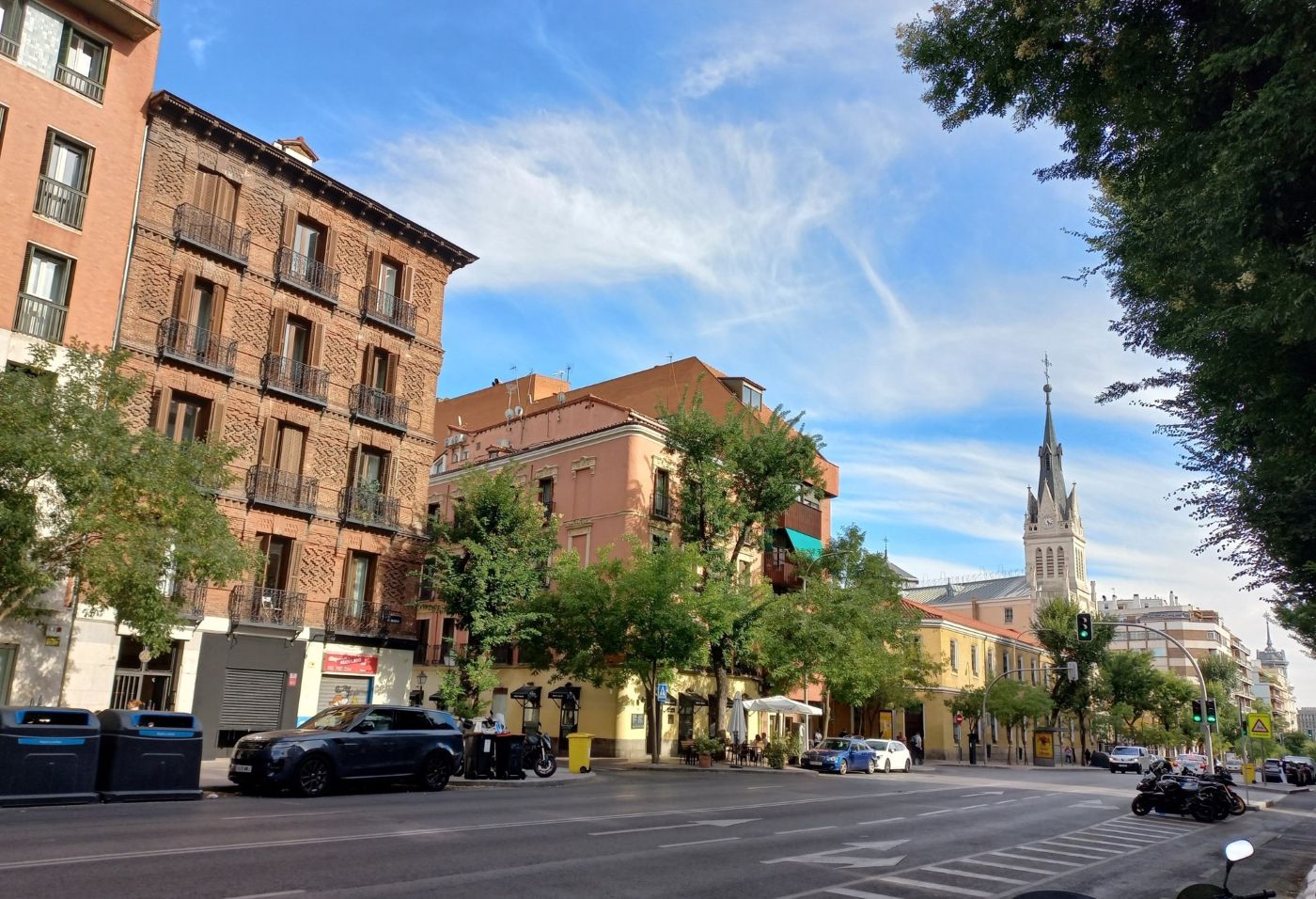
Notable buildings here includes the Fábrica Real de Tapices or the Royal Tapestry Factory, established in 1707 by the three Vanderhoten brothers, tapestry makers from Antwerp. Later, the famous painter Anton Raphael Mengs lived there. Furthermore, Goya worked in that same factory, under Mengs’ direction, painting his memorable tapestry cartoons. The former Apostolic House of the Sacred Heart, built in 1924, still stands at No13, now a secondary school, the IES Santa Engracia. The Church and Convent of the Salesian Sisters of Our Lady of the Visitation, located at No 18,(see pic) occupies the block bounded by Caracas, Fernández de la Hoz, Zurbarán, and Santa Engracia Streets. The convent is one of the largest religious buildings in Madrid’s Chamberí district and was built to replace the original building, which was requisitioned by the State in 1870 to house the Palace of Justice, now the Supreme Court. It was completed in 1880. The architectural style of the complex is Neo-Gothic, with a single tower facing Calle Santa Engracia. Its floor plan is in the shape of a Latin cross with side chapels, above which are the galleries. Before moving here, following the secularization of religious orders, while the new convent was being built, the nuns resided for a few years at the Monastery of the New Salesian Sisters at 72 Calle San Bernardo. After their move to the new building on Calle Santa Engracia, they continued to live there. Also located here is the Parque Casa de las Columnas park, where wild parties were held in the 18C. Well, in that Casa de las Columnas or House of Columns, none other than the invading emperor, Napoleon I, spent a night. The first line of the Madrid metro, which has passed through Santa Engracia since 1919, is also located there. But -with prior reservation, we can visit on weekends the museum that the Chamberí station has become, closed in the 1950s because it could not be extended to accommodate the longer trains that came into service at that time, and which maintains in perfect condition the tiles and advertising posters, also made of ceramic.
The Madrid tourist office on discover Chamberi : https://www.esmadrid.com/en/discover-chamberi
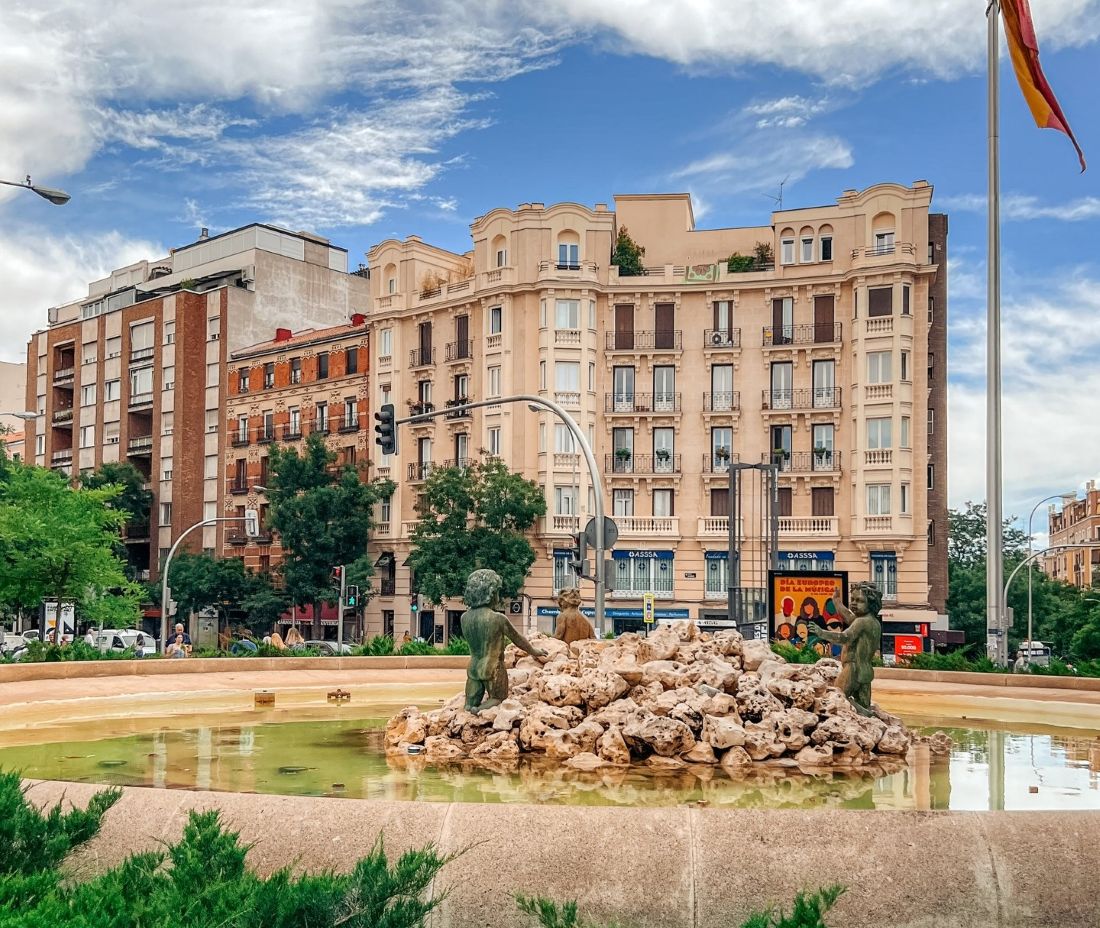
The Plaza de Chamberí square is located at the intersection of Santa Engracia and Eduardo Dato streets in the Almagro neighborhood and was inaugurated in April 1883. On the side of the square closest to Calle de Santa Engracia (see post)stands a circular fountain. It is a rounded basin of white artificial stone, approximately 10 meters in diameter and 80 centimeters high, with a rockery in the center and three bronze sculptures of nude children. A central jet of water, set atop the rockery, and 12 other jets distributed in a circle around the basin, with irregular vertical plumes approximately 1.5 meters high, adorn the fountain. Outside the rockery, a concentric circle of soil is planted with vegetation, and this garden is bordered by a rounded granite curb and a low wrought-iron fence. The fountain is equipped with underwater lighting. It is said that during the occupation of Spain by Napoleon’s French troops, a military encampment was established in what is now this square, which they called “Chambéry,” and from which the neighborhood, one of the most traditional in the capital, takes its name. Stories recount that Daoiz and Velarde (see post) themselves, along with a small militia made up of locals from the neighborhood and surrounding areas, confronted the soldiers of this “barracks,” marching up from Malasaña and Tribunal along what is now Calle de Luchana during the events of May 2, 1808, which would lead to the War of Independence (peninsular war) against the French. The Plaza de Chamberí houses the only closed station on the Madrid Metro, the Chamberí station, which some curious onlookers always try to glimpse when passing by on Line 1 between Iglesia and Bilbao stations. The proximity of the two stations made the metro too slow in this area, rendering this station unnecessary. It was therefore closed in 1966 and has recently been transformed into the Madrid Metro Museum, which is open to the public with free admission. You get here on metro Iglesia of line 1, Bilbao of lines 1 and 4, and Rubén Darío of line 5 Also on bus lines : 1, 3, 5, 27, 45, 74,149, as my favorites there are others.
The Madrid tourist office on the walks in Chamberi : https://www.esmadrid.com/en/discover-chamberi
There you go folks , another wonderful nostalgic, sentimental trip to my dear Spain, A love affairs with my Madrid, as do not know when we will be back, we sure will have this trip in our hearts forever, Again, hope you enjoy this post on curiosities of Madrid, part XIII !!! as I
And remember, happy travels, good health, and many cheers to all !!!


