
I take you back to my dear Madrid !! love it !! I like to continue the saga of my dear Madrid with new pictures from my cd rom vault that should be in my blog for you and me, This is again my lost walking trails of wonderful sublime Madrid, Therefore, let me tell you about the Plaza de Gabriel Miro of Madrid !!! Hope you enjoy the post as I.
The Plaza Gabriel Miró Square, formerly known as Vistillas de San Francisco, or Campillo de las Vistillas, or better known locally as simply Las Vistillas, is a small, landscaped square in the barrio Palacio neighborhood, part of the Centro district of Madrid. It is bordered by Calle de Don Pedro, Calle de San Buenaventura , and the travesia de las Vistillas alleyway; and the Cuesta de los Ciegos, Calle de la Morería , and Calle de Yeseros. The square is bordered by gardens designed in 1932 and remodeled in 1945. These gardens occupy the highest part of Las Vistillas hill . The Las Vistillas Gardens are a secluded urban park in the historic center of Madrid. In 1944 it was named after the Alicante writer Gabriel Miró, although it continues to be known by its popular name Plaza de las Vistillas since the 17C. It is considered one of the most traditional viewpoints in old Madrid, and is a regular venue for the San Isidro and La Paloma festivals.
The Jardines de las Vistillas Gardens consist of three open areas, with a difference of a couple of meters in height between them. The uppermost area is primarily an asphalt surface surrounded by a wall. It also has paths with granite benches and a curious decorative fountain, which we sometimes found completely overgrown with vegetation, making it almost impossible to see. At one end, at the top of the stairs, we find the statue of La Violetera, representing the Argentine vedette Celia Gámez dressed in a traditional Madrid costume ; a traditional and stylish woman, which was previously located at the confluence of Calle de Alcalá and Gran Vía and was moved to Las Vistillas on June 13, 2003, The second open area has more trees and a series of grassy flowerbeds, perfect for sitting in the shade when the weather is nice. In the center is a fountain shaped like a four-leaf clover. In the buildings that would later become Plaza de Gabriel Miró , in a building located between Calle de San Buenaventura and Travesía de Las Vistillas field, the sculptor Victorio Macho set up his studio, a space that would later be occupied by the painter Ignacio Zuloaga, and where a small museum was located on the second floor of the building, which was closed in 1975. And to one side stands the bust dedicated to the painter Ignacio Zuloaga. The lowest esplanade is also the most decorated. In its center stands the monument dedicated to Ramón Gómez de la Serna, surrounded by a reflecting pool and a multitude of plants and flowers. At the far end, a U-shaped pergola defines the space. Between this and the monument runs a walkway lined with benches that serve both as decoration and as places to sit and contemplate the view.
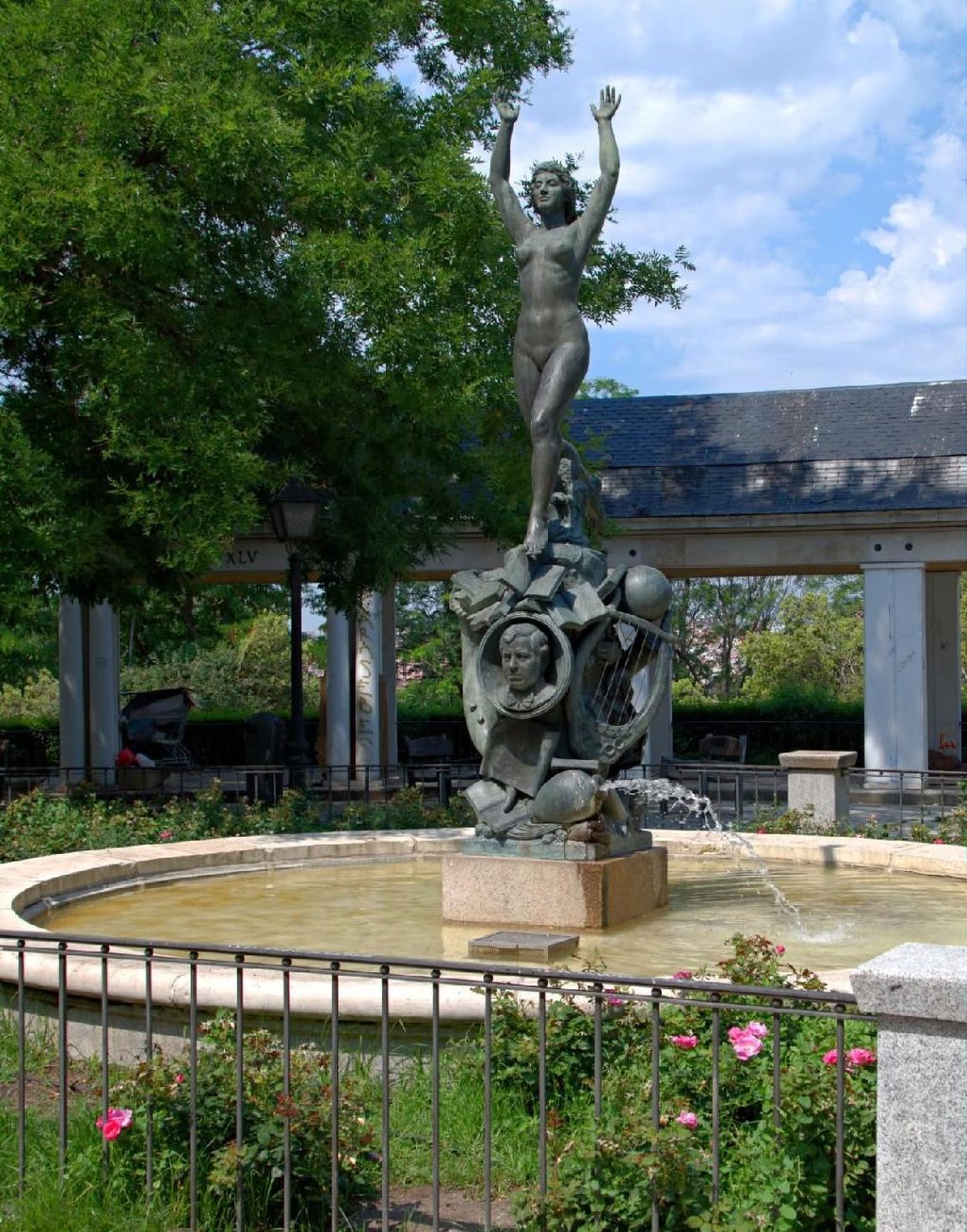
The monument and fountain dedicated to the writer Ramón Gómez de la Serna,(see pic) author of the saying, somewhere between a proverb and a witty aphorism, “Madrid is having nothing and having everything,” it was inaugurated in 1972. The monument consists of a circular basin 5.5 meters in diameter, from the center of which emerges a bronze sculptural group. The statue of a nude woman with her arms raised and looking straight ahead dominates the entire ensemble. She rests on a block of figures alluding to the life and work of Ramón Gómez de la Serna, such as a lyre, a theatrical mask, various books, an armillary sphere, a bow and arrow, a pipe, several fountain pens, and a pitcher from which water flows into the basin. All of this surrounds a medallion, installed on the front, in which the writer’s face appears, sculpted in high relief. Behind the fountain is a roundabout-shaped architectural structure. It has sixteen supports, upon which rests a slate roof. Ramón Gómez de la Serna Puig was a prolific Spanish avant-garde writer and journalist, generally associated with the Generation of 1914 or Novecentismo, and a pioneer of the literary genre known as the greguería. He produced an extensive body of work ranging from essays on local customs and biographies to novels and plays.
The closest transport here is the stop/parada Cuesta de la Vega on bus lines 31,50,65 or stop/parada Las Vistillas on bus lines 3 and 148, Metro line 2 Banco de España to Opera and walk about 1 km , and metro line 5 Gran Via to La Latina ,and walk about 700 meters, You can find parking on street level along Calle de San Buenaventura or Calle de Beatriz Galindo or underground paying parking at Promoparc Gran Via de San Francisco,13 about 14€ per day and 350 meters away,
A bit of history of the square tell us that on Texeira’s map of 1656 it appears labeled as Las Vistillas de San Francisco; and in Espinosa’s 1769 plan, it was called Plaza de las Vistillas. While still wooded and open, these lands were ceded in 1662 by the Madrid City Council to the Duke of Infantado, whose palace was located nearby. Throughout the second half of the 17C and the early years of the 18C, these lands were the subject of claims, litigation, and purchases between the City Council and the Guardian of San Francisco, until they were acquired by the heirs of the House of Infantado and the Duchy of Osuna. They finally built the palace, library, and armory of that ducal house there, separated from the Campillo de Vistillas field only by the now-vanished Corral de las Naranjas. In 1887, the City Council bought the old Osuna house to extend the route of Calle de Bailén; part of these lands would later be purchased in the 20C by the Diocese of Madrid-Alcalá to build the Madrid Conciliar Seminary. Between 1902 and 1906, with an entrance at No 9 on Calle de San Buenaventura.
The Madrid tourist office on the Jardines de las Vistillas : https://www.esmadrid.com/en/tourist-information/jardin-de-las-vistillas
The Madrid tourist office on the Museum of Contemporary Art,(see post) including a reconstruction of Ramón Gómez de la Serna’s study : https://www.esmadrid.com/en/tourist-information/museo-de-arte-contemporaneo
An official site on the life and works of Ramón Gómez de la Serna : https://www.ramongomezdelaserna.net/
There you go folks , another wonderful nostalgic, sentimental trip to my dear Spain, A love affairs with my Madrid, as do not know when we will be back, we sure will have this trip in our hearts forever, Again, hope you enjoy this post on the Plaza de Gabriel Miro of Madrid !!! as I
And remember, happy travels, good health, and many cheers to all !!!

 Paris1972-Versailles2003