
I had this wonderful institution mix in with other posts and really, it should have a post of its own, me think, I have expanded on the text using the older pictures in my blog to this nice post. We know the bank well since 2004 is my bank in Spain, some of its buildings are magnificent architecture and history, worth stopping by, me think; we love !! Therefore, let me tell you my take on the Banco Bilbao Vizcaya (BBVA) in Madrid !! Hope you enjoy the post as I.
The Banco Bilbao Vizcaya (BBVA) is located on Calle de Alcalà,16 very near the Puerta del Sol. You notice first its quadrigas dragged by four horses, whose leg stands out from the facade, flying over the sidewalk. The quadrigas were made in an alloy of bronze, lead and iron, with a golden brass coat and each of them weighs 12.5 tons and is four meters high, The drivers are not found inside the quadriga, but rather they appear standing, in a pedestal located on the carriage, so that they can be seen from the street.

The BBVA bank building was built between 1920 and 1923 as the seat of Banco de Bilbao. In 1845 the Cafe Suizo (today gone but very popular) was inaugurated there, famous for its gatherings. The quadrigas, which were covered in gilded brass and, therefore, could serve as a reference for Franco’s bombing of the city, during the Spanish Civil War, were painted black. After the end of the contest, it was decided that the new color be preserved. In the base of each tower, in front of the balustrade, there are two Italian marble atlantes. On each tower is a quadriga. The quadrigas were dragged each by four horses, whose legs protrude from the facade, flying over the sidewalk. They were cast in the Madrid smelter Codina Hermanos The charioteers are not inside the quadriga, but appear standing on a pedestal located on the carriage, so that they can be seen from the street. In 2010, and for a minimum period of ten years, the building is the headquarters of the Ministry of Environment and Land Management of the Community of Madrid (regional govt).
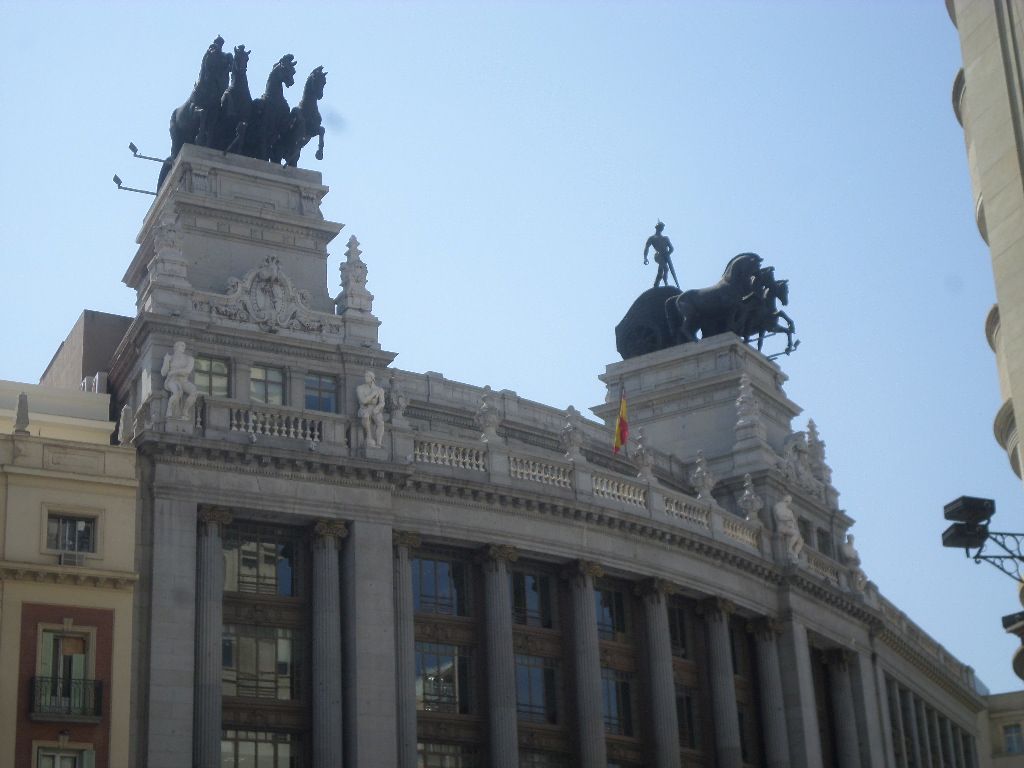
A bit of history tell us that in 1918, the Banco de Bilbao announced a competition to build its headquarters in Madrid. At the time, the institution was mobilizing significant capital for the construction of the Gran Vía, creating a need for spacious and prestigious offices. The competition was won by Ricardo Bastida, who designed a two-part complex: a monumental ten-story building facing Alcalá 16 ,Arlabán 5, Arlabán 3 and Sevilla 8, intended for luxury retail and private offices, with the ground floor featuring a large carriage entrance and the main and service staircases, and a banking building facing Calle de Arlabán, housing the bank’s facilities on the lower floors and luxury offices on the upper ones. The two buildings are linked by spacious galleries for circulation between floors and a large shared circular courtyard; in its rotunda, the painter Aurelio Arteta created ten murals depicting the docks, factories, and mines of Bilbao. The structure is built of reinforced concrete with granite walls and features lavish interior and exterior decoration, including cornice sculptures, a large dome over the rotunda, and copper and gilded bronze accents. Bastida designed the main façade with a symmetrical, convex composition to smooth out the angle between the two streets. He employed a monumental, eclectic style characterized by giant-order columns and crowning pavilions topped by iconic quadriga sculptures created by Higinio Basterra. The remaining sculptures are the work of Quintín de la Torre. Pedro Bidagor was the first to expand the building along Calle de Sevilla, replicating the rhythm of the window openings using an unadorned style. The building has since undergone several renovations.
These are buildings associated with BBVA (which is my bank in Spain) so will have here for information only,
The BBVA Foundation is housed in the palace that used to be the residence of the Marquis of Salamanca on Paseo de Recoletos, 10. The building was fully rehabilitated for the Foundation, one of the city’s top cultural venues. Built between 1846 and 1855 , the palace was a four-façade detached building with a ground floor and a main floor, a lovely garden with a Carrara marble fountain, and a wrought iron gate. The main façade was designed in a classical style under the influence of palazzo-style architecture. It features three rounded arches in the central section leading into the building. The main floor is decorated with grotesque elements, medallions and half-columns. The BBVA Foundation has five strategic areas of activity: Environment, Biomedicine and Health, Economy and Society, Basic Science and Technology, and Culture. It designs, develops and funds research projects, offers grants, courses, workshops and seminars, and organises outreach activities to share the knowledge produced. The foundation’s Multiverso Hall holds video art exhibitions by programme beneficiaries or artists with special commissions.
The Edificio Castellana 81 building known as Torre BBVA is located at the Azca Complex (see post), It is 107 meters tall and has become one of the icons of the Madrid skyline. Built between 1978 an 1981 ; it was the corporate headquarters of the Banco de Santander and until 2015 the main operations office of BBVA bank in Madrid. It has undergone major refurbishing giving it a large variety of additional services, The building has 28 floors with offices, 5 of which are double height, completely open space with no pillars. It also has 390 parking spaces, including some dedicated to electric and carpooling vehicles and 58 bicycle parking spaces.
The Madrid headquarters of BBVA bank are located in one of the capital’s financial districts, known as Las Tablas. This complex of offices and services is spread over an area of 114,000 square metres, comprising seven buildings and a wide range of services, including restaurants. In Madrid’s skyline, you can make out La Vela (The Sail), an elliptical tower standing 93 metres high, divided into 19 floors, which is part of a series of seven buildings that incorporate environmentally friendly materials and energy savings systems. They are surrounded by gardens and landscaped areas, designed in accordance with the same principles of sustainability, with native plant species that require little water and glass surfaces to maximise solar energy.
The Madrid tourist office on money in Madrid : https://www.esmadrid.com/en/money-madrid
The official BBVA bank Calle de Alcalà office : https://www.bbva.es/general/oficinas/madrid/madrid/madrid-quintana/0863
There you go folks, do you well to stop by and enjoy this wonderful institution in my dear Madrid. And good money handling even for visitors ! Again, hope you enjoy the post on the Banco Bilbao Vizcaya (BBVA) of Madrid !! as I.
And remember, happy travels, good health, and many cheers to all !!!


