
I take you back to my dear Madrid !! love it !! I like to continue the saga of my dear Madrid with new pictures from my cd rom vault that should be in my blog for you and me, This is again my lost walking trails of wonderful sublime Madrid, Therefore, let me tell you about curiosities of Madrid, part XII !!! Hope you enjoy the post as I.
The statue of Jacinto Ruiz y Mendoza was erected in the Plaza del Rey in homage to Lieutenant Jacinto Ruiz y Mendoza, a prominent figure in the War of Independence. Along with Captains Daoíz and Velarde (see post), he defended the Monteleón Artillery Park and, after a bloody battle during the uprising of May 2, 1808, in Madrid, he was wounded and died shortly afterward. Inaugurated in 1891, the monument consists of a rectangular, chamfered base. A black marble staircase with three steps, some with inclines at their lower edge, serves as the base. Above this is a red marble platform upon which rests the cylindrical pedestal itself, made from the same gray marble that supports the statue of Jacinto Ruiz. The total height of the pedestal above ground level is 3.80 meters. It is adorned with two bas-reliefs attached to the sides, flanked by two period cannons, cast, like the rest of the work, in bronze. On the main front, on a thick white marble plaque embedded in the wall, is the following inscription: “To Jacinto Ruiz, Lieutenant of Infantry.” On the reverse, on another plaque of the same type, is the inscription: “The Spanish Army to one of its heroes, May 2nd 1808.” The statue measures 2.60 meters and rests on a piece of door, among whose splinters can be seen blunderbusses, stones and grenade casings.
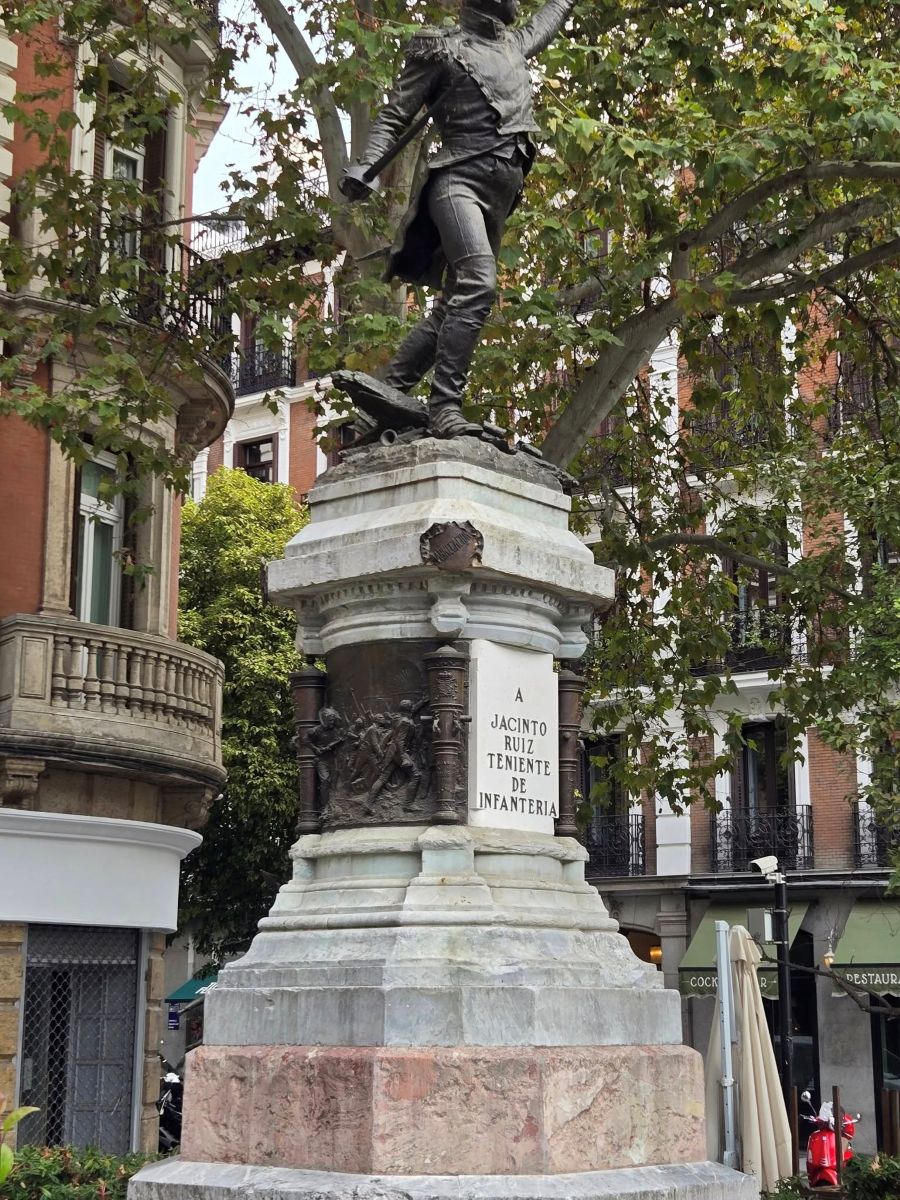
The Plaza del Rey is located on one side of the first section of Gran Vía . It is bordered at one end by Calle Barquillo and Calle de las Infantas. It is located in the Chueca neighborhood. It is named in honor of the proclamation by the people of Madrid in 1808 of Fernando VII as King of Spain. Before 1800, this space was called Plaza del Almirante, because the residence of the Prince of the Peace was located nearby. The name Plaza del Circo (Circus Square) comes from the existence of an equestrian and acrobatic circus called Teatro Circo Paul (aka “Teatro de la Bolsa”) founded by Paul Laribeau, which was located at the intersection with Calle del Barquillo. The space was subsequently occupied by the Teatro del Circo and the Circo Price. During the Second Republic (1931-1939), the square was renamed Plaza de García Hernández, in homage to Captain Ángel García Hernández, one of the leaders of the failed Jaca uprising of 1930. The square is home to one of the city’s most enigmatic buildings,Casa de Las Siete Chimeneas or House of the Seven Chimneys, the oldest residential building in Madrid dating back to the 16-17C, and which houses the spirit of a woman who lived there, according to legend. The Spanish Ministry of Culture has some of its offices there.
The Madrid tourist office on the Plaza del Rey: https://www.esmadrid.com/en/tourist-information/plaza-rey
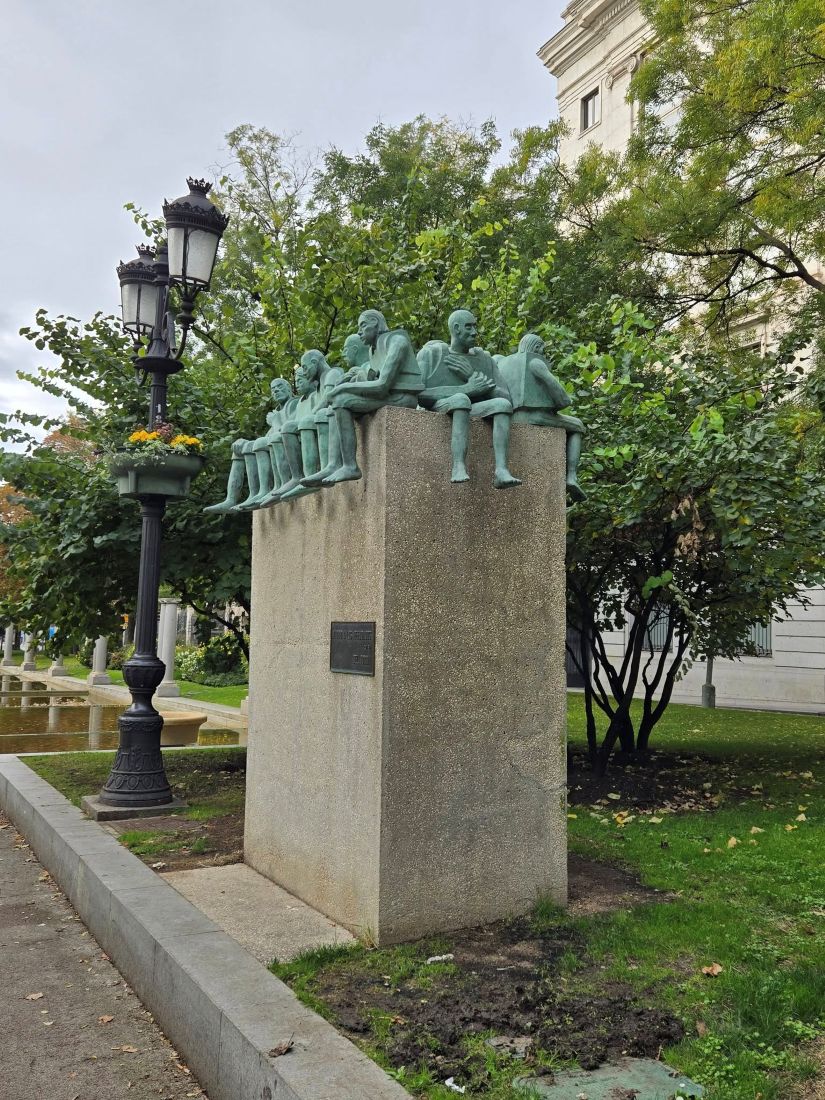
The Paseo de Recoletos is an avenue of 700 meters rising very slightly, from south to north, and from Plaza de Cibeles to Plaza de Colón. It is part of the boulevards of the central axis of the city, which extends north as Paseo de la Castellana , and south as a Paseo del Prado. I have a post on it see for more details, The monumento a Refugiados or monument to refugees is an example of public art located in a landscaped area of the Paseo de Recoletos across from the Church San Pascual, It was conceived as a way to acknowledge the refugees and immigrants who, with their arrival, have built the city of Madrid. The monument consists of a 180 x 100 x 180 cm concrete block with granite veining, upon which the bronze sculpture would be placed. Finally, the monument was installed next to the pond. The bronze sculpture weighs 960 kg and comprises 16 seated figures, both male and female, some carrying babies, all wearing life jackets while awaiting help. The work was created by the Brazilian artist Bel Borba and symbolically pays tribute to refugees. It was presented at the Lake Geneva Sculpture Biennial (Switzerland), and its manifesto, under the slogan “We will all go to Mars,” describes the recognition of the reality of migration.
The Madrid tourist office on Paseo de Recoletos: https://www.esmadrid.com/en/tourist-information/paseo-de-recoletos
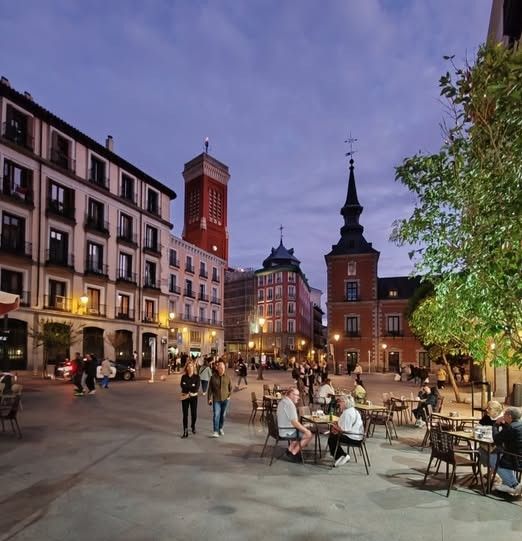
The Plaza Santa Cruz square is connected to the Plaza de la Provincia, is a central hub linking the Plaza Mayor with Calle de Atocha via the arch and arcades of Calle de Zaragoza. Historically, it has been a popular spot for markets, especially Christmas markets, and the carousel that is usually set up during the holidays is still a highlight. The rest of the year, the square is known for its restaurant and café terraces and traditional shops nestled under the characteristic arcades surrounding the Plaza Mayor. The Plaza de Santa Cruz,is in the heart of the Lavapiés neighborhood, is dominated by the imposing presence of the palace of the same name. However, the square does not take its name from the palace, but from the more recent church that was built to replace a building that was demolished to create more space for the square. In the 19C, Plaza de Santa Cruz was the meeting place for the city’s wet nurses. People could go there and hire one. The most important building visible from the square is the Santa Cruz Palace, (actually in Plaza de la Provincia nearby) considered one of the finest examples of Habsburg architecture. It currently houses the Ministry of Foreign Affairs and Cooperation. The Church Santa Cruz (see post) is actually in Calle de Atocha,Both can be seen from the Plaza de Santa Cruz,
The Madrid tourist office on the Lavapiés neighborhood: https://www.esmadrid.com/en/madrid-neighbourhoods/lavapies
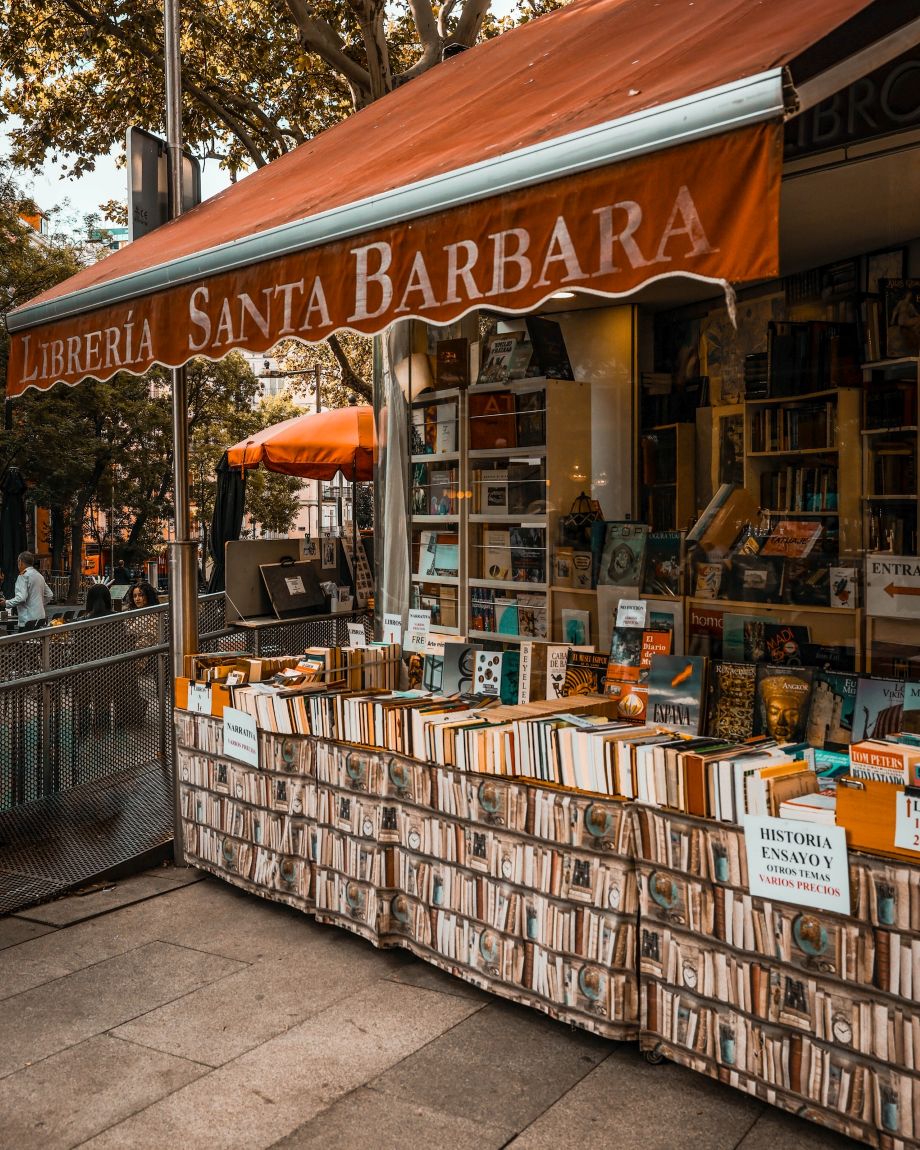
The Plaza de Santa Bárbara is just at the Alonso Martínez metro station, in one of the prettiest neighbourhoods in the city, the square is constantly buzzing with its great bars and terraces to have a nice, relaxing drink in the sun the charming, independently-run Librería Santa Bárbara. The small kiosk, fitting in perfectly with the vibe of the area, is home to a beautiful assortment of used books covering many different subjects like history, philosophy, art, and poetry. I especially love their collection of books about Madrid, which contain some incredible photography and stories about the city. They also have some amazing historical city maps for sale, which would be so nice on the wall of your home, as well as some gorgeous art prints of the Madrid metro, perfect for framing. Visitors to Madrid can also pick up some nice souvenirs here, like magnets and postcards. With over 2000 books on display in Librería Santa Bárbara at any given time and stock changing over regularly, A bit of history I like tell us that the Plaza de Santa Bárbara , aka Plazuela de Santa Bárbara , is located in the Justicia neighborhood, in the Centro district. It is bordered by the Plaza Alonso Martínez and is the intersection of Hortaleza, San Mateo, Santa Teresa, Serrano Anguita, and Orellana streets. At the end of the space stood the Puerta de Santa Bárbara Gate. The square also contained a convent, likewise called Santa Bárbara, founded in 1606, whose church was completed in 1622. The latter was in ruins at the beginning of the 19C, and its location corresponded to the beginning of Calle de Orellana. Further along was the Saladero Prison, inaugurated around 1831, which remained in use until 1884, when its prisoners were transferred to the newly founded Modelo Prison. In the mid-19C, the prison was located at no 7 of what was then called the Plazuela de Santa Bárbara. It also housed the “Olympic Circus,” an entertainment establishment founded around 1834. Between 1862 and 1866, the so-called Palace of the Count of Villagonzalo was built on its sidewalks. In 1889, its entrance was on Calle de Hortaleza and its exit was through the Glorieta de Santa Bárbara roundabout, now Plaza de Alonso Martínez. In 1920, the Palace of the Counts of Guevara was built. In the 20C, the Cerveceria Santa Bárbara brewery is located at no 8 in the square. The Centro district no 1 or Center includes the barrios or neighborhoods with their city id numbers of Palacio (11), Embajadores (12), Cortes (13), Justicia (14),Universidad (15) , and Sol (16)
The official blog on Libreria Santa Barbara: https://libreriasantabarbara.es/tienda/
The Madrid tourist office closest area is Chueca: https://www.esmadrid.com/en/madrid-neighbourhoods/chueca
The Royal Monastery of the Incarnation is a convent of Augustinian nuns gathered in Madrid . The institution, to which ladies of the high nobility belonged, was founded by Queen Margaret of Austria, wife of King Felipe III, in the early 17C. Due to the artistic collections it houses, it is, together with the Descalzas Reales (see post), one of the city’s most prominent temples. It was built between 1611 and 1616, although reformed several times later. The most important teak is the one that contains the blood of San Pantaleón, a martyr of the 3C, who is coagulated, in a solid state, and of a dark color, but every year, on July 27, it liquafies, and acquires a reddish color , without scientific explanation. This teak is taken to the church, so that people venerate it, although before taking it out, the mystery is notarized. The mother blister of this blood, is venerated in Italy, in Ravello, where a viceroy of Naples in the time of king Felipe III, sent a part to Spain. In fact, in the Italian city, the same happens with blood, which is liquefied on July 27!
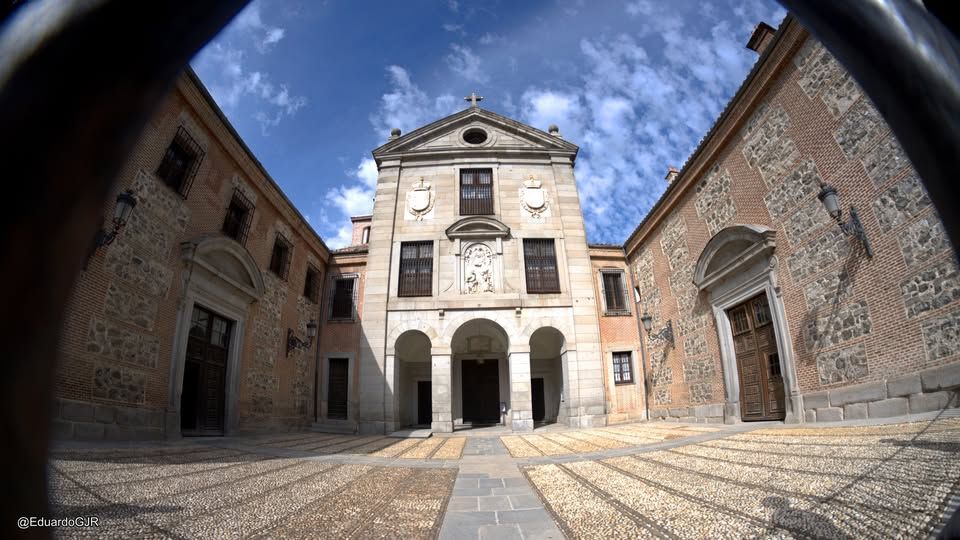
The Plaza de la Encarnación is an open square located between Plaza de Oriente and Plaza de Isabel II in the city’s historic center. It’s a spacious, tree-lined square with cobblestone paving, where the Royal Monastery of the Incarnation stands out as the main building. One of the square’s prominent businesses is the kitchenware shop El Alambique, which has been in the square since the 1970s; before it, there was a printing press and a dairy. Celebrities such as the singer Ruth Lorenzo and María Teresa Campos have visited this shop. Nearest Metro stations are Opéra lines 2,5 and R or Santo Domingo line 2,
The Madrid tourist office on the monastery de la Encarnacion: https://www.esmadrid.com/informacion-turistica/monasterio-de-la-encarnacion
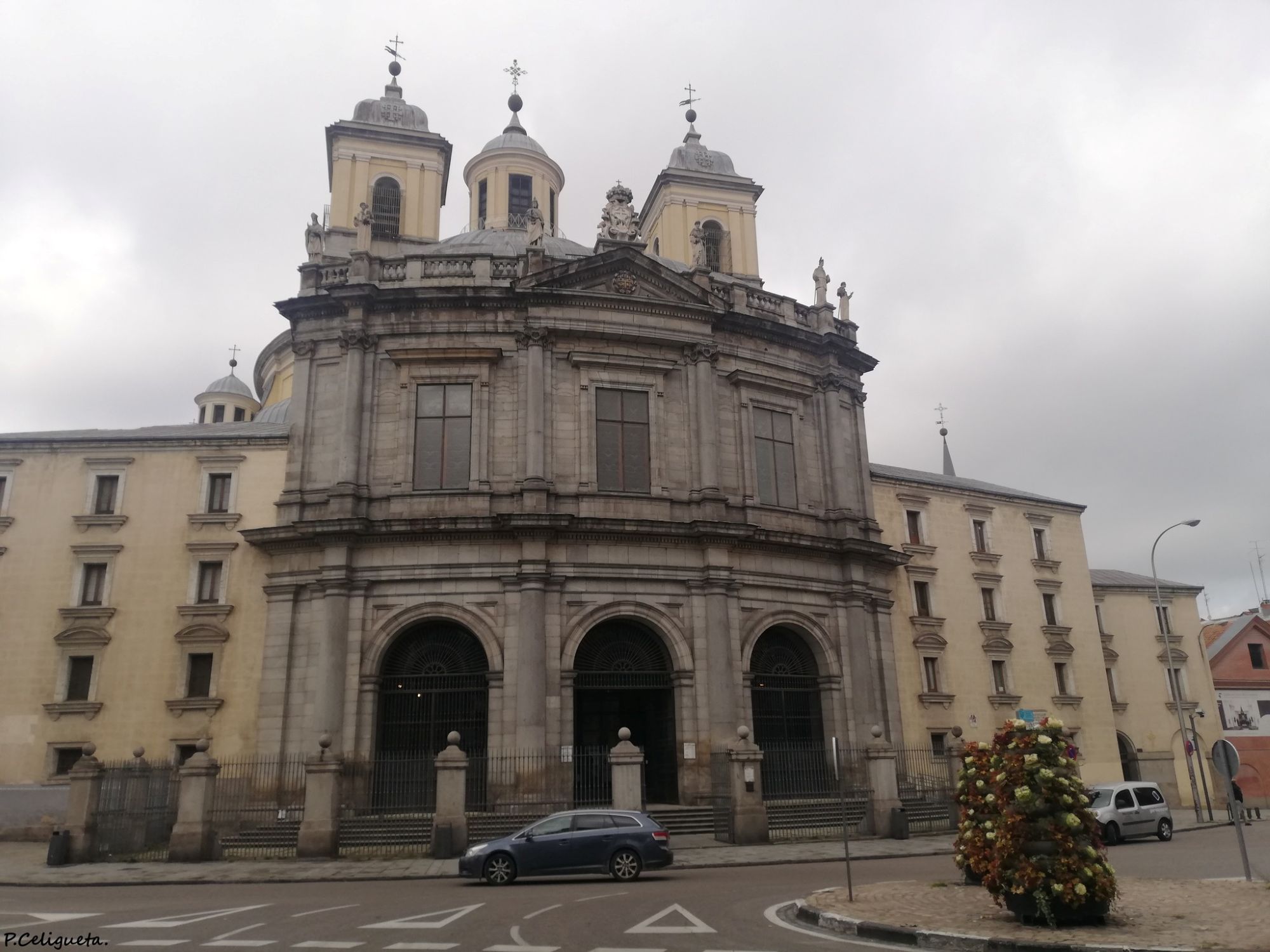
It presides over the western face of Plaza San Francisco , set by the intersection of Calle Bailen and the Carrera de San Francisco street. It is part of the Franciscan convent of Jesús y María, founded at the beginning of the 13C, on a now gone hermitage dedicated to Saint Mary. The current Basilica was built in neoclassical style in the second half of the 18C. The Basilica stands out for its dome, considered as the third largest diameter circular plant in Christendom. The origins of the Basilica San Francisco el Grande date back to a former Franciscan convent. According to legend, the convent was founded by Francis of Assisi around 1217. In 1776, Sabatini designated the main facade and side towers. The facade is divided into two floors. The first consists of three semicircular arches, supported by Doric pilasters and separated by adjacent columns. The second floor has three lintel bays, again separated by columns. The set is embellished with a central triangular pediment and a balustrade. On the balustrade, there are four statues of saints, coming from London. On the tympanum of the pediment is represented the cross of Jerusalem. Above, the Franciscan coat of arms and a royal crown. On both sides of the facade, two towers rise ending in undulating points and weathervanes.
The Madrid tourist office on the basilica : https://www.esmadrid.com/en/tourist-information/san-francisco-el-grande
There you go folks , another wonderful nostalgic, sentimental trip to my dear Spain, A love affairs with my Madrid, as do not know when we will be back, we sure will have this trip in our hearts forever, Again, hope you enjoy this post on curiosities of Madrid, part XII !!! as I
And remember, happy travels, good health, and many cheers to all !!!


