
I take you back to my dear Madrid !! love it !! I like to continue the saga of my dear Madrid with new pictures from my cd rom vault that should be in my blog for you and me, This is again my lost walking trails of wonderful sublime Madrid, Therefore, let me tell you about curiosities of Madrid, part XI !!! Hope you enjoy the post as I.
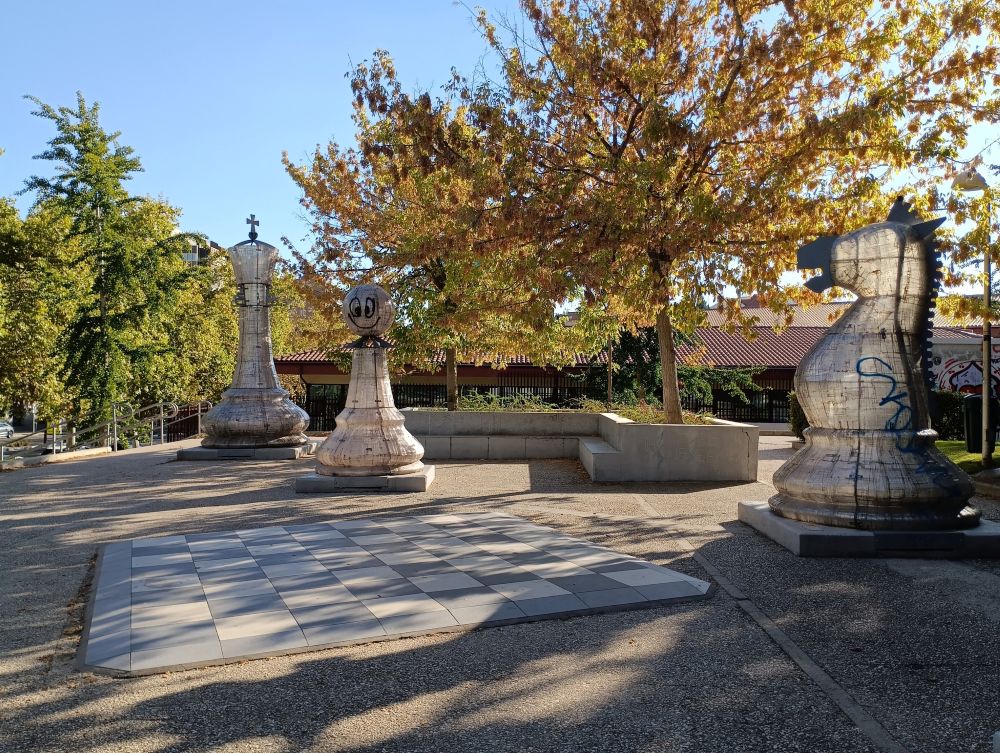
The Jardines de Pablo Sorozábal Gardens are located on Calle Príncipe de Vergara ,139 , opposite the National Auditorium of Music and next to the Colonia Cruz del Rayo in the Chamartín neighborhood. You can get here on Metro Cruz del Rayo, line 9 or bus lines 29 and 52, A secluded space that opened in 2015 and offers a peaceful setting in the city center. Dedicated to the composer Pablo Sorozábal, director of the Madrid Symphony Orchestra until 1952, these gardens house the Parque del Ajedrez or Chess Park, known as “The Dream of the Impossible,” which opened on September 26, 2015. An installation consisting of a giant board with the 32 chess pieces and six large sculptures representing the king, queen, pawn, rook, knight, and bishop. This sculptural ensemble is uniquely illuminated with LED lights at night. The space is completed with a garden area and benches surrounded by maple, cypress, and red plum trees. The park features a bronze bust of the composer for whom the gardens are named. It also offers a lively terrace with tables and benches.
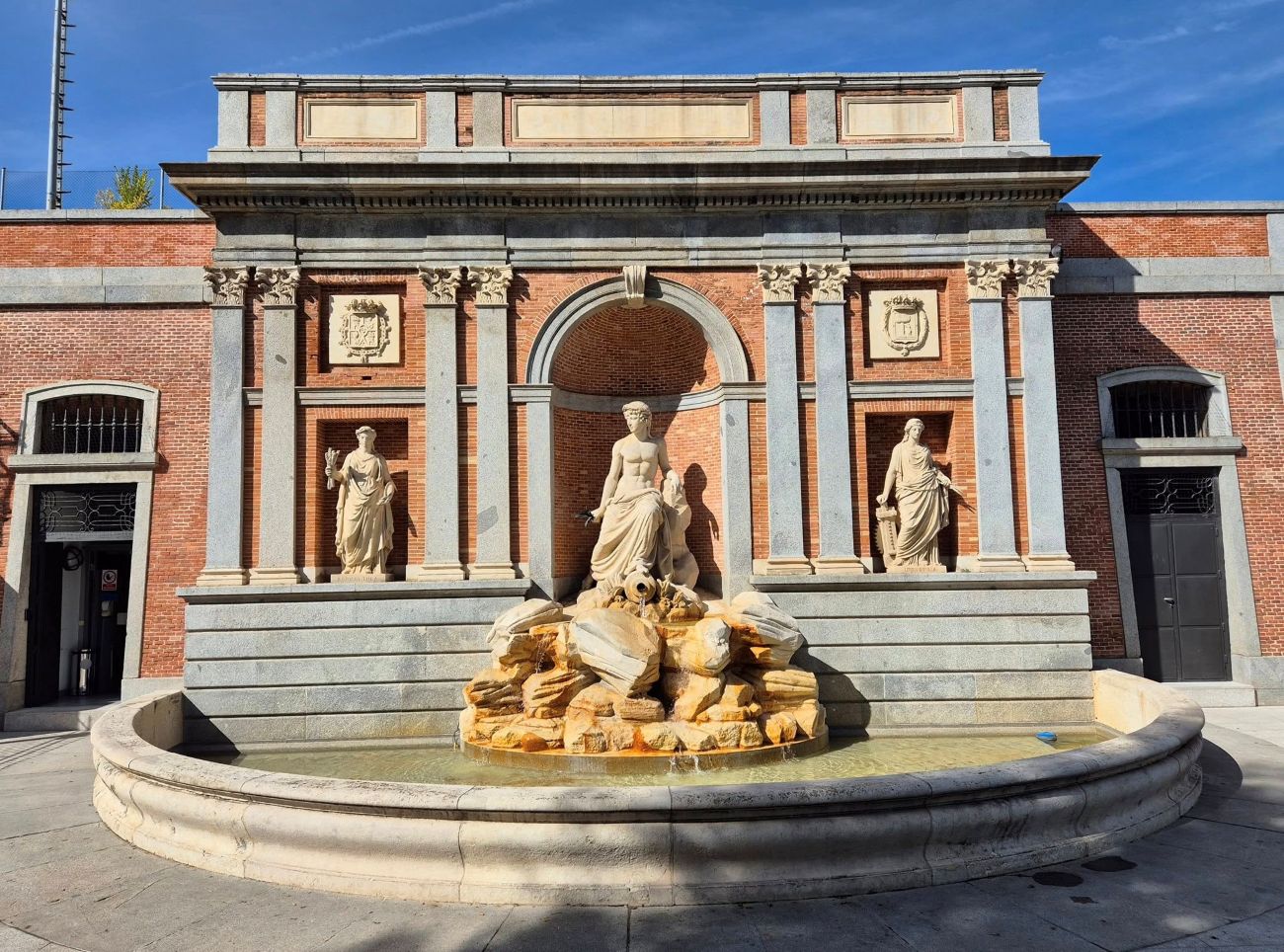
The Fuente del río Lozoya or Fountain of the Lozoya River is located at Calle Bravo Murillo, 49. This mural fountain centers the side wall of the First Canal Reservoir, like a classical triumphal arch, in whose central niche appears a monumental personification of the Lozoya river, flanked on the left by an image of Agriculture and on the right by another of Industry. The Canal de Isabel II, which guarantees Madrid’s water supply from the Lozoya river, was designed in 1848, began in 1851 and was not completed until 1858. Later, at an undetermined date, but before 1947, two metal swans were placed in the pond, which was also decorated with recently removed reeds and aquatic plants. It has a depth of 70 cm, and a diameter of about 10 meters. The Lozoya river rises in the Peñalara Natural Park, forming the Lozoya Valley in its course, the largest within the Sierra de Guadarrama just outside Madrid,
The Madrid tourist office on the fountain of Lozoya river : https://www.esmadrid.com/en/tourist-information/fuente-rio-lozoya
The Plaza de Ramales is an urban space created between 1810 and 1811 in the Madrid of the Habsburgs (Austrias) as the Plaza de San Juan, after the church of the same name, considered the first to be built in Madrid, in the 12C. It was demolished during the renovations carried out by Joseph Bonaparte during his reign . Attached to the still-existing Church of Santiago, in whose crypt Don Diego Velázquez was supposedly buried in 1660 , although attempts to locate his remains have been unsuccessful. In 1841 it was named Ramales in memory of the Battle of Ramales, fought in 1839 and which pitted the Isabelline general Espartero against the pretender Charles V of Bourbon, during the First Carlist War. The square has been the scene of urban transformations, historic demolitions, and reconstructions that have made it one of the most picturesque corners of the city center. Today, the square, amidst the pedestrian terraces and cobblestones, is flanked by historic buildings such as the Casa de Domingo Trespalacios.
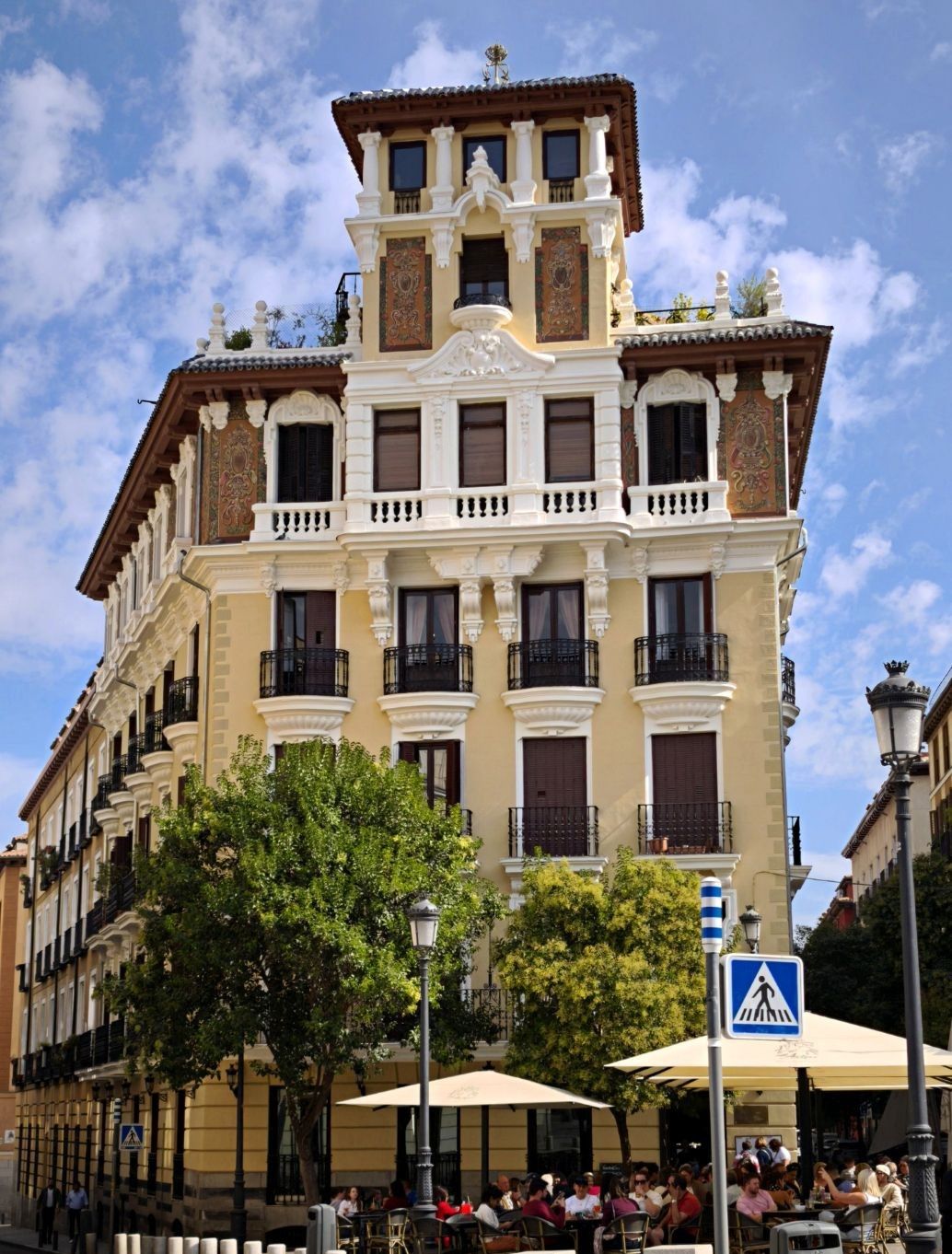
The Casa–Palacio Ricardo Angustias (see pic) located in the Plaza de Ramales, is the result of a renovation carried out on an existing residential building at the beginning of the 20C, specifically between 1920 and 1922. The current Palace is therefore the result of the expansion works on said building. It was given a medieval tower, elevated to two new floors, and beautiful mural paintings were added, along with the embellishment of exterior elements such as balconies, windows, and corbels. See the striking building with a decorated façade, a central tower, and an aristocratic soul that, after years of renovation, has regained its former splendor. We are talking about the Casa-Palacio de Ricardo Augustín, an architectural icon steeped in symbolism and memory. Ricardo Augustín Ortega, banker and real estate developer, held the honorary title of Count of Dávila thanks to his involvement in charitable works.
The Madrid tourist office on the Madrid of the Austrias: https://www.esmadrid.com/en/madrid-neighbourhoods/austrias
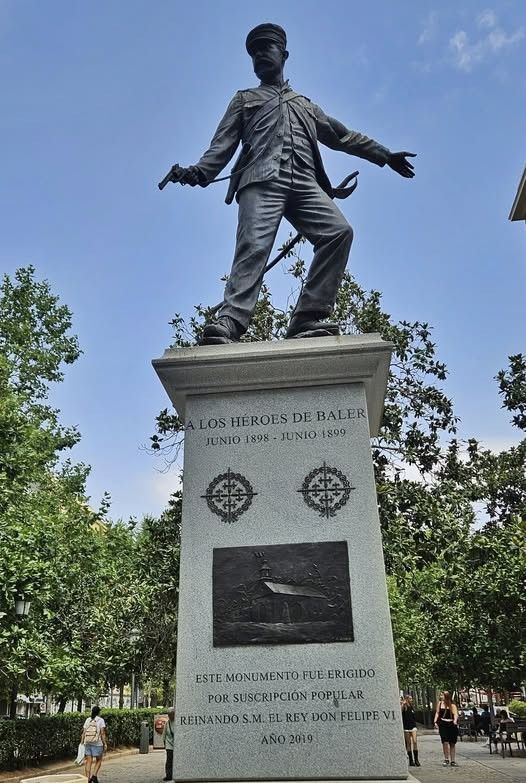
The Plaza del Conde del Valle de Súchil is located in the Arapiles neighborhood of the Chamberí district. It begins at Calle Alberto Aguilera and ends at Calle de Arapiles. It is named in honor of José María de Garay y Rowart, Count of Valle de Súchil, a Spanish lawyer and politician who served as mayor of Madrid. The current Plaza del Conde del Valle Súchil was built by demolishing the buildings that previously occupied the square. This included a garage for beer carts in the center and two apartment blocks on either side. Together, these three buildings blocked the exit onto Calle Alberto Aguilera. These buildings were demolished in 1954 or 1955 to construct the square. The square sits at the beginning of the Jardines Almirante Pascual Cervera Gardens, home to a large sculpture that pays tribute to the Spanish detachment known as “the last of the Philippines,” who were besieged by Filipino troops in a church in the town of Baler, on the island of Luzon, between July 1898 and June 1899. The monument depicts Lieutenant Saturnino Martín Castillo wielding a weapon and standing vigilant. The bronze piece, has a height of 2.60 meters plus a 0.30-meter base. It stands on a square granite pedestal measuring 1.90 by 1.90 meters and with a total height of 3.50 meters, stands on a pedestal bearing an inscription with the date of the commemoration, the names of the fifty-four soldiers who withstood the siege, and words in their memory. The Siege of Baler was the name given to the siege of a Spanish detachment in that town on the island of Luzon during the Philippine-American War. For almost a year, specifically 337 days, some 150 Spanish soldiers resisted the attack of the Filipino insurgents, unaware that the war had ended and that Spain no longer held sovereignty over the Philippines after signing the Treaty of Paris.The monument, commissioned by the Army Museum Foundation and donated to the Madrid City Council, was inaugurated on January 13, 2020, to commemorate the 120th anniversary of this historic event. It can be reach on metro Quevedo Line 2, and San Bernardo on lines 2 and 4,
The Madrid tourist office on the monument to heroes of Baler : https://www.esmadrid.com/en/tourist-information/monumento-heroes-baler
The Madrid tourist office on the district of Chamberi : https://www.esmadrid.com/en/madrid-neighbourhoods/chamberi
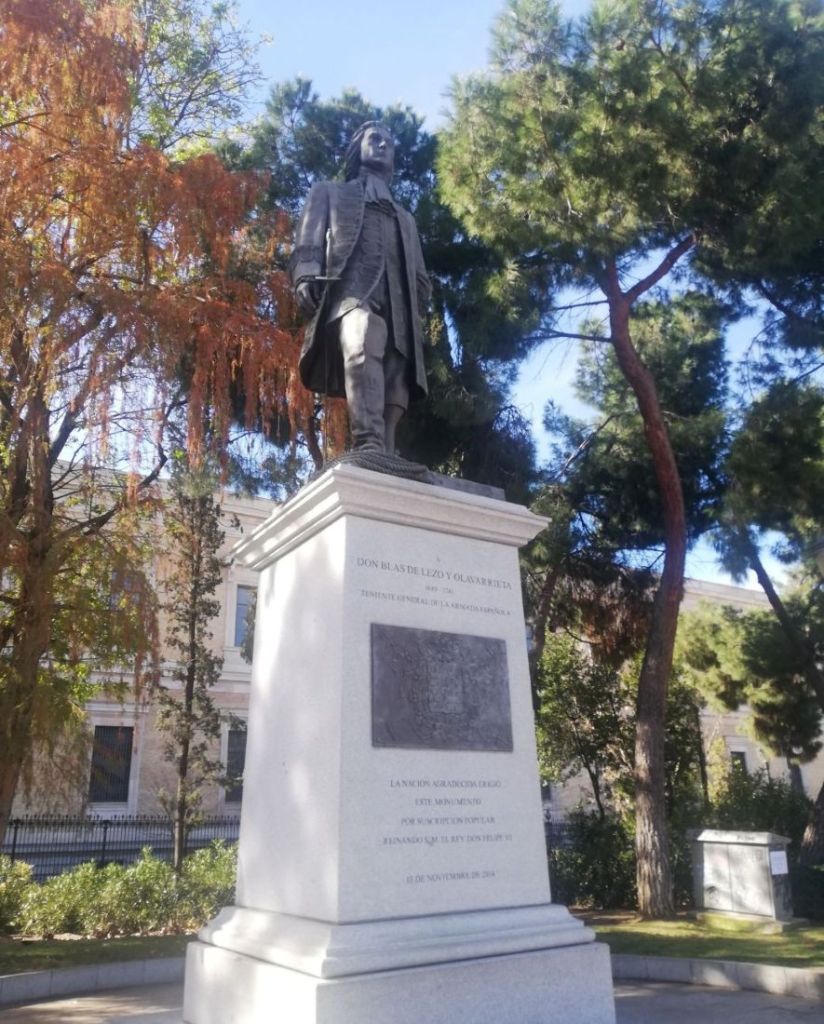
Blas de Lezo y Olavarrieta y Ubillos, nicknamed “Patapalo” (wooden leg) or “mediohombre” (half-man), was born on February 3, 1689 (or 1687 as other sources), in the parish of San Pedro, in Pasajes – Pasaia (Guipúzcoa). At the time, it was a district of Donostia (San Sebastián). He died at the Castillo de San Felipe in Cartagena de Indias (New Granada), Colombia, on September 7, 1741. The location of his tomb in Cartagena is unknown, perhaps in the Church of Santo Domingo. Blas de Lezo was a Spanish admiral, renowned for his strategic brilliance. As a young teenager, he enlisted in the French navy in 1701, and in 1711, this distinguished soldier transferred to the Spanish navy, where he was promoted to captain two years later. Blas de Lezo became an admiral in 1723 and was then appointed Lieutenant General of the Spanish Navy by the King in 1734. His illustrious career continued, and it is even said that he never lost a single battle. However, he died in 1741 from the plague, after a colossal 67-day battle against British forces. Thanks to Blas de Lezo, the Siege of Cartagena de Indias in 1741 resulted in a major defeat and heavy losses for the British. On Saturday, November 15, 2014, His Majesty King Juan Carlos Ier presided over the inauguration of the monument in memory of Lieutenant General of the Navy Don Blas de Lezo, located in the Jardines del Descubrimiento or Discovery Gardens in the Plaza de Colon or Columbus Square (see post),
The Madrid tourist office on the Jardines del Descubrimiento in the Plaza de Colon : https://www.esmadrid.com/en/tourist-information/jardines-descubrimiento#
The Madrid tourist office on the Plaza de Colon : https://www.esmadrid.com/en/tourist-information/plaza-colon
The official Association Monument to Blas de Lezo : https://monumentoablasdelezo.com/acerca-de/comment-page-1/
There you go folks , another wonderful nostalgic, sentimental trip to my dear Spain, A love affairs with my Madrid, as do not know when we will be back, we sure will have this trip in our hearts forever, Again, hope you enjoy this post on curiosities of Madrid, part XI !!! as I
And remember, happy travels, good health, and many cheers to all !!!


