
Never amazed me in my travels the beauty of my dear Spain. This is no surprise to be the 2nd most visited country in the world (UN-WTO). As we say Spain is everything under the sun , I came here to see the famous sherry , horses, and flamenco all in one, mind you as Spanish these are not my traditions been a descendant from Tenerife. The City of Jerez de la Frontera is in the province of Cadiz, autonomous region of Andalucia , and in the kingdom of Spain, The word frontera (frontier) comes from the frontier between moors nazari Granada and the Crown of Castilla during the Reconquista, Therefore, here is my take on the Catedral de San Salvador of Jerez de la Frontera !!! Hope you enjoy the post as I.
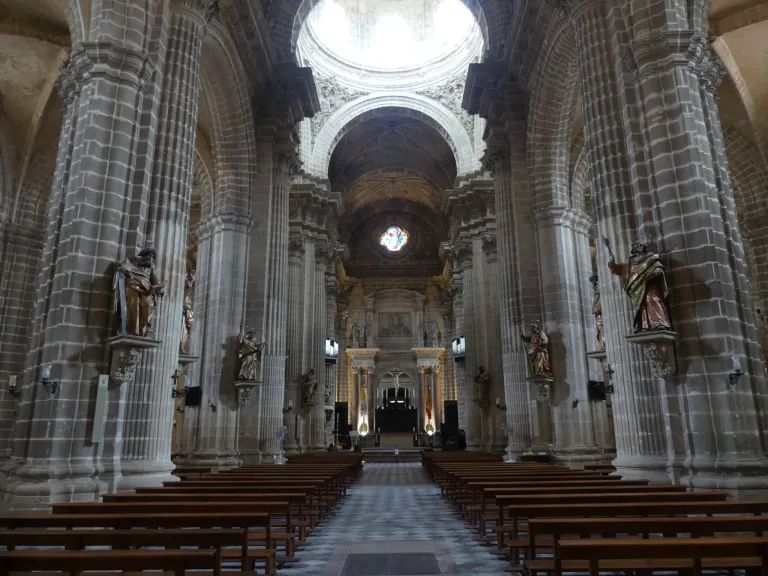
The Cathedral of San Salvador is a 17C church that combines Gothic, Baroque and Neoclassical styles. The temple is with five naves of unequal height supported on the outside by buttresses and flying buttresses, and a transverse nave, where a graceful octagonal dome rises with the main nave 40 meters above the floor of the church. Each of the edges of the octagon are decorated by stone statues representing the holy doctors of the Latin Church such as Saint Augustine, Saint Ambrose, Saint Gregory the Great, Saint Jerome, Saint Athanasius, Saint John Crossostom, Saint Basil the Great and Saint Gregory of Nazianzus. The central nave and transept are 20 meters high, the side aisles are 13 meters high, and the outer aisles are 8 meters high. In its surroundings, remains of the city’s main mosque were discovered on which the temple was built.
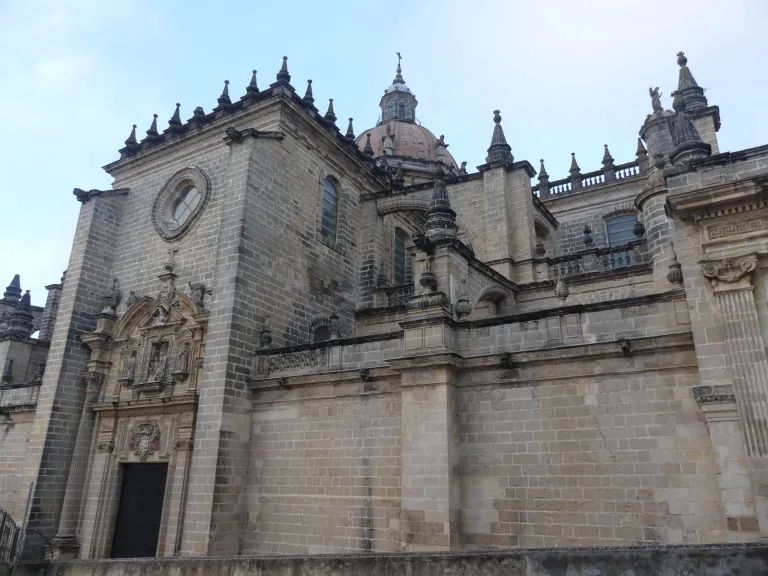
Inside, there are some paintings and images of true artistic value, including the Virgin Child by Francisco de Zurbarán, as well as the silver processional monstrance, a work from 1951. There are also sculptures of the apostles. The Christ of the Beam, a late Gothic crucifix from the late 15C, is featured in an altarpiece. It also has a Romantic organ from 1850, and, since 2012, another one, this being the only instrument in Jerez with mechanical traction. In 2015, a new organ was acquired. The Jerez Cathedral Museum exhibits the painting of The Virgin Child by Zurbarán, the processional monstrance of Corpus Christi, the old choir stalls, the painting of the Virgin of Guía and various silverware and sacred ornaments from the 18-19C. The Collegiate Collection of the Diocesan Historical Archive is located in the cathedral. Most of its contents either remained in Sevilla as documentation of his request for bishopric in the 16C, or were lost in a fire in 1918. However, a privilege from Enrique III dated 1393 stands out. Currently, the temple is the headquarters of two penitential brotherhoods: the Brotherhood of Christ of the Viga and the Brotherhood of the Risen One.
Gothic-Mudejar in its lower part and Baroque in the upper part, the bell tower of the San Salvador Cathedral is separated from the main churchby a few meters. It was probably built on the minaret of the city’s old mosque from the Muslim period. The dome that decorates the highest part of the tower is decorated with tiles in the colors of the city’s flag. At the top, a cross-shaped weather vane. One of the most unique pieces in the cathedral is a matraca, whose size and shape make it unique in all of Spain. It is a wooden box in the shape of a bell, equipped with various metal handles, which hit when turned on pieces of iron nailed to the wood. The ringing of this peculiar instrument only took place between Holy Thursday and Holy Saturday, since tradition prohibited the ringing of the bells during these days. Has ihe Crypt Illustrious burials of the city are found in its tombs.
A bit of history tell us that the current cathedral stands on part of the remains of the original Great Mosque of Jerez and the old church of the Savior from the 12C, The Cathedral of Jerez is the old Collegiate Church, elevated to the dignity of cathedral by the bull of March 3, 1980 of John Paul II. It has as its patron saint Our Lord San Salvador, and celebrates its feast day on August 6. The institution of the Collegiate Chapter dates back to the Christian conquest of Jerez, on October 9, 1264, and it is recorded that it was already constituted on September 23, 1265, when Alfonso X the Wise extended the endowment privilege in its favor. The Collegiate Chapter undertook the work of a new temple on May 9, 1695. The work lasted for more than eighty years, being carried out thanks to the dedication and sacrifices of the canons, and being financed with the assets of Cardinal Arias and later with substantial royal and papal aid, until the entire temple was blessed on December 6. 1778,
The city of Jerez de la Frontera on practical info: https://www.jerez.es/ciudad
The Jerez de la Frontera Tourist office on its cathedral : https://www.turismojerez.com/detalle-fichas/catedral-de-san-salvador-1
The official Cathedral of Jerez de la Frontera: https://catedraldejerez.es/
The Province of Cadiz tourist office on Jerez de la Frontera: https://www.cadizturismo.com/en/municipios/jerez-de-la-frontera
The Autonomous Community of Andalucia on the cathedral : https://en.andalucia.org/listing/jerez-cathedral/15854101/
There you go folks, a dandy beautiful monument of Jerez de la Frontera. This is a must to see, me think in the whole of the City many architecturally and historically attractions, Again, hope you enjoy this post on the Catedral de San Salvador of Jerez de la Frontera !!! as I,
And remember, happy travels, good health, and many cheers to all !!!


