
I am taking you back to my dear Spain again !! love it !! We came by car always except once by plane, and took time to see this wonderful City of Burgos , It really needs more time but on my road warrior trails we will be back eventually, I am glad found me new pictures in my cd rom vault to write this post for you and me, Therefore, here is my take on the Palacio Episcopal of Burgos !!! Hope you enjoy the post as I.
The City of Burgos is located in the province of Burgos in the autonomous community of Castilla y Léón in the kingdom of Spain. Burgos, the cradle of Old Castile, and a stopover on the Camino Francés pilgrimage to Santiago de Compostela, at the junction with the Ruta de la Lana and the western branch of the Ruta de Bayona. It is a notable stopover mentioned in the Pilgrim’s Guide.
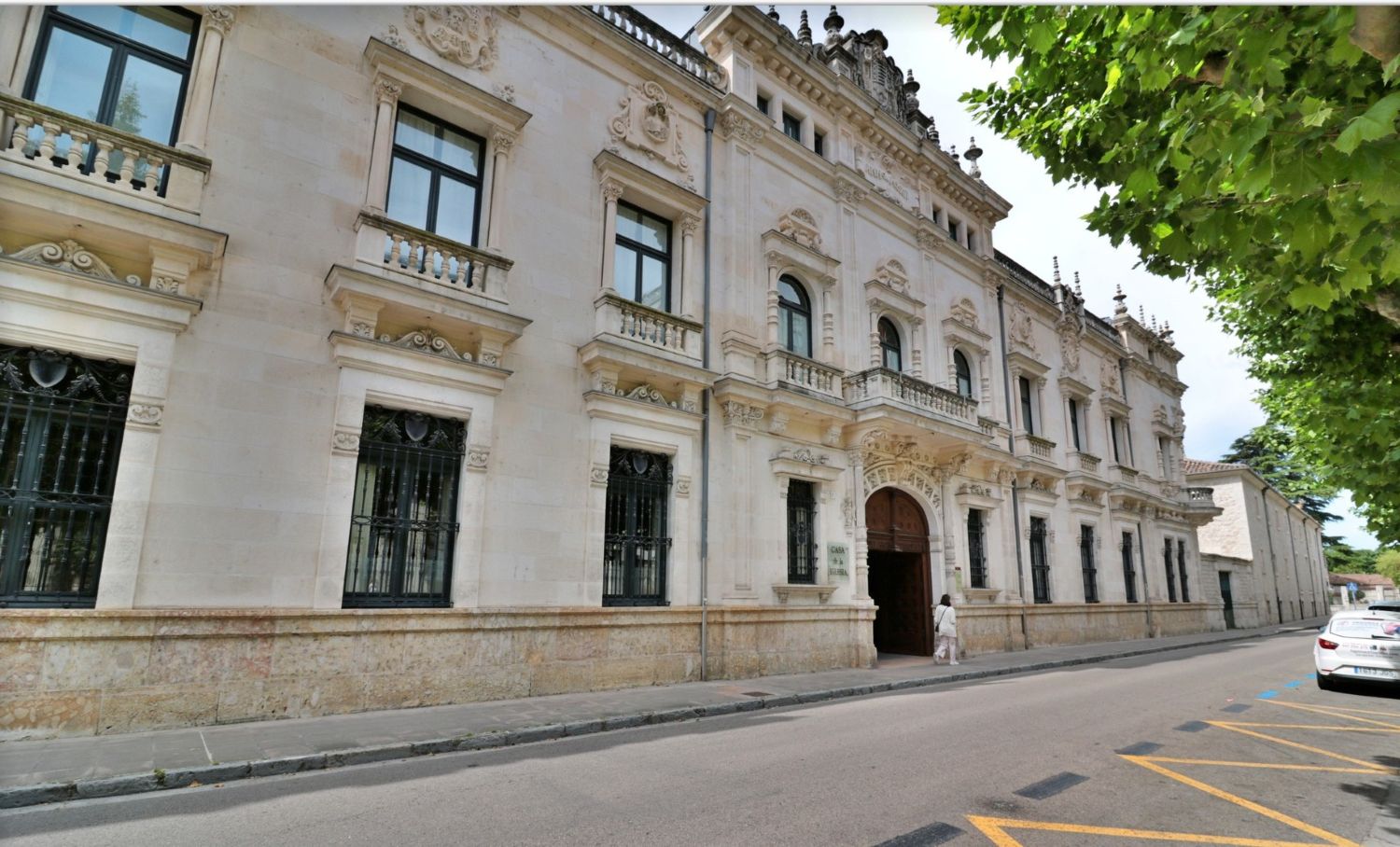
The Palacio Episcopal was built in 1916, during the reign of Archbishop José Cadena y Eleta,it emerged in response to the need for a new seat for the archbishopric, after the old building, located in the Plaza del Rey San Fernando next to the Cathedral, was demolished . The style opted was a historicist style in keeping with the taste of the time. For its construction, they used an interesting Neo-Renaissance style. The building, with an irregular floor plan, consists of a lower level, a main level, and a top level. The beautiful corner balconies, flanked by balusters, and the main entrance are noteworthy.
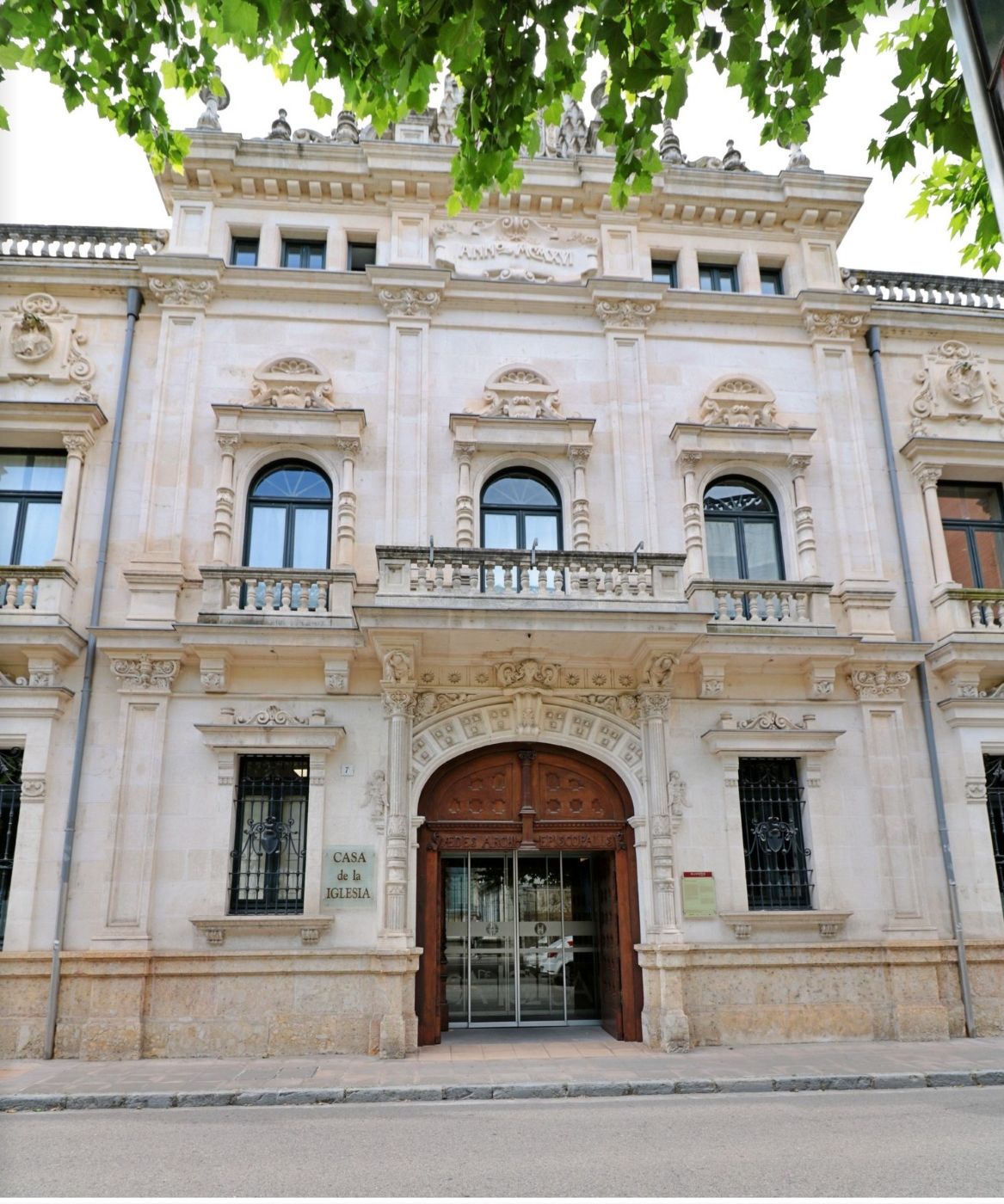
The Palacio Arzobispal or Archbishop’s Palace is a clear example of late 19C eclecticism. This style combines historical elements with a special emphasis on Renaissance and Baroque details, giving it a unique and refined appearance. Every corner of its façade invites you to pause and appreciate the blend of styles that make it so special. The Archbishop’s Palace has been an emblem of Burgos’s Neo-Renaissance architecture. Looking up at the top of the façade, we discover some of the palace’s most symbolic elements. The episcopal coat of arms and the medallions depicting the evangelists connect us with ecclesiastical tradition. Beside them, the coat of arms of Burgos and the Marian vase of lilies , and representations of the Evangelists reminding us of the city’s devotion and deep roots. The interior of the Archbishop’s Palace houses various works of art, including stained glass, paintings, and sculptures, many of them dating back to the early 20C. Among the rooms, the Throne Room stands out, which retains some of its original furniture and reflects the splendor of the period. In addition, opposite the palace is the Faculty of Theology, formerly the Seminary of San Jerónimo, with a library that houses an important documentary heritage. To this day, remains a symbol of the city’s history.
Other things to see here if with more time are the Sainte Mary’s Cathedral is known for its Gothic cathedral from the 13-16C, where the remains of Rodrigo Diaz de Vivar, nicknamed El Cid, are buried. Begun in 1221, its construction took more than three centuries. The third largest cathedral in Spain with 84 meters long and 60 meters wide) is a UNESCO World Heritage Site. The Hospital of Saint John the Evangelist, mentioned as early as 1085, was located on the left bank of the Vena river, opposite the church now known as San Lesmes. It was entrusted in 1091 by Alfonso VI to the Benedictines of La Chaise-Dieu. Of the monastery, only the cloister and the chapter house remain today, both in the Renaissance style, The Hospital de Rey or King’s Hospital was created in 1195 by Alfonso VIII, was dependent on the abbey of Las Huelgas Reales, located a few hundred meters away and founded in 1187 by the same sovereign. Pilgrims reached the hospital after leaving the city through the Puerta San Martin Gate and crossing the Arlanzón River via the Malatos Bridge. Today, the buildings are occupied by the Burgos Law School. The Church Saint Aleaume, rebuilt from the 15C onwards, it is Gothic and Renaissance. There are Flemish paintings, a pulpit, and the tomb of Saint Aleaume, whose complete remains were found in 1968. The tomb was then replaced in the choir in the presence of pilgrims from Loudun.
Again, others are the puente Santa Maria bridge leads to the old town through the triumphal Puerta Santa Maria gate. Nearby, the Paseo del Espolón esplanade, punctuated by cafés and gardens, offers a pleasant stroll along the river, away from any traffic. The Puerta Santa Maria gate had in the 14C walls has a façade modified in the 16C into a triumphal arch for Emperor Charles V. It features the great figures of Burgos: below, Diego Rodríguez Porcelos is flanked by the two semi-legendary judges who are said to have ruled the affairs of Castile in the 10C; above, Count Fernán González and El Cid (on the right) keep Charles V company. The Casa del Cordon is occupied by the Caja de Ahorros savings bank today. built in the 15C for the Constables of Castile, this residence still features, on its facade, the large Franciscan cordon that gave it its name. The Catholic Monarchs received Christopher Columbus here upon his return from his second voyage; Philip the Handsome died suddenly here from a cold caught after a game of pelota, which drove his wife Joanna mad with despair; Francis I, freed from captivity following his defeat at Pavia in 1525, stayed here before returning to France. The Burgos Museum It comprises two sections, each housed in a different residence. The Prehistory and Archaeology section. Housed in the Casa de Miranda, a beautiful Renaissance residence with a pleasant patio, it houses the results of excavations carried out in the province of Burgos, covering the period from prehistory to the Visigothic era. Note the rooms dedicated to Iron Age sites, the Roman city of Clunia, and the collection of Roman funerary steles. The Fine Arts section. The artistic production of the Burgos region from the 9C to the 20C is presented in the Casa de Angulo. In the 15C painting collection, the “Christ with Tears” is attributed to Jan Mostaert, a Flemish painter. The Plaza Mayor a charming circular main square, typically bordered by a covered gallery, serves as a setting for popular celebrations.
The City of Burgos on its history : https://www.aytoburgos.es/historia-de-la-ciudad
The Burgos tourist office on the episcopal palace: https://visitaburgosciudad.es/en/que-ver/palacio-arzobispal
The Castilla y Léon regional tourist office on Burgos : https://www.turismocastillayleon.com/en/heritage-culture/burgos/heritage
There you go folks, another wonderful nostalgic, sentimental trip to my dear Spain, Burgos is nice, awesome will say, and love it ! We will be back, eventually, Very convenient on my road warrior trails between France and Spain, Again, hope you enjoy this post on the Palacio Episcopal of Burgos !!! as I.
And remember, happy travels, good health, and many cheers to all !!!


