
As you know, if reading my blog, love the road and freedom that it provides, and just glancing at my blog realized in a particular way need to update this older post with new text and links using previous older pictures, This is one of my nicest memories on the road and I was there from the beginning of it all ! This is the first beltway of my Madrid , and drove on it always. Therefore, let me tell you about the amazingly wonderful M-30 beltway of Madrid !!! Hope you enjoy the post as I.
The M 30 is a beltway semi circular road of Madrid, the first one, and it is a 3 because it is actually the third beltway in history of Madrid. In 1857 was built the first circular road name the M10, running by Calle Princesa, plaza Colón, paseo de Recoletos, Gran Vía, and Calle de Alcalá. The second attempt was shorty afterward called the Paseo de Ronda, but popularly called the M20. It ran by the calle de Raimundo Fernández Villaverde, calle del Doctor Esquerdo, calle de Pedro Bosch, calle de Joaquín Costa and calle de Francisco Silvela. In 1929, it is spoken of a third beltway and called the M30 ; this plan was approved in 1942 but due to economic constraints and WWII it was not started until 1970 !! Ah yes the M is for Madrid of course ! I was living in the city, when they started building it and left when they had finished it! It has been a trademark to drive on it after finished in 1974! Of course, could not drive then, but walk over its arch and passarelle many times until finally able to drive on it in 1982 and thereafter,
The pretty arch passes near the Monumental Las Ventas (see post) bullfight arena on Calle de Alcalà on the way to my piso (apartment in Quintana metro line 5 stop). It seems every visit I need to take somebody by here and tell of all the businesses there,gone and new over the years. Some like where my Mom purchase my first shoes are still there (Victor Calzados) and of course I purchase my boys shoes there too! The restaurant where we spent many evenings and I do concur the best patatas bravas of Madrid, Docamar since 1963 still there! I remember, going by bus P13 (today 113) to the baseball field of Elipa,(see post) now a huge sports complex park and baseball field still there, the Madrid baseball federation is base there etc. Now ,you can even go there from Calle Doctor Esquerdo on foot and over the passarelle of the M-30! All wonderful memories never to be forgotten.
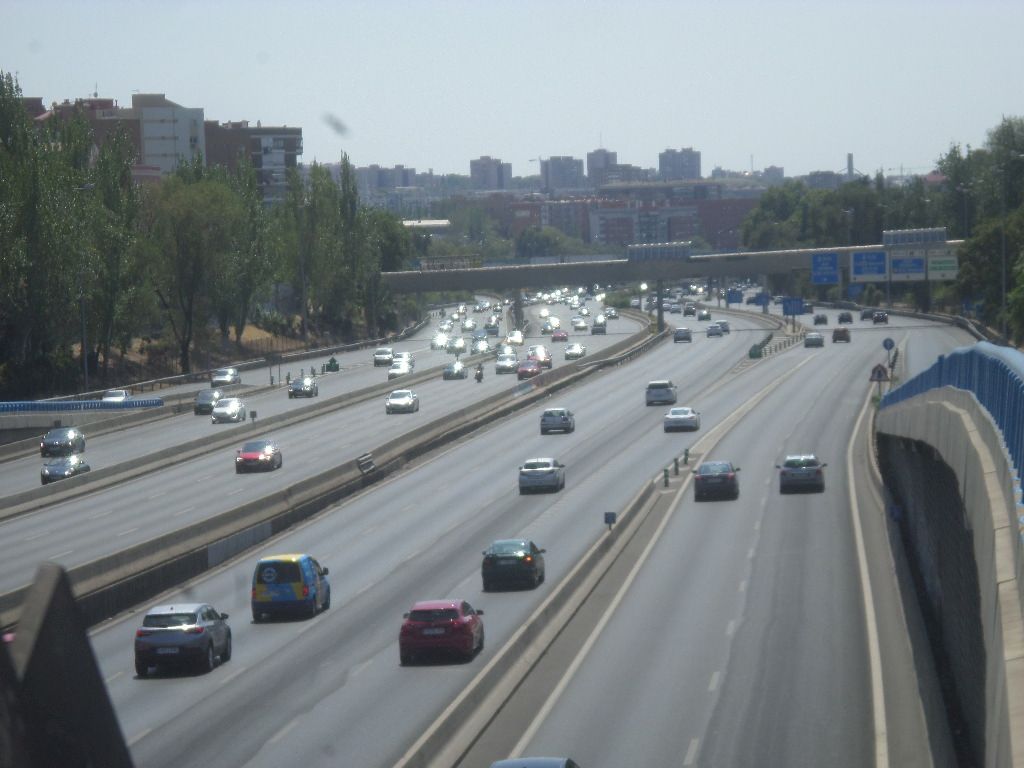
The M-30, also call the Madrid ring road (beltway), is a road done like a highway except in the North of the city on the Avenida de la Ilustracion, this road goes around the city. It has a length of about 32.5 km with an average radius of 5.17 km with respect to the Puerta del Sol. It is heavily congestion and high traffic volume, and some says the most in Spain. Its general speed limit is 90 kph on surface sections, 70 kph in tunnel sections, and 50 kph on the northern section, also known as Avenida de la Ilustración. The particuliarity is to be the only Spanish highway of which is own by the City/Town Hall of Madrid. The construction of the M-30 started in 1970 (while I was living in the city) , in two different sections: the East section, or Avenida de la Paz, between the Carretera de Irún (to France) A-1 and Carretera de Cadiz A-4, which followed the riverbed of the old Abroñigal, which was to be channeled and buried under the highway. The West stretch, or the Manzanares highway, between the Puente de los Francéses (bridge of the French) and the Carretera de Cadiz (road), mostly built following the course of the Manzanares River. Both sections were joined in the South junction, and were not completed until 1974. (When I left Madrid after living 4 yrs).
The first beltway would be formed by the streets that follow the old plot of the wall of king Felipe IV that formerly encircled the city: lower part of the Cuesta de la Vega, Ronda de Segovia, Puerta de Toledo, Ronda de Toledo, Plaza de Embajadores, Ronda de Valencia , Ronda de Atocha, Glorieta de Atocha, exterior wall of Retiro park (currently, Avenida de Menéndez Pelayo, the first section of Calle O’Donnell and Calle de Alcalá), Paseo de Recoletos up to the current Plaza Colón, and the “boulevards”, Calle de Genoa, Calle de Sagasta and Calle Carranza. With the construction of the viaduct, the extension of Calle de Bailen and its union with the Gran Via de San Francisco, at the same time as the construction of the last two boulevards already in the 20C that is Calle de Alberto Aguilera and Paseo del Marqués de Urquijo, the belt was enclosed by the West.
The second beltway would be formed by the Rondas: Avenida de la Reina Victoria, Calle de Raimundo Fernández Villaverde, Calle de Joaquin Costa, Calle de Francisco Silvela, Calle del Doctor Esquerdo and Calle de Pedro Bosch. In the 1970s the most important section was open between the junction of Manoteras (cross with the A-1, M-11 and accesses to Sanchinarro) north side of Madrid and the Nudo Sur (South Junction), that connects to the Avenida de Andalucia (previously N-IV) now A-4.
It usually counts three lanes of traffic in each direction and can align up to 9 lanes, especially east of the city. This is where most of the country’s radial highways go to the various cardinal points of Spain: A-1: North Corridor, A-2: Northeast Corridor, A-3: East Corridor, A-4: South Corridor, A-5: South-West Corridor A-6: Northwest Corridor. A bit technical but will try to give you as much of the history and layout of the M-30, The construction of the tunnel by the South Pass , that connects it directly with the A-5 to the southwest of the city and to the A-3, needed the use of the two biggest tunnel grounders of the world. They are the longest urban highway tunnels in Europe, with sections of more than 6 km in length and 3 to 6 lanes in each direction, between the south entry of the Avenida de Portugal tunnel and the north exit of the M-30 south by-pass there are close to 10 km of continuos tunnels. The M30 tunnels run between a point roughly 700 meters north of the junction with A5 motorway and continue all the way up to the junction between M30 and A3 highway/motorway. Lately my entry in and out of Madrid. Hope I have not lost you , is all well posted !
North sector: The Northern Sector: from the A-6 to the junction with the A-1 and the M-11. connects to the M-30 north-west of the city surrounding the urban center. I come by here last few years !! It runs along the Puerta de Hierro Park before connecting to the M-40 for the first time. It serves all the northern districts of the city (Antonio Machado and Lacoma). The M-30 loses its highway status to become the Avenida de la Ilustracion while waiting for the tunnel by the North Pass from which the M-607 is towards Colmenar Viejo (Segovia etc) on the extension of the Paseo de la Castellana until the junction with the A-1 and the M-11 to the northeast of the city. Improvements to the junctions of the M-30 and Avenida de la Ilustración with the M-607. Widening of the roadway to four lanes in each direction in the northwest area and installation of service roads. Improvement of the junction with the M-40. Construction of a tunnel with four lanes in each direction and a northern bypass that will connect this sector with the eastern sector of the motorway via two tunnels, thus avoiding the section with traffic lights on Avenida de la Ilustración, as well as providing direct access to the A-1.
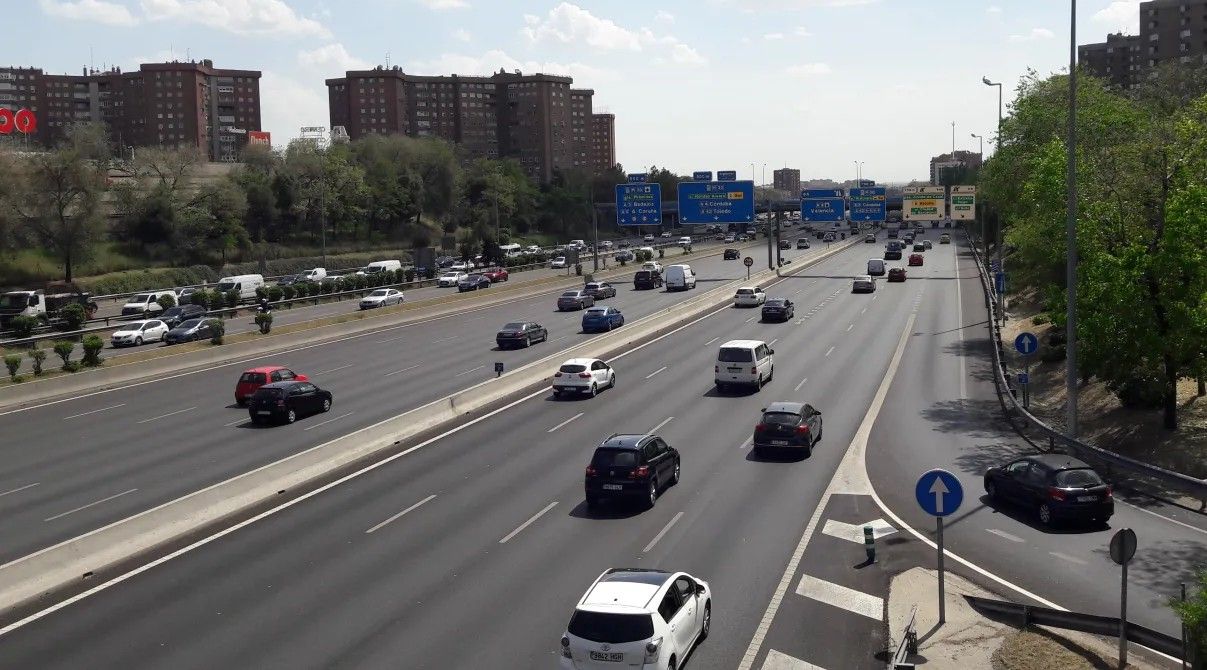
East sector:The Eastern Sector: from the La Paloma Junction to the connection with the A-3. Between A-1 (Burgos) and A-3 (Valencia); It is a very busy area because it recovers the flow from the north of Spain from Burgos, Barcelona or Zaragoza. Indeed very busy by me too ! The M-30 serves the eastern part of the city, where the northeast Highway connects to the 2nd largest city in the country: Barcelona. In this area the road is particularly large and loaded and includes up to 8 traffic lanes, separated according to destination in, each direction. At the Calle de O’Donnell the road crosses the M-23 which allows to reach the radial highway R-3 from the East. Then to the southeast of the city, come the connection to the A-3 which allows to reach the Spanish Levant (Valencia etc). It is at this bifurcation that the tunnel by Pass is detached which directly connects the A-5 to the west of the city. Update : Renovation of the La Paloma Junction. Renovation of the Costa Rica Junction. Renovation of the junction connecting to the A-2. Renovation of the O’Donnell Junction. Renovation of the junction with the A-3, which connects directly to the southern bypass towards the A-5. Resurfacing and standardization of the entire eastern section of the M-30.
South sector: The Southern Sector: from the A-3 interchange to the Southern Junction Between the A-3 (Valencia) and the A-42 (Toledo), it is a double stretch of the road, first with the tunnel By Pass on which connects the southeast to the southwest of the city. The A-4 southbound disconnects to the Manzanares River to serve Andalusia (Cordoba, Seville,…). At this bifurcation it is joined by the Embajadores Tunnel which connects the South highway directly to Calle de Embajadores near the Atocha station in Madrid. Update : Creation of a southern bypass, allowing vehicles coming from the M-30 towards the A-5 (Southwest Highway) and going to the A-3, and vice versa, to use this bypass, avoiding the southern junction, which would then be exclusively for vehicles going to or coming from the A-4 or A-42. Connection of Calle de Embajadores with the M-40.
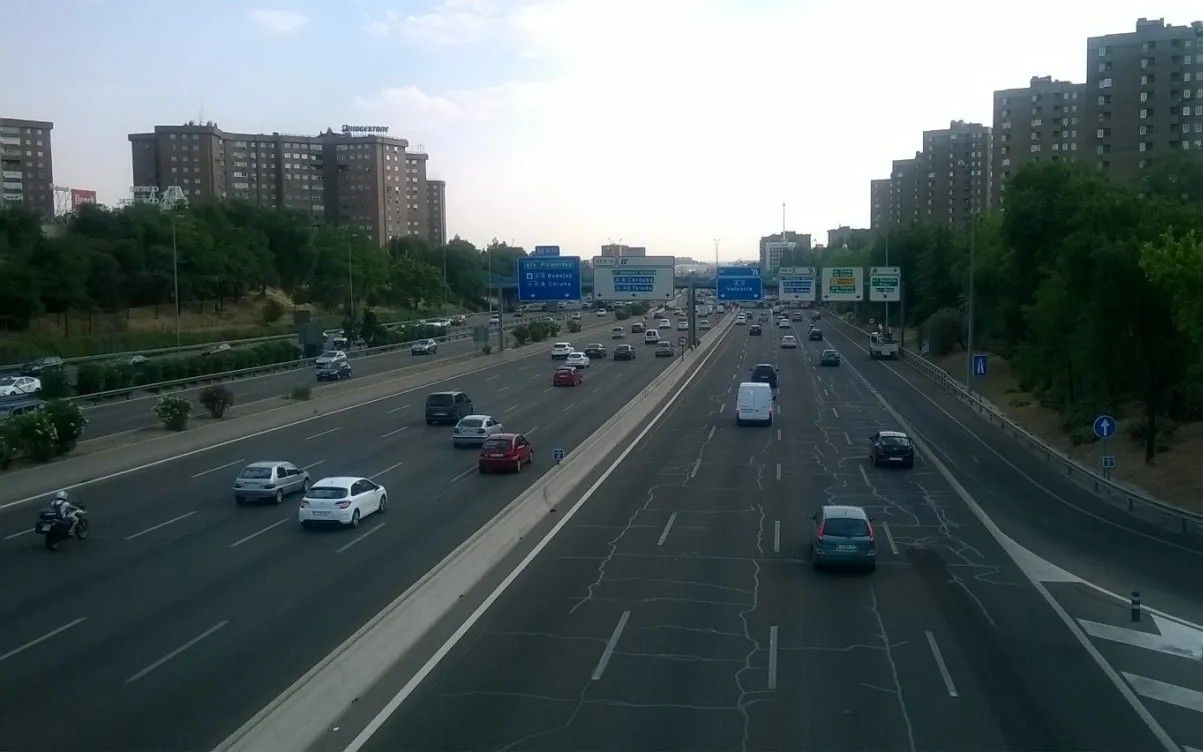
West sector: The Western Sector: from the Southern Junction to the connection with the A-5. Between A-42 and A-6; The M-30 forks with the A-42 to Toledo (yeah the old N400) before going along the Manzanares by joining the tunnel by South Pass. A kilometer further away is the Avenida de Portugal to serve the south-western suburbs of Madrid (Alcorcon, Mostoles etc). Updates : Undergrounding of the M-30, beneath the banks of the Manzanares river, in a four-lane tunnel in each direction, 9,952.7 meters long or almost 10 km (5,973.84 meters of main carriageway and 3,978.91 meters of branch lines). Undergrounding of 2.6 km of the A-5, between the San Vicente roundabout (connection with the M-30) and the intersection with Paseo de Extremadura, and landscaping and improvement of its surface.
The M-30 crosses the M-500 and loops its turn at the junction with the A-6; there are 31 exits/salidas in total, last count. The principal exits to big cities are the no 1- A-1 – Alcobendas, Burgos, exit 2, M-11 to A-2 (E-90)/A-3/A-4/Calle de Arturo Soria – Feria de Madrid, Madrid-Barajas Airport, Zaragoza, Exit 4b, A-2/Calle de Arturo Soria – Zaragoza, Exit 9, A-3 – Valencia, Exit 18, A-5/Plaza España – Badajoz, exit 23a , A-6 – Madrid, Moncloa, Exit 23B, A-6 – a Coruña, exit 23, Calle de Sinesio Delgado exit 23, Calle de Arroyofresno, Avenida Ventisquero de la Condesa, M-605/M-40 to M-607/avenue Cardenal Herrera Oria– El Pardo, Colmenar Viejo, M-40 to A-6 – A Coruña
We have some nice building running alongside this highway M30, the best for me is the Elipa park where I used to played baseball! In my youth there and now there is a passarelle bridge from calle del Doctor Esquerdo to Calle Pez Volador to the passarelle and over to the park easy walk. Others are in a clockwise direction from the junction of Manoteras ,north of Madrid up Paseo de la Castellana: Cámara de Comercio de Madrid (chamber of commerce of Madrid) , Centro Cultural Islámico y Mezquita de Madrid, (the mosque of the M30), Plaza de toros Monumental de Las Ventas (monumental bullfights arena right off my old neighborhood on Calle de Alcalà), Torrespaña, Centro Comercial Moratalaz (shopping mall) , Matadero Madrid (arts entertainment center today on the old slaughterhouse of Madrid), Ermita de la Virgen del Puerto ( a nice Church), Jardines del Palacio Real de Madrid (gardens of the Royal Palace), Estación de Príncipe Pío (train station and shopping), Jardines del Palacio de La Moncloa (gardens of the house of government Moncloa), Real Club Puerta de Hierro ( a private club) , Centro Comercial La Vaguada (shopping mall and one of my favorites in the city), Hospital Ramón y Cajal, Hospital Universitario La Paz(hospitals).
The M-30 appears in numerous films set in Madrid. A very characteristic one is “Que he hecho yo para merecer esto,?” Or what have I done to deserve this? by Pedro Almodóvar. And in literature, it is the protagonist scene of the work of Esther García Llovet La M-30, la gran velada or the M30 the great evening. Of course, only my favorites! A wonderful ride indeed on the M3O. However, in Madrid today there is like a beehive of roads , from the M-30 you have today all the way around to the M 55 and many R (radials) with tolls to make driving in Madrid a Grand Prix Challenge , good ground for the road warior lol! Actually , folks, it is a lot easier than read, if you have driven in big cities before, of course.
And more coming, the latest news tell us that the future Parque de Ventas park, a project envisioned as the next green lung of Madrid, involves covering a section of the M-30 ring road to create a large green space of over 16,000 square meters above the highway, near the Monumental Ventas bullring. (my old home area!) Specifically, the infrastructure consists of 96 beams that will lift part of the M-30 and connect the Salamanca and Ciudad Lineal districts via pedestrian walkways, covering up to 16 lanes surrounding the bullring. The nearly 200-meter-long roof has been completed, and the first of eight footbridges that will serve as entrances to the park has been connected. The future park will feature nearly 600 new trees and almost 50,000 shrubs, and will include 2,150 square meters of meadows with pedestrian and landscaped areas with calisthenics equipment, a grandstand, kiosks, fountains, benches and even an outdoor performance area. Go Madrid !
And for those whose car cannot make there is a park and relay system that allows to leave you car out and come in with public transport, These are the sites :
Fuente de la Mora train station parking. Accessible via the A-1 (Autovía del Norde), this parking lot is ideal if you are arriving from the north of Madrid. From here, you can take the Cercanías commuter train (lines C-1 and C-10) or the Ligero metro (line ML1) to quickly reach the city center and its tourist attractions.
Metropolitano Stadium South parking lot. If you are arriving in Madrid from the east, this parking lot, located near the A-2 (Autovía del Nordeste), will be very convenient. Thanks to metro line 7 (Metropolitano Stadium), you will have direct access to the network for easy travel.
Pavones train station parking lot. For those arriving from the southeast, this parking lot, located on the A-3 (Autovía de Valencia), is an excellent alternative. Simply park and take metro line 9 (Pavones station), which will easily take you to Madrid’s most interesting sights.
El Casar train station parking lot. If you are coming from the south, this parking lot, connected to the A-4 (Autovía de Andalucía), is very convenient. It connects to metro lines 12 and 3 and the Cercanías commuter rail network (lines C-3 and C-4), making it easy to access the main train stations in the city center.
Las Margaritas train station parking lot. Also coming from the south-southwest, this parking lot, accessible via the A-42 (Autovía de Toledo), connects you directly to the Cercanías commuter rail network (line C-4). This will allow you to easily reach Madrid’s main train stations and begin your visit.
Colonia Jardín Station Parking. For tourists arriving from the west, this parking lot, located on the A-5 (Autovía de Extremadura), is a very convenient option. It connects to metro lines 10 and 5, as well as tram lines ML2 and ML3, offering numerous possibilities for exploring the city.
University City Station Parking. If you are arriving in Madrid from the northwest, this parking lot, near the A-6 (Northwest Highway), is an ideal solution. Once parked, metro line 6 (the circular line) will allow you to quickly reach the various tourist districts of the capital.
Tres Olivos Station Parking. Finally, for those arriving from the north on the M-607 (Route Colmenar Viejo), this parking lot is a wise choice. Its direct connection with metro line 10 will allow you to discover the heart of Madrid and its main attractions.
For parking to get around the environmental rules I use this parking and site : https://www.indigoneo.fr/en/parkings/13803/parking-princesa
The Madrid tourist office on getting to Madrid by car : https://www.esmadrid.com/en/madrid-by-car
The Madrid tourist office on driving in Madrid : https://www.esmadrid.com/en/driving-madrid
The Madrid360 environmental issues on requiremenets to drive in Madrid : https://www.madrid360.es/como-me-afecta/etiqueta-a/
The Official news and traffic on the M30 : https://mc30.es/
The Comunidad de Madrid trafic info in Madrid : https://informo.madrid.es/#/realtime?panel=live
There you go folks, a dandy of a M30 beltway in Madrid, with many memories walking over it and driving me, the family, all enjoyed it very much, Hope you can too, and thanks for reading me since Nov 2010, Again, hope you enjoy this post on the amazingly wonderful M-30 beltway of Madrid !!! as I.
And remember, happy travels, good health, and many cheers to all !!!


