
I am taking you back to my dear Spain again !! love it !! We came by car always except once by plane, and took time to see this wonderful City of Léon, It really needs more time but on my road warrior trails we will be back eventually, I am glad found me new picture in my cd rom vault to write this post for you and me, Therefore, here is my take on this is Léon !!! Hope you enjoy the post as I.
The City of León is in the province of León in the autonomous community of Castilla y León, and in the Kingdom of Spain, The city is a communications crossroads in northwestern Spain,being a place of passage towards Asturias from the plateau and towards Galicia from northeastern Spain , The A231 highway León-Burgos Way of St. James, The A60 highway León-Valladolid , The A66 Ruta de la Plata or Silver Route Highway of Campomanes – Caldas de Luna – La Magdalena , The N630 ruta de la plata to Gijón – Oviedo – Mieres – Puerto de Pajares – León – Zamora – Salamanca – Plasencia – Mérida – Seville, The N601 Madrid-Gijon Highway to Madrid – Adanero – Ávila – Valladolid – León – Puerto de Pajares- Campomanes – Mieres – Oviedo – Gijón and the N120 highway Logroño – Burgos – Sahagún – León – Astorga – Bembibre – Ponferrada – El Barco de Valdeorras – Orense – Porriño – Vigo, The City is 178 km from Burgos , 286 km from Vitoria-Gasteiz, 139 km from Valladolid, 142 km from Velliza, and 342 km from Madrid, we came from our rental house in our road warrior trails in Velliza (see posts) along the VP5806 road bearing left on the VA515 road dir Tordesillas,but before this town bear right around it to connect with the A6 autovia or highway to exit/salida 267 to connect with the A66 highway or autovia ruta de la Plata to exit/salida 152 bearing right connecting with the A231 road shortly bear left on exit/salida 1 to connect with the local LE 11 road dir Burgos but just before entering City center bear right onto exit/salida 3 to the beltway LE30 road which same road becomes the LE20 road continue and by roundabout of Centro Comercial Reino de Léon shopping center bear left onto Calle La Granja then quick right onto Calle José Maria Suàrez Gonzalez then on roundabout hommage to the nurses bear left onto Avenida Principe de Asturias continue bear left onto Calle Gonzalez de Lama to our above ground parking or Parking San Pedro– Cathedral at Calle del Arquitecto Ramón Cañas del Río, no,7 very close to the Cathedral, We took a quick swing and came back out to the A231 highway to connect with Burgos and onwards to France
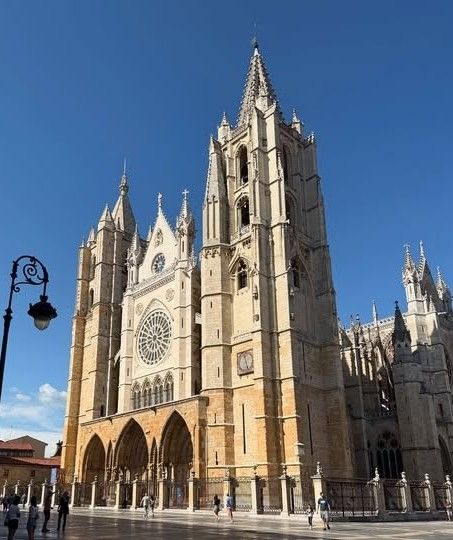
The Catedral Santa Maria is a Gothic temple dedicated to Saint Mary,and was begun to be built in the reign of Alfonso X the Wise in the middle of the 13C on the old Romanesque cathedral, which in turn occupied the grounds of the Royal Palace ceded by Ordoño II for this purpose and which, in turn, was built on the Roman baths , A peculiar characteristic is that the towers appear separated from the central nave by flying buttresses. Its floor plan is three naves, with a ribbed vault. The main body of the cathedral was completed in the early 14C along with the cloister and the north tower, while the south tower was completed in the 15C in flamboyant Gothic style. The most impressive feature is its interior, highlighting more than 1,800 square metres of stained glass from the 13C to the 16C, including three large rose windows and stained glass in the lower part and the triforium, some of them added during the 19C restorations.
Many things to see in Léon with more time ,kept for a future in depth visit, These are the Basilica of San Isidoro ; one of the most important examples of Romanesque art in Spain and, without a doubt, one of the most complete ensembles in this style, since it combines architecture, sculpture and painting, housing in the latter technique the Royal Pantheon, called by experts the Sistine Chapel of Romanesque Art. Its construction was promoted by King Fernando I and his wife Sancha de León in the 11C, it was originally a monastery dedicated to Saint John the Baptist, and it is assumed that a Roman temple previously stood on its foundations. It housed the first Cortes in history, the Cortes of León, held in 1188. The Convent of San Marcos. Its construction was promoted by the Catholic Monarchs as the headquarters of the Order of Chivalry of Santiago, built next to the medieval San Marcos Bridge, across which pilgrims continued the Camino de Santiago. Today, it is one of León’s most important monuments. Built in the Plateresque style, It is currently a five-star inn. The Church of San Salvador de Palat del Rey is the oldest temple in the city of León, founded in the 10C by Ramiro II of León and, as its name suggests, it is the temple of the Palat (the Palace) of the king. The Church of Nuestra Señora del Mercado is a church with a basilica plan in the shape of a tomb, being narrower at the foot. The Church of San Francisco, whose current construction dates back to the second half of the 18C, was built with classical forms and dedicated to Saint Francis. The Convent of the Conceptionists, founded in 1512 by Leonor de Quiñones, has a Romanesque façade of the old building and corridors with Mudejar paintings.
The Palacio de los Guzmánes is from 1560. The building was acquired by the Provincial Council of León in 1882, and was extended from 1973 to 1976. Palacio del Conde Luna, former residence of the Quiñones family, Counts of Luna, it was built in the 14C. Given to the City Council of Léon by the Octavio Álvarez Carballo Foundation, it houses the Spanish headquarters of the University of Washington as well as the headquarters of the León Real Foundation. The Roman wall of León has its origins in an initial military fortification from the Augustan period, around the 1C BC, and consisted of two parallel wooden walls topped by a parapet, joined by a floorboard. They were soon replaced by a stone wall built by Legio VII around the 1C, the remains of which are still visible in the San Isidoro area. Around the 3C and 4C, the one that can be seen today was built. Currently, the fortress or castle is the headquarters of the León AHP is still visible, while the entrance arch was rebuilt in the 18C. It is presided over by a statue dedicated to Don Pelayo and is the only entrance gate to the city that is preserved. The Plaza Mayor or main square was completed in 1677. The City/Town Hall building that dominates the square is in the Baroque style. Today the market in the square still exists, being held every Wednesday and Saturday. The Plaza de San Martín was the place around which the artisans, merchants and pilgrims of the city of León gathered and today, these activities have disappeared or moved to other parts of the city, and have been replaced by hotels and leisure activities. On the southern side of the neighborhood we find the Plaza del Grano. The neighborhood, from Calle La Rúa to Calle Caño Badillo, is dotted with bars, cafes and inns that make the area the main tapas route. The Casa Botines, a work of Antonio Gaudí, in the neo-Gothic style. Gaudí delegated the direction of the works to the builder Claudi Alsina i Bonafont, one of his assistants in several works in Barcelona, The Jardin de San Francisco garden, the oldest green space in the city. The Parque Quevedo Park of 48,042 m². Its main entrance is located on Avenida Quevedo , there are four other entrances located, two on Avenida Magdalena and two on Calle Riosol. The Museum of Contemporary Art of Castilla y León was inaugurated by the then Princes of Asturias, Felipe de Borbón and Letizia Ortiz, on April 1, 2005. The Museum has become one of the international references in Contemporary Art. The Museum of León is the oldest in the province and is dedicated to telling its history through Archaeology, Art and Ethnography. Inaugurated in 1869, the Museum of the Royal Collegiate Church of San Isidoro is noted for the Pantheon of the Kings, which is called the Sistine Chapel of Romanesque for its elaborate frescoes. The Plaza de Toros or bullring, currently also known as León Arena, was built in 1948 on the site of a previous wooden bullring, built in 1912. Since 2003,it hosts not only bullfighting shows during the patron saint festivities, but also national and international concerts, sporting events, fairs and conferences, exhibitions and major shows.
A bit of history I like tell us the Léon was born as a Roman military camp of the Legio VI Victrix around 29 BC, its character as a camp city was consolidated with the definitive settlement of the Legio VII Gemina from the year 74, founded by Galba, which would remain in León until approximately the beginning of the 5C. It was the only legion settled in Hispania (current Spain) until the fall of the Western Roman Empire in 476, so during all this time León was the military capital of the Peninsula. After the Roman period, the city became part of the Suebi Kingdom and later, after its conquest, of the Visigoth Kingdom. The city was conquered, during the Muslim invasion of the peninsula, in the year 712, being recovered in 754 by Alfonso I, although due to its border status it would remain uninhabited for almost a century. It was in the year 853 in which Ordoño I effectively incorporated the city into the Kingdom of Asturias, successfully repopulating it. It would finally be with Ordoño II, who occupied the throne (914-924) after the death of his brother García I, when the city became the capital of the Asturian kingdom, initiating the Kingdom of León in 910;one of its most notable historical stages by becoming head of the Kingdom of León, actively participating in the Reconquista against the Muslims, becoming one of the fundamental kingdoms in the configuration of the Kingdom of Spain. In the 12C, and after the passage of the first queen, Urraca I, her son Alfonso VII stands out, who notably advanced the reconquest and became emperor of all Hispania in the old Leonese cathedral. After the death of Alfonso VII, he divided the kingdoms of León and Castilla among his children; Fernando II reigned in León, highlighting the reconquest of Extremadura. His successor and last king of León was Alfonso IX, who convened the first cortes of Europe, with the participation of all social classes, in the Basilica of San Isidoro in 1188. The integration of the Leonese kingdom into the Castilian Crown,was definitive from 1301. In the 16C, the War of the Communards against Carlos I in León stood out for an unusual comunero fervour in the cathedral chapter and in the neighbourhoods outside the walls. In the local sphere, the two dominant families of that time, the Guzmáns, on the part of the comuneros, and the Quiñones, on the part of the king, made the war the perfect excuse to resolve their differences. In the days prior to the outbreak of the Peninsular War,(independance war in Spain) specifically on April 24, 1808, a popular demonstration took place in León, in favor of Fernando VII for fear that Carlos IV, who had the favor of the French, would reign again, thus assuming a rejection of Napoleon. On July 26 of that same year the city would fall to the Gallic general Jean-Baptiste Bessières. Regained under French rule in June 1812, it only returned to French hands for a brief period in 1813, but immediately afterward the French withdrew completely. In León, before the confiscation promoted by Juan Álvarez Mendizábal, much of the surrounding land belonged to the church. With the confiscation, the newly confiscated lands were freed up for urban development, marking a turning point in the urban development of the city, which began to outgrow its medieval center. After the uprising of July 1936, which led to the start of the Spanish Civil War, most of the province remained in the hands of the Nationalists. In León, the uprising of the garrison took place on 20 July, once the mining column, which had been sent from Asturias to Madrid, had left the city. The Nationalists offensive became widespread, recovering the mountain passes and ending the war in the north on October 21, 1937. In 1979, democratic elections were held again in the city of León, with the UCD (Unión de Centro Democrático) being the winner ,led by democratic Spain hero Adolfo Suárez González.
The Léon tourist office on its heritage : https://leon.es/que-ver/monumentos-de-leon/
The City of Léon : https://www.aytoleon.es/es/inicio/Paginas/default.aspx
The Castilla y Léon region tourist office on Léon : https://www.turismocastillayleon.com/en/heritage-culture/leon
The Spain National Tourist Office on Léon : https://www.spain.info/en/destination/leon/
There you go folks, another wonderful nostalgic, sentimental trip to my dear Spain, Léon is nice, awesome will say, and love it ! We will be back, eventually, Very convenient on my road warrior trails between France and Spain, Again, hope you enjoy this post on this is Léon !!! as I.
And remember, happy travels, good health, and many cheers to all !!!

 Paris1972-Versailles2003
🦁
LikeLiked by 1 person