
Oh yes another wonderful old town of my dear Spain; this is deep country and our road warrior trips at its best. There are so many towns that will take you a life time to see them all, and each is unique. I am glad to have found me these pictures in my cd rom vault to share in my blog for you and me, Therefore, this is my take on this is Campillo de Dueñas !!!. Hope you enjoy it as I.
The village of Campillo de Dueñas is located in the province of Guadalajara, in the autonomous community of Castilla-La Mancha, and in the kingdom of Spain. The village has a population of 74 inhabitants (INE 2024). It is 23 km from Molina de Aragón, 162 km from Guadalajara, 69 km from Calatayud, 97 km from Teruel; 161 km from Zaragoza and 218 km from Madrid, We stopped by in my road warrior trails coming from Zaragoza on our way to our rental house in Las Majadas (see posts), We continue south of Zaragoza on the A23 or autovia Mudéjar highway passing by wine famous Cariñera until exit/salida 176 by Caminreal to connect with the N211 road dir Monreal del Campo here bear right and continue on the N211 past El Pobo de Dueñas bear right onto the GU 417 road dir Campillo de Dueñas after about 5 km bear left on a stony dirt road with a rest stop continue on this road to the sigh telling you parking or aparcamiento del Castillo de Zafra and you arrive ! We took a peek and continue our journey past Hombrados to connect with the N211 passing by Molina de Aragon (see post) and continue bearing right onto the CM210 road curvy and mountaineous heavens to Las Majadas, nostalgic, memorable town (see posts).
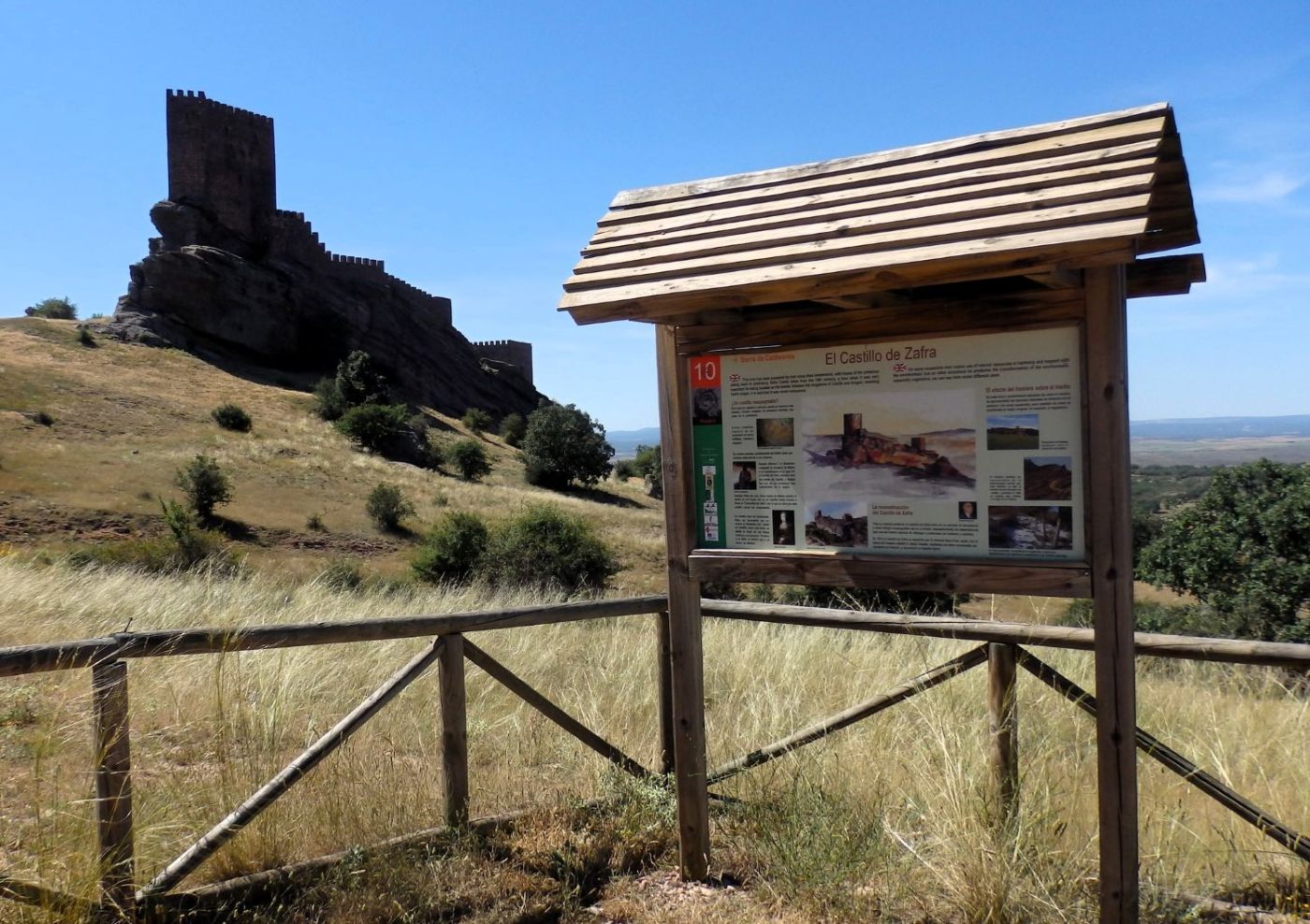
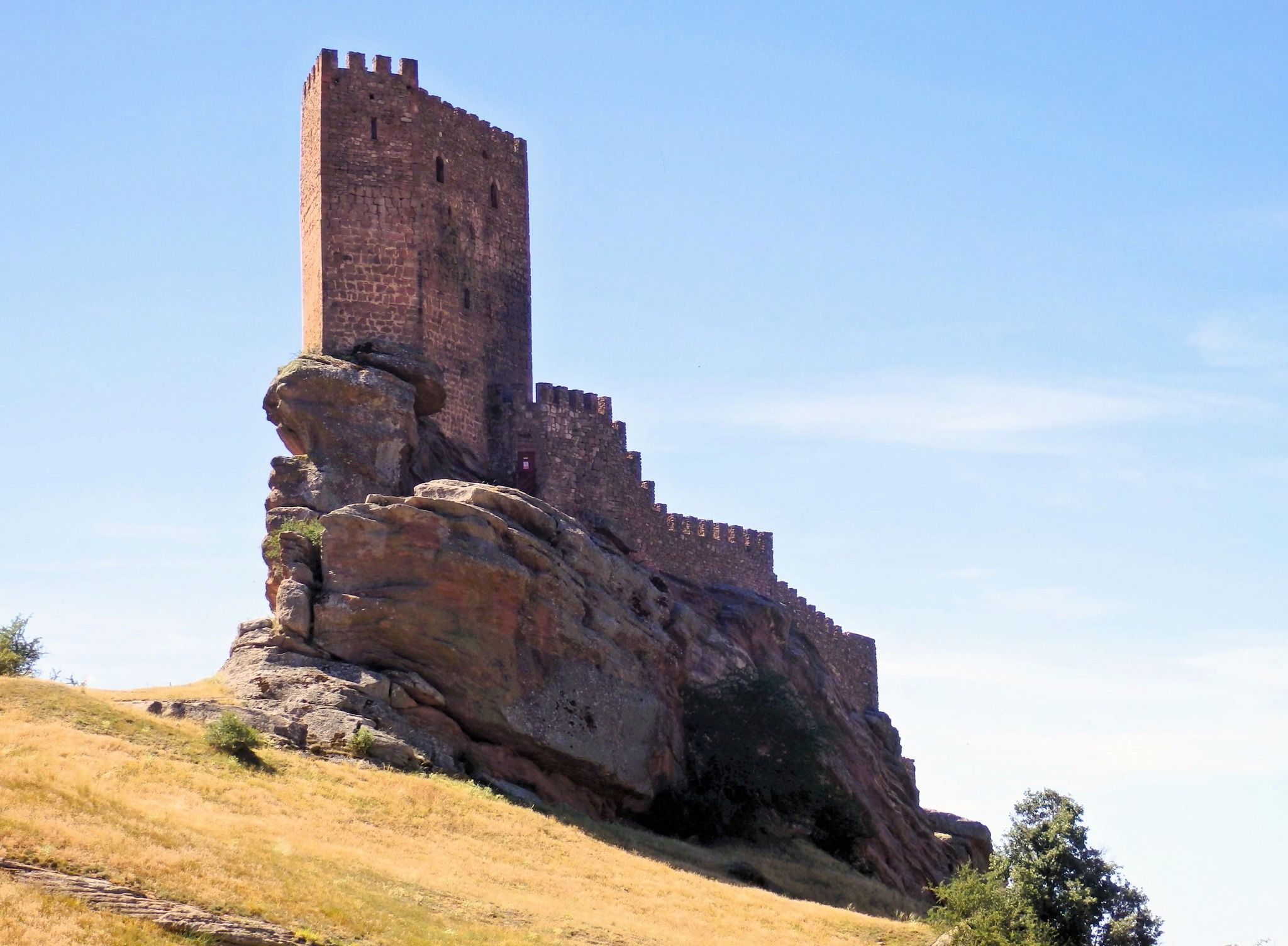
The Castillo de Zafra Castle is a clear example of a rock castle, standing out for its location in an area of steep terrain. The keep, built on top of the rocky cliff, stands out; only its exterior can be visited. Partially restored, we can find part of the walls that made up its crenellated wall, reinforced with towers at its corners. The cistern is preserved in the parade ground, and the keep features a Gothic doorway with a pointed arch. Its interior has a spiral staircase that provides access to the upper terrace. It is believed that the oldest known fortress on the site was established by the Visigoths before 720. The Muslims also had a fortification here, which was used by the Taifa of Toledo. The Moorish fortress changed hands in 1129 when the Christian kingdoms of the north reconquered Zafra as part of the Reconquista of the Iberian Peninsula. The Kingdom of Aragon assumed control to serve as a key defensive position in the south of its territory, to protect the newly created community of the city and the Land of Daroca. It was one of the most important domains of the Charter of Molina de Aragón, proclaimed in 1154.
During the times of King Fernando III the Saint, the third lord of Molina, Gonzalo Pérez de Lara, rebelled against the monarch and took refuge there. Given the impregnability of the castle, they had to agree to the Concord of Zafra, by which the present-day Molina de Aragón would be built. According to the Concord of Zafra, the lordship of Molina would be inherited upon Gonzalo’s death by his daughter Mafalda, who would marry Fernando’s son, Prince Alfonso, and in this way would place the territory under the control of the Crown of Castilla, losing its independent status. During the Castilian Civil War of the 14C, Enrique (Henry) II of Castilla granted the castle and lordship of Molina to his French mercenary ally Bertrand du Guesclin. However, the people of Molina rebelled and invited Pedro IV of Aragon to rule them. The castle was defeated and eventually awarded to a vassal, Pedro Ximeno Pérez de Vera. It eventually returned to Castilla through marriage, but in the 15C, Henry IV of Castile sparked another rebellion when he awarded the castle and town to his favorite, Beltrán de la Cueva. Its castellan, the famous Juan de Hombrados Malo, managed to get rid of all opponents and remained in control of the castle until it finally passed into the hands of the Catholic Monarchs of the unified kingdoms of Castilla and Aragon in 1479. The reconquest of the Iberian Peninsula and the merger of the two kingdoms deprived the castle of its former strategic importance, and from the 16C onwards it began to fall into ruin.
The Zafra Castle remained the property of the Spanish State until 1971, when it was sold to Antonio Sanz Polo. However, by this time the castle was completely in ruins. Sanz Polo spent the next thirty years and most of his fortune rebuilding the castle, hiring cranes, architects, and historians to help him. He was recognized for his efforts with the Medal of Merit from the National Association of Friends of Castles. In 2015, HBO filmed outdoor scenes for the sixth season of its fantasy series Game of Thrones at the castle. The castle stands in for the Tower of Joy in three episodes of the season, “Perjured”, “Blood of My Blood”, and “The Winds of Winter”, during flashback scenes that reveal a secret from Ned Stark’s past.
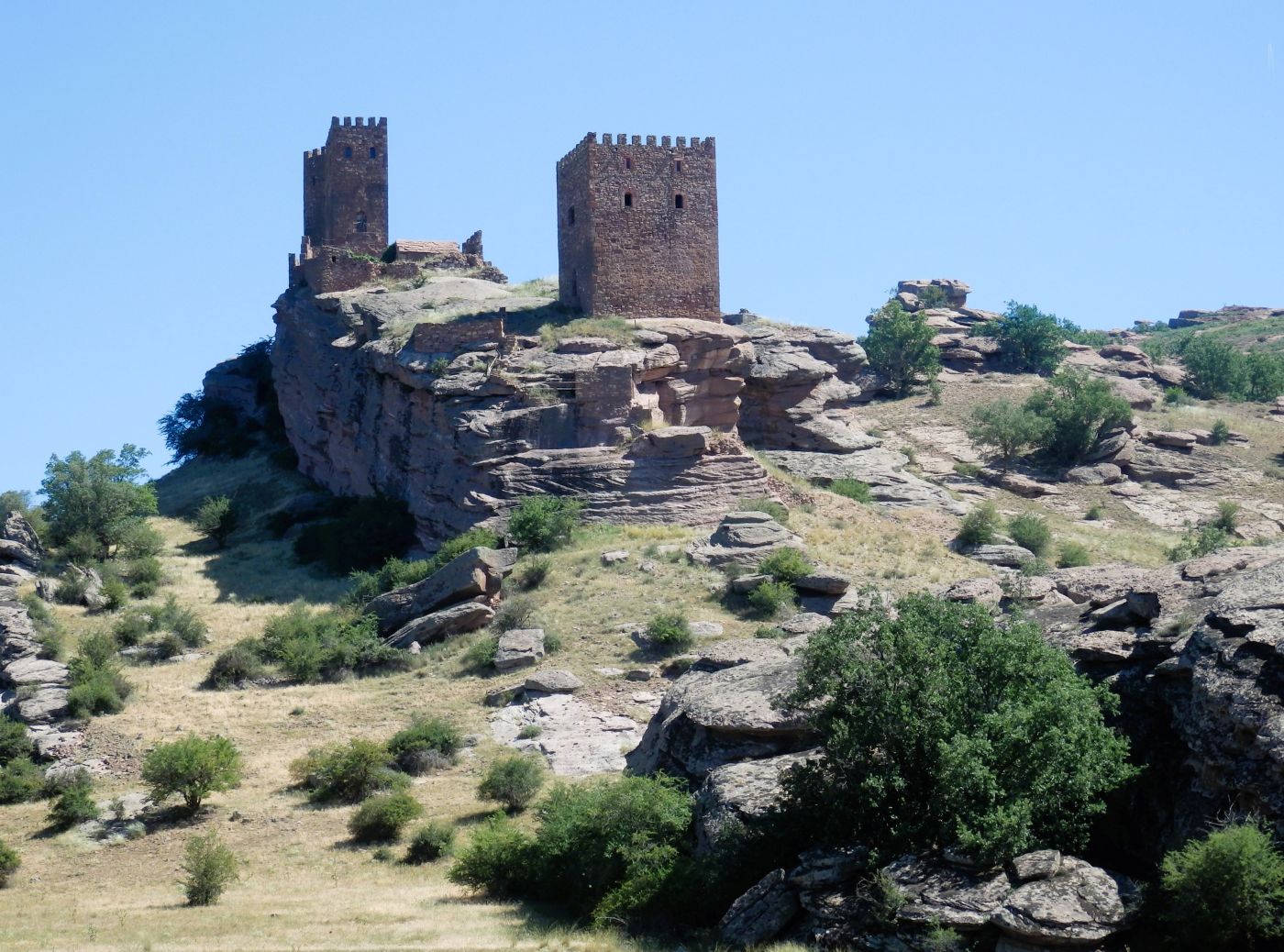
Other things to see here in the village are Parish church formed by the ashlar tower, covered with zinc in its upper part, on an area on the other side of the stream, facing the main façade to the square. In 1526, after its rehabilitation, the sacred functions were resumed, celebrating masses and the divine offices. The Ermita de la Antigua Hermitage was built in 1231, renovated and changed its dedication. In 1697 it stopped being called Virgen de San Crispín and was renamed Virgen de la Antigua. And in the same way, the sanctuary lost the name of hermitage of San Crispín to be called hermitage of the Virgen de la Antigua. The hermitage continued to be built until 1835, when it was decided to demolish the old hermitage and build a new one, with greater capacity, on the same site.
A bit of history I like tell us that Campillo was already a village in 1231, and remained so until 1426, when it had not yet been destroyed, unlike other surrounding villages. Campillo was one of the many villages that were razed to the ground at that time, and two ladies survived the ruin of the town. These two ladies, owners of the depopulated Campillo and its surrounding areas, gave rise to the town, without losing its original name, being called “de las Dueñas”, a nickname by which it has been known since its repopulation. Finally, Campillo was added to the House-Community of Molina, giving rise to the repopulation of the town. Campillo was destroyed in 1428 and from that date until it was annexed to the Common of the Lordship (a specific territorial space ,continuous or dispersed was subject to the authority of a lord or private person who exercised powers over said territory and its inhabitants that exceeded those of a simple owner). In 1779, they obtained a judgment in their favor recovering the lands, houses and other properties that had been retained by the Common for so long.
The Castilla La Mancha region tourist office on the Zafra castle : https://en.www.turismocastillalamancha.es/patrimonio/castillo-de-zafra-33564/descripcion/
The private site Castillos de Guadalajara on the Zafra castle : https://www.castillosdeguadalajara.es/quienes-somos/
There you go folks, another dandy in the wonderful region of Castilla La Mancha, in the off the beaten paths roads of my Spain. The village gave me the thrill of driving in mountain barren areas ,glorious. Again, hope you enjoy this post on this is Campillo de Dueñas !!! as I
And remember, happy travels, good health, and many cheers to all !!!


