
I have been by here rather quickly in my road warrior trails, and after this post really need to be back for more, eventually, Nevertheless, found some pictures in my cd rom vault that should be in my blog for you and me, The City of Plasencia is in the Autonomous region of Extremadura in my kingdom of Spain. The city is compact ,and full of architecture, history all around you. This one is worth the detour, me think, Therefore, let me give you my take on this is Plasencia !!! Hope you enjoy the post as I.
The City of Plasencia is 80 km from Caceres, 82 from Trujillo, 128 km from Salamanca, 163 km from Avila, 249 km from Madrid ; and 236 km from Velliza from where we came from on our way to Madrid, taking the A62 autovia de Castilla going around Tordesillas dir Salamanca past it on exit/salida 244 take the A66 or Autovia de la Ruta de Plata,continue on this expressway to exit/salida 471 to connect with the EX370 or Carretera de Montehermoso towards Plasencia dir Plaza Mayor or Catedral , Given the city’s geographical location, halfway between the two Iberian capitals, Madrid and Lisbon, and practically in the middle of the most important communication route that runs through western Spain, the Vía de la Plata, Plasencia has become an important communications hub, and several highways and roads connect it with the rest of Spain; the A-66 highway as it passes through Plasencia, the Ruta de la Plata ,the Highway, the EX-A1 Autovía del Norte de Extremadura, the N630 Gijón to Puerto de Sevilla, the N110 Avenida del Valle, EX 205 Ruta de Trujillo, EX 304 Plasencia Southern Ring Road Intercity access between the EX-A1 and the junction of the N-110 and the EX-203. You can reach Plasencia from Salamanca, Ávila and Toledo via the A-66. From Cáceres or Salamanca, you can also take the N-110 and the EX-A1, which connects with the A-5 at Navalmoral. From Madrid: Take the A-5 or Autovía del Suroeste towards Badajoz and then the N-521 to Plasencia.
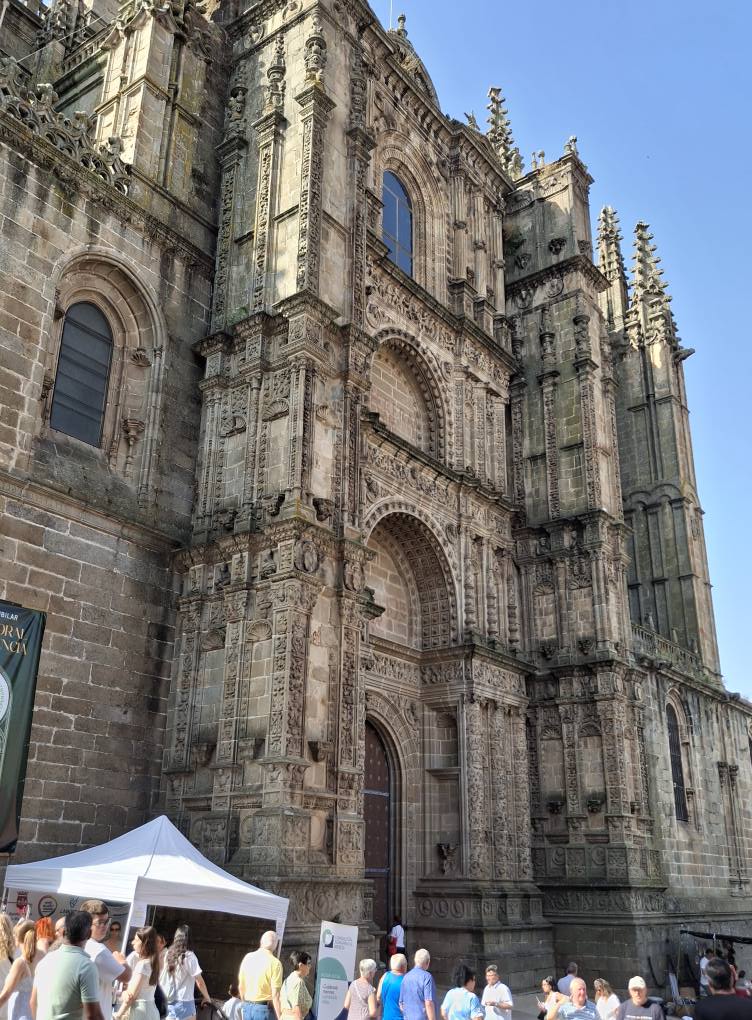
There are two cathedrals: the old cathedral and the new cathedral. The first was built between the 13-14C, in the Romanesque style , its chapter house being of particular note. The new cathedral, designed at the end of the 15C, was originally intended to replace the old cathedral, but due to various problems the works were stopped in 1760. Of this new cathedral, the choir their majestic grille ,and the Churrigueresque altarpieces of the Assumption and Saint Augustine stand out. The New Cathedral, or Catedral de Asunción de Nuestra Señora (see pic) in the Plateresque style. Materials from the Old Cathedral were reused for its construction, and its unfinished appearance is due to a lack of funding. Its interior houses numerous pieces of artistic interest, such as paintings, It has high vaults supported by groups of columns. The High Altar, dating from the 17C, features carved images by Gregorio Fernández and paintings by Francisco Ricci. Highlights inside the church include the choir stalls in the flamboyant Gothic style in transition to the Plateresque,The Old Cathedral, on the other hand, was built in a Romanesque style, a transition to Gothic. The Romanesque portal, its oldest section, stands out on the exterior, with a niche depicting the Annunciation of the Virgin and a Gothic alabaster rose window. Inside, we can enjoy its beautiful Cistercian-inspired cloister, valuable sculptures, the treasures held in its Cathedral Museum, and the 14C statue of the White Virgin. Above the Capilla de San Pablo (St. Paul’s Chapel), the former Chapter House of the Cathedral, stands the popular “Melon Tower,” which can be admired from the paved terrace. In addition, in this room, we find the image of Our Lady of Forgiveness from the late 13C and early 14C.
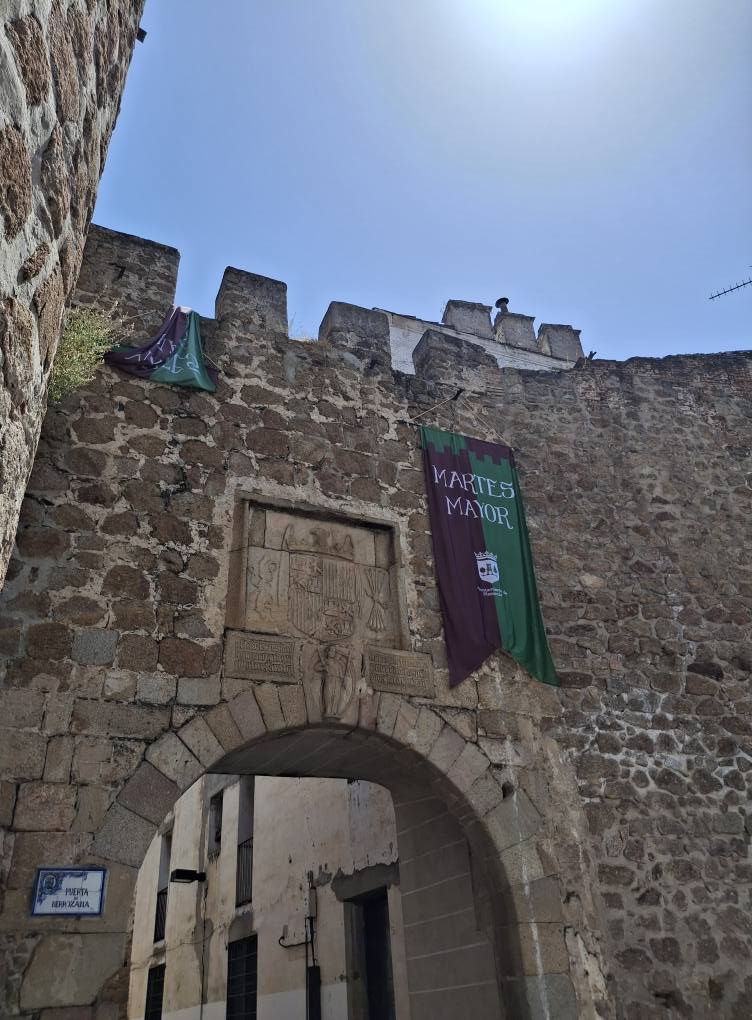
The walls of Plasencia have protected the old town since the time of the city’s founding, allowing access to the old town only through its gates Next to the walls there are notable buildings such as the Lucía Tower, a tower on the top of which a bonfire was once lit at night, used as a beacon for walkers approaching the city. It was built at the end of the 12C for defensive purposes, its main promoter being Alfonso VIII of Castile, who founded the city in 1186 to defend both its southern border with the Andalusian territories and its western border with the Kingdom of León. Given the imprecision caused by the current state of conservation, with large fragments of the wall lost, it can be said approximately that the cartographic surface occupied by the walled enclosure was 26.71 ha and its perimeter 2.44 km, not including the barbican and cubes. The gates and wicket gates are, starting from the north and going clockwise: the Fortress Gate or San Antón Gate (now disappeared), the Santiago Gate, the Carro Gate, the Sun Gate, the Clavero Gate, the Talavera Gate, the Santa María Gate, the Trujillo Gate (now the Cañón de la Salud), the Coria Gate, the Berrozanas Gate and the Salvador Gate. These entrances are still used to enter the central area of Plasencia. The puerta de Berrozanas gate (see pic) owes its name to the fact that it is located on the road that gives access to the Berrozanas pastureland, belonging to the neighbouring town of Oliva de Plasencia. This gate provided access from the San Julián suburb outside the walls to the noble quarter of the San Martín Church. In this way, it connected the area where the nobles of Plasencia lived with the Jewish cemetery and the San Lázaro bridge. It is a semicircular arch that supports a coat of arms of the Catholic Monarchs and is topped with four battlements.
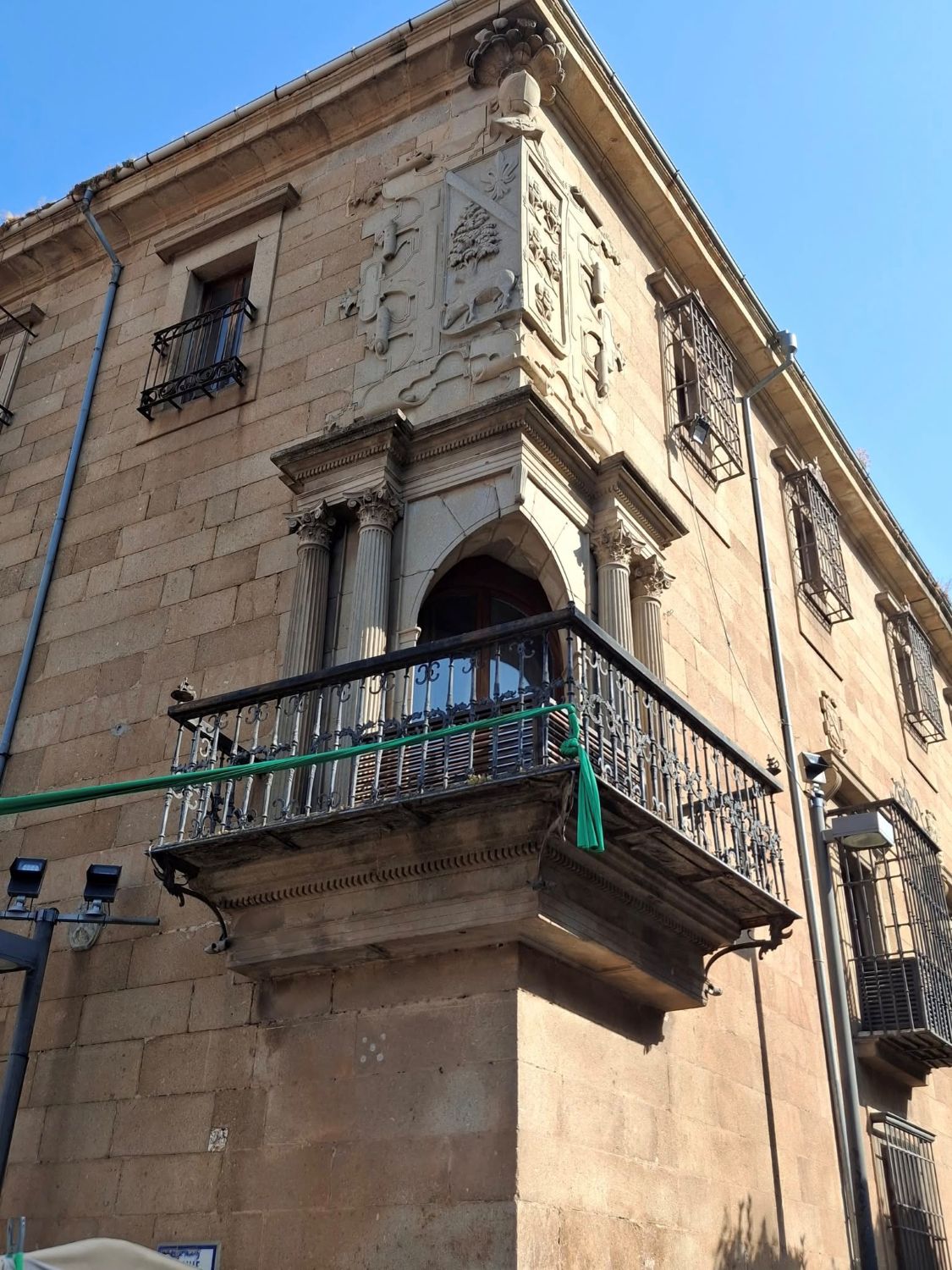
The Casa Palacio del Deán,(see pic) in the plaza de la Catedral ,look like the same building but are two different buildings, although they were joined at the beginning of the 20C to become the seat of the Palace of Justice. Both are contemporary. The Dean’s House, built in the 17C in a neoclassical style, has the most emblematic corner coat of arms in the city and belongs to the Paniagua and Loaisa families, with five roses that give rise to the Loaisa surname, and the sow under the holm oak and the fleur-de-lis of the Paniagua surname. The Doctor Trujillo House,,next, attach is a mixture of two architectural styles, Plateresque and Gothic, was built between the 14C and 16C. In the upper part, there is a gallery with six arches, and on the ground floor, it preserves the beautiful ironwork of the time. Its name comes from the archdeacon of Trujillo, Alfonso Fernández de Medina, who lived there in the 15C.
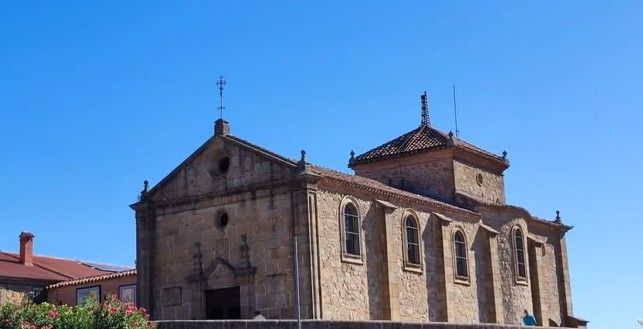
The Ermita de la Virgen del Puerto or Hermitage of the Virgin of the Port is located in the mount of Valcorchero about 5 km from the center of the city of Plasencia. Its construction began in the 15C, but the current hermitage dates from the 18C. The main façade is topped with a pediment with an oculus on its axis, flanked by the coats of arms of Plasencia and the first Marquises of Mirabel. Inside, the image of the Virgin of the Port is a polychrome wooden carving of unknown origin, from the late 15C or early 16C, which shows the Virgin breastfeeding the Child. This Virgin is the patron saint of the city and a multitudinous pilgrimage is held in her honor on the Sunday following Easter.
Other things to see , with more time than a road warrior trail are among the palaces, the Palace of the Marquis of Mirabel, the Municipal Palace, the Palace of Monroy or House of the Two Towers, the Almaraz Palace, the Carvajal-Girón Palace and the Episcopal Palace. The stately homes are the House of the Infantas and the House of the Argollas, There are eleven churche !! such as Cristo Resucitado, El Salvador, Nuestra Señora de Guadalupe, Nuestra Señora del Pilar, San Esteban, San José, San Miguel Arcángel, San Pedro, Santa Elena, Santa María de la Esperanza y San Nicolás el Real. Along with the parish churches there are also churches that are not used as parishes: examples are the church of Santa Ana, which serves as an auditorium, or the church of Santo Domingo, which houses a collection of Holy Week floats and the church of San Martín. As for the hermitages, the hermitages of La Salud, Santa Elena and San Lázaro stand out. To the churches and hermitages we must add convents such as those of the Claras, Dominicas, Dominicos, San Vicente de Padres Dominicos, Capuchinas, Ildefonsas, Carmelitas and Franciscanos. The convent of the Dominicos stands out for housing the Parador Nacional de Plasencia.
And more, this town is loaded one more reason to plan a re visit in-depth, You have a medieval aqueduct built in the 16C replacing another 12C structure. It brought water to the city from Cabezabellosa and El Torno. Fifty-five arches remain, most of them in the San Antón neighborhood, and are known as the San Antón arches. The oldest bridge is the San Lázaro Bridge, located next to the hermitage of the same name and built in the 16C in the Gothic style. The other historic bridge is the Trujillo Bridge, which carries the Vía de la Plata, One of the city’s most notable public thoroughfares is the Plaza Mayor. It houses the City/town hall, and the automaton popularly known as Abuelo Mayorga. Also located there is the open market that has been held in Plasencia every Tuesday since the Middle Ages. Another notable square is the Plaza de la Cruz Dorada, close to the Jerte river and framed by the apse of La Merced and the convent of San Francisco. In the center of the square there is a cross that gives it its name.
A bit of history I like (condense) tell us Plasencia was founded as a city by King Alfonso VIII of Castile in 1186. Its establishment in this place was due to military strategy reasons of the Reconquista, since just a few kilometers from the city were the Castilian borders with the Kingdom of León to the west and with the Muslims to the south. The beginnings of the city were difficult, due to its location in a border area and its proximity to territories dominated by Muslims. In 1196 it was taken by the Almohads as a result of the Castilian defeat in the Battle of Alarcos (1195) but Alfonso VIII and the Kingdom of Castile would recover it that same year, on August 15. After this reconquest, the decision was made to build the city walls. At the end of the 13C, the king granted the Charter of Plasencia, which gave great importance to coexistence between Christians, Muslims and Jews. This led to the formation of a large Jewish community, which was the largest in Extremadura and had considerable economic power. In 1442, King John II of Castile gave the city to the Estúñigas or Zúñigas family, granting Pedro de Zúñiga the title of Count of Plasencia. In the second half of the 15C, Plasencia played a part in the conflict over the succession of Henry IV of Castile. King Henry IV was deposed in the city on 27 April 1465 as ruler of Castile. Later, the Count of Plasencia took an active part in the Farce of Ávila by snatching the sword, a symbol of justice, from the wooden statue representing the Castilian king and proclaiming Infante Alfonso as such. Later, the daughter of King Henry IV, Juana la Beltraneja, married Alfonso V of Portugal on 29 May 1475 at the House of the Argollas in Plasencia, where they were proclaimed kings of Castile and Portugal. During this time, Plasencia was the place recommended by the court doctors to Fernando el Catolico (Ferdinand the Catholic) as the healthiest place in all his kingdoms and where he should establish his residence. The monarch moved to Plasencia in 1515. He died in Madrigalejo in January 1516 while traveling from Plasencia to Guadalupe (see post) to attend the chapter of the orders of Calatrava and Alcántara at the monastery of Guadalupe (see post) Between 1520 and 1522, during the War of the Communities of Castile, Plasencia participated on the side of the comuneros, managing to establish a community in Plasencia, but this was diminished by the proximity of nearby royalist centers, such as Ciudad Rodrigo or Cáceres. In the Peninsular War (independance war of 1808-1814), Plasencia became a strategic location for French troops. In 1917, the Valencian painter Joaquín Sorolla (see post) immortalized the city in one of his paintings, El mercado (the Market), in which he painted the view from one of the banks of the Jerte river, with the Episcopal Palace, the Cathedral, the Trujillo Bridge and women dressed in Montehermoso costume. The work belongs to a series of fourteen large canvases entitled Vision of Spain, commissioned by the American magnate Archer Milton Huntington to decorate the library of the Hispanic Society in New York, an institution that he himself had founded. In the Spanish Civil War, Plasencia was not an object of dispute between the two sides, since the military uprising of 1936 immediately triumphed in the city.
The City of Plasencia on its heritage : https://www.plasencia.es/web/turismo-plasencia/guia-de-la-ciudad/horarios-y-monumentos
The Plasencia tourist office on its heritage : https://contenidos.plasencia.es/los-7-imprescindibles/
The Plasencia tourist office on the religious monuments:https://plasenciaturismo.es/que-ver/iglesias
The Caceres province tourist office on Plasencia : https://www.turismocaceres.org/en/turismo-cultural/plasencia-historical-site
There you go folks, worth the detour indeed, glad did it and looking forward to be back, eventually, Plasencia is full of architecture and history my Spain, and Europe! Again, hope you enjoy this post on this is Plasencia !!! as I
And remember, happy travels, good health, and many cheers to all !!!


