
We have come back to my dear Spain again !! love it !! We came by car of course and took time to see new places with my sons and our dog Rex ! I found me pictures in my cd rom vault that should be in my blog for you and me, I like to continue the saga of our road warrior experiences even if now with less in our family,This post is on small quant medieval nice Urueña ! Therefore, let me tell you about this is Urueña !!! Hope you enjoy the post as I.
The village of Urueña is located in the province of Valladolid, in the Autonomous Community of Castilla y León, and in my Kingdom of Spain. It has one of the best-preserved urban centers in the province of Valladolid, offering visitors the appearance of a small medieval town. It has only 203 inhabitants (INE 2024), It is 51 km from Valladolid, 38 km from Toro, 80 km from Palencia, 36 km from Velliza, and 224 km from Madrid, I went there from our rental house location in Velliza along the VP 5806 local road bearing right onto the VA 515 road which at the village of Torrelobaton connects with the VA 5604 road same road changes number to 5605 dir San Cebrian de Mazote where changes name to VA5003 bear right into VA5606 road to City center Urueña,
Its streets and restored and renovated houses give the appearance of a small medieval town. It preserves much of the wall with two of its gates, some sections of the castle, stone mansions of a certain quality, and a Gothic-Renaissance parish church. Urueña was the first registered Villa del Libro or Book Town in Spain.
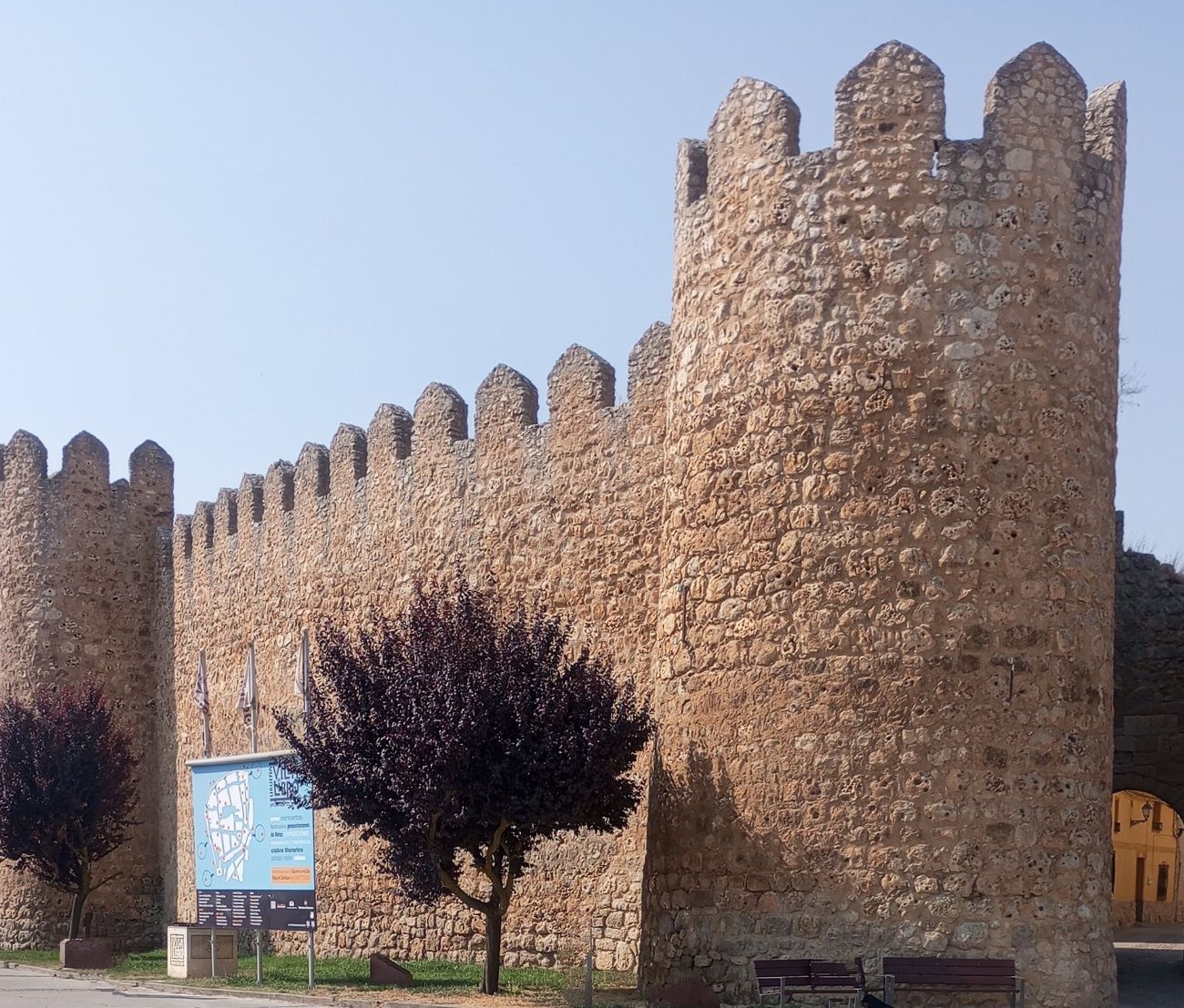
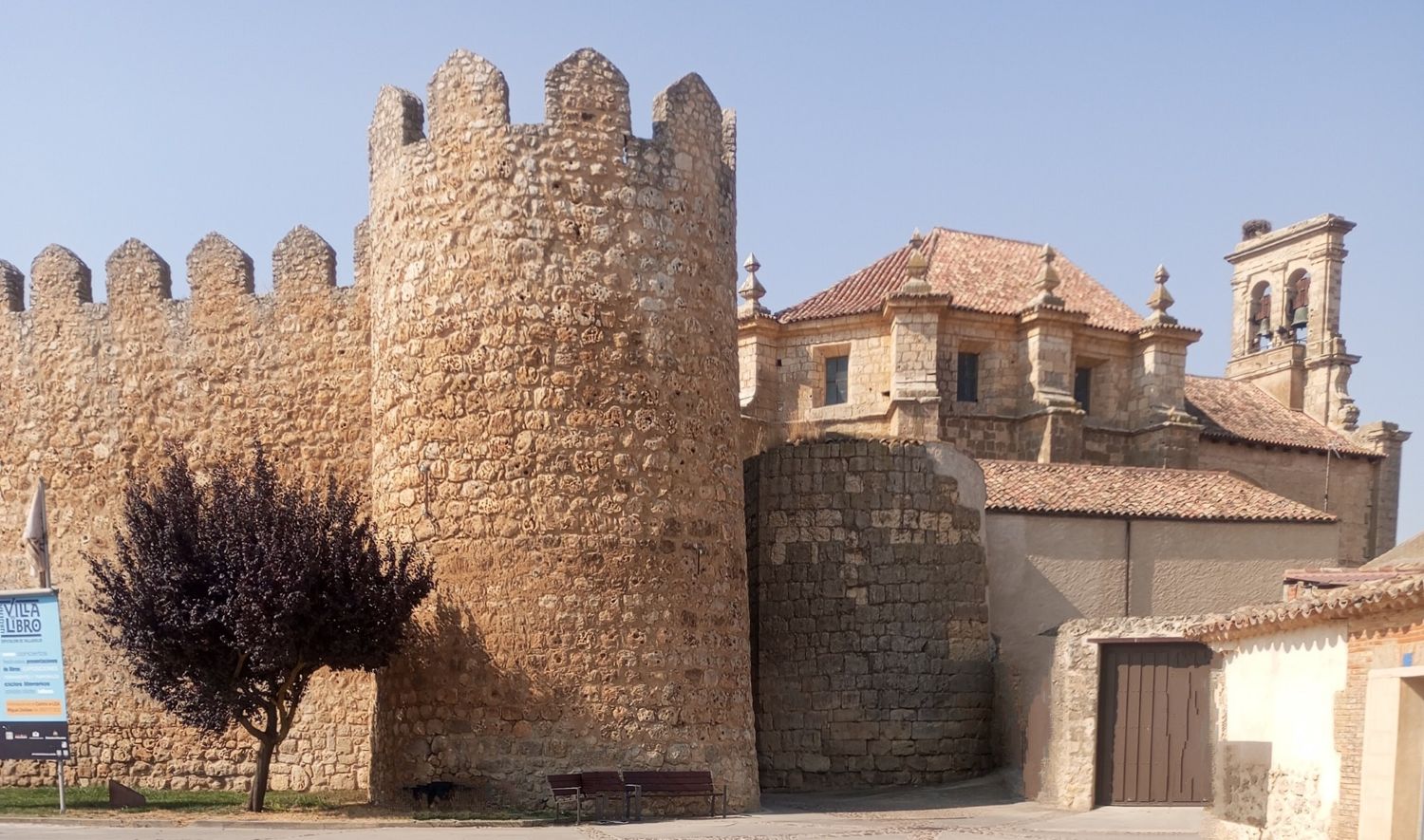
The muralla or wall surrounding the city dates back to the 12C and 13C and is made of masonry, intersected at intervals by semi-cylindrical cubes. It has two gates. The main one, Puerta del Azogue, opens to the north and is the typical gate built at an angle for better defence against potential invaders. The other gate is to the south, bordering the previous one; it is the Arco de la Villa, less protected from an architectural point of view, since on that side the plain falls abruptly to the valley.
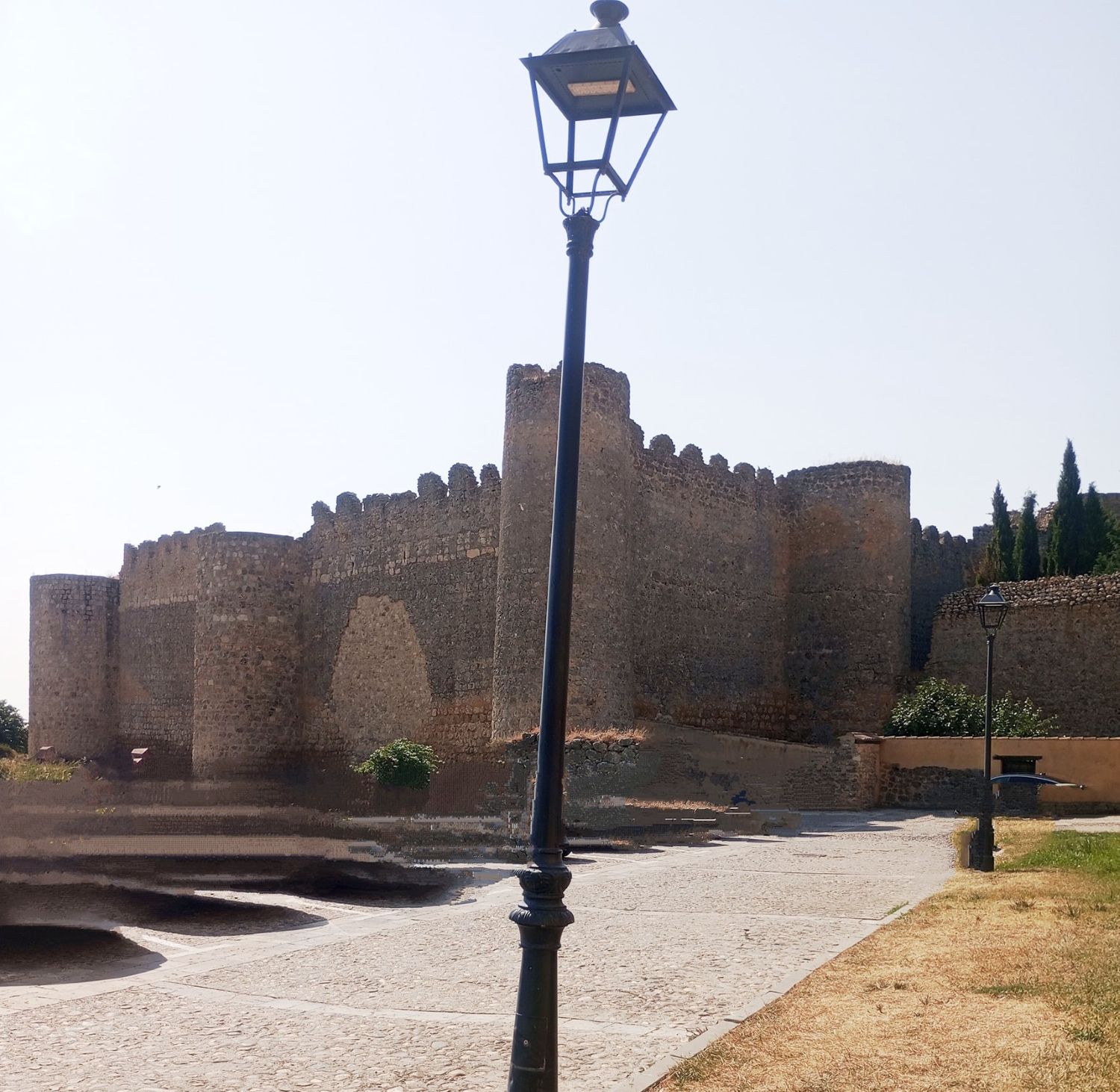
The castillo de Urueña castle has a square keep and corner pipes. It is fairly ruined and served as a cemetery for many years. When it was built it was a very important fortress, as it formed the border between the kingdoms of Castilla and León, a division that had been carried out in the mid-12C by King Alfonso VII of Castilla. It was the habitual residence of Doña María de Padilla, lover of Pedro I the Cruel. Others were held prisoner, such as the Princess of Portugal Doña Beatriz, who later married Pero Niño, Lord of Cigales. The Count of Urgell, James II, defeated at the Compromise of Caspe and militarily at Balaguer, was tried and taken prisoner by Don Fernando de Antequera. Legend has it that the most famous prisoner guest was the Castilian Count Pedro Vélez, who was caught having an affair within the compound with a cousin of King Sancho III the Desired.
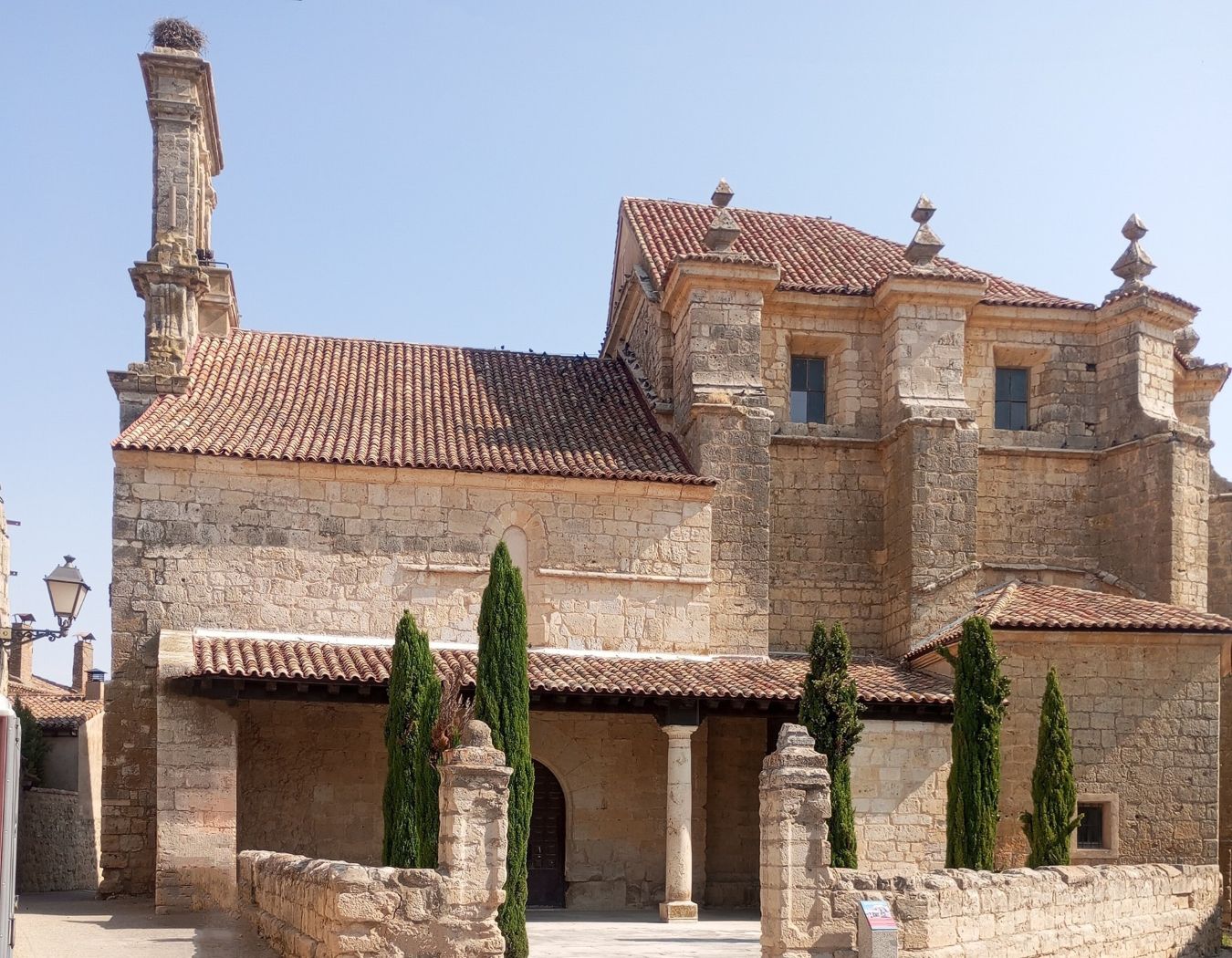
The parish Church of Santa María del Azogue is currently the only church in Urueña. It is located inside the walled enclosure, next to the Puerta del Azogue, Built between the 16C and 18C, it has examples of styles: Gothic in its apse, Renaissance in its nave and an incomplete Baroque reform. The interior has an altarpiece from 1671, and the Christ tied to the column, a work dated 1635.
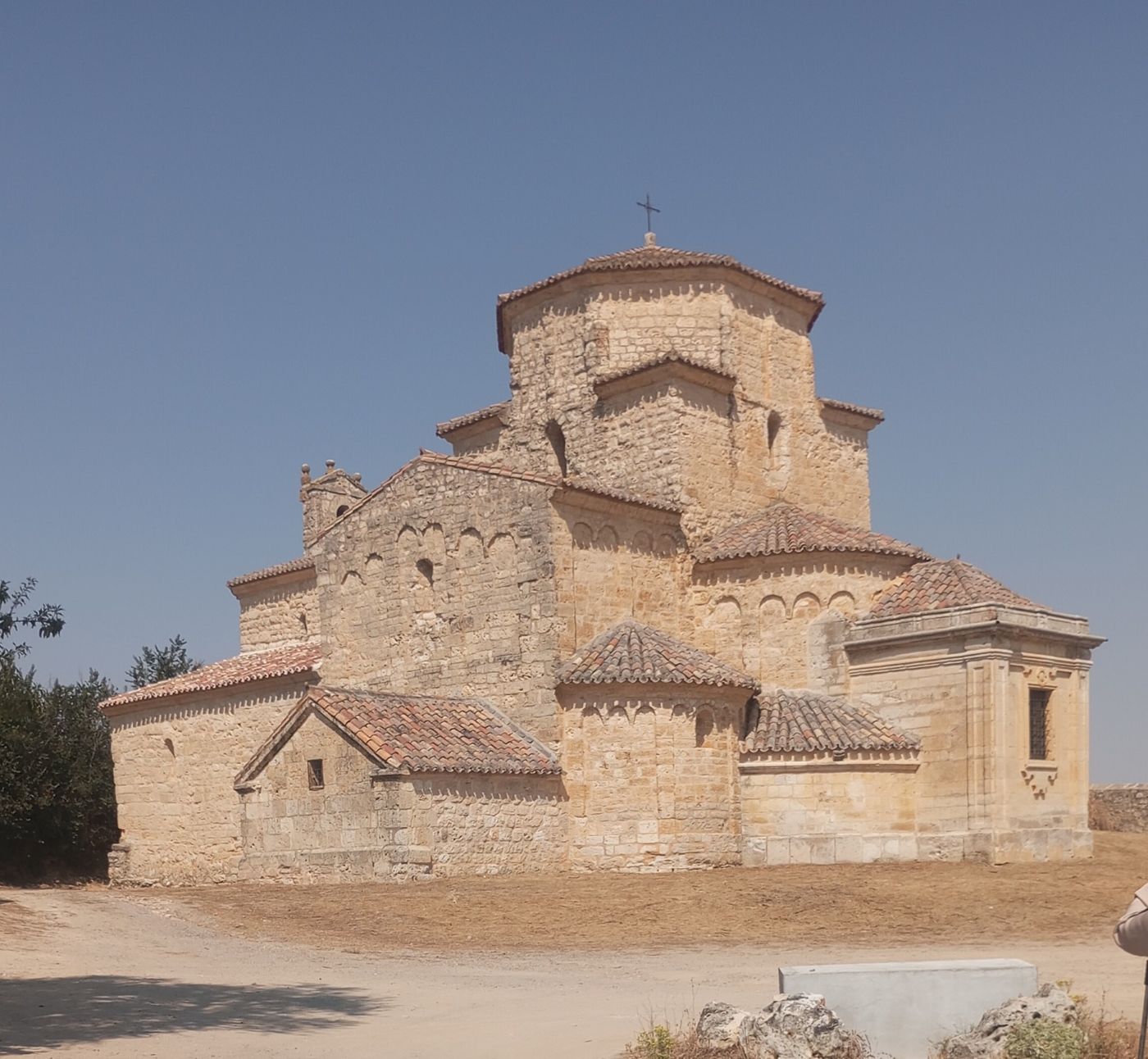
The Ermita de Nuestra Señora de la Anunciada or Hermitage of Our Lady of the Annunciation dates from the 11C and is located outside the walled enclosure, below, in the valley. In the 18C, the current quadrangular dressing room was added to the apse and the foot portal was changed. Inside is the image of Our Lady of the Annunciation, a dressed image. In this hermitage, we can see several examples related to Lombard Romanesque, which is inspired by the Italian current. This style reached the peninsula through the Crown of Aragon, which had conquered much of southern Italy. The floor plan of the church is a rectangle about 16 meters long and 14.5 meters wide, with three naves and an inscribed transept, whose design does not protrude from the general perimeter. The central nave is wider and taller than the side naves, and the sanctuary is formed by three semicircular apses. The Hermitage of Our Lady of the Annunciation is a key element in the study of Romanesque architecture in Castila y León region, both for its stylistic uniqueness and its historical context.
Other things to see here, me think are the Centro Etnográfico Joaquín Díaz or the Joaquín Díaz Ethnographic Center , a museum founded by the folklorist Joaquín Díaz González in 1985 and its permanent headquarters were installed in the Casa de la Mayorazga in March 1991. An exhibition called “Amas de cria”, sheets of cordel, a collection of engravings, a library, a record library, a spacious entrance hall and a museum of instruments are housed in this Ethnographic center. The Museo de la Música: Colección Luis Delgado or the Music Museum: Luis Delgado displays a private collection of instruments belonging to the composer, performer and researcher Luis Delgado and the Doctor of Philosophy, pedagogue and dance teacher Gema Rizo. It is considered one of the most outstanding music museums in Spain. Its collection can be divided into the following sections: Instruments based on medieval iconography (codices, carvings, miniatures, etc.) whose construction has been commissioned to builders and luthiers specialized in this type of music. Instruments that have been added to the collection through trips around the world, taking into account both the symbolic and historical value of each element, as well as the cultural, social and musical context. Instruments received through donations and loans from various musical personalities and Original instruments from the 18-19C and early 20C.
A bit of history I like tell us that this town takes us back to the first Vaccaean settlements. It was Romanized at the beginning of our era and Christianized around the 10C. It was the head of the Infantado de Valladolid from the 12C to the 14C. The Romans arrived in these lands around the year 1 BC. A road connecting Palencia and Zamora, the Via de la Toresana, passed through the area, where remains of the road and a bridge remain. In the Middle Ages, under King Sancho II of Castilla (Sancho the Strong), the town was the head of the Infantado de Valladolid. His sister, Doña Urraca, looked after and inhabited the fief. Later, Alfonso VII granted his sister Sancha Raimúndez the Infantado of Valladolid, with the dominium of the towns of Medina de Rioseco, Castromonte and Urueña, all three on the border of the kingdoms of León and Castilla, which were united during the reign of this king. In 1157 Alfonso VII died, dividing the kingdoms again: he left León to his son Fernando II and Castilla to his other son Sancho III the Desired, who was the one who fortified the town of Urueña in view of the new division. Sancho III reigned for only one year, being succeeded by Alfonso VIII of Castilla who was only a child, but the Infantado of Valladolid passed to the jurisdiction of Fernando II of León who, feeling harmed by Alfonso VII’s will, took advantage of Alfonso VIII’s minority to take over these lands. When Alfonso VIII came of age, he waged war against Fernando II and forced the signing of a peace treaty in Medina de Rioseco, which restored the borders between the two kingdoms as Alfonso VII had left them in his will. After this treaty, the two monarchs’ quarrels returned, and they had to make another peace treaty, the so-called Treaty of Fresno-Lavandera, which listed the places that should belong to each kingdom; Urueña remained within the kingdom of Castilla. In the 15C, King John II donated the town to Don Pedro Girón, steward and favourite of the prince and future king Henry IV.
The town of Uruéña on its heritage (see Que Visitar and Museos en Uruéña ) : http://www.xn--uruea-rta.es/
The province of Valladolid tourist office on Uruéña : https://www.provinciadevalladolid.com/en/-/sorpresas-e-imprescindibles-en-una-visita-a-urue%C3%B1a
The Castilla y Léon region tourist office on Uruéña : https://www.turismocastillayleon.com/en/heritage-culture/uruena
There you go folks , another wonderful nostalgic, sentimental trip to my dear Spain, Do not know when we will be back, we sure will have this trip in our hearts forever, Again, hope you enjoy this post on this is Urueña !!! as I
And remember, happy travels, good health, and many cheers to all !!!


