
Walking around towns I got to know the intricate history of each place visited. More so in my beloved Spain, walking and visiting is not enough, you might want to get to know the people and the places, monuments, statues you see , Several of them caught our attention in lovely Segovia, and I like to tell you more using older pictures from my blog. Therefore, let me tell you about the curiosities of Segovia , part I !!! Hope you enjoy it as I.
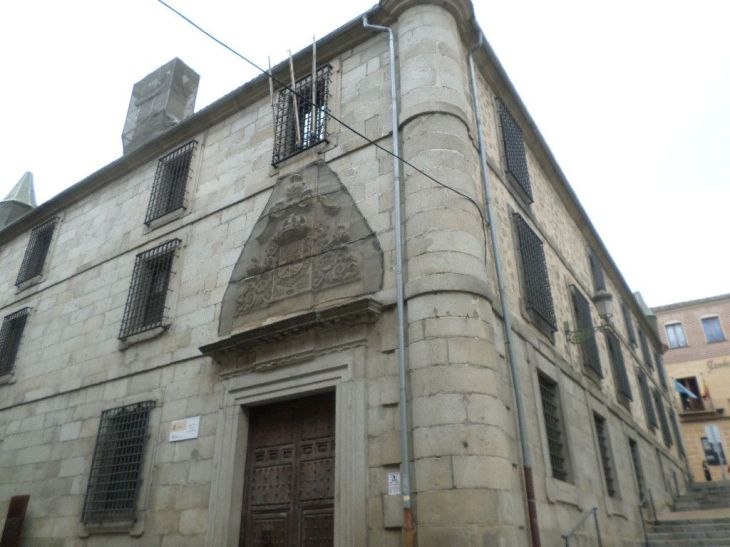
You go on calle Juan Bravo just before the Plaza San Martin see what was the Real Prisionor Royal Prison, The building we can see today is in the Renaissance architectural style. It was built between the 17C and 18C, replacing a Cistercian nunnery built at the end of the 10C and which was used as a prison shortly after its construction. The Romanesque doorway of a disappeared hermitage in the province dedicated to San Medel is preserved in the entrance hall. The building has three floors topped by a bell gable. Its decoration is very austere; it has a square floor plan with rooms organized around a small interior courtyard, highlighting the coat of arms of the Austrians that appears on the cover. It was the public prison of the city until the beginning of the 20C. The primitive prison had among its inhabitants the illustrious playwright Lope de Vega, imprisoned in the year 1577 and Fernando Delgado Sanz, aka El Tuerto de Pirón , a Spanish bandit much feared in his time who over time gained a reputation for being kind, so called because since he was a child he had a cloud over his eye that he covered with an eye patch. He operated mainly in the Sierra de Guadarrama and the basins of the Pirón and Lozoya rivers. Today the Casa de la Lectura – Biblioteca Municipal or House of Reading – Municipal Library with extensive reading and cultural programming.
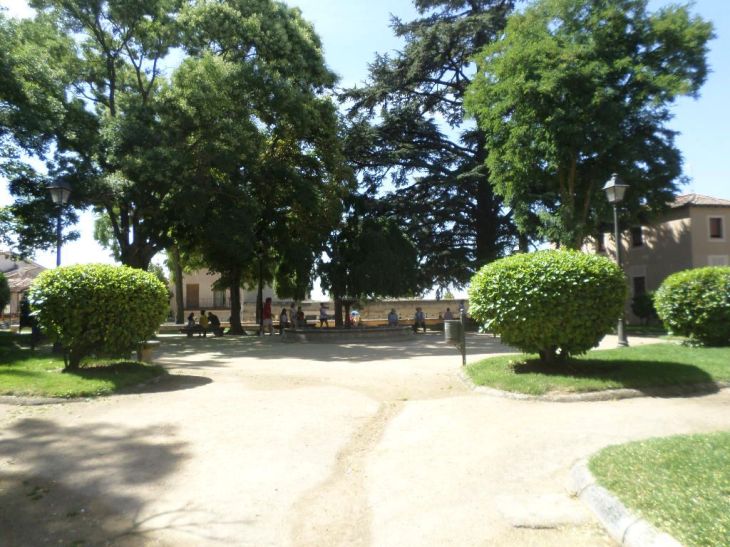
The Plaza de la Merced,is a square, which in addition to its current name has also had others honoring the monarchs Isabel II and Alfonso XII, The square is entered through the streets of Daoiz, de la Almuzara, and del Marqués del Arco. The Plaza de la Merced owes its name to a convent of the Mercedarians, demolished at the beginning of the 19C. It has green spaces where a cedar of Lebanon and a sophora tree stand out. A large children playground and sliding tubes makes it a family retreat in the City, If you are at the cathedral, exit the cathedral and take Calle de la Catedral. Continue straight until you reach Calle de Juan Bravo. Turn right and walk straight until you reach Plaza Mayor. From there, follow Calle del Socorro until you arrive at Plaza de la Merced.
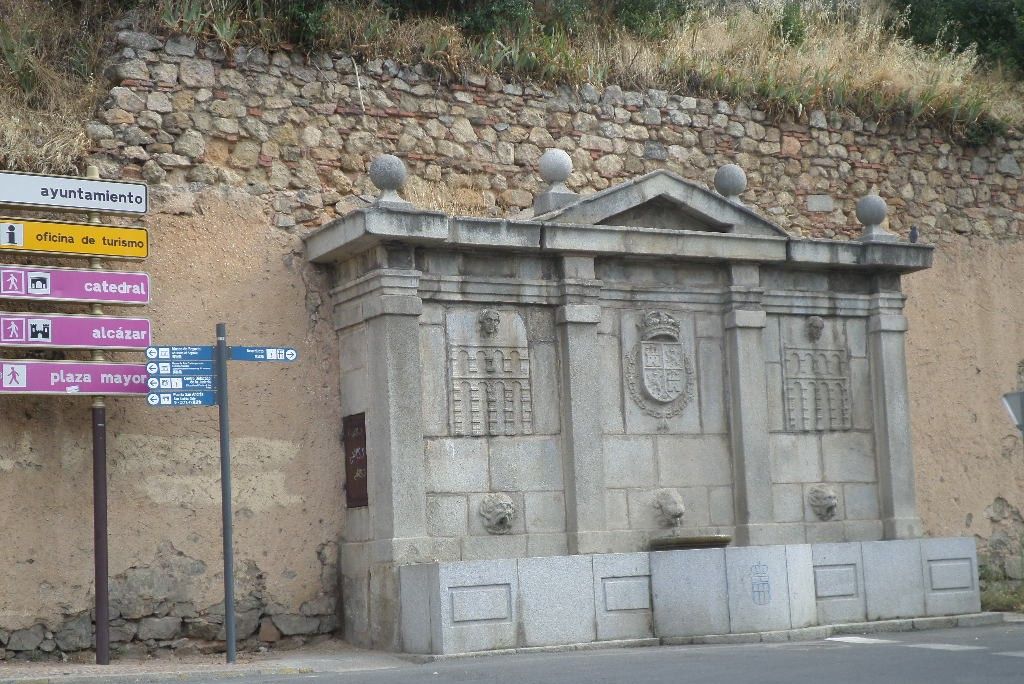
We walked on the Paseo de los Tilos by a beautiful fountain encrusted on the ramparts walls; this is at the intersection of Paseo de los Tilos and Calle San Miguel. It is a peculiar fountain not very much info on it just notice it has encrusted the shields of Castilla y Léon and the symbol of the aqueduct!! Neat to walk by it.
The other story on this post is historical and part of the history of my beloved Spain. The statue to Juan Bravo was erected in bronze on April 22 1922 at the Plaza Medina del Campo, looking straight ahead, wearing period clothes and one leg slightly bent, Juan Bravo raises the flag of freedom with his right hand.
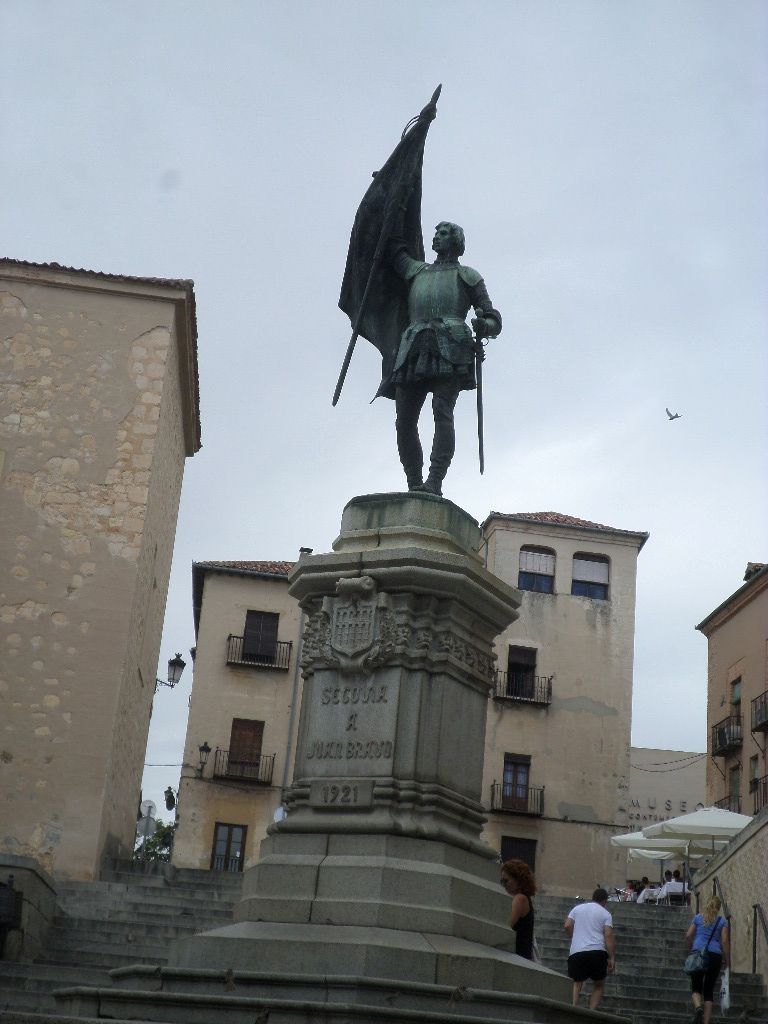
Juan Bravo was a Castilian noble known for his participation in the War of the towns of Castile. The war of the towns of Castile, led by the commoners, is an armed uprising of the interior towns of the crown of Castile, especially Toledo and Valladolid, against the royal power between 1520 and 1521, that is to say at the beginning of the reign of Charles I of Spain. Between 1499 and 1504 Juan Bravo followed the steps of Queen Isabel I (the Catholic) thru Granada, Sevilla, Toledo, Madrid, Alcalá de Henares, Segovia ,and Medina del Campo. When Queen Isabel of Castilla died in 1504, he was let go of his posts. In October 1519 , Juan Bravo was appointed leader of the militias of Segovia. He led a revolt against the representative to the court,organisation and militarily and led the operations preventing the entry of royalist troops into Segovia. Juan Bravo took charge of maintaining relations with the rest of the insurgent towns and went to Tordesillas to parley with the Queen Mother Juana for her support, but to no avail. Subsequently he joined forces with those of the commoners council of Valladolid, without being able to avoid defeat before the royal troops in the battle of Villalar on April 23, 1521. Taken prisoner, he was beheaded on April 24, 1521. When his remains was transported to Segovia, the royal authorities had to stifle with difficulty a great tumult of indignation.
As a side anecdote,not been in it. The Juan Bravo Theater in Segovia bears his name in memory of him. It is the city’s main theatre, inaugurated on October 26, 1918, it is located in the Plaza Mayor (see post) in the same place that the La Zarzuela theater and the Reina Victoria cinema had previously occupied. It receives its name from the local community leader Juan Bravo, On opening day they played the zarzuela “La Alcaldesa de Hontanares” of local Pepe Rincón Lazcano. In 1982, it closed its door only to be rehabilitation and reopened on May 23, 1989 with the performance of the Reina Sofía Symphony Orchestra. The act was chaired by S.M. Queen Mrs. Sofia. The Juan Bravo Theater maintains a stable programming during the months of September to June, theater, music, dance, children’s shows, varieties , etc, It is,also, the headquarters of the Titirimundi International Puppet Festival.
The official Juan Bravo theater : https://www.teatrojuanbravo.org/
The City of Segovia : https://segovia.es
The Segovia tourist office on its heritage :https://www.turismodesegovia.com/en/what-see
The Castilla y Léon region tourist office on Segovia : https://www.turismocastillayleon.com/en/heritage-culture/segovia
The Spain National Tourist Office on Segovia : https://www.spain.info/en/destination/segovia/
There you go folks ,another round in my beautiful Segovia, These monuments are on the off the beaten paths and they should be seen , me think. Again, hope you enjoy this post on the curiosities of Segovia, part I !!! as I
And remember, happy travels, good health, and many cheers to all !!!


