
A wonderful memorable city we have visited couple times over the years, Gladly found me again pictures in my cd rom vault that should be in my blog for you and me. I stop by on one of my road warrior trips way back ,and then came back years later and it remains a nostalgic spot in my life, Therefore, here is my take on this is Oviedo !!! Hope you enjoy it as I.
The City of Oviedo is in the Principality of Asturias and in the kingdom of Spain. It is the geographical, university, religious, political and administrative center of Asturias, The city is protected from the north winds by Mount Naranco; To the south is the Sierra del Aramo, where the Angliru mountain pass is located, famous for its difficulty for cyclists and popularized for being the final stage of the Vuelta a España on several occasions. The main highways taken are the Autovia A63 Oviedo-La Espina highway, Autovia A64 Oviedo-Villaviciosa highway, The autovia A66 Ruta de la Plata highway going from Gijón – Oviedo – Mieres – Campomanes – León – Benavente – Zamora – Salamanca – Plasencia – Mérida – Seville , The national road N634 going to San Sebastián – Bilbao – Solares – Torrelavega – San Vicente de la Barquera – Unquera – Llanes – Oviedo – Luarca – Ribadeo – Baamonde – Santiago de Compostela , The local AS 381 going on the Oviedo-Gijón highway, The City is 31 km from Gijón, 33 km from Avilés, 191 km from Santander, 286 from La Coruña, 455 km from Madrid, 378 km from San Sebastian, and 184 km from Xove from where I was coming from on our way to France, along the N642 road and by San Cosme de Barreiros go around the trafic circle bearing right into the N634 road and on next trafic circle bear left into the autovia do Cantabrico or A8 highway stay on this road for a while until bearing right into the AS325 road by Espin continue quickly becomes the A66 highway or Autovia Ruta de la Plata right into Oviedo looking for Plaza de la Catedral.
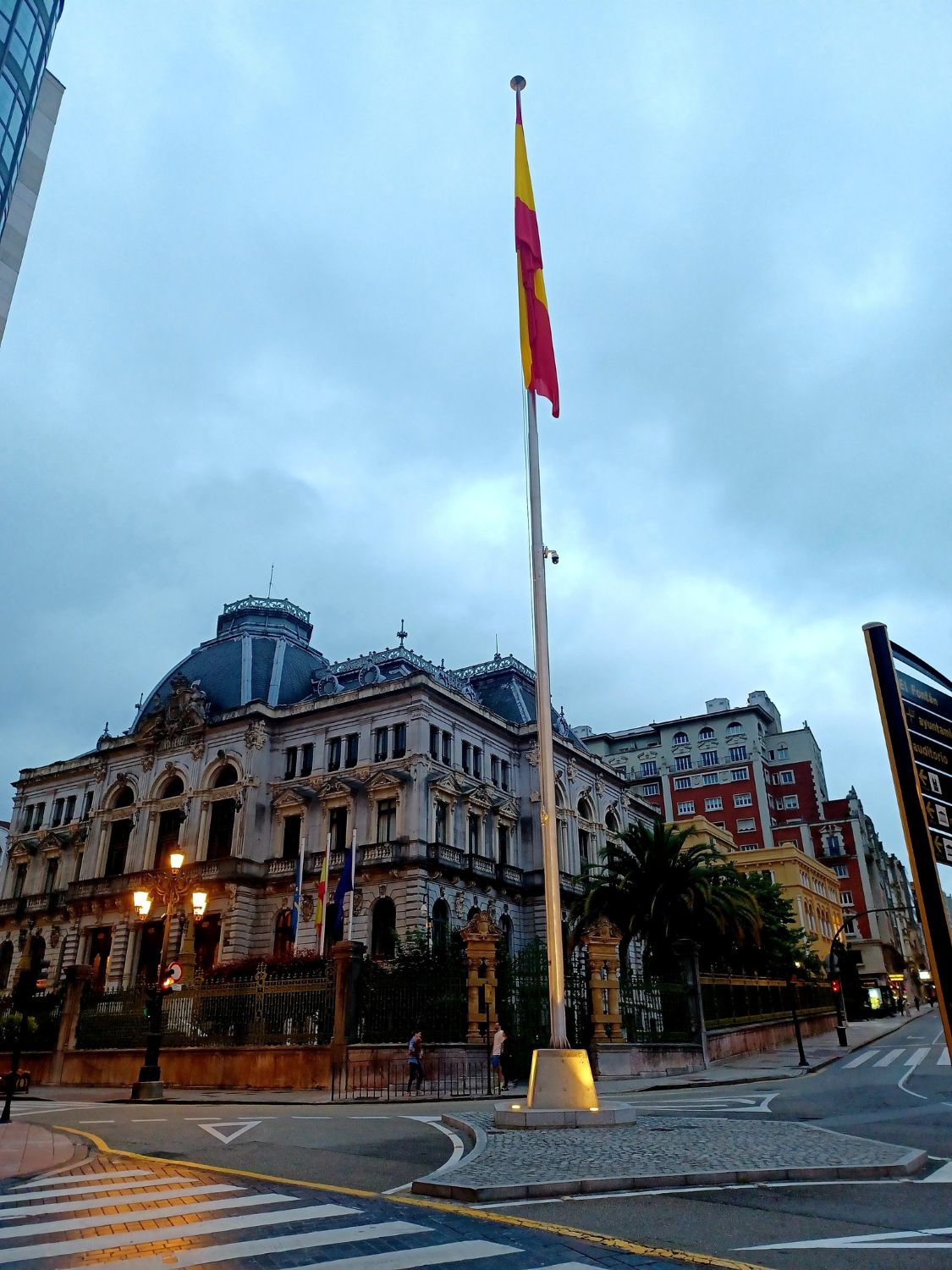
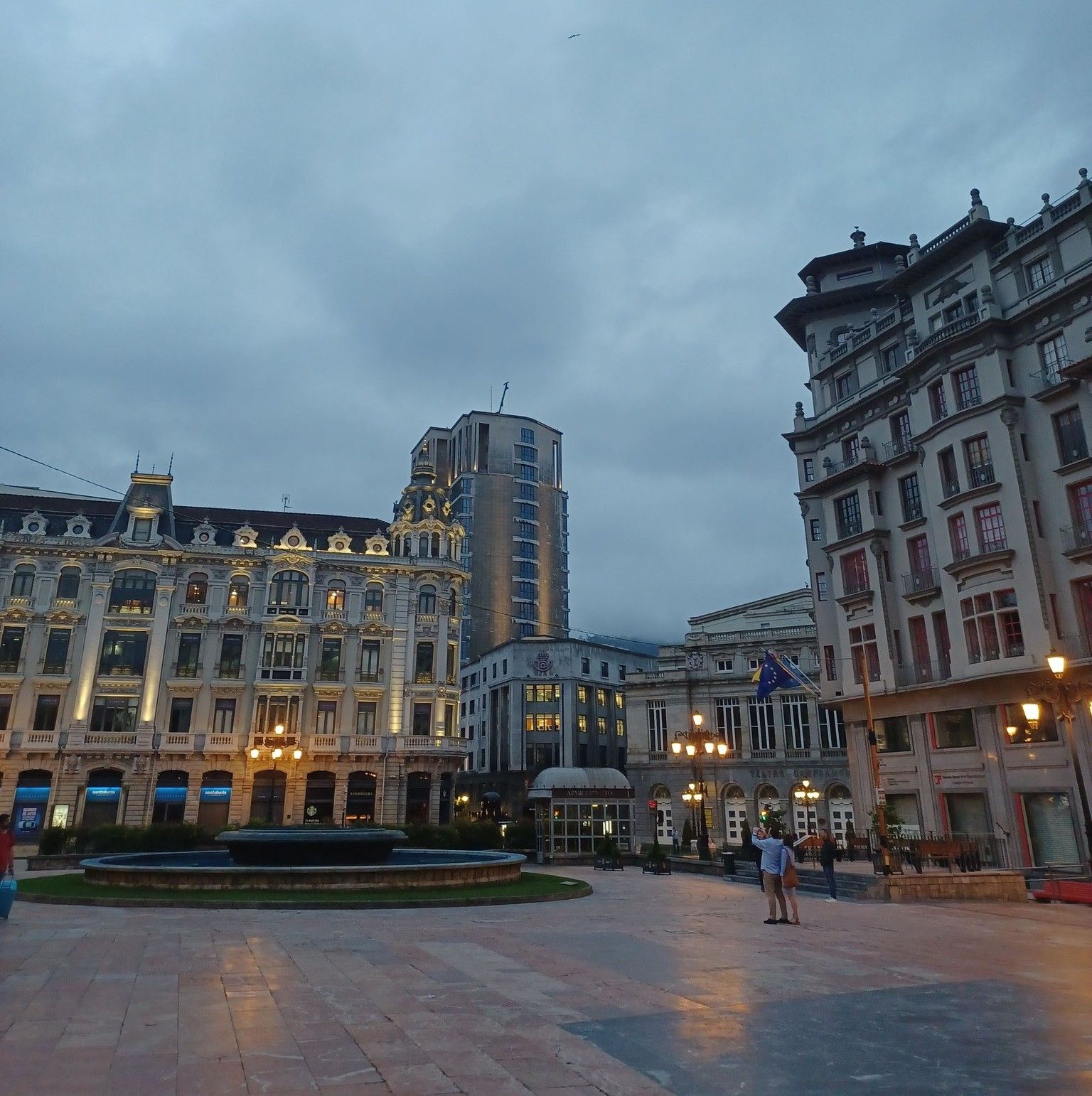
The Plaza de la Escandalera square which I was able to walk around a bit is located between the historic center and the commercial center of the city, making it a very busy area. It is rectangular in shape, bordered by the Paseo de los Álamos and Uría Street, which run parallel, and the Campo de San Francisco Street. On this side, Fruela Street and Marqués de Santa Cruz Street end at the southern corner, and Uría Street continues at the northern corner. The calle San Francisco ends in the same direction at the corner with Calle Argüelles and, tangentially, Calle Pelayo. There are beautiful buildings here which will name as the Casa Conde, it occupies the entire north side of the square, with facades also facing Uría and Pelayo streets. It was designed in 1904 in an eclectic style of French inspiration, as can be seen in its mansard roof and domes over rotundas at the corners. It was name after its first owner, Soledad Menendez Conde. The Casa del Termométro or Thermometer House. located on the corner of Fruela and San Francisco streets, it was designed in 1936 in the avant-garde functionalist style. The vicissitudes of the Civil War prevented the project from being carried out until 1944. The building’s sharp corner is characterized by a continuous glass window along the entire length of the building, giving it the appearance of a thermometer, for which it is popularly known. The building of the Caja de Ahorros de Asturias ; it occupies most of the eastern side of the square. Its height and imposing presence dominate the entire square. It was built in the 1960s. It is the headquarters of the Caja de Ahorros de Asturias ; a savings bank, The building de la Tesoreria de la Seguridad Social or the Social Security treasury Building from 1922 ,and now the headquarters of Social Security. The Sede de la Junta General del Principado de Asturias or Headquarters of the General Assembly of the Principality of Asturias. This building is not located in the square itself, but rather where Calle del Marqués de Santa Cruz and Calle Fruela meet the Paseo de los Álamos. Despite this location, the building attracts the attention of those who enter the square from Calle Argüelles, Calle Pelayo , Calle Uría , and the Paseo de los Álamos itself. Originally, the Palace was a building linked to the urban history of the City, and always to the power of Asturias. It was built as the palace of the Oviedo Provincial Council and inaugurated in 1910. The Plaza de la Escandalera had in 1955, a granite fountain and after renovation it was installed in 1974, replacing the old one. The original fountain was installed in Pedro Miñor Square, at the end of Calle Valentín Masip where it still remains.In the square (see pic) you can see the façade of the Teatro Campoamor Theater, inaugurated in 1892 and named after the poet Ramón de Campoamor. Among other things, it is famous for being the setting for the Princess of Asturias Awards ceremony.
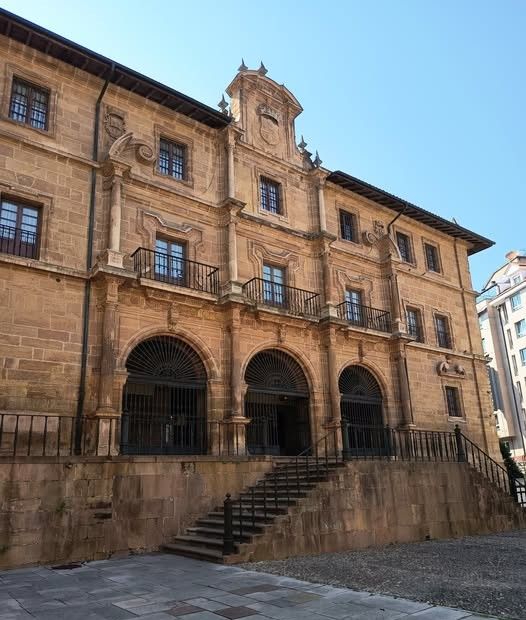
The Monastery of San Pelayo ,cloister is three stories high, making it a massive construction with a certain monumental air. Like the church, the cloister is supported by Tuscan pillars and columns. The church was built between 1592 and 1600, In the 17C, the old bell tower was replaced by a new tower topped with a Gothic tracery arrow, which reproduces the verticality of the Cathedral tower in a smaller size. It was founded in medieval times under the patronage of San Juan Bautista. However, with the transfer of the remains of San Pelayo to Oviedo to be deposited in this convent, it changed its name to San Pelayo Monastery. The nuns who occupy it have traditionally been known as the Pelayas. In its splendid archive can be found the collections of the monasteries of San Bartolomé de Nava, Santa María de Villamayor, San Vicente and Santa María de la Vega, together with abundant objects and relics that became part of the convent. In 1703, the vicarage’s striking façade was designed on the basis of Baroque palaces. The ground floor is organised with three large arches between free-standing Tuscan columns, which support the balconies on the first floor, The cloister is three stories high, making it a massive construction with a certain monumental air. Like the church, the cloister is supported by Tuscan pillars and columns. It served today as the provincial archives.
A bit of history I like tell us that the city of Oviedo was founded in 761, according to the account given in the Monastic Pact of San Vicente, dated 781 and preserved in a 12C copy in the Archive of the Monastery of San Pelayo, on a hill located at the crossroads that linked, from north to south, León with Lucus Asturum, the current Lugo de Llanera, passing through the Pajares mountain pass, and the one that headed west towards Galicia. The then deserted hill, called Ovetao or Oveto, was occupied by the monks Máximo and Fromestano, who built a monastery that they dedicated to Saint Vincent. Later, on an uncertain date and probably to confirm the possession of the hill by the monks of Saint Vincent, King Fruela I visited the place and decided to erect a basilica dedicated to San Salvador or Saint Savior and other dependencies in which his son, the future Alfonso II the Chaste, would be born. Alfonso II the Chaste moved the capital of the kingdom of Asturias to Oviedo at an undetermined time, but before 812, the date of the Testament of Alfonso II, which is kept in the archive of the cathedral , and where he already mentions the city as his place of residence. He made it the episcopal seat, fortified it and provided it with palaces, churches and other structures. In the 10C, the advance of the Reconquista led to the transfer of the capital to León, causing the city to lose some of its importance. However, thanks to its contact with the court of Charlemagne, a river of pilgrims began to flow from his kingdom through the Pyrenees and from the north went to Oviedo and from there to Santiago, making the northern route the oldest route for pilgrims to Santiago de Compostela. In 1075, the king of León and Castilla, Alfonso VI, visited Oviedo as a pilgrim. He solemnly opened the Holy Ark in the Church of San Salvador, which contained many very fine relics that had been hidden in the Hermitage of Santiago ,located 10 km away, following the Muslim conquest. From this event, Oviedo and its relics became internationally famous. In 1388, King John I founded the Principality of Asturias, a title inaugurated by the Infante Don Enrique, his son, and which from then on would correspond to the successors to the Crown. In October 1807, the Napoleonic invasion of Spain took place. When news of the events that had taken place in Madrid on May 2, 1808, reached Asturias, and after the uprising of the population, the General Council of the Principality of Asturias met on May 9 to take the first measures to ensure the defense of the province, in open rebellion against the orders issued by the Central Government, already in the hands of the French. The news continued to spread, especially the abdications of Bayonne, so that finally on May 24, with great popular support, and after the expulsion of the opposing members, the Junta declared itself sovereign, becoming the Supreme Governing Junta of the Principality of Asturias, and declared war on France.
During the Spanish Civil War, ten days of intense fighting took place within the city, leaving much of it devastated: damage was caused to a greater or lesser extent to, among other buildings, the University, the Campoamor Theatre and many private homes, especially in the area of Uría Street. The Holy Chamber in the cathedral, for its part, was dynamited. Colonel Aranda rose up, and it was the only city in the whole of northern Spain that remained in the hands of the rebels, completely surrounded by troops and militiamen loyal to the Republic. Soon the city was besieged, and remained so for ninety days until the rebel army from Galicia broke the siege, creating a corridor that remained open until the end of the war in the north, a year later. This was the end of the war in Oviedo, which was never in danger again.
The Oviedo tourist office on its heritage : https://www.visitoviedo.info/que-visitar/imprescindibles
The City of Oviedo on its heritage (open descargador callejero turistico de Oviedo) : https://www.oviedo.es/#content
The Principado de Asturias tourist office on Oviedo : https://www.turismoasturias.es/en/-/blogs/las-10-mejores-cosas-que-ver-y-hacer-en-oviedo
The Spain National Tourist office on Oviedo : https://www.spain.info/en/destination/oviedo/
There you go folks, another gem in my dear Spain, Soria, an easy ride by car all worth it for a pleasant rest stop or more on my road warrior trails between France and Spain. Again, hope you enjoy this post on this is Oviedo !!! as I.
And remember, happy travels, good health, and many cheers to all !!!

 Paris1972-Versailles2003
Un gran abrazo! Buen post. Me ha encantado.
LikeLiked by 1 person
Me alegro un monton! Gracias por comentar, saludos!
LikeLiked by 1 person