
I am becoming sentimental again, and this is a town of memories on my road warrior mode in my former region. I am glad looking into my cd rom vaults to find me these wonderful pictures of memorable times that allows me to show in my blog for you and me, I like to tell you a bit on the town of Étampes. A passing memory but as everything in my blog, part of my life’s history that should be here. Therefore, this is my take on this is Étampes !!! Hope you enjoy it as I.
The town of Étampes is located in the Essonne department 91, in the Île-de-France region of my belle France, A fortified royal city since the Middle Ages, a county and peerage that became a duchy given as an appanage to three successive favorites, and a member of the Cities and Countries of Art and History label, it was sometimes nicknamed “Little Venice” because of the old canals that supplied the thirty-two mills, In addition, the city was awarded three flowers in the Competition of Cities and Villages in Bloom.
The town of Étampes is located at the crossroads of two important communication axes, the N20 road which crosses its entire territory and the D191 road acts as a major ring road for the region and allows access to the A10 autoroute 19 km away, the A11 autoroute , and the N10 26 km away nand the A6 autoroute 27 km away. The D roads 836 and 837, which encircle the south of Essonne, lead one to Dourdan and Rambouillet, the other to Milly-la-Forêt and Fontainebleau. In addition, parallel to the N20, there is the railway line used by the RER C line which serves two stations: that of Étampes and the terminus of Saint-Martin-d’Étampes. Étampes is located 55 km from Paris, 20 km from Dourdan, 26 km from Milly-la-Forêt, 58 km from Chartres, 73 km from Orléans, 61 km from Versailles, and 448 km from my current home. I always came here from Versailles, going across town towards the potager du roi on the D91 road or Rue du Maréchal Joffre to connect with the N12 on Avenue du Maréchal Juin ,this road continues as the A86 dir Vélizy-Villacoublay and connect with the N118 road that connects with the A10 dir Bordeaux short distance and into the N104 La Francilienne road to connect at exit/sortie 43 with the N20 road dir Orléans bearing right into the D191 road to rondpoint bear left into Avenue de Bonnevaux, left on Bd Berchére, right into Rue de l’Abreuvoir Mouton ,left into Rue des Cordeliers, right into Rue Traversiére, and right into place Saint Gilles to the church.
The Church Saint Gilles located at the Place Saint Gilles,was built in the 12C, 15C and 16C, as it is located a few hundred meters from the city center was an easy sight for me to see in my road warrior trails.
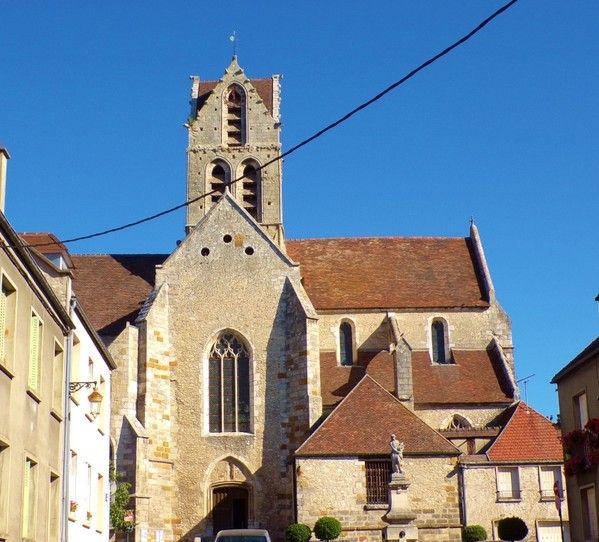
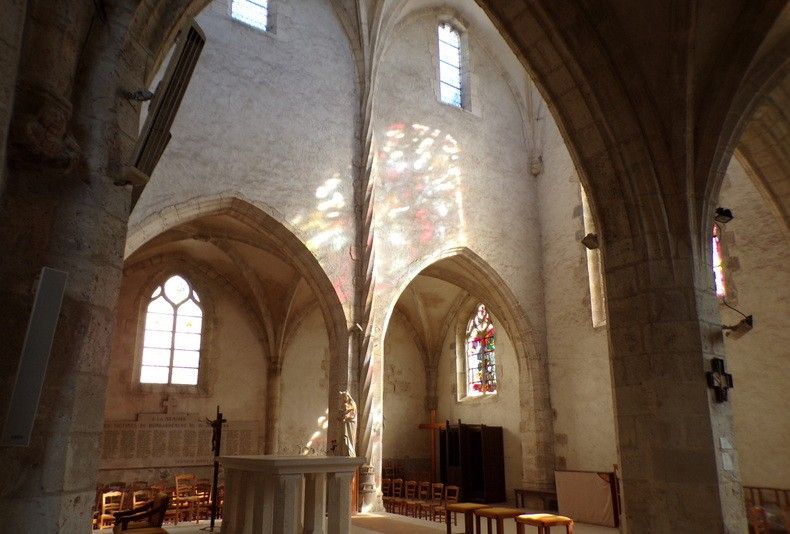
The church is built on a three-aisled Latin cross plan .The bell tower and the lower part of the nave were built in the 13C in the Romanesque style. In the 15C, the chevet, the choir, and the transept arms were added in the Flamboyant Gothic style with quadripartite ribbed vaults.
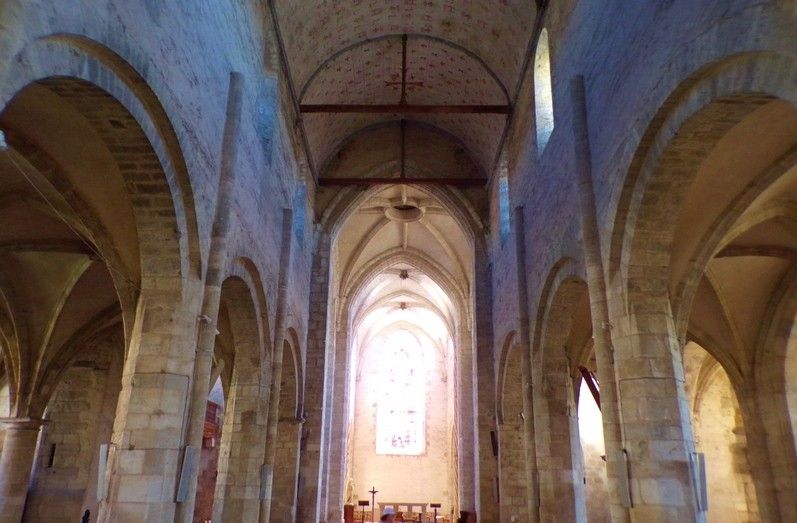
In 1596, frescoes were added to the nave’s cradle, depicting King Louis IX as Henry III, Saint Michael, Saint John the Baptist, Saint Vincent, Saint John, and a Maltese cross on a background of crowned fleurs-de-lis and the initials “H” and “L.” The bell known as Marie-Flore was cast in bronze in 1850, and the baptismal font in gilded cast iron completes the rich furnishings of the church.
A first church was built in 1123 during the creation of the square hosting the wheat market established by Louis VI the Fat, in order to establish a link between the northern and southern parts of the town of Étampes. In the 13C, a new church was built of which the nave, the entrance pillars and the piers of the transept remain. At the end of this century, the bell tower was added, which supports the crossing tower in a Romanesque style. In the 15C, the choir was rebuilt with a flat chevet in a flamboyant Gothic style. In 1547, the side aisles and side chapels were added, as well as the sculpted keystones. On June 10, 1944, the district was bombed by the Allies. A large part of the church had to be rebuilt.
Other things to see in the vastness of richness of my belle France that always need to come back ,eventually are the Collegiate Church Notre-Dame-du-Fort built in the 12-13C, its cloister from the 14C, its presbytery from the 19C, the Church Saint-Basile from the 12C and 15C, the Collegiate Church Saint-Martin, which dates from the 12-13C, famous for its Renaissance leaning tower, the Hôtel-Dieu, created in the 16C then regularly modified until the 19C, the City/Town Hall, composed of the old houses of Saint-Christophe then of the Treille, built between the 15-16C, remodeled in the 19C, the hotel known as the Maison de l’Écu de Berry, from the 16C, renovated in the 19-20C and which today houses the sub-prefecture since 1819 : the 14C courthouse, within the walls of a former Capetian palace ;the Guettard college, former Saint-Antoine hospital in the 13C, Barnabite convent in the 17C, converted into a college in 1885; the hôtel known as Anne de Pisseleu, from the 16C, actually built in 1538 by a county tax collector named Jean Lamoureux; the hôtel known as Diane de Poitiers, from the 16C, actually built in 1554 by a receiver of the County Estate named Esprit Hattes, remodeled in the 19C, which became the Étampes Museum; the hôtel Saint-Yon, from the 16C and remodeled in the 19th century; the Petit-Saint-Mars castle, built in the 17C, transformed into a retirement home; the Valnay castle, built in the 18C, which has now become a municipal hall and an association center; the municipal theater built between 1851 and 1852 thanks to a public subscription. Its royal past and stronghold has left traces in Étampes, including: the Guinette tower, the keep of the old royal castle built by Louis VI Le Gros in the 12C, the emblem of the town, the square tower of Petit-Saint-Mars, which probably dates from the 11C; the remains of the old ramparts of Étampes from the 13-14C, and the fortifications, completing the previous ones in the 17C, known as the Saint-Pierre, Saint-Martin and Portereaux suburbs. The leisure island of Étampes, with its 78 hectares, is the main lung of the town. Added to this are the Promenade des Prés, the neighboring Square de la Douce-France, the Valnay park and the Jeurre park, located partly on its territory.
A bit of history (condense) tell us that in 911, Rollo’s Norman troops sacked the town. Little is known about the history of the gradual transfer of the main urban core to the current town’s center. King Robert the Pious and his wife Constance of Arles, constructed a palace in this castrum, as well as that of a collegiate church served by twelve canons, named Notre-Dame. It seems, however, that this last foundation was mainly the work of the local nobility. Two towns coexisted at that time: Estampes-le-Châtel and Estampes-les-Vieilles. Philip I stayed several times in Étampes. While wintering there in 1079, he tried to impose his authority on Hugues du Puiset, who was mistreating the clerics of the neighboring Chartres region. But this vassal rebelled and defeated the royal army near Puiset, a humiliation from which the royalty only recovered under the following reign, that of Louis VI. In 1123, Louis VI the Fat granted a franchise to the merchants who settled in the uninhabited sector which then separated the Notre-Dame district from the Saint-Martin district. This was the origin of the settlement of the Saint-Gilles district. François I gave the county and the city to his favorite Anne de Pisseleu, whose obliging husband was even created Duke of Étampes in 1536. The territory of the new duchy was increased by the lands of Dourdan and La Ferté-Alais. However, the beautiful mansion known as the house of Anne de Pisseleu never housed this duchess. Henry II, upon ascending the throne, removed this title from his father’s mistress and awarded it to his own favorite, Diane de Poitiers. But the Hôtel known as Diane de Poitiers was not the residence of this second Duchess of Étampes. Then the Vendôme family received Étampes as an inheritance from Gabrielle d’Estrées, favorite of Henry IV. For the defense of Paris, the lieutenant general of the royal army, Antoine de Bourbon, installed a garrison in Étampes. The garrison abandoned the city, which was taken by the Prince of Condé on November 13, 1562. Protestant troops occupied it and caused numerous damages, particularly to the churches. But the victory of the royal army at the Battle of Dreux allowed the Duke of Guise to lay siege to Orléans and force the Protestant garrison of Étampes to abandon the city on January 2, 1563, before his arrival. In 1567, despite the organization of a bourgeois militia, the Count of Montgomery took the city after an assault on October 17 during which the Cordeliers convent was burned. But on November 16, the Protestant party had to abandon the city again, after the Battle of Saint-Denis. In 1569, the region was again ravaged by the disbanded mercenaries returning to Germany after the Battle of Moncontour. In 1587, the city formed a Catholic league, which rallied to the Holy League on August 19, 1588. It then received a League garrison, but was quickly captured by the two Henrys (Henry III and Henry of Navarre) on June 23, 1589, then pillaged for three days. On October 20 of the same year, the League members laid siege to Étampes and entered it on the 23rd. Several Catholic magistrates were subsequently massacred. On November 5, Henry IV retook the city without a fight, the League governor, the Count of Clermont-Lodève, having been abandoned by the city’s bourgeoisie. During the Fronde, Turenne defeated a Fronde army, deprived of its leader, Condé, on May 4, 1652. The royal army then laid siege to the city. That same year, the plague-stricken city was rescued by Saint Vincent de Paul. In 1712, the duchy returned to the crown. In 1790, the province of Orléanais was dismantled and the department of Seine-et-Oise was created. The precursor departments on the Île de France region today such as that of Yvelines (which took number of Seine-et-Oise “78”); Essonne (number “91”); Val-d’Oise (number “95”). Hauts-de-Seine (number “92”); Seine-Saint-Denis (number “93”); and Val-de-Marne (number “94”), Louis Blériot prepares his crossing of the Channel, in 1909, by a flight from Étampes to Chevilly. Shortly after, he sets up, on the territory of the neighboring town of Guillerval, an aviation school next to which Maurice Farman sets up another. A third is created in Étampes itself, on the road to Chartres, which is bought by Armand Deperdussin. During the Great War or WWI, this military aviation school of Étampes is one of the most important in France, It is also in Étampes, on the air base 251 Étampes-Mondésir that the Patrouille de France was born, first named Patrouille d’Étampes. It was also in Étampes that the first drones were designed, starting in 1923. During the Great War or WWI, the Jeanne-d’Arc boarding school housed a 40-bed hospital, the Auxiliary Hospital of the Society for the Relief of the Military Wounded (HASSBM) No. 15, while the Geoffroy-Saint-Hilaire college became the Auxiliary Hospital of the Association of the Ladies of France (HAADF) No. 217. During this war, Belgian airmen were able to occupy the land of Ville Sauvage. The town was liberated on August 22, 1944, Étampes was located on the famous Voie de la Liberté.(freedom way), The town was decorated with the Croix de Guerre 1939-1945.
The town of Étampes on its heritage : https://www.mairie-etampes.fr/ville-royale-ville-dart-et-dhistoire/
The Essonne dept 91 tourist office on Étampes : https://www.essonnetourisme.com/?s=%C3%89tampes
The Île de France region tourist office on leisure island park of Etampes : https://www.visitparisregion.com/en/ile-de-loisirs-d-etampes
The Local Etampois south Essonne tourist office on the Héritage monuments of Étampes: https://www.caese.fr/decouvrir/patrimoine-et-lieux-dexception/?f=1&recherche=&type=&commune=etampes
There you go folks, as said my blog is my life’s history ,here is a bit more of it, An off the beaten path town of my belle France, worth the detour for the architecture, and history of Étampes ,me think. Again, hope you enjoy this post on this is Étampes !!! as I,
And remember, happy travels, good health, and many cheers to all !!!

 Paris1972-Versailles2003